A Turkey Flag

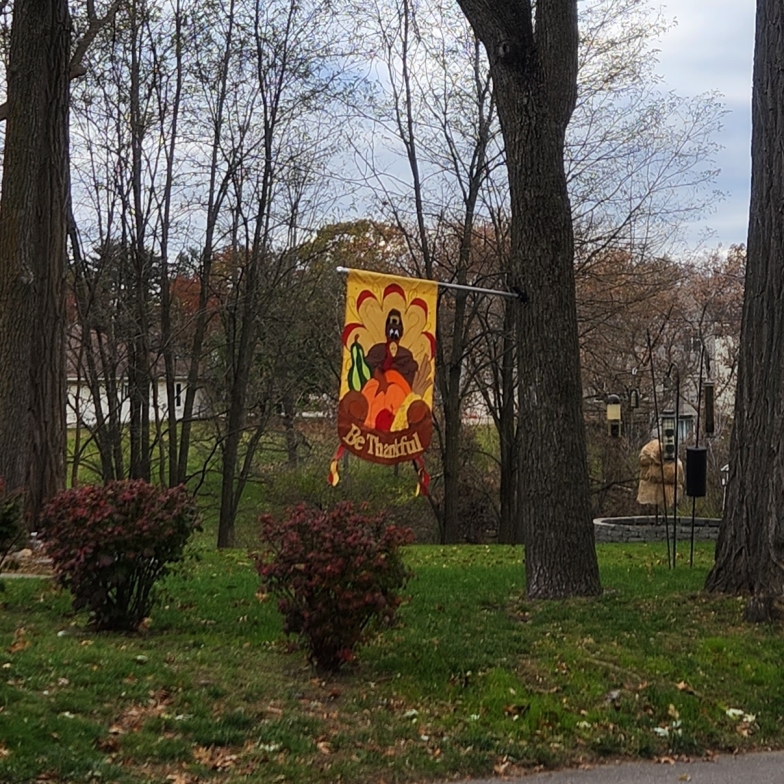
Turning left out of my subdivision, a few houses down on the left, there’s a home with a flagpole bracket attached to a tree in the front yard. The homeowners change the flag with the seasons. In the spring, they have a more flowery flag. On the approach of Christmas, the flag is appropriately festive. At other times, the flag demonstrates team pride, flapping their favorite football or baseball team’s symbol and colors in Linden, Michigan’s breezes. Right now, the flag is taking aim at the forthcoming Thanksgiving holiday, displaying a bright-eyed and smiling turkey character surrounded by all the Thanksgiving feast’s usual food suspects. Across the front of these things, in colorful letters, are the words, “Be thankful!”

Of all the flags this home displays, the first time I saw it, I laughed. I’ll tell you why in a moment. However, the more I thought about it, the more the flag became my favorite in the homeowner’s collection. It isn’t my favorite because I appreciate the style of cartoony banners it exhibits. I’m fond of it for its deeper message.

If you’ll allow me an extra minute or two, I’ll offer its explanation this way.

I know plenty of stories from Christian history, but what immediately comes to mind is one I just shared in passing with my wife, Jennifer, and my daughter, Madeline, this past Friday. It’s the story of Antonio Herrezuelo and his wife, Leonore. Herrezuelo was a lawyer in 16th-century Toro, Spain. He and Leonore had converted to Lutheranism, joining the secretive congregation of only seventy Christians in Valladolid. Relative to the times, this was, by nature, dangerous. The Reformation’s contention was in full bloom, and so was the Spanish Inquisition, which, as you may know, was an already well-established conquest intent on purifying the Church through brutality.

As the account would go, the little congregation was discovered, and all its members were accused of heresy—that is, they were accused of believing as Luther believed, which is that one is justified by faith apart from works of the law (Romans 3:28). At this point, accounts begin to differ somewhat. Some say that nearly all the church’s members recanted to save their lives. Other reports say that many did not. Either way, what’s common to most accounts is that as a principal nobleman in the region, Herrezuelo, along with thirteen others of similar status, was imprisoned and brutally tortured. In the end, only Herrezuelo maintained without recanting.

Leonore was kept separate from her husband throughout the ordeal. One account records that eventually, the two stood together before a final court of inquisition. The tribune interrogator is the only one among the court who spoke, and he did so with merciless brevity. He offered the couple what were essentially three choices. First, they could recant immediately and accept imprisonment, trusting that perhaps, in time, a pardon might be granted. Second, if any hesitation occurred relative to their recantations, they would be shown mercy, but only in that they’d be strangled to death before being burned at the stake. In other words, when asked, an immediate recantation was required. Third, if they refused to recant altogether, they would straightway be burned alive.

The interrogator turned first to Leonore and demanded, “What will you do?” Her words were soft between trembling gasps. “I will recant,” she said.

“Repeat it for God and Emperor!” the inquisitor fiercely demanded.

“I recant,” she said, this time with more fervor.

Without pause, the same question was put to Antonio, who, at that moment, stood captured in a frozen stare at Leonore. Prompted again, this time more vehemently, Antonio turned to his ferocious questioner. Still stunned by his wife’s words, it’s said he gave barely an intelligible slur, tearfully offering, “I cannot. I cannot recant.”

He was not asked a second time. A motion from the chief inquisitor stirred the guards to immediate action. Antonio was shuffled from the room to the nearby square. Another account depicts Antonio reprimanding his wife as he left. Others do not. Others portray a man led to a pine post on a readied platform at the center of a town swelling with as many as 200,000 onlookers. Tied to the post still nubbed and sap-sticky from branches hastily pruned for the event, a blindfold was added. Antonio’s last words were an unrelenting plea to his wife, “Leonore! I thank God for you! Please return to Christ, my love!”

Unable to see, he called in every direction, doing all he could to shout above the taunting noise from the gathered spectators, some even crowding the rooftops. Indeed, and surprisingly, Leonore heard him.

“Please return,” he continued crying. “We will be united together in heaven!” Annoyed by his persistence, one guard shoved a burlap wad into his mouth. For good measure, another stabbed him with a spear.

After a ceremony that included an hour-long sermon against the so-called heresy of salvation by grace through faith alone, the fire was set. The flames were stoked. Dreadful moments passed, and Antonio was dead.

Still in prison several years later, Leonore called to the guards from her cell early one morning. She requested an audience with a magistrate. Eventually, a court representative arrived. With the same quivering voice as years before, she informed her visitor, first, of her thankfulness for her husband’s steadfast faithfulness to Christ at his death, and second, she expressed gratefulness to Christ for His continued grace measured against even her dreadful betrayal. With that, she demanded her visitor send word that she had rescinded her recantation.

The message was delivered. Leonore was judged, condemned, and executed the next day.

It’s said she whispered to her executioner as he tied her to the post, “My first words to Antonio will be, ‘I have returned to our Jesus, my love.’” Her last words were, “Oh, give thanks to the Lord, for He is good, for his steadfast love endures forever.’”

So, what does this have to do with the flag adorning the tree around the corner from my subdivision’s entrance—the one with a smiling turkey?

The story I just shared has both of its victims giving thanks when thankfulness seems wholly inappropriate. When you think about it, a turkey is the one guest at the Thanksgiving Day feast who is killed, cooked, and eaten. And yet, there he is on the flag announcing to every passerby, “Be thankful!” Again, for as cartoony as the banner is, this is an extraordinarily rich image. It is a Christian image.

A lot is happening in America right now; there are some incredibly dreadful things. For one, Christianity is more than being pushed further and further into the shadows of criminalization. People are considered backwater bigots for holding to the truth of God’s Word. As this devolution continues, the temptation increases among us to ask, “What, exactly, is there to be thankful for?”

Many churches don’t offer a Thanksgiving Day service. That’s unfortunate. We do here at Our Savior. In case you’re interested, it happens on Thanksgiving Day at 10:00 a.m. Interestingly, one of the appointed texts for the day is the same as Leonore’s last words. At some point during the liturgy, God’s people will sing, “Oh give thanks to the Lord, for he is good, for his steadfast love endures forever” (Psalm 107:1). Why would we sing these words? Well, it isn’t because of what we see occurring in the world around us or because of what we must endure day after day. Instead, it is because of what we know by faith.

By the power of the Holy Spirit at work in believers for faith, even as everything around us may be coming undone—even as the fires of persecution rage, as we are betrayed, slandered, unjustly maligned, and brutally mistreated by the powers and principalities of this fallen world—we can and will be thankful to the Lord. Why? Because the most insurmountable of all insurmountables was conquered by Christ. He defeated Sin, Death, and the powers of hell for us. By His person and work, through faith in Him, we’ve been made His own. Knowing this, let the world kill, cook, and eat us. From among all on this transient blue ball hanging in space, we’re the only ones with an otherworldly viscera enabling us to lay our heads on the chopping block the same way we’d lay them on a pillow to rest. We can close our eyes in peace, knowing we are not inheritors of this world. We are inheritors of the world to come (Matthew 25:34, Luke 12:32, Romans 8:17). For a believer to live is to do so beneath Christ’s gracious benediction, no matter what we suffer. For a believer to die is not loss but gain beyond measure (Philippians 1:21).

Remember this. And when you forget it, may God be so gracious as to remind you. He reminded me this past week while driving past a flag with a turkey on it.

Thankfulness in the Middle of Withoutness

Today is a day for appreciation. Well, I suppose every day is such a day, especially for Christians. We know the compassion of the one true God who loves humanity, no matter our wretchedness. This love was most fully expressed through the person and work of Jesus Christ, the Redeemer. If there’s something to appreciate, it’s that. In fact, this Gospel is the lens through which we view our world.

Beyond this, everyday appreciation is a muscle to be flexed. I mean that it takes practice to become something we engage in habitually. And yet, it’s a routine worth forming. Better yet, it’s an economy of sorts with a rather astounding exchange rate. In my own life, I’ve learned the more appreciation I uncover for the blessings I’ve been given, the less concerned I seem to be for what I don’t have. The more appreciation I have for where I am in life, the less time I spend wondering what could have been had I done things differently.

Maybe you know what I mean. Of course, you do. Any honest human being understands it’s impossible to be angry and happy simultaneously, just as it’s impossible to be disparagingly frustrated and appreciative simultaneously. These two passions can’t exist in the same sphere at the same time. One will always outbox the other. Let me give you an example.

Two weeks ago, during a nightmarish layover in Chicago, I found myself standing in a line no less than a football field in length. Indeed, there were hundreds of stranded passengers, and, as a general collective, the emotions were running hot throughout. I stood immersed in that thickly volatile line for three hours before finally reaching the desk and speaking with an American Airlines representative who, through a less-than-four-minute discussion, informed me there was nothing the airline could or would be doing to help or accommodate me.

I was being left helplessly without.

I did not express my rage to the representative. I’m not that kind of person. Besides, it probably wouldn’t have mattered, anyway. She had already endured the same sentiments from hundreds of people before me, and she would continue to suffer them with the same emotional immunity after I wandered off to find food and a place to sleep for the night. Still, I was mad.

I was frustrated.

I was feeling contemptuous.

I wasn’t experiencing any discernible reason for thankfulness—until I saw a particular little boy holding his big sister’s hand.

I told Jennifer and the kids the story when I got back to Michigan. The boy was no more than five or six years old. Both of his legs had been amputated and replaced with prosthetics. He was hobbling along unnaturally, laughing as he attempted to keep up with his sister amid the bustling crowd. Hand in hand, they passed right by me, both giggling. I don’t remember noticing the parents. Instead, I was more caught up in the playful coaxing of the sister. She was poking fun at him for slowing her down. She wasn’t being cruel, but instead big-sisterly. She was speaking as one speaks to a little one while at the same time doing what any typical big sister would do to any typical little brother. Except the boy wasn’t typical—at least not according to the assumed definition of typical. He didn’t have legs. He was forever without. But here he was laughing with his sister. He was tottering along without concern for what he didn’t have while rejoicing in the moment for something he did have, which was an incredibly devoted sibling.

I immediately felt a little sick to my stomach for being so inconvenienced by my travel woes. Combined, they were a relatively insignificant withoutness that I would undoubtedly forget in time. I can’t recall for sure if I did or not, but I likely whispered to myself, as I often sigh in other troubling situations, “In a hundred years, who’s going to care?” I speak this way to reposition my thinking. It’s a deliberate admittance that any moment of struggle, while I might not want to go through it again, will inevitably become laughable upon future reflection. In another sense, it’s also a subtle acknowledgment that past situations of struggle often become memories of having learned something important or discovered a personal strength, or better yet, a vivid depiction of God’s faithful deliverance when I could not self-deliver. In other words, my struggles play a part in God’s broader plan for my completeness.

This sounds familiar (Romans 5:1-5; 8:28). It also takes me back to the big sister.

Her playful pushback—calling him a slowpoke and saying he’d never get to where he was going if he didn’t keep moving—believe it or not, this reminded me of texts like Luke 18:21, Psalm 27, 1 Corinthians 9:24, Galatians 6:9, and others. These texts encourage believers not to give up, to keep pushing onward, to stay the course of faithfulness, always looking to Christ. They remind me that God has made promises and that He’s never One to break them. The sister’s persistent presence brought to mind such texts as Matthew 28:20, Zephaniah 3:17, Hebrews 13:5, Romans 8:38-39, Isaiah 41:10, and countless more. These remind me that God is with me in my struggles. The world would try to convince me that He is present as my enemy. Faith speaks something better. It knows He’s holding tightly to my hand. It knows the crowd is chaotically swirling, but it also admits God knows right where I am. He’s never going to lose sight of me. And all along the way, He’ll be prodding me in ways that lead me to discover proficiencies He is instilling for a faith that can meet with struggle and survive, even becoming thankful right in the middle of the storm.

God employs struggle in this way. Human storms are rarely fun, but they’re not necessarily bad.

Before attempting to fall asleep on the floor at gate E7 in O’Hare’s Terminal 2, I asked the Lord to forgive me for my foolishness. After that, I found myself as I described before: unable to be both angry and grateful simultaneously. At that point, gratefulness took over. I thanked Him for allowing those two children to pass by. That brief intersection in time was a reminder of something essential. I also discovered a quiet appreciation for the woman at the American Airlines desk who was tolerating the ire of countless travelers, doing what she could to at least listen to their concerns. I discovered a measure of thankfulness that I would be sleeping on the ground in an air-conditioned building instead of outside in the heat and humidity. I was thankful for the sandwich I could afford to buy before I got situated at my little campsite. I was thankful for the people who played a part in making it. I relearned what was meant by the old saying that when eating the fruit, be mindful of the one who planted the tree.

The Gospel goes the deepest in this regard.

Christians know God is always the One to whom thanksgiving is due. No matter who planted the tree, the trail of every tree’s planting and subsequent fruit leads to Him. In fact, Jesus encourages His believers in Matthew 6:26-29 to look around for easy reminders of this. A bird flitters around, doing what it can to eat and feed its young. It’s likely the flowers in your garden did not plant themselves, but rather, you did. Still, whether it’s the swooping birds or the well-dressed lilies of the field, God is the Creator, and we can behold His steady care on full display for His world even by looking at them. As we look, Jesus asks rhetorically, “Are you not of more value than they?” Of course, we are. This knowledge can only deliver the believer to the foot of the cross, the Kingdom that Jesus wants us to pursue (v. 33). It’s there we can measure our withouts against the greatest withoutness ever endured—the greatest struggle ever suffered, resulting in the most extraordinary care ever bestowed, all of it unfolding so that He could fill us with what truly satisfies—something that does not rust and thieves cannot steal: the forgiveness of our Sins.

With this as our heading, everything else seems so trivial. Everything else—both the blessings and struggles—seem worthy of appreciation.

But here’s the thing: we’re sinners and saints. We slip in and out of both thanklessness and gratitude. I did last week. I went from despair to hope that Thursday night in the airport, but I became frustrated by the whole thing again when I wrote last Sunday’s eNews message. I’d been on the phone with American Airlines for hours on Saturday, trying to get some financial satisfaction, all to no avail. I was getting angry. Looking back at what I wrote, I can see the nonchalance of thanklessness’s grip at work in the Sinful nature. It’s subtle, but it’s there. It wasn’t until later in the morning that I did find the ability to say, once again, “In a hundred years, who’s gonna care.”

God fed me with His love. He took me by the hand and coaxed me along in my withoutness toward something of far greater value that I’ll never be without: the love of God given through the person and work of Jesus Christ, my Savior.

I pray the same comfort for you.