A Passing Storm?

Apparently, those among us who called it a social contagion were right.

That said, some will meet this moment with anger because the numbers undermine their narrative. Others will read them with sorrow, because it’s too late for people they know. And still others will exhale with relief, sensing that perhaps the edge of this storm has finally been sighted, and calmer seas are on the horizon.

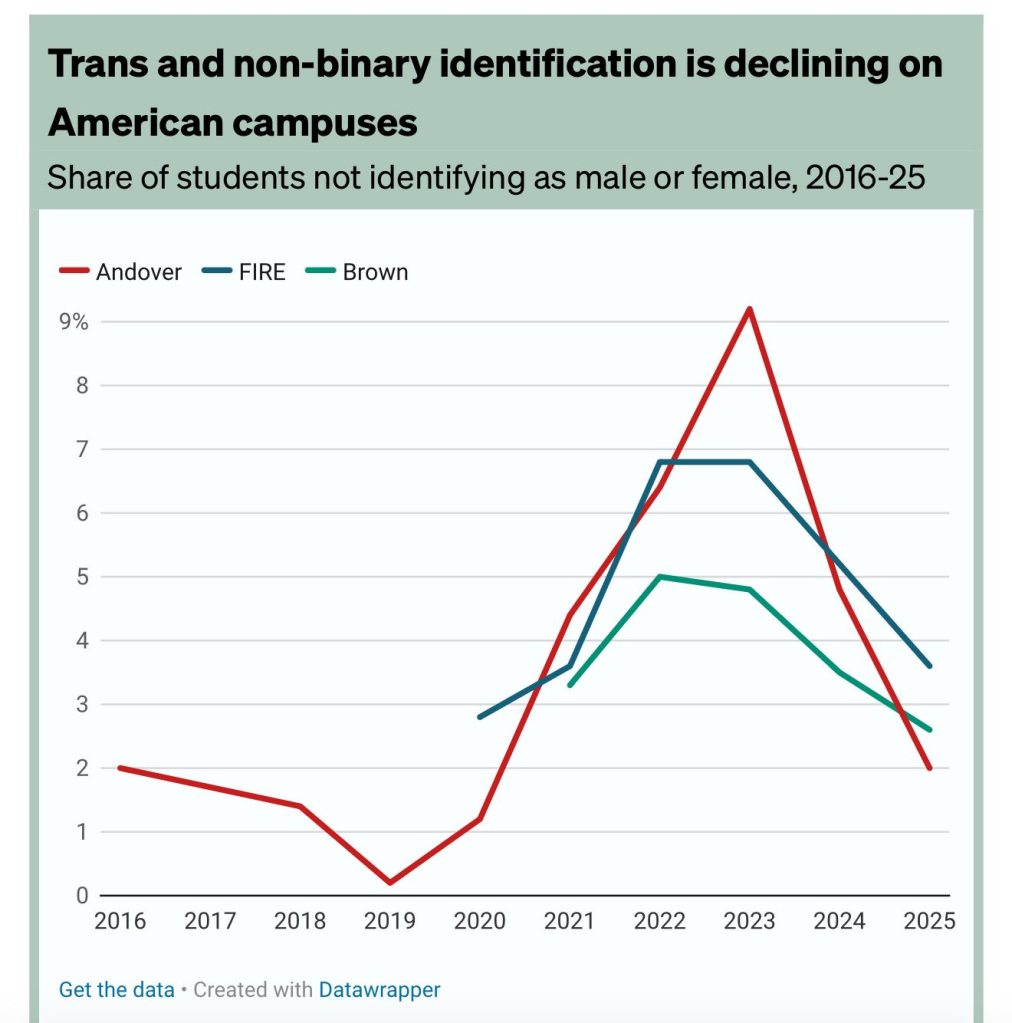
If you have no idea what I’m talking about, then you’ve missed some very important news. A recent study showed that the number of students identifying as transgender or nonbinary has dropped from nearly 7 % in 2022/2023 to around 3.6 % in 2025. Regardless of how the media might spin the data, that’s not a statistical wobble. That’s pointing to a collapse.

Go figure. Truth, after all, is patient, and fads have a way of burning themselves out.

That said, we should be careful not to take a victory lap just yet. Too many lives have already been scarred, if not completely ruined, this side of eternity. Too many parents have lost children to this mess. Too many were shamed into silence by doctors, family members, and friends. And yes, too many pastors chose the comfort of quietism, deciding that inaction was courageous and engagement was heterodoxy. They hid behind pious phrases like “Just preach the Word and God will handle the rest,” as though the Word they preach never calls for the courage to act, let alone to speak plainly about or against the wolves devouring the flock.

I should stop right there. There’s no need to go further. The task now is not to point fingers, but to lock arms and bear witness. Our job is to bind up wounds. Just know that for some, that means to stand where they refused to stand before and speak truth into the ruins.

Admittedly, we do this remembering that when entire societies exchange truth for a lie, God sometimes gives up and gives them over to the “due penalty for their error” (Romans 1:18-32). I think that’s precisely what we’ve lived through—a due penalty. We landed here because, in part, a generation was catechized not by faithful pastors and teachers, but by algorithms. They were allowed to believe the body is moldable and that feelings are sovereign. The result was pain on a scale we will not fully grasp for a very long time.

But again, lies are brittle things. They can’t bear the weight of actual reality. And that’s what the entire LGBTQ, Inc.’s world is facing right now with this study. But when the fantasy does finally collapse for some, the Church needs to be ready, because they’ll find themselves wounded and wandering.

While eating dinner with Chloe Cole in our home a few weeks ago, everyone at the table learned intimately that for every young person who detransitions, there is a story of profound regret. However, Chloe herself exemplifies hope in the mess—or better said, faith rediscovered. Admittedly, the truth may seem a little slower than lies when reasserting itself, but eventually, it does.

If we are indeed witnessing the beginning of the end of this cultural mania, the Church should be careful not to respond with cynicism or self-congratulation. Honestly, I don’t think she will. It’s not what her Lord desires to accomplish through her. I think she’ll respond with compassion. But it can’t be as before. It must be compassion built on faithful conviction—the kind that is never afraid to say to anyone in any context what’s actually true. We can never be scared to say out loud and in public that male and female are not arbitrary categories. They are divine gifts. “From the beginning of creation, God made them male and female” (Mark 10:6). That truth is not subject to revision.

From this conviction, genuine compassion is born, the kind that understands that many of the children and families caught up in this wave were not villains but victims. They were misled by an age that despises God’s boundaries, preferring instead to worship the self. As I said before, many needed shepherds, but didn’t have them. Now more than ever, they need shepherds who will not flinch from the devilries this world imposes on humanity. But they also need shepherds who will not sneer at the fallen.

I’ll be honest with you. I was starting to think God was giving up. As I mentioned before, He does do that in certain circumstances. Well, I was beginning to think we were experiencing it firsthand—that we were venturing into a forsaken landscape that Luther warned about so long ago:

“Let us remember our former misery, and the darkness in which we dwelt. Germany, I am sure, has never before heard so much of God’s word as it is hearing today; certainly, we read nothing of it in history. If we let it just slip by without thanks and honor, I fear we shall suffer a still more dreadful darkness and plague. O my beloved Germans, buy while the market is at your door; gather in the harvest while there is sunshine and fair weather; make use of God’s grace and word while it is there! For you should know that God’s word and grace is like a passing shower of rain which does not return where it has once been” (LW 45:352).

Perhaps this study is proof that God has not yet abandoned this generation. The same Christ who stilled the storm is still speaking His Gospel to the winds and the waves of this culture, saying, “Peace, be still.” (Mark 4:39) It sure seems the chaos that claimed so many sons and daughters is not being given the last word.

In one essential sense, the study is not just data. It’s a mirror. It reflects a society that appears tired of pretending. Divine truth is interrupting a worldwide delusion—an ideology built on lies that delivered only despair and loneliness. And now, as the illusion collapses, as is almost always the case, a vacuum will form. Rest assured, the human soul cannot abide in emptiness for long. If the Church does not step in to fill the void with truth, another dreadfulness will rush in to fill it.

Rest assured, this moment will test us. Will God’s people seize the opportunity to engage with compassionate conviction? Will we speak mercy to the misled while refusing to avoid or soften what’s true? The time for polite silence has passed. In fact, I’d say it was never an option. Indeed, more than ever before, bold catechesis leading to an even bolder confession must fill the space left unattended.

The turbulence may be passing, but God’s mandate through Saint Paul remains. Even when the waters are still, he insists, “Be steadfast, immovable, always abounding in the work of the Lord, knowing that in the Lord your labor is not in vain.” (1 Corinthians 15:58). Through our continued labors, many in the world may yet come to see something better—that the cure for confusion was never self-creation through mutilation. The solution to every bit of the sin-nature’s confusion is to become a new creation through faith in the mutilating crucifixion of Jesus—His death for our redemption.

Active vs. Passive Learning

As you may already know, the Life Team here at Our Savior in Hartland, Michigan, (along with some help from “The Body of Christ and the Public Square”) orchestrated a substantial event entitled “An Evening for Life” featuring Seth Gruber. If you know anything about Seth, then you know he’s a caffeinated firehose of valuable information. That’s why it only took a little more than three weeks of promotion to get 206 attendees from all around the state on a cold Thursday evening, some willing to drive a few hours to be with us. However, referring to these visitors as “attendees” seems insufficient. “Active learners” is more appropriate. Craving information, they actually got into their cars and drove to an event.

Conversely, if there’s one thing that bothers me about typical information exchanges, it’s the tendency some folks have toward spoon-feeding. For example, I wrote and shared something on Facebook a few weeks back in which I discussed a somewhat controversial theological topic. Sometime afterward, I received a private message from someone asking me to explain some unfamiliar terms I used in the post. First, the person wasn’t on my friend list, so I elected not to reply. If you know anything about Facebook Messenger, then you know that if you reply to someone outside your network, you are granting him full Messenger access. I try not to do that. Ever. The times I have, I’ve inevitably needed to block the person.

Second, and putting the best construction on things, my guess is that the person asking for the explanations must live in a place without adequate internet time or resources. Perhaps he lives in a Kath Kuni in the Himalayas or a cave in Afghanistan? However, if neither of these describes his actual plight, then I assume he can research the terms for himself. With a few taps at the computer, followed by a click or two with the mouse, he’d be on his way to learning anything and everything he’d ever hoped to know about the terms he’d never heard before. Instead, he wanted me to spend time writing it all out for him.

He wanted to be spoon-fed.

Now, before I go any further, I’ll admit to doing the same thing on occasion. The Thoma family has a family calendar. It’s synced to my phone. Still, rather than looking at the calendar, I’ll ask my wife, Jennifer, “Is there anything on tonight’s schedule that I should know about?” When I do this, I’m demonstrating passive learning. I have access to the information, but rather than doing my own investigating, I make the mistake of expecting her just to tell me. It’s lazy practice. I admit it.

Genuine learning isn’t lazy. It’s an active process. It takes work. Sure, there are things we learn passively, which is to say, we learn them without active engagement. Infants learn many things that way. They’re human sponges. I suppose there’s an element of passive learning for infants relative to language. They learn to speak as language is brought to them. But it doesn’t take long for the infant to become an active learner in the process, eventually engaging in language exploration. They begin making noises and sounding out words. Indeed, any parent will tell you that infants are the epitome of active learning in almost everything. They see something and, no matter what it is, reach out to explore it in every way they can. And none of their five senses is off limits, not even taste. My grandson, Preston, when he discovered his toes, guess where he eventually decided to put them?

Thinkers are active learners. There’s a chance I’m not dealing with an active learner when, let’s say, I post on Facebook, “William Federer will be one of the speakers at our upcoming conference,” and someone replies, “I’ve never heard of him? Who is he?” A reply like this irritates me because it expects me to present a detailed biography. I certainly could have provided a link to one in the post. However, not every hand needs to be held.

This leads me to something else.

Relative to intellectual lethargy, could it be that we’ve arrived at a time in history where it’s no longer possible to actually convince or convert anyone to a position other than the ones they already hold? What I’m saying is that, for virtue’s sake, I get the sense that most people consider themselves open-minded. And yet, are they passively or actively open-minded?

A passively open-minded person listens to whatever is being said but is only willing to consider and embrace those parts that align with what they already believe is true. They don’t want to do any thinking work. They don’t want to get up from their mental couch to answer another perspective’s knocks at the door. An actively open-minded person knows what they believe, and yet, while listening, searches for breakdowns, loopholes, or contradictions in not only the speaker’s argument but also their own belief system relative to the argument. In other words, they get up from the couch, open the door, and let the perspective into the house for a conversation. As they do, they put in the interrogative work. They ask questions. They offer content and counterpoints. They examine the topic from more than just their perspective, giving and taking along the way.

I think active learning also insists on active open-mindedness.

I guess what I’m wondering out loud right now is why so many seem to lean so heavily on passive learning styles, especially at a time in history when having a grasp on what’s going on is not only incredibly important but, at the same time, we have instant access to so much information. A few weeks back, I shared some of these thoughts with the teachers in our congregation’s school during our regular study of the Book of Concord. One teacher supposed part of the problem could be the overwhelming flood of content we encounter daily. With so many things happening at once and so much content to process, it’s easy to choose the spoon-fed route, preferring extracts from trusted sources rather than taking the time to do a deeper dive. Considering the person I mentioned at the beginning of this particular meandering, perhaps he wanted me to feed him the information because he trusts me. If so, I’m flattered. But my gut tells me it’s more likely that because social media is so overrun with memes, news snippets, and soundbites, he’s been trained to skim rather than study. But therein lies part of the problem.

Dependency on others to think for you—to distill complex ideas into more easily digestible pieces—robs a person of genuine growth.

Most often, controversial or challenging topics are not easily digestible. They take a little extra work, especially if the intent is to understand the argument and then formulate a barrier of truth relative to it. Sure, you can have a sense that transgenderism is weird. You can even know that the Bible stands against it as a perversion. But do you know where the Bible says this, and can you provide a convincing argument for why the Bible might speak this way? Do you know the topic’s relation to natural law, essential societal structures, the nature of male and female, terms like Imago Dei, or the fertile imagery of the mystery of Christ, the Groom, and the Church, His bride? There’s a lot more to the discussion than saying, “I think it’s weird, and I’m against it.”

I know my writings are longer than most you’d find on the internet. But regardless of the “less is more” inclination, I prefer a thorough wrestling with most topics. Snippets are fun, but they rarely close the loopholes.

Again, passivity in learning can be problematic. It’s happy enough to pursue the “tell me what to think” approach rather than investigating and thinking through something for oneself. The first results in echo chambers that never go anywhere. The second is intent on locating truth while buffeted with a firmer grasp on what makes it true.

The distinction between these two approaches has a blast radius that ripples out into the broader cultural landscape. I’m sure, like me, you’ve experienced those conversations with people that have devolved into name-calling, mainly because the debaters couldn’t get any deeper than their emotions. For example, as soon as I mentioned that James Lindsay would be a speaker at this year’s conference, I had someone essentially calling me a rotten pastor for “platforming” someone he deemed an enemy of Christ. But James isn’t an enemy of Christ. Of course, snippets won’t teach this. A deeper dive will. Even better, an interrogative conversation with the man reveals his person. That said, I’ve eaten meals and consumed whisky with the man in my own home. We’ve talked about lots of things, many of which were faith-related. If anything, he’s more open to an introduction to Christ than most. Passive learning is self-centered, and it won’t learn this about James Lindsay.

By contrast, it seems to me that active learning is born from a sense of humility. It approaches others from the perspective, “I’m not perfect, and I don’t know everything. What can I learn from you?” It begins with knowing that objective truth is real, but to truly discover it means admitting oneself is flawed. From there, it’s willing to hear from others. In James’ case, formerly atheistic but now more so agnostic, he’s willing to sit at a clergy friend’s bar in his basement and entertain things of God, while simultaneously, that same friend is willing to hear from his expertise relative to various topics of interest. I’ve learned a lot from James Lindsay about how mainstream Christianity got to a condition in which rock shows are considered worship and lesbian bishops are ordained. If I’d written him off as merely an enemy of Christ, I’d never have learned these things, and my theological prowess would be far lesser.

Of course, as with most things, Christians always have the upper hand on humble learning. We know by faith that objective truth exists. We understand that every human being is terminally flawed in sin, and as a result, objective truth will never be discovered from within. From there, we can say that active learning is fundamental to the Christian life. It’s not like the Bible rarely encourages believers to seek wisdom and understanding. It does so throughout its pages. For example, a ready text is Proverbs 2:2-5. Here, Solomon actually emphasizes active learning, urging us to incline our ears to wisdom and seek it as one searches for hidden treasure. Treasure hunting requires effort. It requires digging deep into the strata. Relative to God’s Word, when we dig deeply, we are not only better equipped to defend the faith (1 Peter 3:15), but there’s something else that happens. Speaking only for myself, the more I dig into the Word of God, the more I sense my mind is attuned to the mind of Christ that Saint Paul talks about in Philippians 2:5.

Circling back to where I started, you need to know the Bible warns against intellectual laziness and the dangers of relying solely on others for understanding. Another prime example is found in Saint Paul’s commendation of the Bereans in Acts 17:11. He praises them for examining and measuring the Scriptures against everything they’ve been taught. By doing so, they were successful in verifying what was true and avoiding what was false. This is a demonstration of active learning, which is in sharp contrast with the passive learners who risk falling into deception or shallow thinking (Ephesians 4:14).

Don’t be a passive learner. Instead, with diligence, embrace your responsibility to think deeply, both for the sake of personal growth and, more importantly, for carrying the Gospel to the world around you in thoughtful, persuasive, and respectful ways, just as the Bible portrays the Apostles and Evangelists before us (1 Peter 3:15-16, 2 Timothy 2:24-25, Colossians 4:5-6, Acts 17:2-3, Jude 1:22-23, Proverbs 16:21, and so many more).

Things Are Not Always As They Seem

Grab your coffee. I have a lot to say.

I’m guessing you’ve heard the saying, “Things are not always as they seem.” Truer statements have been made throughout history. Still, this is one worth remembering, especially now that artificial intelligence (AI) has become so prominent.

Relative to images of people, to gauge their authenticity, I’ve learned to look at the hands. It seems AI has difficulty creating human hands. There was an image of Trump going around not that long ago that seemed quite real. He was on his knees in prayer in a dimly lit church. It was defended as authentic and promoted with the byline, “This is what we want in a president.” Agreed, a praying president would be nice. The only problem is that the man in the picture had twelve fingers. I’ve shaken hands with President Trump. If he had such alien-like hands, I’m sure I would’ve noticed. Although a twelve-fingered, non-woke, pro-life extraterrestrial that affirms two genders, believes in secure borders, promotes religious liberty, and understands Critical Race Theory and Socialism as the devilish ideas they are, well, I might actually vote for such a creature.

I read an article several months ago about how 20 million of the 200 million writing assignments submitted in schools last year were as much as 80% AI-generated. That’s not good, especially since many of the assignments were university and research-level work. With this as education’s trajectory, could it be that, as a society, we’re not progressing but regressing? I wonder how many of those assignments were submitted in Michigan. U.S. News & World Report shared that Michigan is currently number 41 in education in the United States. Florida is number 1. Go figure.

Within the last year, I’ve seen occasional Facebook advertisements for sermon-generating software from a company called SermonAI. I’ve started reporting it to the Facebook overlords as sexually offensive. Why? Because there isn’t a “perverse” option, and when it comes to perverted behavior, a pastor preaching a sermon written by a machine seems pretty weird. Even if the resulting sermon’s content is good, it certainly stirs concerns relative to a pastor’s call. I mean, Jesus didn’t call ChatGPT to stand in His stead and by His command. He called a human man. He called a pastor.

A few weeks back, Elon Musk shared an AI-generated video of Kamala Harris. I half-laughed and half-cried through the whole thing. With a near-perfectly generated voice, the machine said things most already knew to be true. It confessed to knowing about Biden’s cognitive decline for many years, admitting the debate in June as proof the charade was over. It admitted to being a woke DEI candidate, which, technically, Harris already admitted during a sit-down conference conversation in 2017, saying, “We have to stay woke. Like, everybody needs to be woke. And you can talk about if you’re the wokest or woker, but just stay more woke than less woke.”

For clarification, woke means things like accepting that men can get pregnant, that the only way to conquer racism is with more racism, and that it’s reasonable to put people in jail for thought crimes. If you don’t know what thought crimes are, you should look up the term, especially if you have plans to travel to England.

The AI software even mimicked Harris’ word salad tendencies, which are the rambling go-nowhere speech patterns she often falls into during unscripted Q and A sessions. I looked up “word salad” to see if it had any clinical references. It does. It’s sometimes referred to as jargon aphasia, and across multiple sources, it appears to happen for one of three reasons. First, it’s an actual disorder, and the person speaking cannot communicate sensibly. Second, it can result from anxiety medication usage. Third, it’s a narcissistic defense mechanism. People in positions of authority who don’t know what they’re talking about will do it to make their listeners think they do. There’s no question Harris is a top chef when it comes to word salads. I’ll leave it to you to decide which of the three reasons fits.

While you’re deciding, one of my favorite Harris word salads involved an attempt at off-script intellectualism during a speech at Howard University. After some toothy cackling, Harris turned solemn, attempting intellectual eloquence, “So, I think it’s very important, as you have heard from so many incredible leaders, for us at every moment in time, and certainly this one, to see the moment in time in which we exist and are present, and to be able to contextualize it, to understand where we exist in the history and in the moment as it relates not only to the past but the future.”

What? That demonstrated genuine cognitive depth akin to a twelve-fingered Trump.

I could go on, showing how this message’s first premise haunts us. Indeed, things are not always as they seem. Knowing this, discernment is necessary. However, to get there, study is required. For example, did Trump really say that there’d be a bloodbath if he didn’t win the forthcoming election in November? Yes, he did. But what did he mean by it? Was he talking about a violent uprising, as the Democrats and media keep insisting, or was he referring specifically to the economy and the effects of certain trade agreements relative to American auto manufacturers? For the proper context, skip the baiting headlines and find the actual speech. You’ll have everything you need to decide.

How about the plot to kidnap Michigan’s Governor Whitmer? Was it really the brainchild of right-wing extremists? Look into it. Having graduated from the FBI Citizen’s Academy in June and experienced first-hand the Bureau’s prejudice against conservatives, I found it interesting that many in the extremist group were actually FBI informants or agents. The others were mostly exonerated. Those who weren’t—the handful who pled guilty—also pled entrapment, insisting they never would have come up with the idea, let alone acted on it, had it not been for the government’s influence. In other words, they were set up. Considering the timeline and its significance, the notably stalwart-against-right-wing extremism, Gretchen Whitmer, was handily re-elected, and both legislative chambers flipped from Republican to Democrat. A massive shift like that hasn’t happened in Michigan since 1983. It seems awfully Reichstag-like. What do I mean by that? Search “Reichstag Fire.” Even the first few paragraphs of the Wikipedia article will tell you everything you need to know.

How about the inconceivable idea that Planned Parenthood, as a commercial gimmick, might provide free abortions during the Democratic National Convention in Chicago next week? “That’s blatantly untrue,” were one friend’s stern online words. “That’s spreading misinformation!” Except, it isn’t. A Planned Parenthood branch—Green Rivers in Saint Louis—announced they’re taking their mobile clinic to Chicago, where they’ll park during the convention. “Here we come, Chicago!” they tweeted joyfully. “Our mobile health clinic will be in the West Loop… Aug 19-20, providing FREE vasectomies & medication abortion. EC [emergency contraception] will also be available for free without an appointment.” The post included a link for online reservations.

How about an easier one—a question that requires no investigation but instead begins with mere sensibility?

Should I trust the science? Should I get this vaccine and take that pill and wear this mask and have that procedure performed simply because the doctors and scientists—the experts—said I should? I wouldn’t even buy shoes without doing some research. I certainly wouldn’t do it simply because the shoe salesman—the product expert—said so.

In all things, investigate, discern, and then act. For Christians, the ultimate motivation for this is faithfulness to and alignment with God’s will. That’s the Bible’s uncomplicated direction. And why? Well, for one, only God truly has our best interest at heart. Therefore, we ought not to prefer above God those who can kill the body but cannot kill the soul (Matthew 10:28). We ought not to live in alignment with the world in ways that contradict His Word and trade away our eternal future (Mark 8:34-38). We must be “wise as to what is good and innocent as to what is evil” (Romans 16:19). Indeed, in all things, “we must obey God rather than men” (Acts 5:29).

Knowing this, we dig deeper. Inspired by the Holy Spirit, King Solomon urged, “The heart of him who has understanding seeks knowledge, but the mouths of fools feed on folly” (Proverbs 15:14). Fools post images of 12-fingered Trumps, vehemently arguing the image is real. Hosea insisted, “Whoever is wise, let him understand these things; whoever is discerning, let him know them; for the ways of the Lord are right, and the upright walk in them, but transgressors stumble in them” (Hosea 14:9). Saint John warned that Christians ought to test each spirit before believing it (1 John 4:1). Still, people blanketly believe that as an ELCA Lutheran, Tim Walz is a genuine Lutheran Christian. ELCA Lutheranism is more cult than Christian. It is in no way Lutheran. Genuine Lutheranism does not deny God’s Word is inspired, inerrant, and immutable. Genuine Lutheranism does not support nor promote abortion, transgenderism, social causes that fundamentally reject the Gospel while allowing cities to burn, and all the other leftist ideologies Walz and his beloved ELCA endorse.

The writer to the Hebrews described mature Christianity as the kind with “powers of discernment trained by constant practice to distinguish good from evil” (Hebrews 5:14). Saint Paul reminded the Church in Philippi to pursue the kind of love for God and one another that abounds in “knowledge and all discernment, so that you may approve what is excellent, and so be pure and blameless for the day of Christ” (Philippians 1:9-10). He said the same thing with fewer words in 1 Thessalonians 5:21, writing, “But test everything; hold fast what is good.”

I’ve already gone on long enough, and I think you get the point. So, how about I close with this?

Things are not always as they seem. Therefore, investigate. Become familiar with the characters’ names and the mechanisms’ histories. Read a transcript on occasion. Watch a congressional hearing. Read a little about the actual differences between LCMS and ELCA Lutheranism. Consider the various details you just can’t get in a two-paragraph article or a 30-second news clip. Finally, make sure you’ve answered your own nagging questions about whatever it is you’re investigating. Those questions may actually be unspoken warnings to keep digging.

When you’re finally ready, act. Put your knowledge to work. I’ve heard it said that knowledge must be put where people will trip over it. The Bible speaks similarly, noting that those who have the Word of God and the knowledge it gives will practice it. Those who do not ultimately deceive themselves in ways that could result in their unfortunate judgment (James 1:22, 2 Peter 2:21-22, Hebrews 10:26-30).

Investigate, discern, and then put your knowledge to work. Start tripping people with knowledge. And not only the identifiable (and beneficial) boundaries of right and wrong, truth and untruth, but also the better facts of sin and grace—namely, the life, death, and resurrection of Christ for the world’s rescue. As a Christian who knows stuff, you may only be working part-time if that’s missing from your efforts.

Staring

Did your mother ever tell you it’s rude to stare? I’m pretty sure mine did. Granted, it was typically an instruction given relative only to people. Parents experience an entirely different form of concern when their children sit and stare at nothing. Good thing I’m the only parent in the entire building right now. Here I sit, staring out my office window. Although, I am not entranced by a strange-looking person, nor am I being drawn into a void of nothingness. Instead, a reasonably hefty groundhog is wandering around outside my window doing whatever groundhogs do. He appears to be busy scurrying and popping up and scurrying again. At one point, he popped up to look in my window. We saw each other. I said hello and told him he looked well-fed. He dropped back down to scurry away, only to pop up again as if to say, “Same to you, buddy.”

There are plenty of other things I should be doing right now. For one, I should be tidying up my sermon for this morning. It’s written, but it isn’t ready. And yet, I’m watching a groundhog. It’s not as if I haven’t seen one before. Or that groundhogs are all that interesting. It’s something else. It’s more that feeling one gets on occasion. I’m guessing you know the one. You begin looking at something, and after a time, you realize you’re locked on it in a lazy stare. You’re not necessarily interested in whatever you’re observing. You’re just looking. And as you do, you leave yourself for a moment.

Have you ever been doing this when someone suddenly asked you a question? One way to know it’s happening is that it takes several seconds to realize you’ve been asked a question and then a few more seconds to answer. And when you give a somewhat disjointed reply (because you began speaking while climbing back into yourself mentally), the person doesn’t thank you but inquires, “Are you okay?” I suppose it wouldn’t be out of order to respond, “Everything’s fine. I just stepped away from the control panel for a moment.”

Returning to the fact that I’m staring at the local wildlife when I should be working on my sermon, I get the sense that staring at someone can’t be all that bad. The Gospel reading for today is Mark 8:1-9. As Jesus directed the hungry multitude to sit, I imagine His disciples were staring at Him. Aware of the dire situation, they’d already asked Him, “How can one feed these people with bread here in this desolate place?” (v. 4). Rather than initiating a food search, the Lord instructed them to stay right where they were. That was weird. It invited astonishment, the kind that could easily become staring because it didn’t want to miss what might happen next.

My wife, Jennifer, is a gifted photographer. She’ll never admit it, but she has a visual sense about her that few others do. It’s a sense that employs staring—not the lazy kind I admitted to this morning, but the intently honed kind. Jennifer can spot things among casual scenery that most others will miss. Genuine photographers have this skill. Painters and poets do, too. They see things that others miss and then lock onto them. They look without flinching, observing the microscopic details. They learn by staring. They know a glimpse isn’t enough. They know you must look intently to truly see. By looking this way, they know they’ll be led to better, more substantial things.

When it comes to Jesus, this should be everyone’s rule. He’s worth far more than a superficial glance. Everything He says, everything He does, you don’t want to miss. There’s a purpose in all of it, and it’s entirely for His onlookers. That’s one reason any seasoned preacher will admit that even the most uncomplicated Gospel narrative can provide a lifetime of sermons. Every little detail relative to Jesus’ person and work—every single motion and word in every single context or conversation—aims for the miracle of humanity’s salvation. That salvation, and all its accessory minutia, must be examined and preached. To do so is to connect with the instance being studied and be prepared to understand other instances.

For example, observing Jesus here in Mark 8:1-9, I imagine that later on in the upper room on Maundy Thursday, when the Lord took the bread, gave thanks, and then broke and gave it to His disciples (just as He did with the multitudes in the wilderness), there were words and actions used that the disciples had seen before. It was an entirely different context, yet it was reminiscently similar. At a minimum, having paid close attention in the wilderness with the starving crowds, they’d know the Lord’s ability to take a single piece of bread in hand and, prior to giving it to anyone else, make it so much more than before He touched it. In the wilderness, one piece in the palm of His hand became five, and then ten, and then thousands upon thousands, enough that the uneaten leftovers filled seven baskets. Surely, a single morsel in the Lord’s Supper, surely a tiny sip from the Lord’s chalice, could be more than well-wishing symbolism. Certainly, Jesus can take hold of mundane things and extend their potential beyond human faculties for reason or comprehension.

Either way, these things are lost on those who are only willing to give Jesus a superficial glance, one that assumes it can sufficiently sort Him out in a drive-by interaction, ultimately considering Him to be just one spiritual guru among many. You can’t just pop up for an occasional peek, fitting him into your scurrying, and expect to be called a Christian. It’s better to stop and stare. You should watch Him closely. You should listen to Him carefully. You should mind what He’s doing, and as He does it, hang onto His every word (Luke 19:48).

Knowing that Christ is the Word made flesh, the same rule naturally applies to the Holy Scriptures. God’s Word is more than worth an irregular glance. Luther is the one who said, “If you picture the Bible to be a mighty tree and every word a little branch, I have shaken every one of these branches because I wanted to know what it was and what it meant.” In a mere practical sense, for Luther, a tree is a tree—until you examine it. When you stare into its branches with investigative eyes, you’ll see far more than a forgettable object with a trunk and green stuff growing out of it. You’ll discover details. You’ll see one branch leading to another—flowering adornments reaching out from countless stems covered in intricately contoured surfaces. You’ll find things living among the tree’s branches, lively creatures that call the tree home.

By the way, I think most pew-sitters can tell the difference between a pastor preaching from a drive-by glance at Jesus and one who has stopped to stare at Him. It’s not only revealed by the preacher’s care with words, but by the details his words are in place to carry. Telling the listeners about a tree is nothing compared to using words that lift them from the earth to set them into its branches. A tree remains an inconsequential construct until the preacher examines and then introduces you to it. That’s a reality relative to language.

Having said that, I should get back to the sermon-writing effort. In the meantime, consider your own willingness to stop and stare at Jesus. Is He of more interest to you than an occasional visit to church? Driving by, is He more than just another object decorating your intellect’s limited landscape? Is His value for life in this world and the next far more substantial than your rarely-opened Bible would betray? I hope so.

How about this? Pick a narrative from any of the four gospels. Long or short, read the same narrative every day for a week. After each textual visit, take some time to savor it. Think about what you read. Let yourself stare into it for a while. Do this with the same text each day for a week, taking a moment to jot down something you notice with each visit. My guess is that each interaction will provide a unique “something.” You might not understand the something right away. Still, you will have taken it in. And you’ll likely recall it right in the middle of another narrative somewhere else that may lead you toward understanding it. You may even begin to notice particular trajectories, ones that lead you from simple uses for water, food and drink, and so on, to other, more substantial truths—ones suggesting that there may be more to faith’s origin than you knew; or there may be more to baptism than you first thought; or there may be more to the Lord’s Supper than the one-size-fits-all church or the meme-assembled theologies have taught you.