
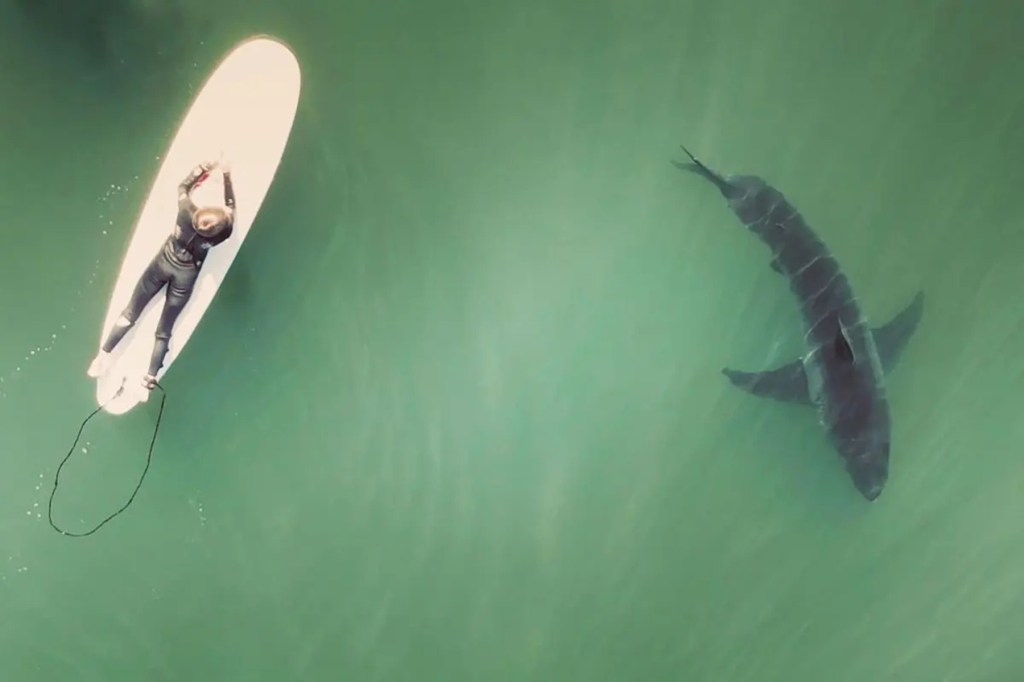
It might be old news, but one of my all-time favorite films, Jaws, celebrated its 50th anniversary this past June—the 20th, to be precise. Of course, the Thoma family observed the special day by ordering a pizza and watching it.
What brings this to mind right now is that I just learned that a documentary about the making of the film was released on July 11. I haven’t watched it yet, but I plan to. I’m sure it’ll bring back memories.
I remember the first time I saw the film. I wasn’t very old, maybe seven or eight. My brother and I watched it on a Betamax player my dad borrowed from a friend at work. At least, I think that was the context. I can’t say for sure. Either way, I loved the movie, and I dare say it played a huge part in my fascination with horror films. Although Jaws wasn’t really a horror film. It was more of an adventure-like thriller with horror elements. It was slow-building and suspenseful. But its charm was that it was grounded in something that could happen.
Ask my family, and they’ll tell you there isn’t much that I fear. Scary movies never bothered me. I’m rarely startled when surprised. I was never afraid of the dark as a kid. I never felt the urge to rush up the basement steps after turning out the light. But I can admit, I’m no fan of sharks. I have my reasons. And as such, I can admit, even when I was a 20-something lifeguard working at a freshwater lake in the summer, I thought about what might be lurking beneath the surface every time I went for a dip.
Harrison and I were listening to movie soundtracks on Spotify several weeks back. Jennifer and the girls walked in just as I played the soundtrack from Jaws. Right away, they all knew the iconic two-note motif, even without me telling them. Go swimming in a pool, and at some point along the way, it’s the resident father’s job to dip lower, his mouth just above the rippling surface, and begin, “Dun-dunt… dun-dunt… dun-dunt-dun-dunt-dun-dunt…” When that happens, no matter how old the children are, there’s a crazed splashing as they dash for the pool’s edge.
I finished the fantasy-fiction book I was writing and sent it off to the publisher. I’m glad to say it has been accepted for publication. Two more are expected. Now I’m five chapters into something completely different—a thriller. For the record, I’m loving every minute of its creation. Stepping beyond myself for a moment to observe the writing process, I think movies like Jaws did more than just spark my interest in all things scary. I believe it played a role in introducing me to the power of storytelling, particularly in terms of tension and pacing. It taught me that what you don’t see is often more frightening than what you do. Spielberg’s restraint—the decision to show the shark sparingly—was brilliant. It left space for the mind to fill in the fear.
It’s hard to believe it’s been fifty years. But then again, some stories never truly grow old. They just circle beneath the surface, waiting to rise again.
I read a reply to one of my Facebook posts this morning. It more or less supported the point in a cultural sense. Ultimately, I deleted the reply, if only because it was crass and attacking. Essentially, the person believed that LGBTQ issues should be seen as entirely normal and, therefore, acceptable. His premise was that LGBTQ relationships have existed as long as heterosexual relationships. So, in other words, longevity equals legitimacy.
For the record, that’s just silly.
Age alone doesn’t validate something. Throughout history, plenty of things have been long accepted, yet we now easily recognize them as absurd. The Spartan culture, for many centuries, considered it honorable to dispose of newborns with birth defects by throwing them from cliffs. Although I wouldn’t put it past Michigan’s current leadership to write the practice into the state’s constitution. We already have an amendment that allows abortion up to birth, and in some instances, afterward.
But before I stray from my original thought, my point is that the age of a thing, or even its level of acceptability in cultures throughout history, says nothing about its morality or truth. Ultimately, sin has been around since Eden. Pride, murder, greed, envy, idolatry—all of these things have endured. Not one of them is new. And all along the way, God’s Word has spoken clearly against them. Just because something has endured doesn’t mean it’s good or right.
Indeed, the enemy of God’s truth has always worked subtly, patiently, and yes, sometimes through the slow-building suspense of cultural conditioning—until finally, it’s time once again for the fin to break the surface and for the attack to come.
By the way, that Facebook reply itself was a tired example of the premise. The desire to justify one’s sin is an ever-lurking predator. It waits patiently just below the surface of the conscience, always ready to offer an excuse, always prepared to snap with, “This is who you are,” rather than, “This is what Christ came to redeem.”
It’s no coincidence that the Bible often describes devilish things in predatory terms. Sin crouches at the door (Genesis 4:7). The devil prowls like a lion (1 Peter 5:8). These things are purposely framed as ensnaring and deceiving. The cultural arguments we hear today try to steer away from these descriptions. But in the end, they’re little more than recycled lies with polished packaging—that is, for the lifeguard who’s paying attention. They see the appeal to emotion or history. They recognize the labeling of objectively true things as “fascism” and “bigoted,” and they see the same old fin circling the swimmers.
I suppose my concern these days is that the Church, the appointed lifeguard, is too often lulled by the quiet of the water. Too many in our ranks are too often asleep in the chair, thinking all is well. Perhaps worse, among those who know the dangers, many are afraid to swim out into the crimsoned waters to help. We know we, too, could be attacked, and that the effort to help might have an irreversible cost to our reputation, our comfort, our families, and so much more. In other words, not unlike the tension that Jaws portrayed so well, there’s a fear of what you don’t see but know could happen.
But here’s the thing. Christians are not called to fear, but to faithfulness. Our calling is not to retreat. We’re not to remain on the beach. We are sent into the waters knowing full well what stirs beneath. I’d say this is true because we’ve already been carried into and through the better waters of Holy Baptism, which is a washing that doesn’t remove fear, but transforms it. Our LCMS President, Rev. Dr. Matthew Harrison, once described this kind of Christian courage in a way that I’ve never forgotten. He said something about how Christian courage is nothing less than fear that’s been baptized.
He was right in so many ways.
Grafted into Christ, fear becomes something altogether different (John 15:4-5; Romans 11:17). It doesn’t necessarily vanish. Instead, it bows. It gets reordered by the Gospel, and as a result, it no longer rules the heart (Philippians 4:7; Colossians 3:15). That’s because it has been fixed to Jesus. Indeed, “we were buried therefore with him by baptism into death, in order that, just as Christ was raised from the dead by the glory of the Father, we too might walk in newness of life” (Romans 6:4-5). This is to say, we are joined to the One who has already gone into and through the depths of darkness and emerged alive again (Revelation 1:17-18).
That said, we’re not here to tread water or stay dry on the shore. We’re here to swim, and sometimes that means swimming right into the blood-stained mess. We do this not because we’re immune to fear. We’re no fools. We know so many unseen and fearful things are gliding quietly beneath us (Ephesians 6:12). This is especially true in the waters of culture. But the point is that for Christians, fear is not preventative. We know that the worst that could ever happen in any situation—death—has no dominion (Romans 6:9; 1 Corinthians 15:54-57).

 Cruciform Stuff