A Passing Storm?

Apparently, those among us who called it a social contagion were right.

That said, some will meet this moment with anger because the numbers undermine their narrative. Others will read them with sorrow, because it’s too late for people they know. And still others will exhale with relief, sensing that perhaps the edge of this storm has finally been sighted, and calmer seas are on the horizon.

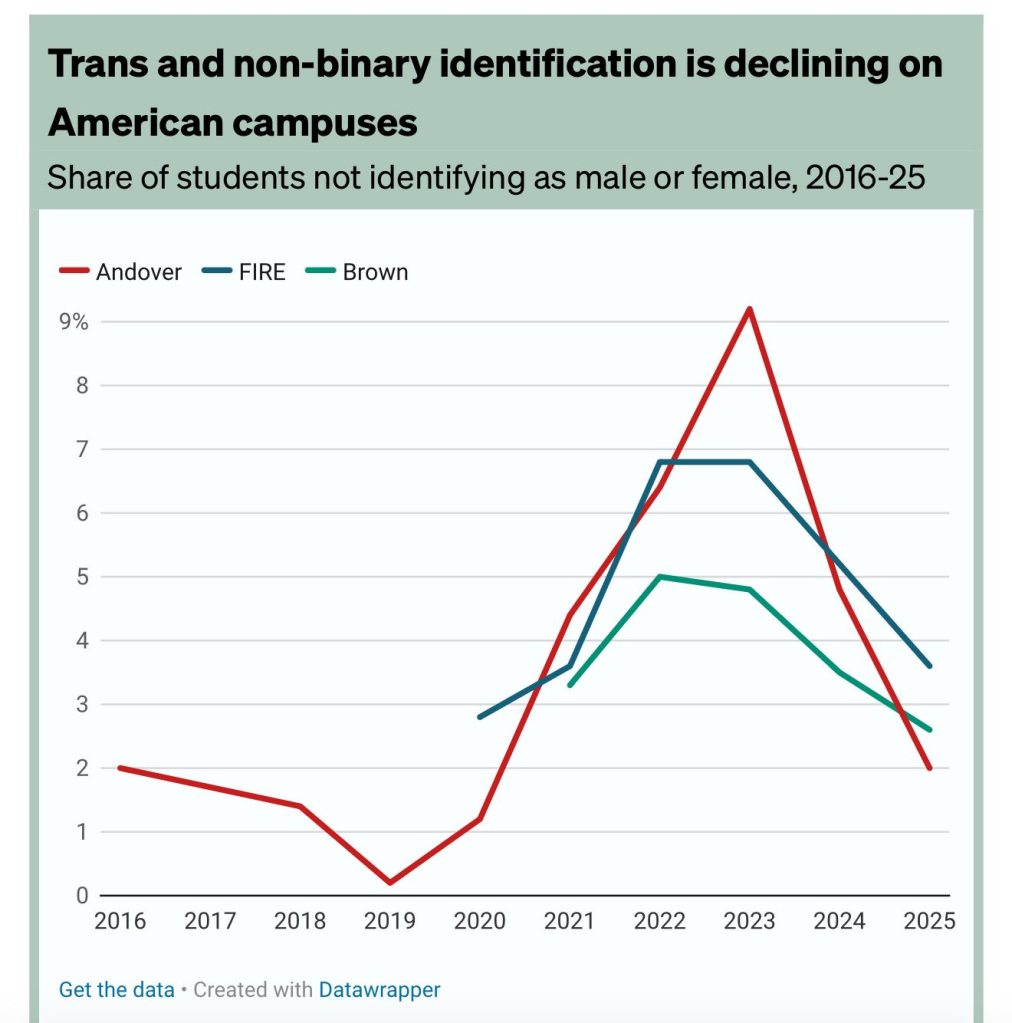
If you have no idea what I’m talking about, then you’ve missed some very important news. A recent study showed that the number of students identifying as transgender or nonbinary has dropped from nearly 7 % in 2022/2023 to around 3.6 % in 2025. Regardless of how the media might spin the data, that’s not a statistical wobble. That’s pointing to a collapse.

Go figure. Truth, after all, is patient, and fads have a way of burning themselves out.

That said, we should be careful not to take a victory lap just yet. Too many lives have already been scarred, if not completely ruined, this side of eternity. Too many parents have lost children to this mess. Too many were shamed into silence by doctors, family members, and friends. And yes, too many pastors chose the comfort of quietism, deciding that inaction was courageous and engagement was heterodoxy. They hid behind pious phrases like “Just preach the Word and God will handle the rest,” as though the Word they preach never calls for the courage to act, let alone to speak plainly about or against the wolves devouring the flock.

I should stop right there. There’s no need to go further. The task now is not to point fingers, but to lock arms and bear witness. Our job is to bind up wounds. Just know that for some, that means to stand where they refused to stand before and speak truth into the ruins.

Admittedly, we do this remembering that when entire societies exchange truth for a lie, God sometimes gives up and gives them over to the “due penalty for their error” (Romans 1:18-32). I think that’s precisely what we’ve lived through—a due penalty. We landed here because, in part, a generation was catechized not by faithful pastors and teachers, but by algorithms. They were allowed to believe the body is moldable and that feelings are sovereign. The result was pain on a scale we will not fully grasp for a very long time.

But again, lies are brittle things. They can’t bear the weight of actual reality. And that’s what the entire LGBTQ, Inc.’s world is facing right now with this study. But when the fantasy does finally collapse for some, the Church needs to be ready, because they’ll find themselves wounded and wandering.

While eating dinner with Chloe Cole in our home a few weeks ago, everyone at the table learned intimately that for every young person who detransitions, there is a story of profound regret. However, Chloe herself exemplifies hope in the mess—or better said, faith rediscovered. Admittedly, the truth may seem a little slower than lies when reasserting itself, but eventually, it does.

If we are indeed witnessing the beginning of the end of this cultural mania, the Church should be careful not to respond with cynicism or self-congratulation. Honestly, I don’t think she will. It’s not what her Lord desires to accomplish through her. I think she’ll respond with compassion. But it can’t be as before. It must be compassion built on faithful conviction—the kind that is never afraid to say to anyone in any context what’s actually true. We can never be scared to say out loud and in public that male and female are not arbitrary categories. They are divine gifts. “From the beginning of creation, God made them male and female” (Mark 10:6). That truth is not subject to revision.

From this conviction, genuine compassion is born, the kind that understands that many of the children and families caught up in this wave were not villains but victims. They were misled by an age that despises God’s boundaries, preferring instead to worship the self. As I said before, many needed shepherds, but didn’t have them. Now more than ever, they need shepherds who will not flinch from the devilries this world imposes on humanity. But they also need shepherds who will not sneer at the fallen.

I’ll be honest with you. I was starting to think God was giving up. As I mentioned before, He does do that in certain circumstances. Well, I was beginning to think we were experiencing it firsthand—that we were venturing into a forsaken landscape that Luther warned about so long ago:

“Let us remember our former misery, and the darkness in which we dwelt. Germany, I am sure, has never before heard so much of God’s word as it is hearing today; certainly, we read nothing of it in history. If we let it just slip by without thanks and honor, I fear we shall suffer a still more dreadful darkness and plague. O my beloved Germans, buy while the market is at your door; gather in the harvest while there is sunshine and fair weather; make use of God’s grace and word while it is there! For you should know that God’s word and grace is like a passing shower of rain which does not return where it has once been” (LW 45:352).

Perhaps this study is proof that God has not yet abandoned this generation. The same Christ who stilled the storm is still speaking His Gospel to the winds and the waves of this culture, saying, “Peace, be still.” (Mark 4:39) It sure seems the chaos that claimed so many sons and daughters is not being given the last word.

In one essential sense, the study is not just data. It’s a mirror. It reflects a society that appears tired of pretending. Divine truth is interrupting a worldwide delusion—an ideology built on lies that delivered only despair and loneliness. And now, as the illusion collapses, as is almost always the case, a vacuum will form. Rest assured, the human soul cannot abide in emptiness for long. If the Church does not step in to fill the void with truth, another dreadfulness will rush in to fill it.

Rest assured, this moment will test us. Will God’s people seize the opportunity to engage with compassionate conviction? Will we speak mercy to the misled while refusing to avoid or soften what’s true? The time for polite silence has passed. In fact, I’d say it was never an option. Indeed, more than ever before, bold catechesis leading to an even bolder confession must fill the space left unattended.

The turbulence may be passing, but God’s mandate through Saint Paul remains. Even when the waters are still, he insists, “Be steadfast, immovable, always abounding in the work of the Lord, knowing that in the Lord your labor is not in vain.” (1 Corinthians 15:58). Through our continued labors, many in the world may yet come to see something better—that the cure for confusion was never self-creation through mutilation. The solution to every bit of the sin-nature’s confusion is to become a new creation through faith in the mutilating crucifixion of Jesus—His death for our redemption.

A Hope-filled Sprig

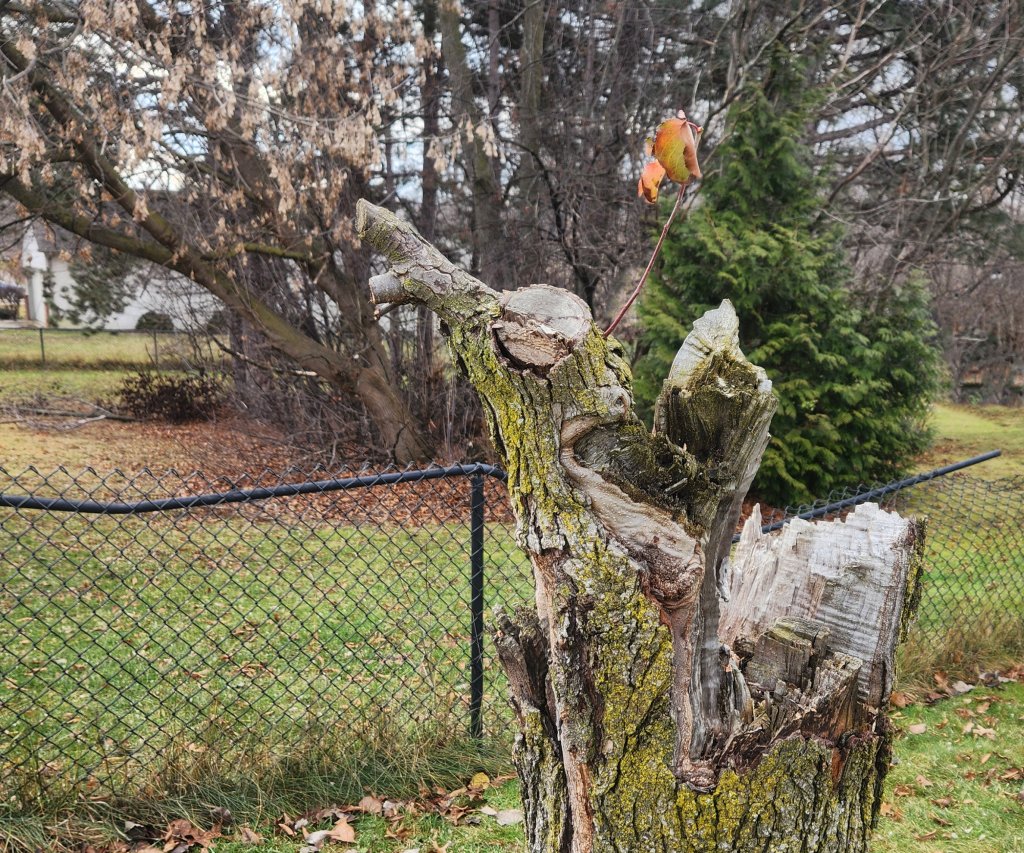
There’s a tree in a yard just down the street from my home that toppled twice this past year during two separate storms. The first was a windstorm that swept through last spring. By the time the ruckus had passed, one of the three stems ascending from the tree’s primary trunk broke free and crushed a nearby fence. The second gale was a late summer thunderstorm that brought equally powerful wind. When it finally quieted, the other two stems had fallen and destroyed another portion of the same fence. All that remained was a four-foot trunk with a splintered top.

It wasn’t long after either storm that the property owners cut and removed the debris, eventually leaving what is now a grayed and seemingly dead stump. I drive past it every day. For me, even in its obtusely pathetic state, the stump has faded into the neighborhood’s landscape, becoming something I no longer even notice.

But then one day last week, I did notice it. Even in mid-winter, it had a shoot growing from its top. Astounded, I circled back around and stopped to take a picture.

I’m not an arborist. Still, I know most deciduous trees in Michigan hibernate in winter. Essentially, they go to sleep at the end of summer. They slip into their dormancy stage, locating their essential nutrients in their roots. Doing this helps to keep them healthy and ready to bloom again in the spring. That’s why the leaves fall in autumn. The trees are shutting down the supply lines to everything but the roots, starving its skyward limbs and keeping the food where it’s needed most.

But this tree is not sleeping. It’s awake and growing in winter. Wearing only a slightness of green on one of its two leaves, a passerby can see by its sprig that it’s struggling against the elements. Its tiny, outstretched appendages are tinged with shades of autumn’s hues. Still, there it is, pushing up from a seemingly lifeless trunk, attempting to snatch every bit of Michigan’s occasional wintertime sunlight.

While barely anything at all, it’s an inspiring scene. Against the bleakest landscape, while everything else around it has given up and gone to sleep, it is awake, as if reaching up from hope’s nutrients with an unwillingness to forfeit.

Seeing this, as a Christian, I suppose my first inclination was to experience echoes of Isaiah 11:1, which reads, “There shall come forth a shoot from the stump of Jesse, and a branch from his roots shall bear fruit.” Isaiah’s words are forward-looking. They refer to Jesus. He is the One who, even as all mortal muscle for rescue was beyond spent, arrived bearing life. There He is. God did not leave us. He acted. He sent His Son, just as He said He would. Hope against all hope has been fulfilled. The Son has brought new life into what seemed to be Death’s dooming winter. And joy of joys! From His person and work, branches emerge and grow where no one thought they could. And this happens no matter life’s seasons, each shoot bearing extraordinary fruit (John 15:5).

I had a before-worship conversation on New Year’s Day with the chairman of our Board of Elders, Harry. Analyzing the societal landscape, we predicted that the forthcoming year would likely be far bumpier than the previous one. For the record, we weren’t being pessimistic but realistic, and in a sense, we were admitting to our need for the fruits that can only be plucked from Christ’s tree. In the New Year, we’re going to need the fruits of love, joy, peace, patience, kindness, goodness, faithfulness, gentleness, and self-control (Galatians 5:22-23). We’re going to need fortitude, the kind that wholeheartedly owns the title “Christian” (James 1:2-4; John 16:1-4). We’re going to need endurance (Romans 5:1-5). We’re going to need wisdom, the kind that can’t be duped by evil disguised as good (Ephesians 5:15-17). We’re going to need persevering strength to follow Jesus when doing so might appear to make very little sense (Hebrews 12:1; Luke 5:4).

We’ll need to be hope-filled sprigs against this world’s dismal backdrop (Romans 15:3).

But there’s another thought to be had. As a perpetual watchman for summer, the tree’s lonely sprig was a “consider the lilies of the field” moment (Matthew 6:28). It had me thinking about how God loves and cares for His people. Taking the stump’s picture, I spoke out loud to myself, “Storms will come, people will cut down the lilies, but nothing can stop spring from coming.” Christians will know what I meant.

No matter how the world rages, God’s promises will not be stopped (Romans 8:31-39). He’s caring for us now. As He does, we know the springtime of eternal life is coming. This means that even in the face of persecution and Death, believers have a limitless wellspring of hope. Like the stump’s sprig, what the world might expect from us in the darker moments is not what we’ve been recreated to do. The world will bear down on us with icy impositions, expecting that we’ll shrink into self-preserving hibernation. But instead, we reach up to the heavens as sprigs in winter. We stretch out in stark contrast to the surrounding world, bringing even the littlest bit of color into the sin-sick grays of this passing world.

We endure when enduring seems impossible.

This is my continued prayer for you in the New Year. God grant it.

God’s Shame

I want to start off by saying thank you to all who’ve reached out to me to show their care and concern following the surgery. Your love has been an uplifting thing, and I truly appreciate it.

This morning’s attempt at some sort of message to you is really my first time back at the keyboard since the surgery. I just haven’t had the energy for much. I still kind of don’t. I know others have far more difficult roads to travel than the one I’m currently on. Still, I won’t lie. It’s been a rough week. For one, I think I can officially say I miss sleeping far more than walking.

My plan was to forego the prescribed pain medications for as long as I could, but as it would go, I ended up taking them, anyway. Once I did, the pain lessened, but the typical difficulties I experience with the medications began. After a little more than a day of nausea, headaches, and sweating, I decidedly went cold turkey (except for Tylenol), having realized that all the discomforts brought on by the surgery were far preferable.

Of course, as some of you know, things got even more complicated this past week. Less than twenty-four hours after surgery, a terrible storm blew through and we lost power, which didn’t get repaired until Friday morning. Thankfully, we invested in a generator a few years ago. When the storm was at its worst and the lights were flickering, Madeline was over at her grandma’s house and Jennifer was running some necessary errands. Harrison and Evelyn were here with me. I probably shouldn’t have, but when the power finally did go out, I managed to hobble from my upstairs bedroom to the basement to help get the generator up and running. Harrison and Evelyn did the heavy lifting to get it outside and gassed up. Josh drove from his apartment in Argentine (through a warzone of fallen trees, as he described it) to take and fill our other gas cans. I directed traffic on breaker boxes, switches, and hookups. Once everything was in place, Evelyn covered my leg with a towel while I crutched outside in the rain to pull the startup. Not long after that, Jen made it home, and like a champ, took everything from there. I could see she’d already switched into “prepper” mode as she went right into doing things like putting flashlights in each of the bedrooms, giving directions on what things could or could not be operated while the generator was engaged, and making a point to go outside every twelve hours or so to shut the generator down to let it cool before refilling it with gas. Of course, while doing all of this, she was also making sure I had everything I needed.

I am, indeed, a blessed man with a wonderful family. And so, here we are together a few days beyond all the excitement and well on our way to greeting whatever new and exciting things may be coming over the horizon.

I won’t keep you long this morning. Again, I don’t have much energy for sharing at the moment. I guess I’ll say that for me personally, the last few days have been nothing short of constant conversation with God. Prayer, that is. I’ve been sending along a steady stream of anything and everything to His listening ears. I’m praying while eating. I’m praying in the shower. I’m praying at two o’clock in the morning. Sometimes it’s little more than unintelligible mutterings as my calf muscle cramps and pulls on the newly sewn tendon. In those moments I’m just begging for relief because the Tylenol does very little to help. In between, I’m telling Him random things that come to mind; things that pertain to my family, things that meet with many of you as individuals, things relative to the entire church family at Our Savior and beyond. Other times, my words to Him are self-analyzing. They’re honest communications telling Him what I really think about things; about myself, about what’s happening right now, about what’s going on in our world, about the things I do or don’t do that I want to change for the better.

Thankfully, God is so graciously willing to hear all these things, especially when it comes to the darker moments of genuine contrition or concern. I assure you that devout prayer does turn in such directions sometimes, so be ready.

Of course, and technically, God knows every little detail behind every possible thing we could share before we utter the first word. And yet, how incredibly comforting it is to know that He still craves for His children to spill it all, that He wants to hear our voices in His divine ears, that He wants us to know that He is listening and won’t turn us away. He loves us.

You should know that this love is what fuels His very core, and its most vivid display can be seen in the crucifixion of His Son, Jesus Christ. (Romans 5:8; John 3:16-17).

We’d expect the world to disparage the crucifixion of Jesus, and so it does. It’s strange, then, that here at 3:50 AM I’d stumble across a few Christian friends on social media expressing in passing their general discomfort with crosses and crucifixes. While I don’t know the math behind Facebook’s algorithms, I’m guessing there’s a chance these friends might read this. Still, I’m pretty sleep-deprived and in pain, so, whatever.

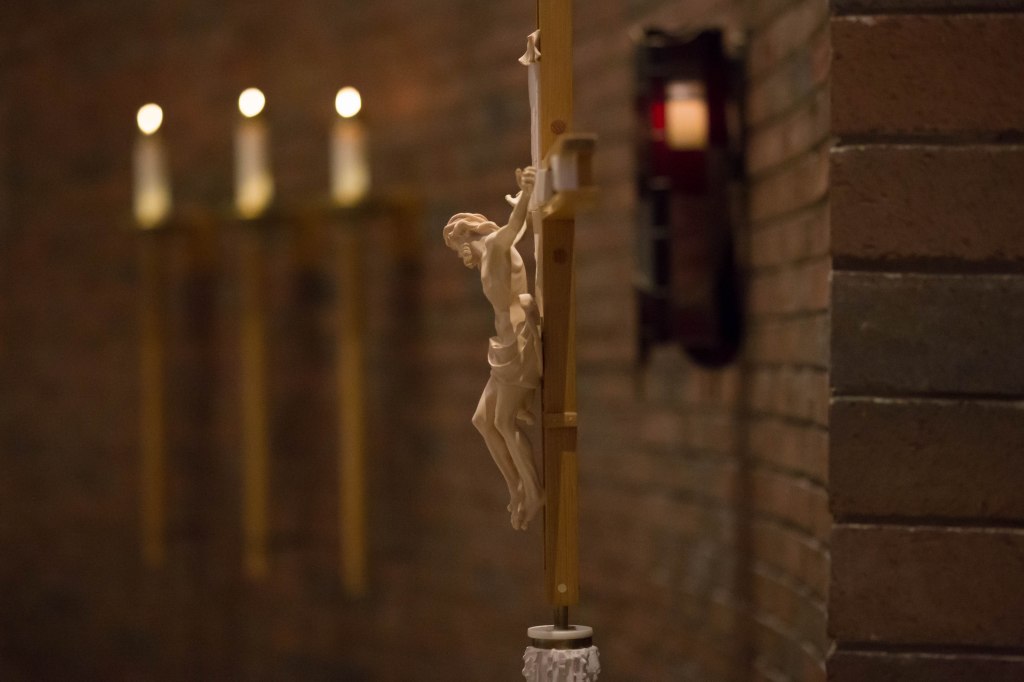
Firstly, and for the record, I prefer crucifixes over crosses. The corpus—the body of the Lord on the cross—matters to me. Secondly, what are you, vampires?! Why would a Christian be offended by the symbol of the Lord’s work to save us? How is it at all possible to be offended by the depiction—the visible communication, the visual transmission, the observable delivery—of the very act that rescued the world from Sin, Death, and the power of the devil?

No wonder Christianity is slipping away in America.

Although, what should I expect? So many of our mainstream churches are believing and teaching some ridiculous things these days. It should be no surprise to me, then, that there’s a pretty popular megachurch in Brighton, Michigan teaching that both crosses and crucifixes are offensive to visitors, and as a result, they refuse to display them anywhere in their facility. Think about that for a second.

Saint Paul dealt with this kind of idiocy in various places in his ministry, one of which he addresses in the very first chapter of 1 Corinthians (vv. 18-31). By the way, this was a letter written to a church filled with Christians who thought they knew better than the rest of Christendom. In many circumstances, they thought they knew better than Saint Paul, himself! So, from there, I think I’ll just say that any Christian or church offended by a crucifix needs to rethink things—a lot. I honestly don’t know how anyone can look at a crucifix and, in any way, disregard the all-important Gospel message it is silently proclaiming—which is that God was indeed ready and willing to meet us in our filth, that He wanted to be the absolute miracle of relief we needed in our most dreadful of hours. And how did He bring forth and accomplish this aid? By His Son’s death on the cross.

As this meets with prayer—since that’s what I was originally talking about—I don’t know how anyone can look at a crucifix and say honestly that God does not care enough to hear our cries no matter the hour or the need.

To close, there’s something else to consider when approaching prayer from this gritty perspective. I’d urge you to keep in mind the nature of the things you’re sharing with God and then ask yourself, “Would I be willing to publish on social media what I’m sharing with God right now?” If the answer is a red-faced “no,” then you’ve taken one step closer to the deeper teaching value of a crucifix: to the visceral nature behind something unseen becoming seen. I suppose in one sense you can know that seen or unseen, you have a “seen-it-all” God who loves and receives you as others couldn’t and wouldn’t. But then in tandem, you can be mindful that your God didn’t rescue you from your darkest, most secretive, sins by some private act. His death was a humiliating public spectacle—a sanctioned execution. He was tortured and propped up for all. His death for all sins for all time was meant to be seen. And I dare say, once you see it, you can’t unsee it. I’m guessing that while God is okay with your shame remaining hidden from the masses, He thinks it’s better for His to be out there in the open.

I’ll just leave you with that.