
A Hope-filled Sprig

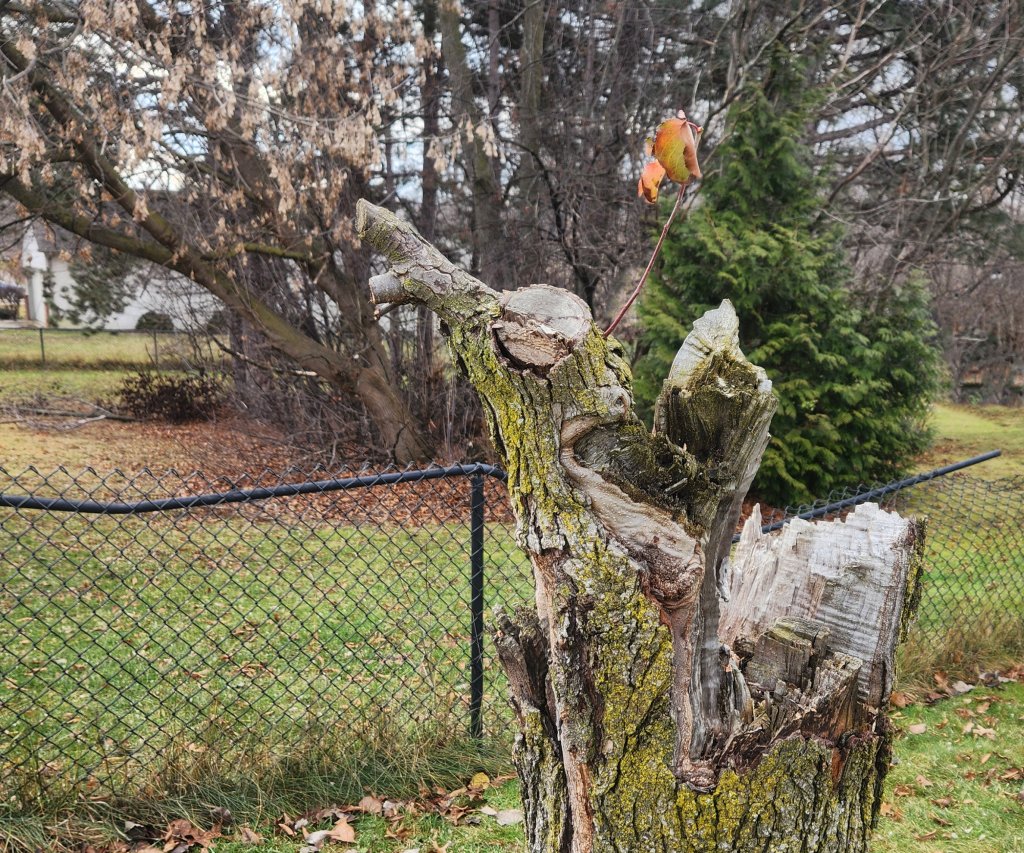
There’s a tree in a yard just down the street from my home that toppled twice this past year during two separate storms. The first was a windstorm that swept through last spring. By the time the ruckus had passed, one of the three stems ascending from the tree’s primary trunk broke free and crushed a nearby fence. The second gale was a late summer thunderstorm that brought equally powerful wind. When it finally quieted, the other two stems had fallen and destroyed another portion of the same fence. All that remained was a four-foot trunk with a splintered top.

It wasn’t long after either storm that the property owners cut and removed the debris, eventually leaving what is now a grayed and seemingly dead stump. I drive past it every day. For me, even in its obtusely pathetic state, the stump has faded into the neighborhood’s landscape, becoming something I no longer even notice.

But then one day last week, I did notice it. Even in mid-winter, it had a shoot growing from its top. Astounded, I circled back around and stopped to take a picture.

I’m not an arborist. Still, I know most deciduous trees in Michigan hibernate in winter. Essentially, they go to sleep at the end of summer. They slip into their dormancy stage, locating their essential nutrients in their roots. Doing this helps to keep them healthy and ready to bloom again in the spring. That’s why the leaves fall in autumn. The trees are shutting down the supply lines to everything but the roots, starving its skyward limbs and keeping the food where it’s needed most.

But this tree is not sleeping. It’s awake and growing in winter. Wearing only a slightness of green on one of its two leaves, a passerby can see by its sprig that it’s struggling against the elements. Its tiny, outstretched appendages are tinged with shades of autumn’s hues. Still, there it is, pushing up from a seemingly lifeless trunk, attempting to snatch every bit of Michigan’s occasional wintertime sunlight.

While barely anything at all, it’s an inspiring scene. Against the bleakest landscape, while everything else around it has given up and gone to sleep, it is awake, as if reaching up from hope’s nutrients with an unwillingness to forfeit.

Seeing this, as a Christian, I suppose my first inclination was to experience echoes of Isaiah 11:1, which reads, “There shall come forth a shoot from the stump of Jesse, and a branch from his roots shall bear fruit.” Isaiah’s words are forward-looking. They refer to Jesus. He is the One who, even as all mortal muscle for rescue was beyond spent, arrived bearing life. There He is. God did not leave us. He acted. He sent His Son, just as He said He would. Hope against all hope has been fulfilled. The Son has brought new life into what seemed to be Death’s dooming winter. And joy of joys! From His person and work, branches emerge and grow where no one thought they could. And this happens no matter life’s seasons, each shoot bearing extraordinary fruit (John 15:5).

I had a before-worship conversation on New Year’s Day with the chairman of our Board of Elders, Harry. Analyzing the societal landscape, we predicted that the forthcoming year would likely be far bumpier than the previous one. For the record, we weren’t being pessimistic but realistic, and in a sense, we were admitting to our need for the fruits that can only be plucked from Christ’s tree. In the New Year, we’re going to need the fruits of love, joy, peace, patience, kindness, goodness, faithfulness, gentleness, and self-control (Galatians 5:22-23). We’re going to need fortitude, the kind that wholeheartedly owns the title “Christian” (James 1:2-4; John 16:1-4). We’re going to need endurance (Romans 5:1-5). We’re going to need wisdom, the kind that can’t be duped by evil disguised as good (Ephesians 5:15-17). We’re going to need persevering strength to follow Jesus when doing so might appear to make very little sense (Hebrews 12:1; Luke 5:4).

We’ll need to be hope-filled sprigs against this world’s dismal backdrop (Romans 15:3).

But there’s another thought to be had. As a perpetual watchman for summer, the tree’s lonely sprig was a “consider the lilies of the field” moment (Matthew 6:28). It had me thinking about how God loves and cares for His people. Taking the stump’s picture, I spoke out loud to myself, “Storms will come, people will cut down the lilies, but nothing can stop spring from coming.” Christians will know what I meant.

No matter how the world rages, God’s promises will not be stopped (Romans 8:31-39). He’s caring for us now. As He does, we know the springtime of eternal life is coming. This means that even in the face of persecution and Death, believers have a limitless wellspring of hope. Like the stump’s sprig, what the world might expect from us in the darker moments is not what we’ve been recreated to do. The world will bear down on us with icy impositions, expecting that we’ll shrink into self-preserving hibernation. But instead, we reach up to the heavens as sprigs in winter. We stretch out in stark contrast to the surrounding world, bringing even the littlest bit of color into the sin-sick grays of this passing world.

We endure when enduring seems impossible.

This is my continued prayer for you in the New Year. God grant it.

A Springtime Sprig

I don’t mean to distress anyone within my relative vicinity. Still, I read that Michigan is number seven on the list of cloudiest states in the U.S. Apparently, 43 other states in the union have more sunshine than we do. Parsing the details, Michigan averages only 65 bright-beaming days during its 365-day trek around the sun. This means that 82% of our year is shrouded in gray.

I shared this information with the 7th and 8th-grade students in my Tuesday morning religion class. Within seconds, a handful spoke of their parents’ open disdain for Michigan’s seemingly unfair allotment of gloomy days. One even said something like, “My dad is like you, Pastor Thoma. He wants to live in Florida.”

Every year at this time, I feel compelled to communicate just how much I crave sunshine. I’ve never been officially diagnosed, and yet, having read the Cleveland Clinic’s definition of Seasonal Affective Disorder (SAD), I sometimes wonder if I bear some of the condition’s determiners. The affliction is “triggered by the change of seasons and most commonly begins in late fall. Symptoms include feelings of sadness, lack of energy, loss of interest in usual activities, oversleeping, and weight gain.”

I think I do experience a heightened sense of melancholy through the autumn and into the winter. I believe the dreariness causes less interest in a number of things I might usually enjoy. I don’t necessarily oversleep. My body is its own alarm clock. I go to bed. I wake up. I get started with my day. I would gain weight if I didn’t wage a conscious war against the gloom through exercise. However, I struggle to care much about exercising during the winter months. I often feel so drained that I don’t even want to look at the treadmill. It isn’t this way in the spring or summer.

A more pronounced sadness, check. Lack of energy, check. Loss of interest in usual activities, check. Three of five. Uh oh.

The clinic’s definition continues that “seasonal depression gets worse in the late fall or early winter before ending in the sunnier days of spring.”

“The sunnier days of spring.” That sounds nice. But that’s a long way from where we are on the calendar. Technically, December 1 was the first day of winter, even though many put winter’s beginning at the solstice on December 21. Either way, winter is just beginning here in Michigan. Its frigid clock has been tightly wound. Its chilled hands are ticking steadily from one number to the next. It will be some time before the clock slows, its time having eventually run out.

But it will run out.

I appreciate poetry. Relative to my doctoral studies, I’ve been reading a lot more of it. James Riley was thinking clock-like when he wrote of winter, “O, it sets my heart a-clickin’ like the tickin’ of a clock, when the frost is on the punkin and the fodder’s in the shock.” In other words, his heart’s hopeful timepiece begins ticking when he sees winter’s frosty specter beginning to pall the landscape, covering the pumpkin fields and the shocked fodder (the dried cornstalks bundled together and propped). He knows winter is coming, but he also knows it won’t be a forever thing. It has limited time to employ its dreadfulness.

I visited my dear friend, Sue, in the hospital this past Tuesday. Somehow, the details concerning Michigan’s cloudiness ranking came up. She doesn’t mind winter as much as I do. Still, she was surprised. During our time together, I read to her the Gospel lesson appointed for the Second Sunday in Advent: Luke 21:25-36. After reading it, we considered the Lord’s words. Along the way, I was reminded of another poet’s observation. Percy Shelley jotted, “If winter comes, can spring be far behind?” I shared Shelley’s rhetorical question with Sue.

“No, it can’t,” she replied. We smiled together.

Ah, the sunnier days of spring—those easing days when the naked landscapes become green again, teasing the forthcoming and golden expanse of summer, a time we both thoroughly enjoy.

But no matter what the poets say, Jesus truly calibrates our perspective.

Relative to my feelings for winter, I’m in good company. Jesus more than nodded to winter as a symbol of this world’s sin-plagued drudgery in the text from Luke 21. Referring to His return in glory on the Last Day, He instructed His disciples, “Look at the fig tree, and all the trees. As soon as they come out in leaf, you see for yourselves and know that summer is near” (vv. 29-30). Crucial to His point, like winter’s grim unpleasantness, this world’s current season of undoneness is not permanent. Jesus is coming back, and when He does, He will make all things new (Revelation 21:5), bringing with Him the spring and summer seasons of eternal life. If we lose sight of this, even the tiniest springtime sprig can serve as a Gospel reminder.

As someone who takes extra Vitamin D and keeps a sun lamp on the shelf beside his desk to help defend against the gravity of winter’s gloom, I do well to keep certain things in mind. In a broad sense, no matter what’s happening, I must remember that Christ has not abandoned me in some cosmic orphanage, having left me to fend for myself. He has promised His presence and the joy that comes with it (Matthew 28:20). He insists He will never leave nor forsake me (Hebrews 13:5). While I await His return in glory to bring me into His nearest presence, even if my deceptively sinful emotions have me somehow feeling forsaken, I can look to the cross. That’s the springtime (literally) sprig above all other sprigs emerging from the earth. When I see the cross, I can rejoice with childlike gladness. Perhaps this is what Edgar Guest meant when he rhymed:

“Spring’s greatest joy beyond a doubt
is when it brings the children out.”

The spring and summer of eternal life will bring God’s children out from this gray world’s wintry seclusion into the bright days of unending joy. How do I know this? Because Jesus said so, and His Word is sure. Look back at Luke 21:25-36, and you’ll see. Just after He directed our attention to the fig tree, He reminded us that all things will pass away, yet His words won’t (v. 33).

Believe Him. Be comforted by Him. He meant what He said; we can take Him at His word. This world’s wintry bondage will end. A divine spring and summer will arrive. It’s only a matter of time.

Complaining

As I type this, a bag sits on the chair across from my office desk. The bag has puzzles inside. I don’t know who placed it there, but I’m assuming it to be a kindly gesture by someone who knows my family likes such things. Somewhat of a betrayal of my observational skills, I think the bag was delivered to my office this past Wednesday. I can’t say for sure, mainly because last week was a bit of a blur. A lot happened in a very short period. Some of it was easy. Other parts were more challenging. All of it is in the Lord’s hands. It’s His church. We can all sleep easier knowing that.

I should say that as grateful as I am for the gifted puzzles, unfortunately, I do have one concern about the bag. It is adorned with a wintry scene bearing a smiling snowman. Above the frosty gent are the words, “Let it snow!” Again, thank you to whoever gave us the puzzles. What a treat! Nevertheless, I need you to know I’m going to burn this bag once my family removes the thoughtful gifts in its keep. I dread the snow and everything that comes with it. I say, keep the snow upstairs in heaven’s attic, and instead, let the warm sunshine continue to gild the grassy summertime landscapes down here.

Summer is better. Summer is my thing.

Of course, this isn’t to be. Anything I might call “my thing” is never really mine to control. Nothing is. Even the things I might consider autonomic—something like breathing—will one day cease. I won’t be in control at that moment. And so, for as much as I want summer to remain, winter is coming. Beyond that, there’s no use in complaining about it—even though I’m pretty sure I will continue to do so.

Technically, I have no right to complain. I live in Michigan, a tundra-like state. I do so by choice. Well, maybe not by choice. I blame my wife, Jennifer. She’s from Michigan. I met her, fell in love, and I stayed here because I wanted to be where she was. Thankfully, God saw fit to put me into a congregation I dearly love. Or perhaps better stated, I’d die for the people of Our Savior in Hartland, Michigan. Considering Joe Biden’s recent speech, it seems that’s becoming less a rhetorical statement and more a possibility.

Still, if I had the magical ability to lift Our Savior Lutheran Church and all its people from the earth and set them down on a gulf-kissed shore in Florida, I would. The place would look nice with some pineapple trees in our gardens and a few palm trees by our bell tower. I know I’m a stickler for stewardship, but if anyone suggested during a congregation meeting that we install a pool, I’d probably go for it. I mean, why not? Hey, trustees, what do you think?

But as I said, I have no right to complain. Come to think of it, at a base level, none of us has a right to complain about discomforting things we experience in this world. These things exist because of Sin. Sin is our fault, and complaining about it is a bit like turning on the stove, putting our hand in the flame, and then whining that we were burned. Besides, in the grand scheme of things, the One to whom we’re most likely directing our complaints—God—isn’t responsible for Sin. The fact that He handled it anyway says something about Him.

He loves us.

That brings something else to mind this morning: the Complaint Psalms—Psalms such as 3, 31, 44, 64, 142, and others. The Psalms of Complaint certainly are good examples of divinely inspired writers whining to God. That being said, such Psalms assume a few things.

Firstly, they assume a distinction between good and bad complaining. Bad complaining is often described in the scriptures as grumbling. Grumbling is the negative bemoaning that happens when our attention is more set on self than Christ. We want what we want. When we don’t get it, we complain. Perhaps worse, we end up blaming God for our woes rather than trusting in His divine care. I think good complaining—biblical concern—is different. God expects His people to complain to Him. He expects us, like Him, to be bothered by Sin’s darkly products. If we’re not expressing our concern in some measure for Sin’s grip on humanity and its dreadful horribleness unfolding in the lives of every man, woman, and child across the planet, then we’re far denser than we might give ourselves credit. This same assumption understands faith. It understands, firstly, that God is ready to hear the cries of His people; and secondly, we go to Him because He’s the only One capable of doing anything about Sin. Yes, we can complain about the ungodliness of abortion. We can even get involved, doing everything we can to stop it. Still, God is the only One who will see to its permanent demise. This leads to another assumption about good complaining: the anticipation and expectation of God’s love. We know God will always be ready to exchange our concern with His comforting Gospel—the wonderful proclamation of our deliverance from Sin through the person and work of Christ and the promise to strengthen us for meeting the challenges that stirred our concern in the first place.

He loves us. He hears us. He’s with us. He enlightens and empowers us, using the momentum of our Godly concerns to work through us in His world.

Still, as with the rest of God’s Word, the Complaint Psalms are in place to herald Christ. They meet with the Sin problem, being sure to dole out the only hope that can soothe our visceral concerns. Take a look at some of the Psalms I mentioned above. They never leave the complainer without hope.

I’m not so sure my complaining about snow fits into the category of good griping. While I’m burning the snowman bag, I’ll reflect on what I do know—which is that if it’s the Lord’s will, He’ll see me through another season that more than taxes me holistically. This world—His world—will continue to spin. Winter will become spring. Summer will return after that. All along the way, He’ll take both my bad and good complaints and put His faithful Word before me—both His Law and Gospel. He’ll give His Law to reveal my sinful selfishness and His Gospel to forgive and strengthen me for being His trusting child who engages in the surrounding world.

In all, I’d say that will forever be a pretty good gig for whiners like me.

“Let Us Run the Race…”

As always, I pray all is well with you and your family, and that as we make our way toward summer, you are beginning to receive some relief from winter’s grip.

When I say grip, I mean it. Michigan winters are long. I grew up in central Illinois. Until I moved here in 1994, I was ignorant to the fact that it’s all but guaranteed that eight of Michigan’s twelve months will deliver a measure of frigidity. It’s a truth that tips its bowler cap reminiscently to the British notion that there’s only one way to ensure summer in England and that’s to have it framed and hanging in the living room.

And yet Michiganders press on, we endure, knowing that when summer does finally arrive in our state, there will be few other places in America that can capture our hearts for home in comparison.

Although, “endure” is an interesting word to use in relation to something we love, isn’t it?

As a pastor, even as I’ve needed to endure troubling people, places, and things, I’ve also been on the scene to watch other people endure, too. About thirty-six hours ago I was sitting at gate B16 in the McNamara Terminal at Detroit Metropolitan Airport on my way to St. Louis, and across the way at gate B15 was a family enduring their restless two-year-old. Come to think of it, we were all enduring the toddler. I’m sure they love their son, but I have to imagine that in that particular moment they were doing what they could to get through the oncoming hours of travel, ultimately hoping for the peace that comes with arriving at their final destination—which appeared to be Knoxville, Tennessee.

Observing those folks (not gawking, of course), I’d say they were doing a stellar job of receiving the disdain-filled stares of the folks around them, while at the same time managing their own inclinations to put a red tag on the kid and check him as extra baggage at the door of the plane before boarding because they knew they wouldn’t get away with stuffing him into the overhead bin.

I’ve learned over the years that the way people endure struggle often reveals more about them than the actual thing being endured. I was reminded of this rather vividly earlier this week when I was called to the scene of an unexpected death. There were family members of the deceased who claimed faith in Christ, and yet were completely inconsolable—more so than I’ve ever seen before—wailing and calling out that life was now over, that all hope was lost, that God was their enemy, that they hated Him, that He was punishing them even as they’d been so faithful to Him in church attendance and prayer and giving. (For the record, I found out later after talking to their pastor they weren’t actually as faithful as they’d claimed.)

Over the course of the hour after I arrived, other Christian family and friends arrived, too. I didn’t learn of their faith in Christ by asking, but instead beheld them embracing the inconsolable ones and offering them the reassurance that hope was not lost, that God was not doling out injustice, that He was not scheming to harm or destroy them.

To be clear, I’m not belittling anyone’s moment of grief. I’ve been in and around it enough to know that it’s different for everyone. And besides, it truly was an unfortunate scene. Still, when it comes to relationship status, I’d say that for the most part, everyone in the room held equal shares of the burden of the moment. But for some reason, one group in particular seemed capable of finding their way in the darkness, of believing that even amid the coldness of Death, the summer of eternal life through faith in Christ was approaching on the horizon. They were proving a deep trust that the sadness would eventually pass, that the Day of Days was coming. It was only a matter of time. Armed with this knowledge, they were going to press forward displaying a different kind of grief, one that emitted hope and was capable of shepherding others in the same.

Paul said something about this in 1 Thessalonians 4:13-14:

“But we do not want you to be uninformed, brothers, about those who are asleep, that you may not grieve as others do who have no hope. For since we believe that Jesus died and rose again, even so, through Jesus, God will bring with him those who have fallen asleep.”

Those who fall asleep in Jesus are brought along with Him. In the moment of their passing, no matter how dark it might seem to be, they are immediately carried to where He is. This is true by virtue of His unarguable power over Death.

Saint Paul’s words are Easter words. Easter owns them. I’m here to tell you that it’s no coincidence that God established Easter in the springtime. Spring steps forth from the grave of winter with its heart set toward summer, the sunlit upland of new life in full bloom.

Until then, indeed, the need to endure is rarely an easy thing. Just look around. But as you do, I’d caution those of you expecting to discover nothing but hopelessness unfolding throughout the world that you’ll likely see Christians continuing to prove the engine of endurance being fed by the Gospel of hope. History itself testifies to this. In a sense, you are enjoying the benefits of this verity. Fellowship in the Christian congregation you call home exists in part because the Christians who were tossed into dens filled with lions endured. The faith you are laboring to pass along to your children and grandchildren continues because Christians staked by Nero endured. The Bible—the Word of God for faith is even now in your hands because the Apostles who went out with a willingness to be crucified—even upside down—endured. The world has continued year after year to pit itself against Christianity, and yet countless generations continue in the way of salvation. Why? Because that which is the power of God unto salvation—the Gospel (Romans 1:16)—continues to endure, just as the Lord said (Matthew 16:15-20). And so, like those who’ve gone before us, we are not fearful as the world is fearful. We do not grieve as the world grieves. We do not endure unpleasantness and struggle and suffering and pain as the world endures. We have hope. We have that which has reached into us from the divine spheres and kindled our hearts with the warmth of a joy that can withstand the temperatures of mortal struggle that fall below freezing.

We know the summer of eternal life is coming. It’s not that we think it’s coming, but rather by the power of the Holy Spirit alive in us, we know it. That being true, and all of our senses being so attuned by faith to this Gospel reality, we cannot help but invest in its inevitability, ultimately letting it be visible to the people around us.

I know I don’t always do this as I should, which is why I need to continue to prepare.

I don’t know about you, but I dedicate time in the spring to preparing for summer. I clean up the yard. I trim back bushes. I prepare flower beds. I test sprinkler heads. I swap the snow blower in the garage with the lawn mower in the shed. (Michigan being what it is, sometimes I learn that I’ve made the swap a little too early.) I do countless things to make sure all is in order. I’m sure the Christians who are faithful in worship will make the appropriate connection here. They don’t need help understanding that because Christ fully accomplished our redemption, there isn’t anything we do for God that somehow plays a part in winning the unending summer of heaven. And yet, they also understand that the same Savior calls for us to prepare. He urges us to a readiness that doesn’t doze off so easily, but rather remains aware, that actively engages in order to keep itself well-stocked and complete for the Day’s arrival when we will be brought into Christ’s presence (Matthew 24:42-44; 25:1-13 ).

Christians know that holding “unswervingly to the hope we profess” means “drawing near to God” where He locates Himself (Hebrews 10:22-27). They know God’s divine prompting for readiness means being with Him in worship, together with other Christians, to receive as one like-minded, supportive, and believing family His gifts of Word and Sacrament that feed the flame of faith for running the race (Hebrews 12:1-2) and enduring until the end (James 1:12).