
A Hope-filled Sprig

There’s a tree in a yard just down the street from my home that toppled twice this past year during two separate storms. The first was a windstorm that swept through last spring. By the time the ruckus had passed, one of the three stems ascending from the tree’s primary trunk broke free and crushed a nearby fence. The second gale was a late summer thunderstorm that brought equally powerful wind. When it finally quieted, the other two stems had fallen and destroyed another portion of the same fence. All that remained was a four-foot trunk with a splintered top.

It wasn’t long after either storm that the property owners cut and removed the debris, eventually leaving what is now a grayed and seemingly dead stump. I drive past it every day. For me, even in its obtusely pathetic state, the stump has faded into the neighborhood’s landscape, becoming something I no longer even notice.

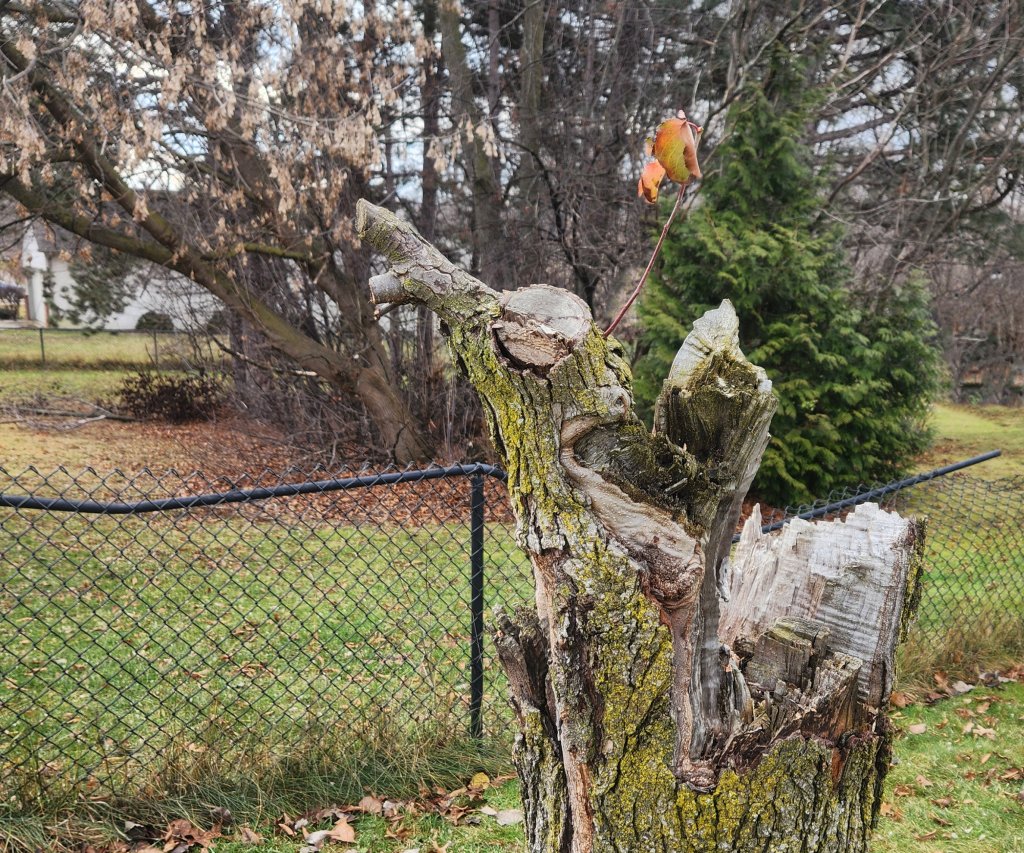
But then one day last week, I did notice it. Even in mid-winter, it had a shoot growing from its top. Astounded, I circled back around and stopped to take a picture.

I’m not an arborist. Still, I know most deciduous trees in Michigan hibernate in winter. Essentially, they go to sleep at the end of summer. They slip into their dormancy stage, locating their essential nutrients in their roots. Doing this helps to keep them healthy and ready to bloom again in the spring. That’s why the leaves fall in autumn. The trees are shutting down the supply lines to everything but the roots, starving its skyward limbs and keeping the food where it’s needed most.

But this tree is not sleeping. It’s awake and growing in winter. Wearing only a slightness of green on one of its two leaves, a passerby can see by its sprig that it’s struggling against the elements. Its tiny, outstretched appendages are tinged with shades of autumn’s hues. Still, there it is, pushing up from a seemingly lifeless trunk, attempting to snatch every bit of Michigan’s occasional wintertime sunlight.

While barely anything at all, it’s an inspiring scene. Against the bleakest landscape, while everything else around it has given up and gone to sleep, it is awake, as if reaching up from hope’s nutrients with an unwillingness to forfeit.

Seeing this, as a Christian, I suppose my first inclination was to experience echoes of Isaiah 11:1, which reads, “There shall come forth a shoot from the stump of Jesse, and a branch from his roots shall bear fruit.” Isaiah’s words are forward-looking. They refer to Jesus. He is the One who, even as all mortal muscle for rescue was beyond spent, arrived bearing life. There He is. God did not leave us. He acted. He sent His Son, just as He said He would. Hope against all hope has been fulfilled. The Son has brought new life into what seemed to be Death’s dooming winter. And joy of joys! From His person and work, branches emerge and grow where no one thought they could. And this happens no matter life’s seasons, each shoot bearing extraordinary fruit (John 15:5).

I had a before-worship conversation on New Year’s Day with the chairman of our Board of Elders, Harry. Analyzing the societal landscape, we predicted that the forthcoming year would likely be far bumpier than the previous one. For the record, we weren’t being pessimistic but realistic, and in a sense, we were admitting to our need for the fruits that can only be plucked from Christ’s tree. In the New Year, we’re going to need the fruits of love, joy, peace, patience, kindness, goodness, faithfulness, gentleness, and self-control (Galatians 5:22-23). We’re going to need fortitude, the kind that wholeheartedly owns the title “Christian” (James 1:2-4; John 16:1-4). We’re going to need endurance (Romans 5:1-5). We’re going to need wisdom, the kind that can’t be duped by evil disguised as good (Ephesians 5:15-17). We’re going to need persevering strength to follow Jesus when doing so might appear to make very little sense (Hebrews 12:1; Luke 5:4).

We’ll need to be hope-filled sprigs against this world’s dismal backdrop (Romans 15:3).

But there’s another thought to be had. As a perpetual watchman for summer, the tree’s lonely sprig was a “consider the lilies of the field” moment (Matthew 6:28). It had me thinking about how God loves and cares for His people. Taking the stump’s picture, I spoke out loud to myself, “Storms will come, people will cut down the lilies, but nothing can stop spring from coming.” Christians will know what I meant.

No matter how the world rages, God’s promises will not be stopped (Romans 8:31-39). He’s caring for us now. As He does, we know the springtime of eternal life is coming. This means that even in the face of persecution and Death, believers have a limitless wellspring of hope. Like the stump’s sprig, what the world might expect from us in the darker moments is not what we’ve been recreated to do. The world will bear down on us with icy impositions, expecting that we’ll shrink into self-preserving hibernation. But instead, we reach up to the heavens as sprigs in winter. We stretch out in stark contrast to the surrounding world, bringing even the littlest bit of color into the sin-sick grays of this passing world.

We endure when enduring seems impossible.

This is my continued prayer for you in the New Year. God grant it.
A Springtime Sprig

I don’t mean to distress anyone within my relative vicinity. Still, I read that Michigan is number seven on the list of cloudiest states in the U.S. Apparently, 43 other states in the union have more sunshine than we do. Parsing the details, Michigan averages only 65 bright-beaming days during its 365-day trek around the sun. This means that 82% of our year is shrouded in gray.

I shared this information with the 7th and 8th-grade students in my Tuesday morning religion class. Within seconds, a handful spoke of their parents’ open disdain for Michigan’s seemingly unfair allotment of gloomy days. One even said something like, “My dad is like you, Pastor Thoma. He wants to live in Florida.”

Every year at this time, I feel compelled to communicate just how much I crave sunshine. I’ve never been officially diagnosed, and yet, having read the Cleveland Clinic’s definition of Seasonal Affective Disorder (SAD), I sometimes wonder if I bear some of the condition’s determiners. The affliction is “triggered by the change of seasons and most commonly begins in late fall. Symptoms include feelings of sadness, lack of energy, loss of interest in usual activities, oversleeping, and weight gain.”

I think I do experience a heightened sense of melancholy through the autumn and into the winter. I believe the dreariness causes less interest in a number of things I might usually enjoy. I don’t necessarily oversleep. My body is its own alarm clock. I go to bed. I wake up. I get started with my day. I would gain weight if I didn’t wage a conscious war against the gloom through exercise. However, I struggle to care much about exercising during the winter months. I often feel so drained that I don’t even want to look at the treadmill. It isn’t this way in the spring or summer.

A more pronounced sadness, check. Lack of energy, check. Loss of interest in usual activities, check. Three of five. Uh oh.

The clinic’s definition continues that “seasonal depression gets worse in the late fall or early winter before ending in the sunnier days of spring.”

“The sunnier days of spring.” That sounds nice. But that’s a long way from where we are on the calendar. Technically, December 1 was the first day of winter, even though many put winter’s beginning at the solstice on December 21. Either way, winter is just beginning here in Michigan. Its frigid clock has been tightly wound. Its chilled hands are ticking steadily from one number to the next. It will be some time before the clock slows, its time having eventually run out.

But it will run out.

I appreciate poetry. Relative to my doctoral studies, I’ve been reading a lot more of it. James Riley was thinking clock-like when he wrote of winter, “O, it sets my heart a-clickin’ like the tickin’ of a clock, when the frost is on the punkin and the fodder’s in the shock.” In other words, his heart’s hopeful timepiece begins ticking when he sees winter’s frosty specter beginning to pall the landscape, covering the pumpkin fields and the shocked fodder (the dried cornstalks bundled together and propped). He knows winter is coming, but he also knows it won’t be a forever thing. It has limited time to employ its dreadfulness.

I visited my dear friend, Sue, in the hospital this past Tuesday. Somehow, the details concerning Michigan’s cloudiness ranking came up. She doesn’t mind winter as much as I do. Still, she was surprised. During our time together, I read to her the Gospel lesson appointed for the Second Sunday in Advent: Luke 21:25-36. After reading it, we considered the Lord’s words. Along the way, I was reminded of another poet’s observation. Percy Shelley jotted, “If winter comes, can spring be far behind?” I shared Shelley’s rhetorical question with Sue.

“No, it can’t,” she replied. We smiled together.

Ah, the sunnier days of spring—those easing days when the naked landscapes become green again, teasing the forthcoming and golden expanse of summer, a time we both thoroughly enjoy.

But no matter what the poets say, Jesus truly calibrates our perspective.

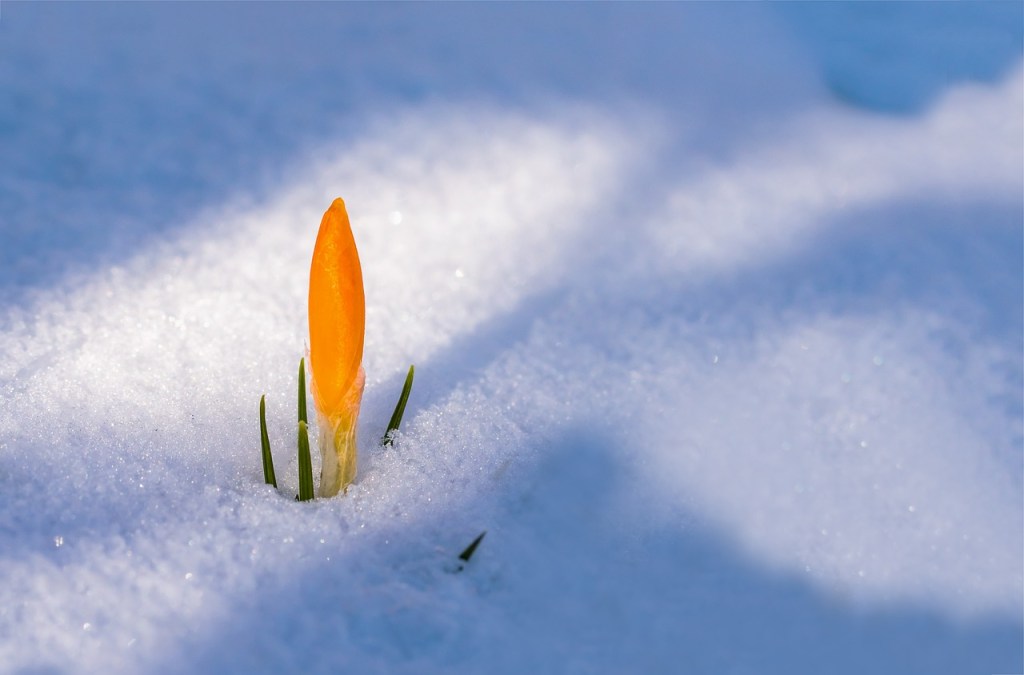
Relative to my feelings for winter, I’m in good company. Jesus more than nodded to winter as a symbol of this world’s sin-plagued drudgery in the text from Luke 21. Referring to His return in glory on the Last Day, He instructed His disciples, “Look at the fig tree, and all the trees. As soon as they come out in leaf, you see for yourselves and know that summer is near” (vv. 29-30). Crucial to His point, like winter’s grim unpleasantness, this world’s current season of undoneness is not permanent. Jesus is coming back, and when He does, He will make all things new (Revelation 21:5), bringing with Him the spring and summer seasons of eternal life. If we lose sight of this, even the tiniest springtime sprig can serve as a Gospel reminder.

As someone who takes extra Vitamin D and keeps a sun lamp on the shelf beside his desk to help defend against the gravity of winter’s gloom, I do well to keep certain things in mind. In a broad sense, no matter what’s happening, I must remember that Christ has not abandoned me in some cosmic orphanage, having left me to fend for myself. He has promised His presence and the joy that comes with it (Matthew 28:20). He insists He will never leave nor forsake me (Hebrews 13:5). While I await His return in glory to bring me into His nearest presence, even if my deceptively sinful emotions have me somehow feeling forsaken, I can look to the cross. That’s the springtime (literally) sprig above all other sprigs emerging from the earth. When I see the cross, I can rejoice with childlike gladness. Perhaps this is what Edgar Guest meant when he rhymed:

“Spring’s greatest joy beyond a doubt
is when it brings the children out.”

The spring and summer of eternal life will bring God’s children out from this gray world’s wintry seclusion into the bright days of unending joy. How do I know this? Because Jesus said so, and His Word is sure. Look back at Luke 21:25-36, and you’ll see. Just after He directed our attention to the fig tree, He reminded us that all things will pass away, yet His words won’t (v. 33).

Believe Him. Be comforted by Him. He meant what He said; we can take Him at His word. This world’s wintry bondage will end. A divine spring and summer will arrive. It’s only a matter of time.