At the men’s Bible study in my home two weeks ago, we wandered into a momentary discussion concerning the necessity of sound doctrine. I don’t remember how it happened. We’re currently studying the Book of Acts, and I think it came up while making our way further into Chapter 2. I do remember that it stirred something from Luther’s Bondage of the Will, which I did my best to recall. Here’s what Luther wrote:
“Christians must know for sure what they believe and must witness to their belief. Therefore, if you take away that certain affirmation so that Christians are no longer sure of what they believe, they have ceased to be Christians, and you have taken away their faith. For the Holy Spirit is given to them from heaven in order that He may sanctify the hearts of the faithful and make them firm and sure in their witness to Christ so that they will live and die for it. And is not this the greatest certainty if I stand so firmly by my yes that I am ready to die for it? Yes, it is. The Holy Spirit is no skeptic. He has not written an uncertain delusion in our hearts, but a strong, great certainty, which does not let us waver, and may it please God, will not let us waver, but praise be to God, makes us as sure as we are that we are now alive and that two and three make five.”
My favorite line in the paragraph is, “The Holy Spirit is no skeptic.” Of course, He isn’t. When you know truth in its entirety, there are no in-between spaces of uncertainty. You can move along unfettered, assured that what’s true is true and what’s false is false.
Indeed, the Holy Spirit does not wrestle with ambiguous skepticism.
Part of Luther’s essential point was, first of all, that Christians are only Christians because the Holy Spirit has been given to and abides in them for faith. That said, the faith the Holy Spirit brings isn’t a garment sewn from flimsy fabric. It isn’t a wobbly dwelling built from fragile materials. It certainly isn’t formed from ever-shifting human opinion. It is constructed from divine, knowable, and affirmable doctrines that, no matter the world’s erratic ideas, remain steady and true. Take these doctrinal foundations away, and faith becomes shaky. In fact, Luther warns that without them, faith ceases to exist entirely. That’s what he meant when he said, “Therefore, if you take away that certain affirmation so that Christians are no longer sure of what they believe, they have ceased to be Christians, and you have taken away their faith.”
What does this free-floating anti-dogma ignorance look like in real-time?
Well, it translates into a societal context in which people are susceptible to beliefs that sound Christian doctrine steers to avoid. They become capable of believing pretty much whatever they want while still considering themselves faithful. And I’m not just talking about some of the more ridiculous things, like thinking that people become angels when they die, which I intend to mention during this morning’s sermon. I mean some truly dreadful things that separate them from God altogether—like denying the Holy Trinity or rejecting the premise that Christ was God in the flesh.
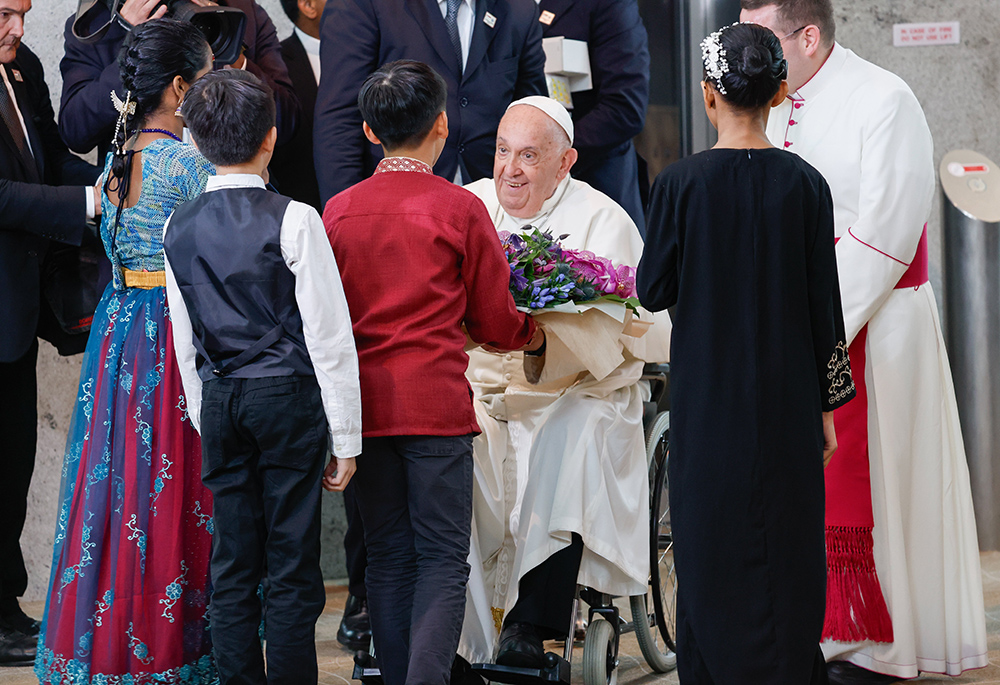
Self-constructed Christianity has other dreadful potentials, too. It produces people who believe abortion is something about which Christ smiles. It mistakenly prattles on social media that Jesus forbade judging anyone or anything. It heralds innumerable genders while encouraging irreversible surgeries for children. Speaking of children, it produces a pope fit for a millstone (Matthew 18:6) as he tells a young boy in Singapore that “all religions are a path to God… and each of us has a language to arrive at God. Some are Sheik, Muslim, Hindu, Christian, and they are different paths to God.”
Regardless of how Pope Francis’ handlers are spinning what he supposedly meant to say, his actual words measured against sound biblical doctrine proved themselves the heresy of religious pluralism, which rejects the essential teaching that Christ is the only way of salvation (John 14:6). Christians do not subscribe to religious pluralism. However, there may be one young boy in Singapore who does now, especially since he heard it from someone who’s supposed to know for sure.
Thinking about last week’s Epistle reading from Ephesians 4:1-6 appointed for worship here at Our Savior, I think Saint Paul indirectly weighed in on these things when he wrote, “I, therefore, a prisoner for the Lord, urge you to walk in a manner worthy of the calling to which you have been called…” (v. 1). Paul says three things here.
First, he insists on faithful abidance in “the calling to which you have been called.” In other words, you’ve been called to something—the Christian faith. That something has a walkway—faithful doctrine. Walk accordingly in it. When you wander past its edges, repent, and go back because the terrain beyond ends in destruction (Matthew 7:13-14).
Second, the walking is to be done in a worthy way. In one sense, it is demonstrative. People will see and hear. A young boy in Singapore saw and heard. Therefore, Paul instructs Timothy, “Watch your life and doctrine closely. Persevere in them, because if you do, you will save both yourself and your hearers” (1 Timothy 4:16).
Finally, Saint Paul already implied from his own situation, which he mentions specifically in Ephesians 4:1, that walking according to our calling could get a Christian into trouble. Behold, Paul was a prisoner for doing what he was even now urging his readers to do.
But here’s the thing.
Neither ease nor trouble affected the stepping stones of sound doctrine for Paul. The path was the path. What’s true was true, and what’s false was false. And so, he walked, and his faith was secure. In fact, it was armor-like. It could lean into and withstand the enemy’s thrusts along life’s way. It became fortress-like. Its resident could stand at the walls and confess truth before the barraging legions that surrounded it, even when standing where the enemy could see him meant imprisonment and eventual death.
Luther’s life was similar. Our lives are, too. And yet, together we have, as Luther described, a faith that is not an “uncertain delusion,” but instead, is a “strong, great certainty, which does not let us waver….” We can bear whatever the world brings our way, even a death sentence, and still retain the same kind of unshakeable trust in Christ that’s as simple as believing that “two and three makes five.” Indeed, that’s a simple analogy Luther made. And yet, it’s profoundly powerful. Even better, it’s unarguably true.
 Cruciform Stuff