
I’m sure you’ve heard about the shooting in Minneapolis by now. I waited to write something until this morning, if only because I wanted more information first. But now I know the dreadful details in full.
A 23-year-old man, Robert Westman—his transgender name, Robin—opened fire during Annunciation Catholic School’s morning mass. Two children are dead. Eighteen more were wounded.
Why did he do it?
Well, he left a thorough manifesto behind. The theme scribbled through its pages: hate. He hated Trump. He hated Christians. It seems he hated anyone unwilling to embrace and perpetuate his dysphoric condition. Strangely, he wrote of hating children. He fantasized about killing them, ultimately writing across his weapon, “This is for the children,” and “Where is your God?”
I heard political commentators asking last night, “What normal person dreams of killing the most vulnerable among us?” I thought to myself, “Well, abortion and transgender rights are fundamental planks in the progressive left’s platform. With that, the hatred of children is not as strange as it might sound.”
I say that because, within these ideological places, a devilish concoction is being brewed.
First, someone like Robert likely grew up learning that life in the womb is disposable, therefore making him more than capable of interpreting children outside the womb with the same diminished value. Then mix in a child’s natural lack of acceptance for things that are obviously ridiculous. In other words, children see things with a kind of uncluttered honesty—able to distinguish a man from a woman without mental gymnastics or political jargon. I can imagine that when Robert went out and around as “Robin,” children stared. Children do that when they see something weird. Understanding this, it’s not that hard to see why Robert, a deranged transgender, would hate and therefore target them. Anyone who can pierce through self-made illusions and preferred confusion with the plain light of truth becomes, by nature, an enemy.
And then, of course, relative to truth, we’d expect him to hate Christians. In these situations, that detail never surprises me.
The question he wrote on his gun’s magazine—“Where is your God?”—isn’t surprising either. That same question echoes through history whenever tragedy strikes. The psalmist wrote, “My tears have been my food day and night, while they say to me continually, ‘Where is your God?’” (Psalm 42:3). Evil has always taunted God’s people, daring us to believe that He is absent, indifferent, or even nonexistent when trouble comes. It is Satan’s go-to sneer. It is his preferred avenue for mockery.
But what Satan tends to forget is that the One inside of us is so much stronger than the one in the world (1 John 4:4). And so, the witness of God’s Word, and therefore, Christ himself, remains something far different than what this godless world would propose.
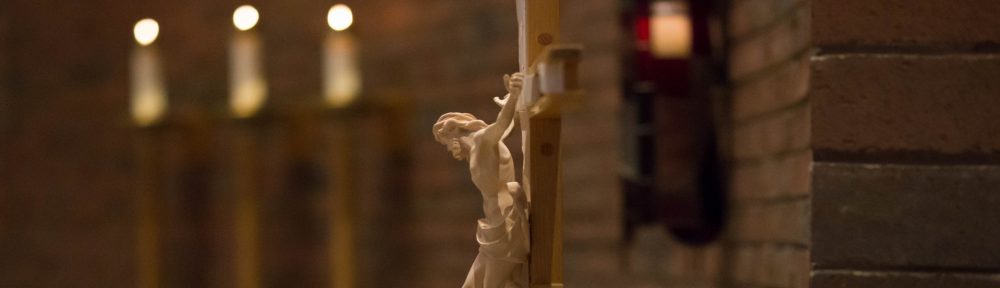
By the power of the Holy Spirit at work in us for faith, given through the Gospel (Romans 1:16), a Christian knows God is by no means absent. He is in no way blind. The Gospel proclaims (and imputes the capability to believe) that at the cross of Jesus, we see God in the flesh entering into our suffering, bearing the fullest weight of sin and death (Isaiah 53:4–6; 1 Peter 2:24). The question, “Where is your God?” finds its answer there: our God is with us, even in the valley of the shadow of death (Psalm 23:4; Matthew 1:23). He is not far off—He is present, even grieving, and ultimately, redeeming this confused and fallen world (John 11:35; Revelation 21:4).
The hope Christians bear in these moments is not that evil will never strike, but that evil will never own the last word (John 16:33; Romans 8:18). Christ’s resurrection is the exclamation point of Christian hope. Death itself has been defeated (1 Corinthians 15:54–57). And now, through all moments of darkness, Christ—the light of the world—forever shines, and the darkness cannot overcome Him (John 1:5).
For a time, this may be incredibly difficult for the families and friends of Annunciation Catholic School’s community to grasp. It may be difficult for many of us, too. Still, that’s the hope we’re given. It’s also the message we’re charged with bringing. Indeed, Christ is the answer to Westman’s question. Christ is the answer to every question that requires hope. That’s because in Jesus, we behold a God who comes near (John 1:14), who suffers with us (Hebrews 4:15), and who promises to make all things new (Revelation 21:5).
May God bless and keep you in this as you pray for and serve the victims of this tragedy. But don’t stop there. Jesus declared, “Love your enemies and pray for those who persecute you” (Matthew 5:44). That command is never easy, but it is essential. It reminds us that no one is beyond the reach of God’s mercy, and that our battle is not against flesh and blood but against the powers of darkness (Ephesians 6:12).
So while you pray for grieving families and a wounded community, also pray for those on the left who are already blaming conservative Christians for Westman’s actions, directing their ire at “conservative intolerance” or whatever. Pray that the light of Christ would break through their foolishness. Pray that God’s mercy might yet turn their visceral hatred into genuine repentance. Pray that the Gospel would consume their confusion and instill faith.
Because only the love of Christ can truly silence the enemy’s mockery and answer once and for all the question, “Where is your God?”
 Cruciform Stuff