

I’ve said it before, and I’ll repeat it: when I get to heaven, after reconnecting with my brother, Michael, I want to meet the disciple, Thomas. The people here at Our Savior in Hartland know I think that of all the apostles, he seems to get a bad rap. That being true, there are some things I want to ask him.
Before actually asking any questions, I’d probably commend him first. After the Lord’s resurrection, he really was the only one demanding the evidence the Lord had already promised would be given (Matthew 16:21). In other words, he demanded to see a living Savior who’d recently been crucified. Once again, that’s what Jesus said on multiple occasions they’d see—a formerly dead Jesus now very much alive, wounds and all (Luke 9:22, 24:7; Matthew 17:9,23; 20:19, 26:32; John 10:17, 20:9). Even the angel at the tomb affirmed this, telling the women that Jesus had gone ahead of them into Galilee and that they’d see Him just as He said they would (Matthew 28:7).
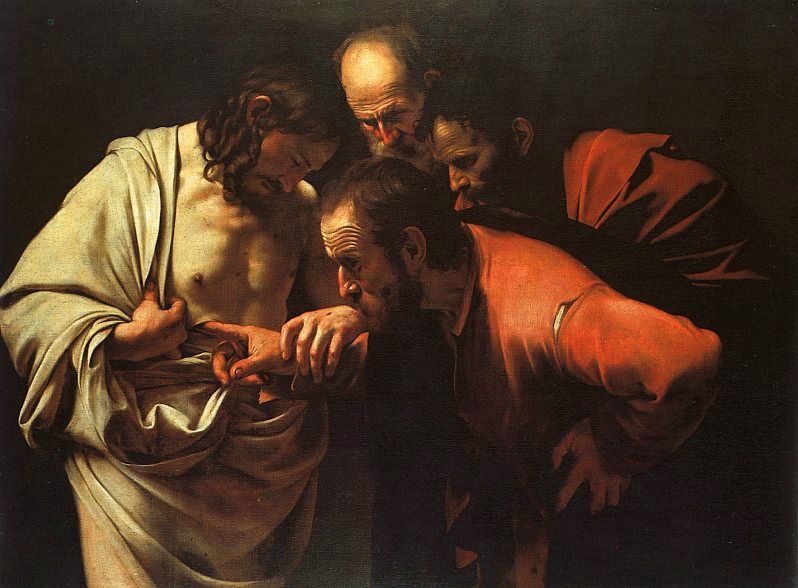
Knowing this to be an essential part of the Lord’s regular teaching to His disciples, I suppose I’d ask Thomas what he was thinking when he refused to accept the other disciples’ message. Was he actually doubting, or was he simply unwilling to accept anything other than Jesus’ own words? Of course, Jesus somewhat answers the question when He eventually visits with Thomas in the upper room after the resurrection. It’s there He encourages him, “Put your finger here, and see my hands; and put out your hand, and place it in my side. Do not disbelieve, but believe” (John 20:27).
“Do not disbelieve….”
There’s something in that phrase. In Greek, the Lord’s words are, “μὴ γίνου ἄπιστος”—do not right now become unbelieving. This is to say, “You’re heading in that direction. Don’t go any further.” Personally, that’s all the wiggle room I need for saying Thomas was not underwater in doubt. Moreover, he certainly doesn’t deserve the unfortunate (and absolutist) title “Doubting Thomas.” He had faith. It was just wobbly.
A scene like this isn’t unfamiliar to any of us. Jesus spoke similarly to the terrified disciples during the storm on the sea in Matthew 8:26. He said, “Why are you afraid, O you of little faith?” Again, His words are precise. In Greek, He calls the disciples “ὀλιγόπιστοι”—little faiths. Each of the disciples had faith. But their faiths were just beginning to sprout. They were little. How much faith does one need to be saved? Jesus has already said multiple times that whoever believes will be saved. In these scenarios, perhaps one of the lessons we learn is that focusing on quantity has the potential to be distracting. Again, did they have it or not? Yes, they did. They likely wouldn’t have slipped and slid across the boat to wake the sleeping Jesus for rescue if they didn’t. But they did go to Him. They went to the One they somehow knew could save them. The same goes for Thomas. For whatever human reasons may have been involved, he was back among the disciples (even though it didn’t make much sense to be there), fiercely demanding what Jesus had already promised. These are clues. Jacob did a similar thing in Genesis 32:22-32. He wrestled with God, demanding a blessing before he’d let God go. The Canaanite woman in Matthew 15:21-28 did, too. She nagged and pestered until the seemingly cold Jesus finally relented in the test. These people had faith. Large or small, they were moved to hold God to His promises.
In a way, by demanding the signs, Thomas was doing the same. But still, it goes deeper.
I think faith was more than stirring in Thomas because, by his words and actions, he forced out into the open the Church’s confession that Jesus had risen in bodily form. In other words, for Thomas, it would be one or the other. Jesus was either fully dead in the body or fully alive in the body. As He couldn’t be both, He also couldn’t land in between. He couldn’t be a ghost. He couldn’t have risen only in a spiritual sense. That’s not what Jesus promised. The resurrection would be physical.
Having nowhere near the disciples’ specificity concerning the resurrection, even the Pharisees understood this. For the record, the Lord never once said in the Pharisees’ presence that He’d die and rise again in the flesh. But He did say, “Destroy this temple, and in three days I will raise it up” (John 2:19). This was to affirm that they’d kill Him, and yet, He would rise from death three days later. After the Lord’s burial, the Pharisees and Teachers of the Law revealed they knew what He meant. They demanded that Pontius Pilate place guards at the tomb, saying, “Sir, we remember how that impostor said, while he was still alive, ‘After three days I will rise.’ Therefore, order the tomb to be made secure until the third day, lest his disciples go and steal him away and tell the people, ‘He has risen from the dead,’ and the last fraud will be worse than the first” (Matthew 27:63-64). Why a guard? Again, to stop a bodily resurrection. Genuine or fraudulent, that would exist at the heart of the Christian Gospel.
Even the Lord’s enemies knew it could only be one or the other.
So, what’s the difference between Thomas and the Lord’s enemies? Faith. Jesus kept His promise and visited Thomas. The disciple declared, “My Lord and my God!” (John 20:28). Even after countless eyewitness accounts, the Lord’s enemies denied Him, doing all they could to kill the message and the messengers. That’s hardened unbelief. That’s real doubt.
Today the Church retells the Lord’s resurrection, and as it does, it includes Thomas’ important role. As you listen, go easy on him. Remember, he’s a believer like you and me. Times get tough. Things get confusing. We find ourselves calling out things like, “Why are you allowing this to happen?! How can you claim to love me?!” Still, we’re calling out, right? And to whom? The only One who can hear and save us. With that, follow Thomas’ lead. Look for the wounds of Christ. Look to the cross. See the Lord’s passionate display. Look there and, as the Lord said, do not right now become unbelieving. Be empowered to go no further in that direction. And then remember, He actually had you in mind when He said to Thomas, “Have you believed because you have seen me? Blessed are those who have not seen and yet have believed” (John 20:29).
That’s you He’s talking about. That’s me, too. We were on His mind. And He called us blessed. His blessed ones are His believers. Big or little faith, believers go to the One with the gifts that strengthen faith. That One is Jesus.

 Cruciform Stuff