I’ll admit, the news of Chuck Norris’s passing ten days ago in Hawaii hit pretty hard. While I wasn’t a devoted fan of all his films and television shows, I more than appreciated him. When I was younger, if one of his movies was playing, I watched it. Because he wasn’t just tough. He was emotionlessly cool in his toughness. I’m guessing that’s why he became a kind of cultural shorthand for invincibility.
I’m sure you’ve seen or heard the jokes. Everybody has. My wife, Jennifer, has a favorite. It goes something like, “Chuck Norris is so tough, he can pick an apple from an orange tree and make the best lemonade you’ve ever had.” Jokes like that one, while ridiculously silly, certainly do laud what a tough and determined man can achieve. For many, Norris seemed to embody what winning looked like.
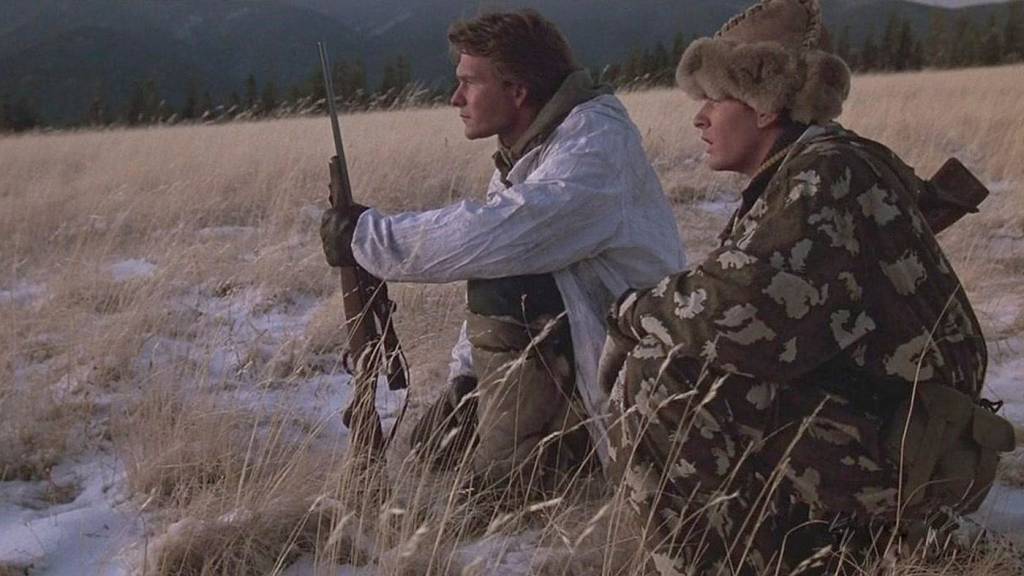
That said, I’m also Gen-X. Regardless of the current generation’s memes, we owned Chuck Norris’s myth in real-time. For me personally, legends like him, especially the ones built around genuine toughness, don’t go quietly from my imagination. While not exactly the same, I felt the same way when Patrick Swayze died. I wasn’t a fan of his later films. But no matter how many times Hollywood remakes Red Dawn, Swayze will forever be Jed Eckert, the backwater nobody who led a group of high school kids against foreign invaders. Even today, when I experience a personal victory, you might hear me whisper a subdued shout, “Wolverines!” I have a sticker on my Jeep Wrangler that does the same.
Now, before I steer too far off course, again, I was genuinely saddened to hear about Norris. In a world that admires strength, he stood as a towering symbol of it, and for all the right reasons. Not only a cultural icon, but he was also a man of conviction—open about his Christian faith and intent on living it out before the world. That matters to a guy like me. If anything, it adds depth to his legend. It’s a reminder that behind the myth of his invincibility was a man who understood that, apart from Christ, he was nothing, regardless of his worldly feats. It seems that the real Chuck Norris knew that strength, real strength, isn’t always demonstrated as we’d expect.
Considering today’s date—Palm Sunday—the point resonates. Not every hero’s entrance looks like a victory parade.
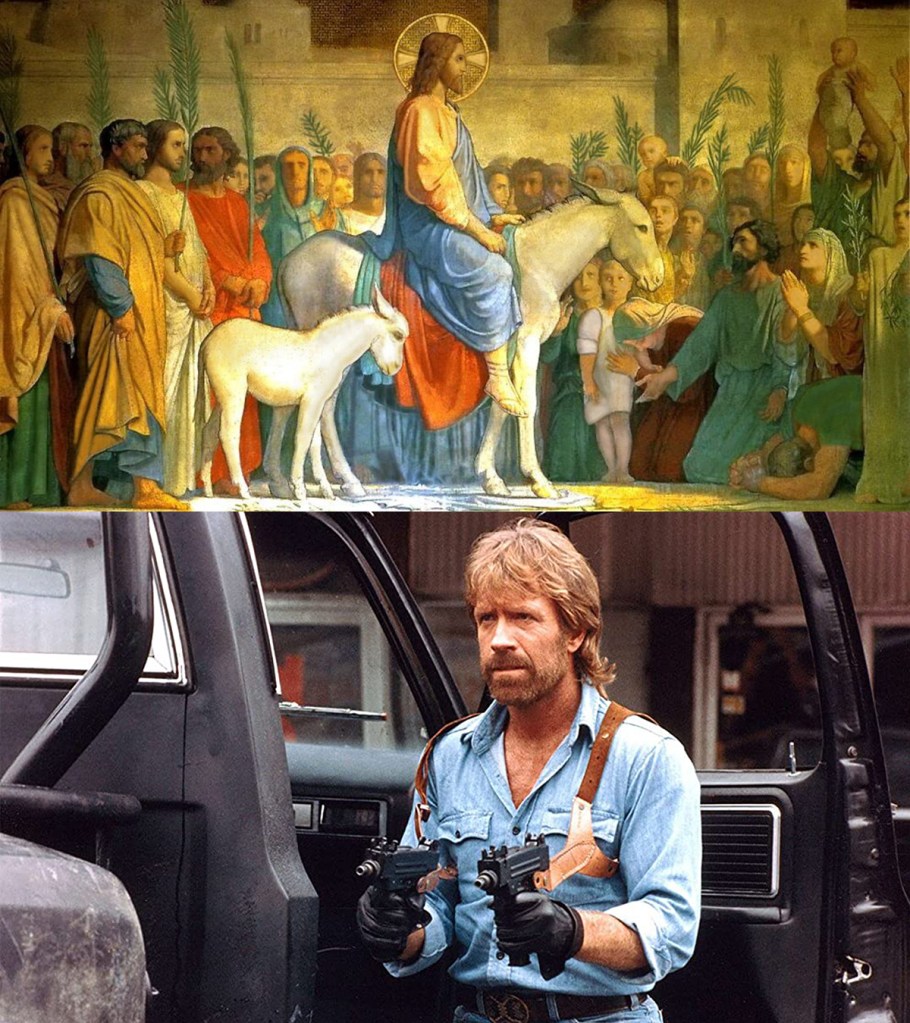
Today’s the day the Church commemorates our Lord’s ride into Jerusalem. It begins His walk to the cross. The crowd shouts. The road is paved in their cloaks. The palm branches wave. In all of this, there is, unmistakably, a sense that something powerful is happening. And yet, a donkey? Where’s the war horse? The prophetic scriptures called this particular rider humble and lowly. Where’s the physical dominance? Luke’s Gospel tells us that Jesus was weeping as he entered. That’s not very manly.
So, what’s going on here?
Well, none of these details is incidental; rather, they steer us toward a particular point. What we see is a deliberate subversion of everything we instinctively associate with strength. Kings ride stallions. Conquerors arrive to chest-rattling kettle drums and banners. But Jesus comes lowly. He’s unthreatening, at least on the surface. Everything about Him threatens this world’s powers. Still, in His humility is the better strength and authority we need. We don’t need laser lights and smoke machine spectacles. We need someone to submit Himself into the lowliest station to bear our sins and take hold of a victory we could never grasp, not even in a million lifetimes.
I guess what I’m saying is that if Chuck Norris represented the kind of strength the world instinctively understands, Palm Sunday presents something altogether different. We behold a strength that refuses to serve the self, even when it could. This is part of the tension inherent to the moment. It’s easy to admire the man who cannot be defeated. It’s harder—and far more unsettling—to reckon with the One who chooses not to win the way we expect.
I suppose this is why it was so easy for the crowds that were shouting “Hosanna!” to grow quiet—and then hostile, and then complicit in our Savior’s death. They wanted Jesus to come into Jerusalem wearing a black belt, ultimately kung-fu-ing the Romans, overturning their earthly rule. But Jesus came to overturn something deeper. The crowds wanted mortal victory. He came for eternal redemption.
I’m so glad Chuck Norris knew this. I watched an interview shortly after his death in which he told the interviewer, essentially, how his mythic toughness was nothing compared to Christ’s unwillingness to yield in going to the cross. Wow.
His inherent point was that the world actually needs the Lord’s kind of strength more than the muscle of any action star. We certainly need regular people of strength who can step into the world and take control. But we need the otherworldly kind that removes threats, settles scores, and makes things right in ways that matter for eternity. Sin, death, and the devil have us surrounded. Christ comes to our rescue. He does this by His humble submission to the cross. It looks like defeat. But it isn’t. Chris enters Jerusalem bearing the exact kind of toughness we need most. It’s the kind of toughness that’ll keep fighting even as it’s entirely misunderstood. It’s a toughness that’ll keep going, even when it’s rejected. It’s a toughness that makes its way into and through, not away from, an unspeakable suffering, the likes of which no one has ever experienced before. And ultimately, it’s a toughness that lays down its life for enemies, doing so to make them friends.
In other words, what looks like weakness is, in fact, the most unassailable strength imaginable. Perhaps more importantly, it has in mind a very simple premise. Christ, the Son of God, does not lack the power to end a world of enemies. He could obliterate everything with a wink. The thing is, He’s motivated by divine love. He has not come to destroy sinners, but to redeem them.
I should add, regardless of Christianity’s strength through the ages, what I’ve just described is the reason the cross, not the sword, has always been the defining image of Christianity. It’s not because Christ lacked strength. It’s because His strength was of an entirely different order. It’s cruciform strength. It gives rather than takes. It endures rather than escapes.
The world likes stories of men who cannot be beaten. But there’s the simple truth that no mortal man can outwit or outmaneuver death. It is, as Saint Paul said, “the last enemy” we all will face (1 Corinthians 15:26). Chuck Norris faced it recently, and like everyone else before him, could not outmuscle the reality.
But then again, in a sense, Norris did outmaneuver it. Well, he didn’t. But his Lord did, and by Christ’s strength, just as Norris believed by the power of the Holy Spirit through the Gospel, he was not beaten. Death had no final say for Norris because it had no final say for Norris’s Lord. That must be the last word here.
Action movie legends like Chuck Norris are strong in so many ways. They can take on armies carrying two Uzis and donning perfectly feathered hair and a well-groomed beard. But in the end, there’s only ever been one kind of strength that could carry the weight of this world’s sin. Behold, he comes to you, “righteous and having salvation is he, humble and mounted on a donkey, on a colt, the foal of a donkey” (Zechariah 9:9).
 Cruciform Stuff