It Will Never Happen

I had an interesting conversation with the 7th and 8th graders in religion class this past Monday. With Advent on the very near horizon, the season that will inevitably carry us to Christmas, we wrestled with whether or not Herod’s slaughtering of the infants in Bethlehem was a part of God’s plan. It’s a good question to ask, especially following Michigan’s recent election, one that enshrined infanticide in Michigan’s Constitution. In utter disbelief, people are asking, “Why would God do this?”

This, too, is a worthwhile question, primarily because Saint Matthew shows God’s engagement throughout the Christmas events by quoting from the Old Testament four times. Doing this, the Gospel writer stirs a sense of divine orchestration, especially as he remembers certain things revealed to God’s prophets. The slaughter of the innocents is one of them. Matthew tells of Herod’s troops storming Bethlehem, and as he does, he points to Jeremiah’s description of the scene six hundred years prior. It’s a dreadful one describing torrential tears, the piercing sounds of unrestrained wailing, and in between each gasping cry, a mother—Rachel—pushing back against any human words of consolation (Matthew 2:17-18).

In other words, Jeremiah knew a moment would come when the sound of inconsolable mothers would haunt a city and its surrounding hillsides. Matthew stakes the claim that this disturbing vision was relative to Christ’s birth and fulfilled in the slaughter at Bethlehem. But because God revealed this to Jeremiah so long ago, does that mean God planned and enacted it?

The answer is no. I’ll get to the reason in a moment.

The current effort in my religion class is the study of hermeneutics—the “how” of interpretation. As you can imagine, hermeneutics is taking us anywhere and everywhere in the Scriptures. It’s also taking us into what we read and hear in our culture. I do this with the students because language matters. Narratives matter. The intentions inherent to these things matter. They must be interpreted. When the broader horizon of genre, speaker/writer, context, history, and so on can be thoroughly examined, a person is better equipped for discernment leading to genuine wisdom. Simply applying hermeneutical principles to Proposal 3, its dreadfulness was easily detected. Teaching the students to do this is essential. The children who can do this as adults will be the ones worth trusting with critical things.

As far as the answer to the question, again, it’s no. God neither designed nor intended for all those children to die. It happened because that’s how things work in our appallingly corrupted world. Sin has a blast radius, and no one—innocent or guilty, good or bad, believer or unbeliever—is beyond its temporal effects. Therein is the interpretive key to the question’s answer, as well as the key to its relevance for us today.

Forget God’s foreknowledge for a second. While you’re at it, stop ascribing to Him authorship of everything that happens. Instead, remember what He said at the very beginning. His words to Eve and the serpent communicate His direct action. To Adam, however, His tone changes. He speaks in a resultant way, saying that because of what Adam has done, the ground is now cursed (Genesis 3:17). In other words, from now on, life will be harder, and bad things will happen. That’s the way it works in a world infected by Sin. Did God want this for His creation? No. Did He plan it? No. Matthew expresses this same theology through each clause before the four Old Testament quotations. Essentially, he uses two kinds—a purpose clause and a temporal clause. Before the reminder from Hosea 11:1 that the Messiah would come out of Egypt, Matthew uses a purpose clause (ἵνα πληρωθῇ), which comes to us as “This was to fulfill…” (Matthew 2:15). This is to say God acted in this instance. He planned it this way. Before Jeremiah’s foretelling of the Bethlehem tragedy, Matthew uses a temporal clause (τότε ἐπληρώθη), resulting in, “Then was fulfilled…” (Matthew 2:17). While the time in Egypt was divinely orchestrated, the events of Bethlehem happened because the world is now corrupt. Because of what we’ve done, this world will now produce Herod-like devils—people like Gretchen Whitmer and Dana Nessel who rejoice at the death of children, telling all to “celebrate December 23rd” because that’s the day abortion will officially be written into the Michigan Constitution. These are the kinds of celebrations Sin produces.

By the way, I find it interesting that the amendment birthed by Proposal 3 will be added to our state’s founding document the day before Christmas Eve. The devil is good at spitting in your eye right before poking it out.

Still, God knows all of this. By His omniscience, He sees these things coming. Did He ordain them? No. Again, Genesis 3:17 nudges us toward recalling that we’re responsible for letting these monsters loose in Bethlehem. The blame for Sin’s insatiable appetite for misery rests squarely with us, not God. Of course, we don’t like to hear that. And why? Because we are ones who, as Shakespeare mused, “make guilty of our own disasters the sun, the moon, and the stars.” In other words, we’re inclined to blame anything and anyone, even God, rather than accept the simple truth that tragedy’s guilt is ours alone to claim.

The only real blame we can genuinely lay at God’s feet is best placed at the foot of the cross. We can blame Him for doing what was necessary to fix the Sin problem. The death of Jesus is God’s beautiful crime—the absolute innocent One being sentenced to death for the dreadfully guilty.

So, what do we do now?

By the Holy Spirit’s power, we believe this Gospel. Recreated by this Gospel, we continue to stand against Herod while at the same time doing everything within our power to rescue the little ones from his bloodthirsty troops. I was recently asked on three separate occasions what this “standing” might look like in a future Michigan. The first thing that came to mind in each was something I’ve experienced before.

A few years ago, I happened to be visiting my friend, Pastor Stephen Long (now with the Lord), in the emergency room. A few stalls away from us was a robustly pregnant girl—a brave teenager who’d long ago chosen to keep her child. We didn’t know the details of her visit to the ER, but everything we heard through the curtains—the shuffling and crying and confusion—all of it communicated something traumatic. The sounds also reminded us just how overwhelming the terror inherent to any harrowing moment could be. It affects our emotions. It can shatter our wits. We can react in ways we might regret later. Listening in, Stephen and I prayed for the girl and her unborn child.

Now, let’s imagine that scene in today’s Michigan. Let’s say the trauma the girl experienced resulted in her healthy child being born prematurely. Let’s say it also resulted in the terrified and confused girl changing her mind. According to Michigan’s Constitution, if, in the middle of the traumatic scene, the young girl sees the child and decides she cannot be a mother—that she doesn’t have the mental or emotional fortitude required to raise the child—regardless of the stage of pregnancy, and also because the child likely needs extraordinary medical attention to survive, the newest constitutional amendment leaves room for the mother and the physician to choose to let the otherwise healthy child die. Let’s say I’m listening through the curtain to the terrible events unfolding. Let’s also say that I hear and understand what’s about to happen to the child, that she will be left for dead. Make no mistake. It would be time to take a stand. In my case, I would unhesitatingly walk into that stall, take the child into my arms, and walk out. If need be, I’d fight off security guards, nurses, or anyone intent on obeying the new amendment. I assure you I’d do this, ultimately letting the chips of my legal future fall where they may. I would not let that child die, no matter the legal boundaries of the situation.

Plenty of folks say these types of scenarios won’t occur. Well, whatever. Many people said the Supreme Court would never cement same-sex marriage. And yet, here we are, five years beyond the cement’s pouring. Here we are expecting the U.S. Congress to pass the “Respect for Marriage Act,” which will pour a permanent layer of concrete onto what “will never happen.”

Heaping condescension, ridicule, and disbelief upon those concerned for these things is almost always proven foolish.

As far as the Emergency Room scene I described, MLive published an article on November 11 entitled “The abortion rights and potential legal fights coming after Michigan’s Prop 3 won.” In it, Robert Sedler, a law professor at Wayne State and an avowed abortion advocate, mocked the pro-life movement’s concerns about such possibilities. He called them “nonsense.” And yet, the article’s equally progressive author, Ben Orner, commented that the “amendment allows lawmakers to regulate after ‘fetal viability,’ according to its text, when the attending physician believes ‘there is a significant likelihood of the fetus’s sustained survival outside the uterus without the application of extraordinary medical measures.” In other words, protection laws only apply if the doctor determines the child can survive without assistance. Orner caps this by quoting Sedler, again, writing, “The idea is that abortion is only prohibited when a doctor determines that the fetus is viable, capable of living outside of the uterus.”

Three things. Firstly, before taking action to preserve a healthy child’s life, the doctor must affirm that the child can survive outside the womb without extraordinary medical help. What does this mean? What are the boundaries? My 13-year-old daughter has Type 1 diabetes. She cannot survive without extraordinary medical care. Secondly, “when the attending physician believes” is a subjective statement. For every physician who believes one thing, five others believe something different. But objectively, even rationally, a physician’s oath is to do no harm—to provide treatment to the ailing, to preserve life rather than end it. Thirdly, I agree with Sedler, who said the amendment’s language isn’t complicated. It’s deliberately open-ended to allow for as much “reproductive freedom” as the state can provide. The law’s subjectivity is intentional. Now, will most humans in our midst choose to abandon the helpless child I described? Hopefully not. But remember, the ground is cursed. It produces Herods—monsters who write laws providing opportunities to those who’d be happy to let the child perish.

“Nonsense. It will never happen.” Those are the most notorious of all last words. It has happened. Now it will happen beneath the protective banner of the law.

I didn’t share this particular MLive article with the 7th and 8th graders during religion. But I do share articles like it. Maybe I’ll share this one. Either way, we apply hermeneutical principles to what we read. Relative to Matthew 2:13-18, these principles helped the students to dig deeply in search of objective truth. They learned where and when God acts, what He ordains, how He operates in and through His Word, the difference between His revealed and hidden wills, and so much more. In one sense, it was a refreshing discussion for me, especially as I continue to wrestle with accepting whatever God is allowing to occur in America. In another sense, and considering the answers given by the students along the way, the conversation was proof that the 7th and 8th graders at Our Savior are becoming capable of navigating America’s shaky future. Again, the recent elections in Michigan resulted in quite a few Herod-like individuals taking office and arming their troops for grim ungodliness. Was God behind this? Mindful of God’s Word, knowing what I know, you’ll never convince me that He was, not even by pointing to God’s employment of ungodly rulers in the Old Testament or by dropping Romans 13 in my lap. God did not and does not purposely establish or license authorities to exist in contradiction with His will for governance. He does not ordain for governments to murder their citizens. Human beings are the ones who scribe and sign such licenses.

The students are learning to discern these things. God willing, they’re also learning they need to step up and be what God has created them to be, if only for the sake of their children. I believe they’re on their way to being this, and in that sense, I leave class comforted, knowing God will use them—deliberately—for His good purposes.
God Will Let It Slide, Right?

I’m reminded of something my daughter, Evelyn, said to me on our way to the school this past Thursday morning.

Folks in Michigan will recall that Thursday was quite the sunny day. Even at 6:45am, which is when Evelyn and I set out for the day, the sun was already well above the horizon. Turning east out of our subdivision, the sun’s beams poured through the windshield, filling the car with its glory. It felt good—the warmth on my face in crisp distinction from the chill just outside my window. Even as it was somewhat blinding, before feeling the need to adjust the sun visor, its first stirring was that of happiness.

Surprisingly, Evelyn grumbled.

“I don’t like the sun in my eyes,” she said, scooting up in her seat and reaching to adjust her visor.

“I love it,” I replied, my visor still tucked neatly above the windshield. “It feels good.”

“I don’t,” she countered. “It’s too bright.”

“Well,” I added, “we probably shouldn’t complain about it, especially since we’ve been longing for days like this all winter.”

Evelyn didn’t respond, but I could tell she was reconsidering her position.

Certainly, I understood her frustration in the moment, especially since I was piloting the vehicle. For as much as I enjoyed the sun’s resplendence, I needed to be able to see, and the sun was making that a little more difficult. Still, the last thing I ever want to do is lie to myself, expressing any dismay at all for something I’ve been waiting more than a half-year of mornings to enjoy. In my eyes, or wherever, the sunshine was a welcomed guest to a long-suffered winter.

Tapping away at the keyboard while recalling this circumstance, I suppose there are plenty of lessons within it to be learned by it. Although, I can’t think of one in particular.

Okay, how about this…

Looking back at what I just wrote, the lesson that seems most prominent is the foolishness found in lying to oneself.

One of the worst things that anyone can do is to lie to his or herself. And it’s not necessarily the lie itself that holds all the danger, but rather the potential for becoming so convinced by your own deception that you willingly exchange truth for untruth. This reminds me of a video of Joe Biden from 2015 I watched this past week. It was a quasi-interesting twenty minutes of Joe sitting before a fawning reporter and cameraman and doing what Joe does, which is to wear a triangular smile while rambling incoherently. And yet, during the purgatory-like segment of softball-question nonsense, there was something Joe spoke about with relative unequivocalness. I ended up posting something about it on Facebook. Here’s what I wrote:

“I just watched a portion of a video of Joe Biden from September of 2015 in which he attempted to describe the authenticity of his Catholic faith. Barely a few minutes into his plastic words I had a thought. To be a liar is one thing. To be a sincere liar is something altogether worse. Or as Shakespeare mused through the character of Hamlet, ‘One may smile and smile, and be a villain.’”

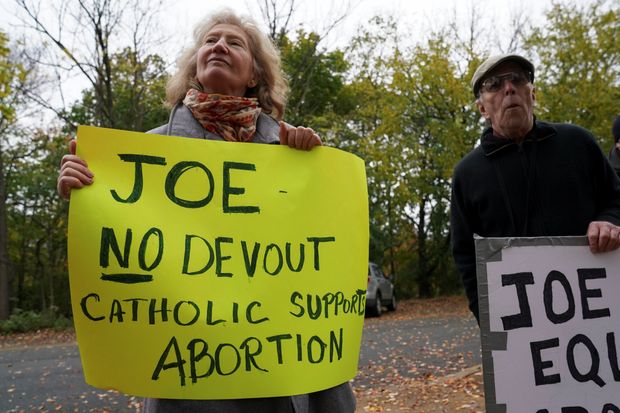
The point behind this comment relates to ongoing news of several Roman Catholic bishops around the country and overseas pushing for Joe Biden to be excommunicated. They’re doing this because Joe claims that one can be a Catholic and be pro-choice—and not just the “safe but rare” kind that the Democrats proffered back in the 80s, but rather the kind that goes right over the cliff into believing abortion (in all of its grisly forms) is a gift from God, and even worse, that full-term abortion is something upon which God dotes with an similarly triangular smile.

Do you know what full-term abortion is? If you guessed a full-term newborn child being killed immediately after delivery, then you guessed rightly. The President of the United States—your president—believes such a thing is holy.

Of course, I expect the nominal Christians to come out of the shadows to say I’m misconstruing his position, that he only supports it in this or that special circumstance. These folks will say this because, well, they voted for him, and like him, they aren’t necessarily using the lens of God’s Word for discerning these things. Well, whatever. Use whichever intellectual dance moves you prefer for avoiding the visceral fact that the President of the United States has given a thumbs-up to doctors delivering and then murdering newborn children if in such a moment a mother decides she doesn’t want her child.

But let me take a brief step backward to where this started.

As a Christian, the only way to arrive at an acceptance of the pro-choice position, no matter the justification, is to lie to yourself about a great many things. It is to lie about what life is and means. It is to lie about life’s Author. It is to lie about what that Author said with regard to human dignity and the truest definition of personhood. It is to wield the Word of God in deceptive ways, and ultimately by such handling, to summarily reject it, whether the one wielding it realizes it or not. Lastly, it is to be caught in the dilemma that to reject the Word of God, by default, is to reject the Word made flesh, Jesus Christ.

You cannot stake a claim in Christianity and reject the Savior who sits at its heart. It just doesn’t work. Thankfully, there remain plenty of Bishops in the Roman Catholic Church who are willing to enforce this basic doctrinal premise.

I wrote and posted something else this past week that comes to mind, too. It had to do with an article from The Federalist entitled “Lockdown Mongers Can Point Fingers, But The Science Is In: They’re To Blame.” By the way, one of the two senior editors at The Federalist is a biblically astute LCMS Lutheran, Mollie Hemingway, whose father is a Confessional Lutheran pastor. I should add that The Federalist has several LCMS writers on its roster of contributors, and in my opinion, that alone makes it one of the few political/cultural news sources out there to be trusted. Anyway, here’s what I wrote when I posted the article:

“The devil has plenty of instruments in his bag, but deception is the glove he wears for wielding each one.”

Again, the point here was to say that there are plenty of tools in the devil’s toolbox for drawing us into Sin, things he uses for convincing us to believe and do the wrong things. But before he goes about his darkly deeds, his grip on each instance begins with deceptively enticing half-truths.

“Sure, I know it’s against God’s Word for me and my girlfriend to live together before marriage,” the young man says, “but it makes good financial and logistical sense to do so. I figure that as long as we have the intention of getting married, God will let this one slide.”

Don’t lie to yourself. Repent.

“It makes perfect sense that the churches are closed,” the husband and wife contemplate over Sunday morning coffee. “The science says that mass gatherings for worship are sure to be super spreaders of the virus. The Church can ‘love thy neighbor’ a lot better by masking up and staying home.”

Don’t lie to yourself. Repent.

“Certainly I’m justified in speaking poorly about that person to others,” she muses. “How could I be wrong in doing so? My friend hurt me, and I need the emotional support from other friends who understand. The only way to get the support is to tell others about what happened.”

Don’t lie to yourself. Repent.

To knowingly persist in such behaviors unrepentantly, having exchanged the truth of God’s Word for lies, won’t end well. Still, the devil will work to convince you that it will. He may even do it in ways that sound pious, kind of like Adlai Stevenson’s infamous words given in jest: “A lie is an abomination to the Lord, and a very present help in trouble.”

Again, I don’t want to lie about the sunshine and say I don’t like it. I love it, even when it’s uncomfortably shining in my eyes. It’s the same here. Don’t be fooled. Stick to the truth of God’s Word, even when it’s uncomfortable to do so. No matter what happens, you’ll have the certainty of real truth. You’ll be traveling along the stepping stones of faith cut from God’s reliable quarry. Along the way, you’ll know and understand the gravity of your Sin—your very REAL Sin—and you’ll know the One who came to forgive you of that Sin, to recreate you by His wonderful love, and to send you out as someone capable of beaming the refreshing and face-warming sunlight of His love in a wintry world of Sin longing for the rescue of a divine summer.

It’s Jesus’ Story to Tell

I was thinking about a social media exchange regarding the theological abilities of our nation’s new President that I participated in this past Saturday after our congregation’s annual “Getting Organized” meeting. But before I share its importance with you, I should probably start with a different conversation that occurred earlier in the week. I hope you’ll bear with me. I think it fits.

I had an interesting conversation with a group of students in my 7th and 8th grade religion class last Wednesday. Knowing that far too many folks these days appear to interpret the Bible according to some pretty messed up criteria, my goal this semester has been to walk the students through the process of completing an exegetical study.

Essentially, I’ve divided the class into two groups. One group is wrestling with Mark 10:46-52 (the healing of Bartimaeus, the blind beggar), and the other is handling Luke 10:25-37 (the Parable of the Good Samaritan). Both groups are tasked with studying from at least four different English translations of their assigned text (I’m helping with the Greek if they discover the need to dig deeper). They are to be concerned with discerning keywords, studying context (genre, writer, major and immediate sections, and the like), exploring parallel texts (which includes non-canonical resources), and so much more, all with the hope of exposing the primary purpose and meaning of the portion of God’s Word they are to be handling.

Pedagogically speaking, I’m not a big fan of small groups in an academic setting. I’m not convinced it’s the best way to learn. Still, I went against my own rule and gathered the students into groups according to their respective texts in order for them to discuss with one another the particular keywords they’d each discovered and were considering for his or her exposition. I hovered closely among the two groups.

For the most part, and interestingly, the students gravitated toward many of the same words. On occasion, however, one or two students would suggest the importance of a word that none of the others had considered. I was glad for that. I could go into greater detail as to why, but rest assured from their discussion, it was proof to me that they were really digging in and taking the assignment seriously.

At one point along the way, I suggested to both groups that they try to imagine themselves as onlookers to the situation, paying close attention with the mind’s eye to the visual flow of events. When they took time to do this, other aspects became visible.

With respect to keywords, an example of an obvious one from the Luke 10 text was the NIV’s term “expert in the Law” in comparison to the ESV’s rather simple descriptor “lawyer.” That’s an easy one. Does the difference matter? Maybe, maybe not. Either way, the students are going to figure that out. But when they placed themselves as observers of the conversation unfolding between Jesus and the expert in the Law, a few of the students noticed almost immediately a very strange shift. On the surface, Jesus seemingly commended the lawyer in verse 28 for giving the right answer to his question. “You have answered correctly,” Jesus said. “Do this and you will live.”

That’s great, right? Who wouldn’t want to be commended by the Lord? But in the very next verse, the lawyer appears to cop an attitude, feeling the need to justify himself, as if he’d somehow been insulted.

So, what happened?

One student in the bunch took the lead in the hunt for an answer. Eventually, he circled back around to the Lord’s reply to the lawyer, guessing that it was either the way the Lord said what He did (which we can’t necessarily determine His tone), or something wasn’t quite getting through in the English translation. Ultimately, he focused on the Lord’s words, “Do this and you will live,” because that seemed to be the critical moment of engagement in the Lord’s commendation. After a little more discussion, “Do this” became the student’s sole focus.

And that was it. In the Greek, the verb reveals the Lord’s insinuation that the lawyer, a man who thought he was keeping the Law of God perfectly, hadn’t been performing in the way he believed himself to be. “Do this” meant that if perhaps he actually got started right then and there, he might discover eternal life. Of course, that was a short, but loaded, reply to the lawyer’s self-righteous answer. To gain eternal life by way of keeping the Law is impossible. No one will pave their way to heaven with deeds. Jesus knows this. That’s why He came. But the lawyer was under the impression that he, an expert in the Law, was doing a pretty good job at actually accomplishing it. Jesus pointed out in front of the massive crowd that the show-off’s expertise in this regard was clearly lacking.

In short, here was a man whose trust for eternal life was located in himself, and the Rabbi he was challenging in that moment believed he was failing desperately at it. Like everyone else in the crowd, the lawyer needed a Savior.

This offended him. It embarrassed him, too. That meant he needed to do something to justify himself in order to regain his previous standing before the onlookers.

Knowing this particular detail in the exchange completely changes the trajectory for the Parable of the Good Samaritan. My guess is that most interpret the parable apart from this introductory text, and when they do, it becomes little more than a Sunday School story about how Jesus wants us to be good to others. But if we’re going to handle it honestly, that’s not why Jesus told the parable. The purpose of the parable is to point out how we fail, and by doing this, He’s putting before us the opportunity to admit we actually need a Savior. The astonishing part to this is that when we actually know the Lord’s real reason for teaching the parable, and then we dig into the parable itself, we may actually see the Gospel woven into its fabric. In other words, Jesus laid some gut-wrenching Law on us, but He didn’t leave us without hope. For the expert in the Law, Jesus foreshadowed the work of the Messiah—Jesus’ approaching work to accomplish our rescue—which is to say that He told the story of us and Himself.

He described someone who’d been pummeled and left for dead, and unless the wretch received help, his permanent end would be inevitable. That’s us. Sin has more than seen to this. Fascinatingly, the well-known animosity between the Jews and Samaritans is a hint to the vastness of the chasm that separates Man from God. And yet, the fact that the dying man’s chief enemy, a Samaritan, is the one who helped him is a glimpse of our Lord’s crossing over that divide in order to save us. As the story unfolded further, the scene became even clearer. The One who would be our enemy, rather than leaving us in our predicament, came down into the valley of our sorrow to be with us, to reach to us in love. He bandaged up our wounds, took us to a place where He arranged for our care, and then He promised to return to settle all accounts.

Sounds familiar, doesn’t it? It’s an image of the Lord’s incarnation all the way through to His return at the Last Day, with the in-between time being His wonderful work to rescue, forgive, and sustain us as His people.

I expect that the students assigned to this text, with a little more recalibrating of their exegetical lenses, are going to discover these gems in the text for themselves. But as I mentioned at the beginning of this note, I suppose the reason I was moved to share this particular moment from my 7th and 8th grade religion class with you is because of a conversation I had on Saturday with a Christian who felt the need to defend Joe Biden’s supposed “devout” Catholicism. One tritely employed phrase that was used during the conversation (and I say “tritely” because far too many Christians believe this): “Well, you interpret the Bible one way, and Biden interprets it another way. Maybe he doesn’t accept parts that you do. That doesn’t necessarily make him wrong.”

Puke.

God didn’t give us His Word so we could do whatever the heck we want with it, picking and choosing this or that portion, ultimately making it say whatever we feel like making it say. It is divinely inspired, inerrant, and immutable—and with that, there are intentions behind every single Word. If you don’t believe this, not only will you never be able to secure a faithful interpretation, but in the end, you’ll see it as having very little value to begin with. When this happens, you’ll have become no different than the self-righteous lawyer in Luke 10 who felt he had no need for Jesus, because after all, Jesus is the very Word made flesh (John 1:14). If you reject the Lord’s Word, by default you reject Him. That leads to big trouble. Eternal trouble.

I doubt our new President will ever allow a faithful pastor thirty or forty minutes of his time to exegize alongside him some of the Biblical texts he believes give license for murdering babies in (and out of) the womb, for allowing men who think they’re women to compete in women’s sports, or so many other ungodly ideologies. In fact, I know he won’t do this. He’s already verbally condemned the catholic bishops who’ve said he should be excommunicated for his radical handling of God’s Word in these particular arenas.

In the end, I guess I’m just going to continue to work with what I have—which means doing what I can to teach the students in the 7th and 8th grade at Our Savior Evangelical Lutheran School in Hartland, Michigan, the powerful contents of God’s Word. And as I do this, I’m going to do what I can to help carry them into a love for Biblical study, one that continues into adulthood. God willing, it’ll be a love that sees the value in taking time to wrestle with what God’s Word actually teaches, rather than relegating it to a thin scan and the shallow realm of “What does this mean to me?” as so many Christians are in the unfortunate habit of doing.