

A Shelter, Fortress, and Resting Place

Near the end of the Lutheran marriage liturgy, a prayer is prayed. Technically, three prayers are prayed. The first is for the groom and bride. The second is for all marriages and the homes they produce. The third is the Lord’s Prayer. The prayer I’m thinking about right now is the second prayer. It reads:

“O God, our dwelling place in all generations, look with favor upon the homes of our land. Embrace husbands and wives, parents and children, in the arms of Your love, and grant that each, in reverence for Christ, fulfill the duties You have given. Bless our homes that they may ever be a shelter for the defenseless, a fortress for the tempted, a resting place for the weary, and a foretaste of our eternal home with You; through Jesus Christ, Your Son, our Lord, who lives and reigns with You and the Holy Spirit, one God, now and forever. Amen.”

I suppose the prayer comes to mind for a few reasons. First, my son, Joshua, and his fiancé, Lexi, will start their premarital counseling classes with me soon. Anyone who wants to be married in this congregation must take these classes. Being related to the pastor provides no exception. Of course, I did offer to step aside and let someone else do it. Nevertheless, they insisted that I be the one, and I’m happy to help.

Perhaps the second reason is that very soon, two longtime and beloved members of this congregation will celebrate their 65th wedding anniversary.

Wow. Sixty-five years.

We can all admit that such marital spans are almost unheard of today. Not necessarily because it’s sixty-five years, but because marriage has more or less become disposable. Before I continue, I should say right away that I appreciate the folks who work hard to preserve marriage, especially those whose marriages may have been undone by divorce. It’s a sensitive subject, I know. Still, I commend the ones who did as their Lord required. They endured a proverbial meatgrinder, pursuing every avenue to preserve the sacred bond. Emotionally thrashed, they didn’t give up, even when they had the biblical license to do so. They kept their eyes fixed on what God said was better. They’ve more than demonstrated their verve as spouses. They’ve more than proven their desire for a home described by the above prayer, one that is “a shelter for the defenseless, a fortress for the tempted, a resting place for the weary….”

I suppose these things relate to another reason this prayer came to mind. Each time I’ve prayed it during the marriage liturgy, I’ve been moved by the words. In a sense, it isn’t necessarily describing a perfect home, but instead, the kind of home produced by marriage to a perfect friend. Or maybe a better way to say it would be the home God makes possible when He pairs a person with a genuine best friend.

For as uncertain and cruel as so many circumstances and relationships in this world can be, in marriage, God provides that one unfailing friend with whom to endure all of it. “It is not good that the man should be alone” (Genesis 2:18). God was right. Speaking from experience, my wife has been a reliable shelter whenever I’ve needed refuge from the pelting world. Through times of seemingly endless attacks, Jennifer has been a fortress. Through one exhausting event after another, going home to my bride has been the fulfillment of promised rest.

I’ll bet if I asked the folks who’ll be celebrating their sixty-fifth year of marriage about these things, they’d likely agree.

Now, don’t get me wrong. Even the best marriages aren’t perfect. Whether one day or sixty-five years into the marriage, trouble is likely to appear. There’s a saying that few men or women are so perfect that their spouses do not regret marrying them at least once daily. Maybe that saying bears a little bit of truth. Humans are born sinful. I can promise that I give Jennifer plenty of reasons for strapping me to a golf tee, pulling out her driver, and thwacking me into the woods. Of course, I’d never say the same thing about her—at least, not in print. (I’d likely need a sand wedge with her.) Still, with the Lord’s promised grace enveloping a marriage, the kind born from the person and work of Jesus Christ—a divine grace that immerses both the husband and wife in a tidal wash of daily forgiveness—not even the worst of marital catastrophes can parch such a relationship, let alone the annoyances that plague one day to the next.

This is what the above prayer means when it talks about being embraced in the arms of God’s love. It’s a good prayer. Of course, it stands in the shadow of the greatest prayer: the Lord’s Prayer. The Lord’s Prayer says all this and more, especially when you consider that everything it asks passes through the hope-filled words “Thy kingdom come, Thy will be done….” If you’re familiar with Luther’s explanation in the Small Catechism, then you know that to ask for God’s kingdom to come is to pray that “our heavenly Father gives us His Holy Spirit, so that by His grace we believe His holy Word and lead godly lives….” To ask, “How is God’s will done?” is to hear Luther reply:

“God’s will is done when He breaks and hinders every evil plan and purpose of the devil, the world, and our sinful nature, which do not want us to hallow God’s name or let His kingdom come; and when He strengthens and keeps us firm in His Word and faith until we die. This is His good and gracious will.”

A marriage rooted in God’s mercy delivered by His Gospel Word for faith rests in the Savior’s wonderful embrace. His protective care is a sturdy bastion capable of withstanding the devil’s terrible assaults. This is true not because the spouse He gives in marriage is perfect but because the Lord is. With Him, a marriage has everything it needs. With Him, sixty-five years with the same person becomes an immeasurable life-long joy shared with a best friend.

Sometime, Just Sometimes

Considering that today is Reformation Day—a day marked by actions resulting in events that changed the course of the entire world—I suppose I’ll just go ahead and put this out there to see what happens.

I sure am glad that Martin Luther didn’t just pray for his enemies, but that he actually fought back, having engaged them in ways that eventually stopped the wheels of a dreadful machine intent on stripping humanity completely clean of the Gospel of salvation through faith in Christ alone.

Thanks, Martin, for reminding us that there’s more to Christian faithfulness than prayers, pious intentions, and potlucks. Thanks for showing us that sometimes—just sometimes—blades need to be sharpened and armor needs to be fastened as battle lines are drawn against the cosmic powers aligned in opposition to Christ and His Church.

Allow me to keep going.

I suppose while I’m sharing these things, I’ll add that I’m glad David went toe to toe with Goliath instead of staying home and figuring that God would sort it all out in His own way (1 Samuel 17). And speaking of this same future monarch, I’m glad the prophet Nathan was willing to risk his own life to confront King David regarding his murderous affair with Bathsheba. I imagine a prophet facing off with a king would be quite the sight.

I should say I appreciate the trifecta of Shadrach, Meshach, and Abednego. When King Nebuchadnezzar imposed mandates that stripped away their religious liberty, they stood against him. Indeed, rather than simply—and much more easily—excusing themselves from faithfulness by saying it was their duty to obey the governing authorities, they demonstrated a better sense, one proving that sometimes the government is genuinely honored when it is resisted (Daniel 3:1-30).

I’m sincerely thankful for John the Baptist’s exemplary stand before King Herod, namely his unequivocal devotion to God’s moral and natural law in relation to marriage. Too many clergy believe it isn’t their place to deal in such things. Sure, they give their theological reasons. And they sound really smart, too. Personally, I think it’s because they’re scared. And why wouldn’t they be? They know, just as John knew, that their actions might spell their end (Mark 6:17–29).

Oh, what will it profit a man if he gains the whole world and forfeits his soul (Matthew 16:26)? I’ll say this can start when a person gets over his or herself.

Let’s keep going.

I’m grateful that Saint Peter finally put his often misplaced boldness to a better use, having told the Sanhedrin to go fly a kite when they attempted to strip the Apostles of their freedom to preach and teach the Gospel. “We must obey God rather than men,” Peter said, so dryly, and yet so robustly by faith (Acts 5:29).

I really appreciate Saint Paul. For example, right after Saint Paul and his fellow missionary, Silas, had been unjustly beaten and thrown into prison, once the treachery to their rights as Roman citizens was discovered, rather than letting their persecutors off the hook, Paul demanded they be paraded through the city in their shame (Acts 16:35-37). I don’t know if such scenes in the Scriptures are supposed to make me smile, but admittedly, this one does.

Even better, while standing before Festus, instead of accepting what seemed to be the inevitable fate of the “little man,” Paul refused to go quietly into the night, as the poets would say. He worked the system, appealing his rights as a citizen before Caesar, rather than sheepishly shrinking into the easier assumption that he was outclassed and done for, relegating his fate to the simpler hope that God would just have to handle it (Acts 25:9-12).

I suppose lastly, I’m also quite fond of the fact that Paul wasn’t beyond calling out the Church’s enemies by name in his Epistles, effectively neutralizing particular characters’ attempts to corrupt or destroy the Gospel both in public and private (1 Timothy 1:19-20). In other words, move in ways that hinder or pervert the people of God and the Gospel for faith and Paul won’t hesitate to make you famous.

I’m not sure if it’s a good thing, but that, too, has the potential for making me grin.

Now, please don’t misunderstand. You should pray for those who are enemies of the Church, offering regular petitions to God that He would change their hearts. This means laboring in love for them, not only trusting that God will keep His promises to work things for the benefit of salvation, but also bearing in mind that you, too, were once at enmity with your Creator, and yet He loved you enough to redeem you by the life, death, and resurrection of Jesus Christ. It’s by His sacrifice that Christians have real peace, and as a result, they’ve been recreated to desire peace with their foes. Still, having said all of this, I sure do appreciate Amelia Earhart’s practical observation, which offered, “Courage is the price that life exacts for granting peace.” I think she was right by these words. And the examples from God’s Word I described above are proof. They remind us we shouldn’t step from the Gospel assuming that the postures of a bowed head or a turned cheek will be all that’s required when engaging with the world around us. There may be times God shows His love for the world through you by putting you out in front of a giant. It may be that He expects you to take an uncompromising, and quite possibly a personally damaging, position against a bully. He may expect you to be a shield for Christian liberty. He may lead you into an unexpected fray to speak a firm word to a liar, or expose a shameful parade of fools, or publicly decry false theology, or call someone out by name who must be marked and avoided by others.

He may require that you demonstrate genuine honor for the government by resisting it.

In short, faithfulness to Christ may mean stepping up. It may actually mean getting in the way of the Gospel’s enemies and doing what you can to crush them. Yes, crush them. It may mean warring against them, not only to bring their godless ways to a halt, but to do so through deliberate actions that confuse their efforts, threaten their power, and eventually retake the fields they’ve seemingly conquered.

As a side note, clergy who preach against this—or do what they can to get in the way of Christians engaging in these ways—are wrong, and they should be told as much. Perhaps at a minimum, they need to read Saint James’ Epistle in its entirety, being sure not to skip over the more uncomfortable portions describing the loveless spirit that would say to a person in need, “Be warm and well fed” (James 2:16). After that, they might give Luther a quick perusal. They’ll find more than enough content relaying something similar to:

“Our works are God’s masks, behind which He remains hidden, although He does all things. If Gideon had not obeyed and gone to battle with Midian, the Midianites would never have been conquered, even though God could, of course, have conquered them without Gideon. He could also give you corn and fruit without your plowing and planting, but that is not His will” (Exposition of Psalm 138, W.A. 31. I. 435 f.).

Finally, after a little light reading from Luther, may I be so bold as to suggest listening to what I said at our recent conference? Click here to view the video.

Remember, the opposite of Biblical love is not hate. It’s apathy. It’s inaction. For God to have lacked love means for Him to have forsaken us in our condition of Sin. But He didn’t. He reached to us. He acted. Even better, God recreated us by His Gospel to be people who are ready to respond when things are out of kilter. Some of the required actions sting. Some of the required actions are very hard to do. No one wants to be wrong. No one enjoys being told they’re out of line. No one prefers to be told “no.” But God’s holy Law reminds us of just how wrong we are in ways that reach into our very cores. In a sense, the discipline God shows us in this regard is an emanation of His love. It is a warning given to those He’d rather not to lose to eternal condemnation. Because we’ve been recreated by that same love, this is our desire, too. If it isn’t, then we need to check our faith.

And so, to bring this morning’s thoughts to a close, Christians love through action, whether that be by rebuking and correcting, or through gentleness and care. Either way, through the Word of God, the Holy Spirit provides discernment, all the while reminding us that such love will take different forms in different contexts. And part of my point: sometimes—just sometimes—this love must roll up its sleeves and get dirt under its fingernails.

God’s Shame

I want to start off by saying thank you to all who’ve reached out to me to show their care and concern following the surgery. Your love has been an uplifting thing, and I truly appreciate it.

This morning’s attempt at some sort of message to you is really my first time back at the keyboard since the surgery. I just haven’t had the energy for much. I still kind of don’t. I know others have far more difficult roads to travel than the one I’m currently on. Still, I won’t lie. It’s been a rough week. For one, I think I can officially say I miss sleeping far more than walking.

My plan was to forego the prescribed pain medications for as long as I could, but as it would go, I ended up taking them, anyway. Once I did, the pain lessened, but the typical difficulties I experience with the medications began. After a little more than a day of nausea, headaches, and sweating, I decidedly went cold turkey (except for Tylenol), having realized that all the discomforts brought on by the surgery were far preferable.

Of course, as some of you know, things got even more complicated this past week. Less than twenty-four hours after surgery, a terrible storm blew through and we lost power, which didn’t get repaired until Friday morning. Thankfully, we invested in a generator a few years ago. When the storm was at its worst and the lights were flickering, Madeline was over at her grandma’s house and Jennifer was running some necessary errands. Harrison and Evelyn were here with me. I probably shouldn’t have, but when the power finally did go out, I managed to hobble from my upstairs bedroom to the basement to help get the generator up and running. Harrison and Evelyn did the heavy lifting to get it outside and gassed up. Josh drove from his apartment in Argentine (through a warzone of fallen trees, as he described it) to take and fill our other gas cans. I directed traffic on breaker boxes, switches, and hookups. Once everything was in place, Evelyn covered my leg with a towel while I crutched outside in the rain to pull the startup. Not long after that, Jen made it home, and like a champ, took everything from there. I could see she’d already switched into “prepper” mode as she went right into doing things like putting flashlights in each of the bedrooms, giving directions on what things could or could not be operated while the generator was engaged, and making a point to go outside every twelve hours or so to shut the generator down to let it cool before refilling it with gas. Of course, while doing all of this, she was also making sure I had everything I needed.

I am, indeed, a blessed man with a wonderful family. And so, here we are together a few days beyond all the excitement and well on our way to greeting whatever new and exciting things may be coming over the horizon.

I won’t keep you long this morning. Again, I don’t have much energy for sharing at the moment. I guess I’ll say that for me personally, the last few days have been nothing short of constant conversation with God. Prayer, that is. I’ve been sending along a steady stream of anything and everything to His listening ears. I’m praying while eating. I’m praying in the shower. I’m praying at two o’clock in the morning. Sometimes it’s little more than unintelligible mutterings as my calf muscle cramps and pulls on the newly sewn tendon. In those moments I’m just begging for relief because the Tylenol does very little to help. In between, I’m telling Him random things that come to mind; things that pertain to my family, things that meet with many of you as individuals, things relative to the entire church family at Our Savior and beyond. Other times, my words to Him are self-analyzing. They’re honest communications telling Him what I really think about things; about myself, about what’s happening right now, about what’s going on in our world, about the things I do or don’t do that I want to change for the better.

Thankfully, God is so graciously willing to hear all these things, especially when it comes to the darker moments of genuine contrition or concern. I assure you that devout prayer does turn in such directions sometimes, so be ready.

Of course, and technically, God knows every little detail behind every possible thing we could share before we utter the first word. And yet, how incredibly comforting it is to know that He still craves for His children to spill it all, that He wants to hear our voices in His divine ears, that He wants us to know that He is listening and won’t turn us away. He loves us.

You should know that this love is what fuels His very core, and its most vivid display can be seen in the crucifixion of His Son, Jesus Christ. (Romans 5:8; John 3:16-17).

We’d expect the world to disparage the crucifixion of Jesus, and so it does. It’s strange, then, that here at 3:50 AM I’d stumble across a few Christian friends on social media expressing in passing their general discomfort with crosses and crucifixes. While I don’t know the math behind Facebook’s algorithms, I’m guessing there’s a chance these friends might read this. Still, I’m pretty sleep-deprived and in pain, so, whatever.

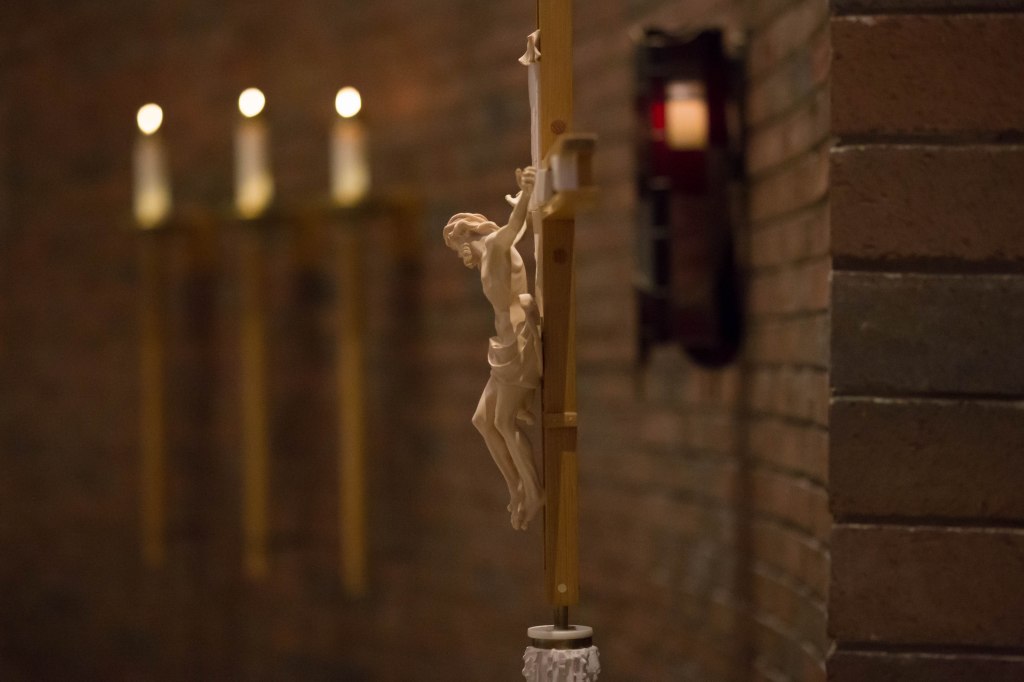
Firstly, and for the record, I prefer crucifixes over crosses. The corpus—the body of the Lord on the cross—matters to me. Secondly, what are you, vampires?! Why would a Christian be offended by the symbol of the Lord’s work to save us? How is it at all possible to be offended by the depiction—the visible communication, the visual transmission, the observable delivery—of the very act that rescued the world from Sin, Death, and the power of the devil?

No wonder Christianity is slipping away in America.

Although, what should I expect? So many of our mainstream churches are believing and teaching some ridiculous things these days. It should be no surprise to me, then, that there’s a pretty popular megachurch in Brighton, Michigan teaching that both crosses and crucifixes are offensive to visitors, and as a result, they refuse to display them anywhere in their facility. Think about that for a second.

Saint Paul dealt with this kind of idiocy in various places in his ministry, one of which he addresses in the very first chapter of 1 Corinthians (vv. 18-31). By the way, this was a letter written to a church filled with Christians who thought they knew better than the rest of Christendom. In many circumstances, they thought they knew better than Saint Paul, himself! So, from there, I think I’ll just say that any Christian or church offended by a crucifix needs to rethink things—a lot. I honestly don’t know how anyone can look at a crucifix and, in any way, disregard the all-important Gospel message it is silently proclaiming—which is that God was indeed ready and willing to meet us in our filth, that He wanted to be the absolute miracle of relief we needed in our most dreadful of hours. And how did He bring forth and accomplish this aid? By His Son’s death on the cross.

As this meets with prayer—since that’s what I was originally talking about—I don’t know how anyone can look at a crucifix and say honestly that God does not care enough to hear our cries no matter the hour or the need.

To close, there’s something else to consider when approaching prayer from this gritty perspective. I’d urge you to keep in mind the nature of the things you’re sharing with God and then ask yourself, “Would I be willing to publish on social media what I’m sharing with God right now?” If the answer is a red-faced “no,” then you’ve taken one step closer to the deeper teaching value of a crucifix: to the visceral nature behind something unseen becoming seen. I suppose in one sense you can know that seen or unseen, you have a “seen-it-all” God who loves and receives you as others couldn’t and wouldn’t. But then in tandem, you can be mindful that your God didn’t rescue you from your darkest, most secretive, sins by some private act. His death was a humiliating public spectacle—a sanctioned execution. He was tortured and propped up for all. His death for all sins for all time was meant to be seen. And I dare say, once you see it, you can’t unsee it. I’m guessing that while God is okay with your shame remaining hidden from the masses, He thinks it’s better for His to be out there in the open.

I’ll just leave you with that.