
Did you know there’s an aspect of human development called childhood amnesia? I didn’t. At least, not until I went looking for information on childhood memory formation. Essentially, childhood amnesia is as it sounds. So many things happened to us when we were little that we just cannot remember. As we grow, a pool of various experiences becomes more and more accessible to memory recall. Scientists used to think that this happened around the ages of seven or eight. Now they believe it happens much earlier, closer to two or three years old.
And so, here’s what prompted my memory-formation search.
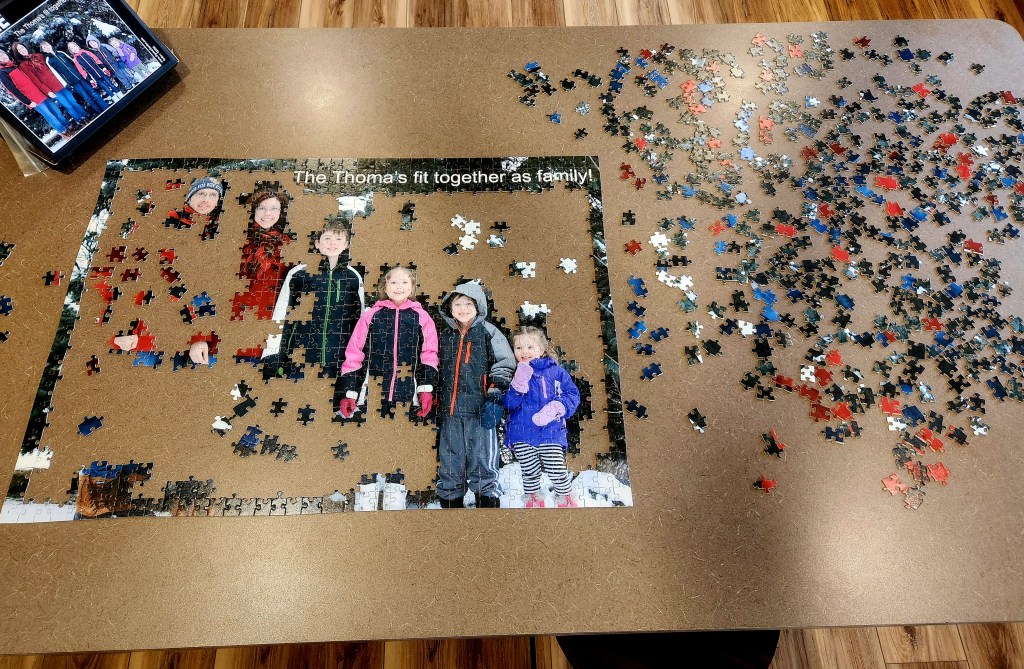
The Thoma family enjoys assembling puzzles. On occasion, Jennifer will fetch one from our shelved collection and dump it on the island in the kitchen. Within minutes, one, two, three, and then all of us are digging through the fragments, looking for the most important startup pieces—the edge pieces. The 1,000-piece puzzle currently occupying our countertop is one I had custom-made as a Christmas gift for the family a few years ago. It’s a wintertime family image taken in front of some pine trees at our former home. The kids were still very young at the time. For perspective, Evelyn is now fourteen. She was a toddler, barely three years old, when the photo was taken.
While assembling herself in the puzzle, Evelyn mentioned that she remembered the image’s moment well. To prove her recollection, she described the event in detail. She remembered Jennifer using one of our old wooden barstools as a camera stand. She remembered her mother taking test shots to sort out the camera’s timer. She remembered snuggling into Harrison beside her. Her ability to recount the details was impressive.
Standing beside her at the puzzle, I attempted silently to conjure my earliest memories. The first that came to mind was sitting in worship at Trinity Lutheran Church in Danville, Illinois. I remember sitting next to my brother, Michael, near the front. I remember flipping through the pages of a book with a red cover. I remember wondering why the people around me said they were “hardly sorry” for their sins. As it would go, that was the 1941 edition of The Lutheran Hymnal, and the word wasn’t “hardly” but “heartily.”
Another that came to mind was being in the bed of a truck at a drive-in. I don’t remember the movie that was showing. Although, I remember explorers, an island, and dinosaurs. It wasn’t King Kong. Kong is hard to forget. If I had to guess, it was The Land that Time Forgot, a film that was instinctively familiar when I discovered it on TV as a Sunday matinee. Concerning the drive-in, I remember a magnificent screen, an expanse of cars, and the tinny sound from a tiny speaker.
There are more memories I could share. I’m sure you have your own, too. What struck me about mine and Evelyn’s is that our earliest memories felt like primitive echoes of who we are today. For example, when it comes to family, Evelyn is all in. She loves her family. If we plan to do anything, the discussion is irrelevant if the whole family cannot participate. This rule remains even now that Josh is married. Interestingly, one of Evelyn’s first memories is a family event captured in a photo. Relative to my first conjurable memories, I’m a Lutheran pastor, and I absolutely love movies, especially the kinds meant to scare.
It’s no secret that a person’s childhood experiences are foundational. Like the puzzle Evelyn and I were putting together, they’re crucial pieces to what will become a more complete picture. I suppose I’m speculating that a child’s first memories mark childhood experiences that had incredibly formative power.
This past week, I had these things in mind while rehearsing with our school children for the children’s Christmas service. The kindergarten and first-grade students, the children who are likely emerging from the amnesia stage right now, sat closest to me. I watched them. As I did, I wondered which among them might have as a first memory what they were currently experiencing. Would any among them remember the twinkling décor adorning every corner of their church’s massive worship space? Would they recall the church’s mighty pipe organ lifting their joyful voices to the very threshold of heaven? Would they one day reminisce about how they were so excited to sing “Joy to the World” that they kept singing too soon? Would they remember their teachers whispering at times, “Just wait, not yet,” gently quieting them for the appropriate moment to start singing? Would little Isabella, a first-grader sitting where she could spy Pastor Thoma behind the Christmas tree, remember how he smiled and winked at her every chance he could and how she smiled so brightly back?
I hope so.
One thing is certain, though. Children kept from such things won’t have these memories. Ever. And this doesn’t just apply to the more fanciful time of Christmas. It’s true all year long. If parents don’t bring their children to church, it should be expected that a desire for Christ and His gifts will be foreign to their future selves. In other words, it’s more likely the puzzle pieces at the edge of their identities will border a future image that doesn’t include Jesus.
Unfortunately, it’s during these crucial developmental stages that parents are most tempted to stay away from worship. Apart from the dreadful poison of outright unbelief, what would keep a Christian parent from bringing their children to the Lord’s house? Well, that’s an easy one. It’s the struggle. Every parent who has (or had) toddlers knows it. Indeed, the toddling stage is simultaneously the most demanding, and yet, the most fertile.
I wrote a piece in 2020 after seeing something occur during Sunday morning worship here at Our Savior in Hartland. It was the all-too-familiar scene of a young mother wrestling with her toddlers. In short, she got more of a cardio workout in worship that day than she could have at the gym. Still, for as wild as the scene may have been, she was an inspiration to many. I told her as much, being sure to give her glowing encouragement. The very next day, I wrote and posted the note to parents I’ve included below. If you’d like to read (and share) the original, you may do so by clicking here. I ask one thing of you, though. As you read it, keep the “first memories” thought in mind. Remember that every minute of the day for our little ones has first-memory potential. Make it so that times with Jesus in worship will be more than one of them. Make sure they start with these pieces of the puzzle.
___________
Dearest Christian Parents struggling with little children during worship,
I know you feel like a mess on Sunday mornings.
I know you feel like every resonating sound in the church nave is coming from your pew. I know you feel like every eye is aimed at you in disgust. I know you feel like everything you are doing is useless and that the little ones in your care just can’t seem to settle in. I know you feel like you’re not getting anything from worship because you’re just too busy doing everything you can to ensure your children and, perhaps, the people in your immediate blast radius are getting the barest scraps between fidgety whines.
I know you feel overwhelmed—like the struggle is never-ending. I know you’re often teetering at the edge of calling it quits before you even roll out of bed.
But don’t.
Know that your children belong right where they are. Sure, take the kids out when it’s clear they need recalibrating, but get them back into the service as soon as you can. Do this knowing that you’re being faithful. Know that the struggle will end one day, and as you venture toward that day, your kids need you to do what you’re doing right now. Know that your gracious God promises to bless your every effort all the way there.
Know that you are being fed in worship. It may not feel like it but know that you are. Know that all of us—an assembly of people with countless distractions unavailable to human senses—are gathered by faith into the presence of our gracious Savior, assured that His reaching into us with His loving kindness hardly depends on our acumen. Again, rest assured, He’s at work there for you just as much as He is for everyone else in the room.
Finally, you need to know that your pastor is rooting for you. I’ve got your six. I’m watching the folks watching you, and if I ever get the sense they have forgotten what it was like to be in your shoes, I’ll be there in a heartbeat to remind them of the Lord’s words to “Let the little children come to me and do not forbid them,” and to steer them to the familiar relief they experienced when others gave encouragement rather than scowls.
Again, don’t give up. Your laboring—worked by the Holy Spirit for faithfulness to Christ and in love for your children—is by no means in vain.
With gladness, appreciation, and admiration, Your Pastor
 Cruciform Stuff