
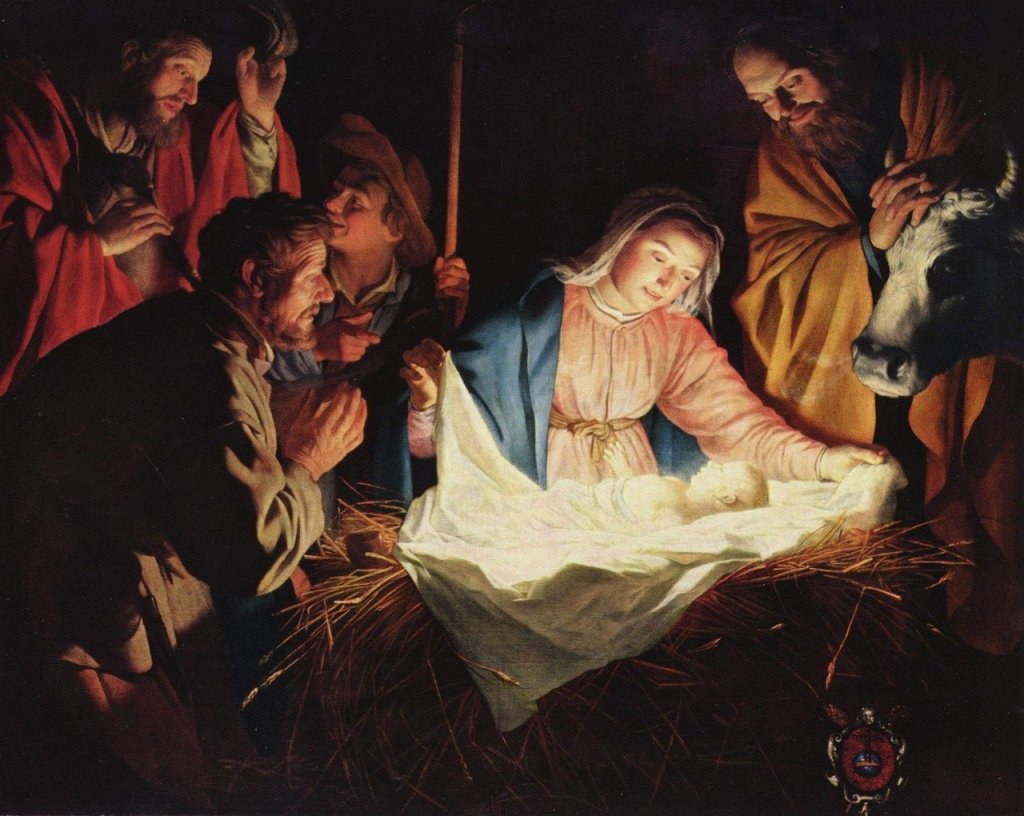
This past Wednesday evening, during our Children’s Christmas service here at Our Savior Lutheran Church in Hartland, Michigan, I found myself unexpectedly undone by one of my favorite Christmas hymns. Those who know me might say, “That happens to you with lots of hymns, Pastor.” Ah, yes, it does. But it only happens when exceptionally well-written hymns are played as they should. “What Child Is This” is one of those hymns.
Our relatively new Kantor, Dr. Richard Newman, had been rehearsing the hymn with the children over the past few weeks. But he’d been playing it plainly and without any noticeable flourish. I don’t mean that as a critique. Kantor Newman is a gifted musician. I mean, he holds a doctorate in his craft, and no one earns one in such fields without peerless skill. Besides, anyone with ears can tell he has far more in reserve than what any given Sunday hymn page he’s navigating allows. That said, and considering the context, he’d been playing somewhat plainly for a reason—to lead the children. He was giving the 130 or so students surrounding him in the choir loft a melody sturdy enough to carry their voices.
Now, I don’t like to drop changes on anyone before a worship service. However, not long before the service, I mentioned to him, pretty much in passing, that if he felt inclined, he could let loose a bit during the second stanza of “What Child Is This,” especially during the lines that actually sit in the hymn’s middle—the lines drawing our attention to the Lord’s inevitable passion.
“Nails, spear shall pierce Him through,
The cross be borne for me, for you.”
I’ve written about those lines at Christmastime before, encouraging people to listen carefully during the hymn, if only their church musicians would play it. Those lines are by no means incidental. Again, they sit squarely at the hymn’s center, literally. Look at the words on the page to see for yourself. But even theologically, they are the hymn’s pivot. Everything before them asks the identity question posed by the hymn’s title. Everything afterward answers with an awareness overcome by strict solemnity—if only the one playing the hymn can get it right. If they do, the lines refuse to allow Christmas to remain sentimental or mushy. Instead, they insist that the Child in the manger, that cooing infant so dearly loved by His mother and adoptive father, has come for one purpose and one purpose only. He will bear our sins on the cross. Nails will tear into and through Him. A spear will be rammed through His side. He will die. It will be terrible. But He will do it—endure all of it—for me, for you.
That reality deserves something more than a simple tune.
Even while I was making the request of Kantor Newman, he was smiling. He then said something to the effect that what I was asking for had a name in the organ world. It’s called text painting. It’s the practice of allowing the music not merely to accompany the words, but to interpret them—to embody them.
Now that I know what he’s talking about, I’m willing to go even further and say it means to let the music preach the words.
And during the service, Kantor Newman did precisely that.
Rolling into the second stanza, the organ changed. It wasn’t loud for the sake of volume. It was expressive for the sake of the text’s actual weight. Our Kantor began building. And the music pressed into the text’s weight in a way that made it seem like the organ was rising into the rafters to play alongside beings we could not see but were nevertheless there. In that moment, for as much as I wanted to sing along, I couldn’t. My jaw tightened, and my throat shrank a little. And had our church’s Christmas tree not been hiding me, I’m sure anybody watching would’ve noticed my inability. I was overcome, even to the point of shedding a tear down my right cheek. For the record, the feeling was familiar. Our former Kantor, Keith Vieregge, could do this with certain hymns, too. I can barely get through “Stricken, Smitten, and Afflicted” with him at the helm.
But regardless of who’s painting the text, such moments capture something essential to Christmas, and it’s something I think too many work very hard to avoid.
We like our Christmas to be gentle. We appreciate it safely wrapped in glistening décor and candlelight. We prefer shepherds and angels and Dickens-like Christmas scenes. And those things are nice. They belong. But if Christmas never takes us beyond the wonder into the weight that the second stanza of “What Child Is This” brings, then I think we’re misunderstanding it entirely.
Grammatically, the hymn’s title is a question. But it’s not a rhetorical one. It’s asking the same question now in the Lord’s infancy that, when He grew and began to speak, He’d ask of others at various times and in various ways throughout His earthly ministry. Inherent to almost every question Jesus asked along the way is the much deeper inquiry, “Who do you say that I am?” (Matthew 16:15). Whether it’s Jesus replying to His mother at the wineless wedding at Cana, “What does this have to do with me?” (John 2:4), which is to acknowledge she knows He can do something to help; or to His disciples on the treacherous sea, asking them, “Why are you so afraid?” (Matthew 8:26), which is to invite trust in the One who’s in the boat beside them. “What child is this?” is another of these questions, showing that Christmas is not immune to concern for the answer.
The hymn refuses to let us stop at the manger and then be on our way. It doesn’t allow us to marvel at the Christ Child without reckoning with the man He becomes—with what He actually came to do. In other words, we risk Christmas being emptied of its principal joy if we don’t know the deeper “who” and “why” of the Child. The incarnation is not just a moment on the timeline that we observe and then carry along to other things. It is this world’s interruption. It is God’s plan moving decisively forward.
That is why the second stanza matters so much. Again, it is the epicenter of the hymn. It has to be. That’s because it’s the epicenter of Christmas. And I dare say William Dix, the hymnwriter, proved that he knew it.
For me, this is where text painting becomes far more than a musical technique. It becomes a theological confession of what the whole congregation must know is true. It’s the same reason certain words are chanted during a service, and some are not. Chanting draws attention to something significant and, by its form, ensures it is heard crisply and clearly. When music leans into the meaning of the words, it reminds us that truth is not only something to be stated; it is something to be immersed in fully. Another way to say it (and any church musicians out there reading this, feel free to correct me), I’d say good church music doesn’t manipulate emotion. It aligns it. It brings heart and mind, body and soul, into harmony with something real.
Last Wednesday, during the Children’s Christmas service here at Our Savior Evangelical Lutheran Church in Hartland, Michigan, “What Child Is This” was sung. But I dare say that, with the school children singing and some exceptional text painting by our very gifted Kantor, the Gospel was amplified in ways that made even the angels jealous. If anything, Gabriel and his pals were smiling through the whole evening. And any mortal human being who was listening—really listening—would’ve sensed that the cross is always the best lens for observing Christmas. The joy we experience at Christmas is a costly joy. It knows the world is not safe. It knows sin and death are no small things. It knows Satan is strong. And yet, the Lord entered into and against all these enemies anyway, and He did so to make sure we are not inheritors of this world—that we are not sin’s, death’s, or Satan’s captives. Instead, these are conquered and destroyed, and we are inheritors of the world to come and eternal citizens of the Lord’s blessed kingdom.
I’m looking forward to singing the hymn again on Christmas Eve. Desperately, so. I sure hope you get to sing it at your church, too.

 Cruciform Stuff