Go With Jesus

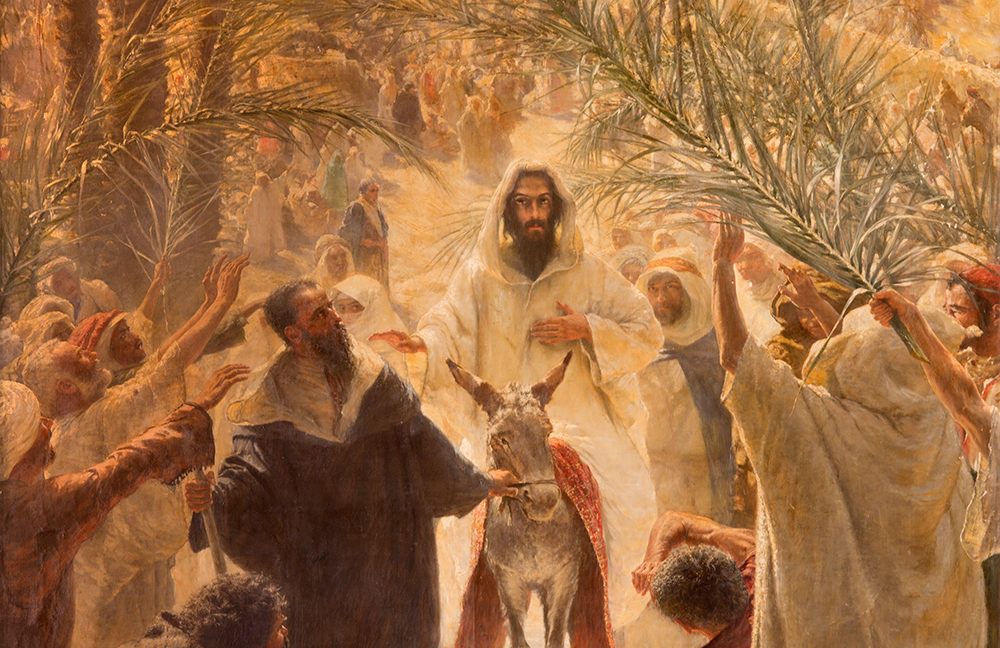
For the Church, Holy Week begins today. Christ is in His final approach. The excitement is thick. The gates are open. Nothing obstructs His entrance. The crowds have gathered. Their songs of Hosanna ricochet and resonate from the narrow pathway’s structures. Some have laid one of their few possessions on the road. A colorful mosaic of cloaks paves His way. Others scurried up nearby trees and then down again, having cut palm branches to share. The people wave them in celebration. Men, women, and children—all are praising His arrival. His disciples go before and after the Lord. A donkey carries Him.

Why isn’t He smiling? Why are His eyes bloodshot and swollen? The Gospel writer, Luke, tells us the celebration within the city had already begun on the outside road going down from the Mount of Olives. Making His way, Jesus came to a place before the city’s entrance where He could see Jerusalem in its fullest landscape. Luke records:

“As he approached Jerusalem and saw the city, he wept over it and said, ‘If you, even you, had only known on this day what would bring you peace—but now it is hidden from your eyes. The days will come upon you when your enemies will build an embankment against you and encircle you and hem you in on every side. They will dash you to the ground, you and the children within your walls. They will not leave one stone on another, because you did not recognize the time of God’s coming to you’” (Luke 19:41-44).

The Lord sees what the onlookers cannot, and He is troubled. They hoot and they holler without the slightest awareness of the peace He comes to exact. He’s traveling into and through the “hour and the power of darkness” (Luke 22:53) that erupts when He’s arrested and beaten, when the people will call for His sentencing and death. For them, at this moment, He is a bread king. They’re expecting Him to ride through and into the courts of the powerful—to rid Jerusalem of the Romans and restore Israel’s might among the nations. But that’s not what He has come to do. He is in His final approach toward something magnificently gruesome, and few, if any at all, will know what’s happening when it finally arrives. Oh, its dreadful midpoint on Golgotha’s hill. The ground will shake, the sky will become nighttime at noonday, the temple veil will tear, the rocks will split, and tombs will open, and still, they will not see. A centurion and a handful of guards will exclaim, “Surely, this man was the Son of God” (Matthew 27:54, Mark 15:39, Luke 23:47), but the rest will leave the horrific scene wagging their heads in disgust.

There’s more Jesus sees in that panoramic moment coming down from the Mount of Olives. He knows more as He rides into and through the crowds. He weeps because of it. He knows that a demonstration of the Last Day’s unbearable judgment for unbelief is coming. It will be awful, and yet, it will be little more than an atom-sized ember of rejection’s blue-hot reward, a recompense He does not want to bring.

In the very near future, in A.D. 70, Emperor Titus, the Caesar, will surround and level the city. The historian Flavius Josephus would one day describe the aftermath:

“Now, as soon as the army had no one left to kill or to plunder because no one was left to be objects of their fury (for they would not have spared any had there remained more work to be done), Caesar gave orders that they should now demolish the entire city and temple… much of the wall as enclosed the city on the west side, this wall was spared, in order to afford a camp for the remaining garrison. The towers were also spared, in order to demonstrate to posterity what kind of city it was, and how well fortified, which the Roman valor had subdued; but for all the rest of the wall, it was so thoroughly laid even with the ground by those that dug it up to the foundation, that there was left nothing to make those who came to see believe it had ever been inhabited. This was the end which Jerusalem came to… a city otherwise of great magnificence, and of mighty fame among all mankind” (Wars VII:1-4).

And so, Jesus weeps this first day of Holy Week. His Lenten travelers weep with Him. But our tears are a strange amalgamation of sorrow and joy.

We cry with our Lord in His sadness. We cry for those who remain in darkness and in the shadow of death. We cry because we know the inevitable wage for sin—eternal Death and separation from God—is entirely avoidable. Christ has made a way through. He has redeemed the world! Still, we cry because we know ourselves. Even as He would have us as friends, in our inherent sinfulness, we are at enmity with God. And so, we know our need. We know, by faith, He does for us what we would never think to do for Him.

But therein lies our Palm Sunday joy. He’s the only One who can do it. He’s the only One who would. And we’re so happy that He did. We watch Him make His way, and we’re thankful. He does not necessarily ride on in majesty because He has to, but because He wants to. He loves His world. He loves all of humanity, and as Saint John will very soon experience and then record from the forthcoming Maundy Thursday night in the upper room, “He loved them to the end” (John 13:1).

The end will very soon be upon Him. Follow Him there. Watch what He does. Listen to His words along the way. Turn an ear toward the cross and hear Him remain completely others-focused until His very last breath.

But how will you watch and listen if you do not follow Him there?

The Word carries you (John 1:1-2,14; Luke 24:27; John 6:68; Isaiah 55:10-11; Romans 10:17; Hebrews 4:12; and others). Do not be divided from it. The Word of God—both the person of Christ and the Scriptures that testify to Him—is what leads believers to the cross, sustains them in faith, and delivers the message that is the power of God unto salvation that reveals the depths of Christ’s love (Romans 1:16).

Let it carry you now. Let it lead you through the hosannas and into the coming darkness, that you would not be found unbelieving, but believing, that you would ultimately see—really see!—and rejoice in the light of His resurrection victory. He went there for you. Go with Him and see.

Here at Our Savior Evangelical Lutheran Church in Hartland, we have opportunities every day in Holy Week to be carried by God’s Word through the Lord’s Passion—Holy Monday, Holy Tuesday, Holy Wednesday, and Maundy Thursday at 6:30 pm, Good Friday Tre Ore at 1:00 pm and Tenebrae at 6:30 pm, Holy Saturday’s Great Vigil of Easter at 6:30 pm, and of course, the Resurrection of Our Lord, Easter Sunday, at 9:30 am.

Now, if I might make a suggestion. Please take a chance and share this eNews message with someone you care about.

To the person who just received it: If you don’t have a church home—a place and a people among whom you can regularly receive and give the care of God’s blessed Word—if ever there was a time to consider finding one, Holy Week is that time. You’ll know the theological heart of a congregation from the way it navigates the Lord’s Passion. Beyond this encouragement, there are other things to know. First, the Scriptures mandate this fellowship; it is not optional (Hebrews 10:24–25, Acts 2:42, 1 Corinthians 12:25–27, and others). And speaking practically, look at the titles of Paul’s Epistles. They are written to congregations in places like Ephesus, Corinth, and Rome. Consider the content of each. Apart from teaching,  he provides instruction for good order and sound doctrine in a precise locale—a congregation—established for the Gospel’s perpetuation. Second, and perhaps the best reason to join a faithful congregation: you will be blessed (Psalm 133:1-3, Matthew 18:20, Galatians 6:9–10), just as the Lord has promised.

Don’t Risk It

We’re entering the fifth week of Lent. The further we go into Lent, the more I’m sad for the churches that skip this penitential season, electing to go straight to Easter. They’ll have missed a critical view of the empty tomb.

The Gospel should always be a church’s center. That said, one of the grand benefits of observing church seasons is that they provide us with different perspectives on the Gospel. Advent considers it one way. Epiphany another. Rather than letting us coast along thinking we know everything there is to know, church seasons lift the Gospel and turn it, allowing examination on all sides. Lent is no different. If observed rightly, Lent, and then Holy Week, deliver us to the Lord’s resurrection, having first shown us the cost of Easter’s joy. Holy Week—the days between Palm Sunday and Easter—dig so incredibly deeply in this regard. It needs to. Humanly speaking, we’d much rather come to worship on Palm Sunday and then again at Easter. We’d much rather enjoy these brighter festivals, having skipped the hours of terribleness that cement the two together.

Why is this? My first guess is that the sinful nature would prefer to keep its role in the narrative a secret. It knows that if we investigate the harder scenes, there’s a chance we’ll be shocked by what we discover—perhaps even learning something about ourselves we’d prefer not to know. These reasons feed my appreciation of the masters—Caravaggio, Rembrandt, and the like. They looked into these spaces and shared the details. A more recent master, Carl Bloch, handled the details well, too. Perhaps you’ve seen his portrait of Christ being comforted by the angel in Gethsemane (Luke 22:43)? Far too many images of Christ in the garden before His betrayal are portrayed with the preferred fluffiness of gilded rays pouring from heaven, Jesus intently meditating but untouched by sadness. But that’s not what the Scriptures describe. They describe intense sadness. Bloch captures the Lord’s physical exhaustion and the angel that came to bolster Him for the forthcoming fight.

Since I already brought it up, Luther wondered aloud about the Lord’s time in Gethsemane. In a sermon in 1545, he asked his listeners why the Lord shivered and shook with such dread while praying. The gory mistreatments hadn’t even begun yet. And still, His behavior is shocking. It grips us. The Lord’s sweat became drops of blood, and Luther shared the reason: “It is for the sin of the world which God has laid upon Him.” Speaking for each of us, Luther added, “My intolerable sin brings Him to this, my sin which He has taken upon Himself and which is so hard to carry” (W.A. 52. 738). Who wants to be blamed for another person’s sadness? Not me. It stings as few other things do. When it happens, I want to look away.

Lent and Holy Week insist, “Don’t look away. Behold the bludgeoned and pathetic Christ. Indeed, it’s startling that He would suffer and die in this way. You’ve heard so often how He did it for you. Do you see what ‘for you’ means? Let your unsettled heart be a clue.”

Of course, that’s not the end of the story. Lifting the Lententide narrative and turning it for a better view, Luther continued that the Lord’s startling grief is also filling in confidence’s terrible gaps, becoming “a comfort to you, that you may be certain that Christ has taken your sin upon Himself, and paid the price for it. If, then, your sins are laid on Christ, be content. They lie in the right place, where they belong” (Ibid.).

Still, there’s the startling nature to all of this.

The topic of abortion came up during our church’s School Board meeting this past Tuesday. Relative to what we were discussing, I mentioned to the Board that I’m one who believes that the only way to end abortion once and for all would be to require our populace to see it—to experience the sights, sounds, and smells of genocide, much like the Allied troops marched Germany’s complacent citizens through the concentration camps after World War II. Changes in heart and mind occurred almost instantaneously in Germany. My theory, which I cannot necessarily prove, is that while incremental behavioral conditioning works, there’s a layer of our being that can only be pierced by jarring news. In a sense, the Bible does both. So much of the Lord’s comings and goings in the Bible are given in ways that caress us to careful attention. In a purely human sense, we’re being incrementally habituated to His identity and what He has come to do. But then there’s the actual doing—the viciousness of His suffering and death. The events themselves are anything but careful. They were a swift and consolidated shotgun blast of dreadfulness. Mark’s Gospel says the Lord was betrayed at midnight on Thursday, while Matthew, Mark, and Luke record the Lord died about the ninth hour, or 3:00 pm, on Friday. Compared to the rest of the Lord’s ministry, there’s very little time to be eased into it.

While it might not be the best analogy, this reminds me of something W.H. Auden wrote about stark incentives. I’ve been reading and writing about the psychology of attitudinal shifts for my doctoral work. Auden agreed that behavioral conditioning had a proven record. But then he joked that with a few select drugs and a simple electrical appliance, he could have almost anyone reciting the Athanasian Creed in public, and he could produce the results far more quickly than any behaviorist. Of course, he was talking about torturing someone into compliance. But beneath his dark comedy lies an elementary truth: extreme experiences have a way of cutting through our protected selves, revealing what might otherwise remain hidden to us, ultimately passing us by.

If Easter greeting cards draped in sunshine, lilies, empty crosses, and empty tombs are all one knows of the Lord’s passion, then something incredibly important has been overlooked.

I guess I’m saying this morning that Lent and Holy Week play an essential role in preventing a superficial understanding of the Lord’s labors. They were jarring, and much of these penitential seasons’ collegial goal is to remind us that redemption came at a cost, that its price tag was attached to a world-sized pile of human brokenness, and then to show us the price was paid in full. From there, the startling image becomes one of genuine comfort. A crucified Jesus is a testament to the unfathomable depths of God’s mercy. His resurrection becomes an indescribable celebration worthy of a joyful ruckus. Skipping over the precision of Lent and Holy Week risks missing this.

Don’t miss out. Start making plans now, especially for Holy Week. Here at Our Savior, we’ll have services every day, sometimes twice daily. If you do not have a church home, or perhaps your church offers little opportunity to observe the harder things, feel free to join us. You are more than welcome. Listen to God’s Word and its preaching. By these things, look into the challenging moments. Measure sin’s cost. Be equipped for another startling of sorts.

In other words, no one goes to someone’s tomb who has been viciously mauled expecting to find that person restored and alive. And yet, we do. We behold and hear Easter’s cosmic announcement that the One who suffered and died so gruesomely is now alive, never to die again, His resurrection victory being ours by faith. Talk about shocking! Indeed, it’s the overwhelming sense of joy that the Easter celebration means to bring.

The Perfect Law, the Law of Liberty

As it happens on occasion, I crossed paths this morning with a social media post making the point that a person doesn’t need to go to church to be a Christian. For the record, this is not only a tired statement but also a theologically lazy one. The simple biblical fact is that Christians go to church. God mandates such fellowship. If you disagree, that is, if the Jesus you confess teaches it’s okay to be apart from Him and the gifts He gives in holy worship, then you’re following a false Christ.

I could go further with this, but I don’t want to. As I said, it’s a tired and lazy position. I’d rather steer into something Saint James wrote. It’s somewhat relevant to the way I started. Although, it reaches a lot further into the Christian life than worship attendance. Essentially, it establishes the premise that faith is one thing and faith adorned with deeds is another. Saying this, I mean what Saint James meant when he wrote:

“But be doers of the word, and not hearers only, deceiving yourselves. For if anyone is a hearer of the word and not a doer, he is like a man who looks intently at his natural face in a mirror. For he looks at himself and goes away and at once forgets what he was like. But the one who looks into the perfect law, the law of liberty, and perseveres, being no hearer who forgets but a doer who acts, he will be blessed in his doing” (1:22-25).

Do you know what the “perfect law, the law of liberty” is? Just know that whatever it is, James is not only insisting that we persevere in it but that such determination is somehow born from hearing it and then results in living according to it.

Maybe the best way to figure out what James means is to begin with the words he uses, namely, the word he employs for “perfect,” which is τέλειον. This word is equally translated as “complete.” In other words, the completed law—the totally accomplished law—establishes a standard for freedom. Variations of the same word are used in other places throughout God’s Word. But there is one crucial instance where it fully intersects with James’ understanding of the Law. It happens in John 19:30. It’s there the Lord announces from the cross the single word τετέλεσται, which is typically rendered as “It is finished.” Although, it’s just as accurately interpreted as “All is complete.”

By “perfect law, the law of liberty,” James has in mind Christ’s absolute fulfillment (completion) of the Law on our behalf. By His work, we have been set free, not only from Sin and Death but from the Law’s crushing burden as the only way of escaping eternal condemnation. In other words, instead of needing to keep the Law for salvation (which all of the Lord’s Apostles affirmed was impossible), we’re free to live in and according to it. It becomes a law of liberty, not one of bondage. James is saying that whoever keeps as one’s heading the Gospel of salvation through faith in Jesus Christ—whoever believes and perseveres in it—will become a “doer,” someone desiring to keep the Ten Commandments, not for salvation but out of love for Christ. These doers will do. And they will be blessed, not because they’re performing the Law, but because they’ve been set free in Jesus. This freedom moves them to desire faithfulness to Him. Faithfulness results in works. This is why James goes on the say:

“What good is it, my brothers, if someone says he has faith but does not have works? Can that faith save him? If a brother or sister is poorly clothed and lacking in daily food, and one of you says to them, “Go in peace, be warmed and filled,” without giving them the things needed for the body, what good is that? So also faith by itself, if it does not have works, is dead” (2:14-18).

Samuel Butler once said, “You can do very little with faith, but you can do nothing without it.” That was a sloppy way to say it, but I’m willing to give him the benefit of the doubt. He attempted to speak alongside James. His point is that a proclaimed faith is not the same as a faith that acts to save the unborn from abortion. Although, from the proper perspective, a proclaimed faith hints at a much bigger picture. The proclamation is itself a deed. And faith made it happen. Faith produces. And why? Martin Luther so famously answered the question relative to justification. He said, “God does not need your good works. Your neighbor does.”

Do you have to go to church to be a Christian? How about this instead: genuine faith moves a Christian to desire to be in worship with his Lord.

On second thought, I did want to go further with my initial concern for worship attendance.

By the way, the people here at Our Savior in Hartland, Michigan, are going to have plenty of opportunities for being in worship this week. Today is Palm Sunday. We’re entering Holy Week. There are services every day, sometimes more than one a day, all the way through to Easter. Should you attend all of them? I’ll simply say, give it your best effort to attend as many as possible. Each plays a role in leading us to the Triduum—Maundy Thursday, Good Friday, and the Vigil of Easter. Attending any or all certainly wouldn’t hurt you. It goes without saying that you’ll be blessed. Do you know what else goes without saying? The fact that your faith already knows this, and it’s craving to act on the knowledge.

Pay Attention to Holy Week

Today is Palm Sunday, also called “Passion Sunday.” Palm Sunday is the doorway into the arena of Holy Week. For those who know, today is a pivotal day in the Church Year. By “those who know,” I mean those who know what’s coming. They celebrate by waving palm branches. Later today, some will fold those branches into the shape of a cross while studying the worship schedule and making plans to return for services during the week. They do this because they’ve learned the value of pondering each of our Lord’s words and actions as He makes His way to the cross and empty tomb—even the ones that may seem inconsequential. From His washing of the disciples’ feet to a mid-trial glance at Peter, everything becomes important, and believers don’t want to miss any of it.

The first few days—Monday, Tuesday, and Wednesday—are days of intense preparation underpinned by a passionate awareness of what’s looming. Then comes the holy Triduum—the three days of Maundy Thursday, Good Friday, and Holy Saturday.

In the evening on Maundy Thursday, our Lord knows He’s in the final hours, and so He establishes His Holy Supper, a divine meal that both gives and assures us of His presence and forgiveness. Establishing this, it truly is as the Apostle John describes:

“Now before the Feast of the Passover, when Jesus knew that his hour had come to depart out of this world to the Father, having loved his own who were in the world, he loved them to the end” (John 13:1).

Indeed, He loved them to the end. If we somehow get distracted from this on Maundy Thursday, it’s likely we won’t on Good Friday. Good Friday demands the attention of all. It is the battle royale—the conflict of all conflicts on a cosmic scale. Jesus goes into the powers of darkness, not for Himself, but for us. It’s there that our salvation is exacted. Moving into the evening of Holy Saturday, or the Vigil of Easter, believers endure the darkness of what appears to be the Savior’s terrible defeat. And yet, they do this by holding to the ancient promises given throughout the scriptures, finally coming face to face with an angel who declares, “Do not be alarmed. You seek Jesus of Nazareth, who was crucified. He has risen; he is not here. See the place where they laid him. But go, tell his disciples and Peter that he is going before you to Galilee. There you will see him, just as he told you” (Mark 16:6-7).

Easter Sunday is the first step from Holy Week into an entirely new season—one of victory, one that celebrates the conquering of Sin and Satan, as well as the death of Death itself; all of it accomplished by the Son of God, Jesus Christ, who was dead but is now alive, and who now reigns for all time.

Today, Palm Sunday, we celebrate. Again, we wave palm branches. We sing with festive voices. Next Sunday we celebrate, too. We’ll sing just as brightly. Our Easter suits and dresses will match the day’s tenor. In between these two Sundays, things aren’t so easy. Holy Week isn’t easy. Rest assured Our Savior in Hartland, Michigan, is a church that’s mindful of this. Knowing this, you’re invited to be present for each of the worship opportunities provided. You’re invited to hear the Word of God read and preached. You’ll want to hear this Word. It saves. You’ll want to take in the rites and be immersed in the ceremonies, all of which are born from the devotion of countless generations of Christians before you who knew something in particular about Holy Week.

And what was it they knew so well?

Well, as Pierre Corneille once observed, “We triumph without glory when we conquer without danger.” This saying is useful to Christians if only to remind us of how easy it is to be robbed of something’s truest value when we don’t know its truest cost. Holy Week spends itself revealing the cost. Without taking time to consider the immensity of it all, without taking at least a few strides alongside our suffering Savior, it’s possible to arrive at Easter without a sense of its worth.

Don’t do that. Pay attention to Holy Week. In my many years as a pastor, I’ve never met anyone who has regretted it.