It’s Okay to Say No

We’re five days into the new year. I hope you had an opportunity to rest somewhat after Christmas. I kind of did. Well, it was more like a few idling moments in between the typical full-throttle busyness. Of course, I fool myself every year into thinking I’m going to get a break after Christmas to just hang around the house and do absolutely nothing for a few days. It seems those plans are forever foiled. The first day or two is usually spent being sick. After that, I get pockets of time—a few hours here and there in between needing to be somewhere doing something for someone. I’m not necessarily complaining. But I’m also looking at 2025 and admitting I’m not Superman.

I had a phone conversation with a friend in California before our New Year’s Eve worship service last Tuesday. He asked what my resolutions were for the new year. I shared one of them. He laughed when I told him. The humor prompted a related question. He asked, “If you were forced to give something up in the New Year—something you could never have or use again—what would it be?” I didn’t even hesitate.

“My mobile phone,” I said. “Although, ‘forced’ is not the right word. I’m tempted daily to throw it out the window at 70 miles per hour and let the highway do the rest. I absolutely despise my phone, if only for the texts and private messages I get all day long.”

He laughed again because of the conspicuous irony. He had reached out to me that afternoon by text to see if I had a minute to chat.

Acknowledging mobile phones and texting as society’s preferred forms of communication, arrangements that won’t be going away any time soon, I asked him the same question.

“I’d give up spicy food,” he replied. “I love it, but as I get older, there’s a terrible price to pay for a date with Sriracha.” He shared a brief description of the unfortunate results. I agree. He needs to give up spicy food.

Overall, the conversation had me thinking about how each new year brings opportunities for doing things differently, usually for the sake of betterment. But it also had me thinking about how personal betterment sometimes means there are things we shouldn’t be doing at all. In other words, we need to be able to say “no.”

But from where I sit, doling out yes’s and no’s is tricky business. I say this because I know how easily people are offended by the word “no,” especially when it comes from a pastor. I could sit here and type for hours about how telling someone “no” usually ends up being interpreted as me not caring about them, even when it’s as simple as not replying to a text or private message. Of course, that’s not true. I do care. Still, that’s the era in which we live. It’s very centripetal.

Unfortunately, that doesn’t change the fact that when I say “yes” to everything, it means I’m saying “no” to an awful lot of somethings. Usually, it’s my family. Additionally, it means I’m saying “no” to self-care, the kind that makes it possible for any normal person actually to give a darn about almost anything they’re doing. Interestingly, even as Jesus was completely outward-focused in every way, having never given up on His monumental task to save the world, he still set boundaries. Even when the crowds were clamoring, many among them calling for His immediate attention, He still took opportunities to step away for rest.

That’s one of my resolutions for the year—to say “no” more often. It’s not the resolution I shared with my friend that made him laugh. Although, as I mentioned, it is somewhat related.

I suppose what I’ve shared here isn’t necessarily for me alone. It’s a lesson for all of us. Whether it’s putting down the phone, giving up spicy food, or simply saying “no” when needed, we should take stock of what truly matters. As I look at just the forthcoming month of January, I can see it’s already brimming. Saying “no” will be a necessity, not a luxury.

For some, hearing the word “no” will sting, and I’ll suddenly be the worst pastor in the world. For others, they’ll be bothered because the “no” will mean “not right now,” and they’ll have to wait a few days for whatever it is they want. And yet, for plenty of others, they’ll understand. They’ll instinctively recognize that saying “no” isn’t a sign of failure but rather an act of stewardship. It’s to admit that you, me—all of us—are human, and we are limited in time, energy, and ability. That means we must be mindful of how we use the resources God has given.

When I think about the people who are counting on me, from my family to the people both inside and outside of my congregation, I realize that saying “no” at the right times is actually saying “yes” to being the kind of pastor God has called me to be. I’m by no means perfect at this. Nevertheless, as the new year unfolds, I’ll start each day as I always do—praying for the wisdom that only the Holy Spirit can provide. In particular, I’ll pray for the wisdom to know when to say “no” and the courage to let that be enough. I’ll do this remembering that even as Christ drives His sheep along from one place to the next, He doesn’t do so endlessly. He also delights in leading His flock to green pastures beside still waters.
New Year’s Resolutions Are Not Bad

A new year is very nearly upon us. For the record, I’m with Tennyson, who said, “The year is going. Let him go.” From there, as I do every year, I ask myself, “How can I improve? What can I do differently?” The answer is always the same. “Plenty.” And so, I make New Year’s resolutions.

I know some folks think it’s a ridiculous practice. I don’t, which is why I tell you as much each year at this time. I make New Year’s resolutions not on the whim of wise words from guys like Benjamin Franklin, who encouraged his friends, “Be always at war with your vices… and let each year find you a better man.” I do it because there’s something I know about myself.

I know I’ll end this year infected with the sin-nature. I know I’ll begin the new year with the same infection. For me, this is an essential concern.

Thankfully, there’s something else I know. I am a forgiven sinner. God loves me, and I live in His grace. This Gospel of Christ’s life, death, and resurrection for my dreadful transgressions changes my trajectory entirely. By the power of the Holy Spirit through that Gospel for faith, I have a new inclination.

“You are not welcome here,” the inclination says to the sin-nature.

I suppose, reminiscent of Franklin’s words, to speak this way to the sin-nature is to coax it to war. If you’re wondering what that war might look like, take a quick moment to read Romans 7:14-25. Fully aware of sin’s dreadful grip, Saint Paul wrote in verse 23, “But I see in my members another law waging war against the law of my mind and making me captive to the law of sin that dwells in my members.”

And yet, the Apostle was prepared to face the deeply rooted inclinations of the flesh, having already written in the previous verse, “For I delight in the law of God, in my inner being…” (v. 22). Paul writes in this way only as the cross remains his strictest heading, adding rhetorically in verses 24 and 25: “Wretched man that I am! Who will deliver me from this body of death? Thanks be to God through Jesus Christ our Lord!” Paul rejoices that his wrestling with the sinful nature is entirely possible as it emerges from the Gospel deliverance won by Christ. In other words, because Christ has defeated death, sin has no rightful claim on the believer. It just doesn’t belong. And so, Christ has equipped us with a better nature, one equipped to wrestle and pin it.

From there, I think it’s interesting how Saint Paul sees God’s Law in an entirely new light. He doesn’t speak of it as burdensome, but instead, as good—as a preeminently useful weapon in the struggle against sin. From this perspective, he appears to lean in a direction that disinterests popular Christianity.

Essentially, mainstream Christianity is opposed to traditions, liturgies, rites, ceremonies, and other historical helps. But Paul appears to delight in the strictness of these things (1 Corinthians 11:1-2, 2 Thessalonians 2:15, 3:6, and others), counting it all joy to observe boundaries that keep him fixed to the Gospel.

I just watched the film Bonhoeffer. Well, I didn’t watch all of it. I only managed about forty-five minutes before I turned it off. The filmmakers framed Dietrich Bonhoeffer as someone who despised Christian tradition. They even wrote into his character syrupy, near-heretical phrases I’ve heard 21st-century mega-church pastors use concerning the faith. But Bonhoeffer didn’t write or speak this way. I studied Bonhoeffer extensively for my doctoral work and half of what so many claim to know about him and his theology is just not true. They often associate him with certain things without knowing what he actually believed. Concerning tradition, he was openly bothered by cultural influences on the Church and her historic practices, which is one reason why he was capably attuned to the Nazi dangers. Bonhoeffer didn’t see the Church’s traditions as humdrum things that needed to be jettisoned. They were protective things—Christocentric things. Their very point was to keep Christian hearts and minds fixed on Jesus. The Nazis brought their own rites and ceremonies—gestures, creeds, attire—all things that steered away from Christ to Hitler. The more they influenced the German Church’s leadership and clergy to massage these practices into the lives of the Deutsche Christen (the German Christians), the more the nation slipped into darkness.

I could go on and on about this, but I won’t. I’d rather return to Saint Paul. The Apostle to the Gentiles insisted that traditions, even though they might appear to some to have a Law sense about them, are quite useful in the spiritual battle. With this in mind, it’s interesting then how Paul insists still more in 1 Corinthians 9:24-27:

“Do you not know that in a race all the runners run, but only one receives the prize? So run that you may obtain it. Every athlete exercises self-control in all things. They do it to receive a perishable wreath, but we an imperishable. So I do not run aimlessly; I do not box as one beating the air. But I discipline my body and keep it under control, lest after preaching to others I myself should be disqualified.”

Mindful of the benefits of such discipline, first, Paul understands its nature and activities. He uses a very strange verb—πωπιάζω—translated as “discipline.” It’s a visceral word that quite literally means to “strike beneath the eye,” thereby implying its visible nature. In other words, Paul doesn’t fight the flesh only in private with prayer, devotionals, quiet meditation, or whatever. His practices are activities—behaviors that others can see. He does these things to “keep [the flesh] under control,” that is, to enslave it to something better, something godly. That something is Christ.

These public behaviors are designed to keep him set on Christ.

I suppose that leads me to something else relative to New Year’s resolutions and why I think they’re good.

Essentially, Paul engages in self-discipline, viewable or unviewable, knowing it is not aimless but purposeful. That purpose matters for himself and others. If it’s visible, then Paul must know it has corporate effects. And so, he says as much in verse 27 when he writes, “I myself should be disqualified.” Disqualified from what? He already said what it was. His role as an Apostle who preaches. Paul knows that if he does not continue to practice visible or invisible discipline—keeping his body under control for the sake of godliness—his work as an Apostle could very easily become of little use not only to himself but also to the body of believers to whom God has sent him.

I practice self-discipline. One of my practices is to make New Year’s resolutions. It’s not just for me but also for you—for my family, friends, parishioners, people who know and see me. I know my sinful tendencies, and so, as a pastor, I fight them for the sake of remaining faithful to my calling.

As for you, consider your own vocation. As you do, take a chance at making your own New Year’s resolutions. Keep your eyes on the cross, and from there, try adding a routine to your life, some rites (words) and/or ceremonies (actions) that help keep your eyes fixed on Christ. For example, start off small. Maybe begin each day by making the sign of the cross and praying before you even get out of bed. If you already do this, maybe add something else. Maybe try something as simple as hugging your spouse and children daily and telling them how thankful to Christ you are for them.

You know you. You know what needs betterment. Give it a try. Be encouraged in the war against the flesh. And when you fail, don’t worry. Dust yourself off and get back in the fray. God is with you. He loves you. Steadied by His Gospel, He’s given you everything you need to maintain the course.

A Hope-filled Sprig

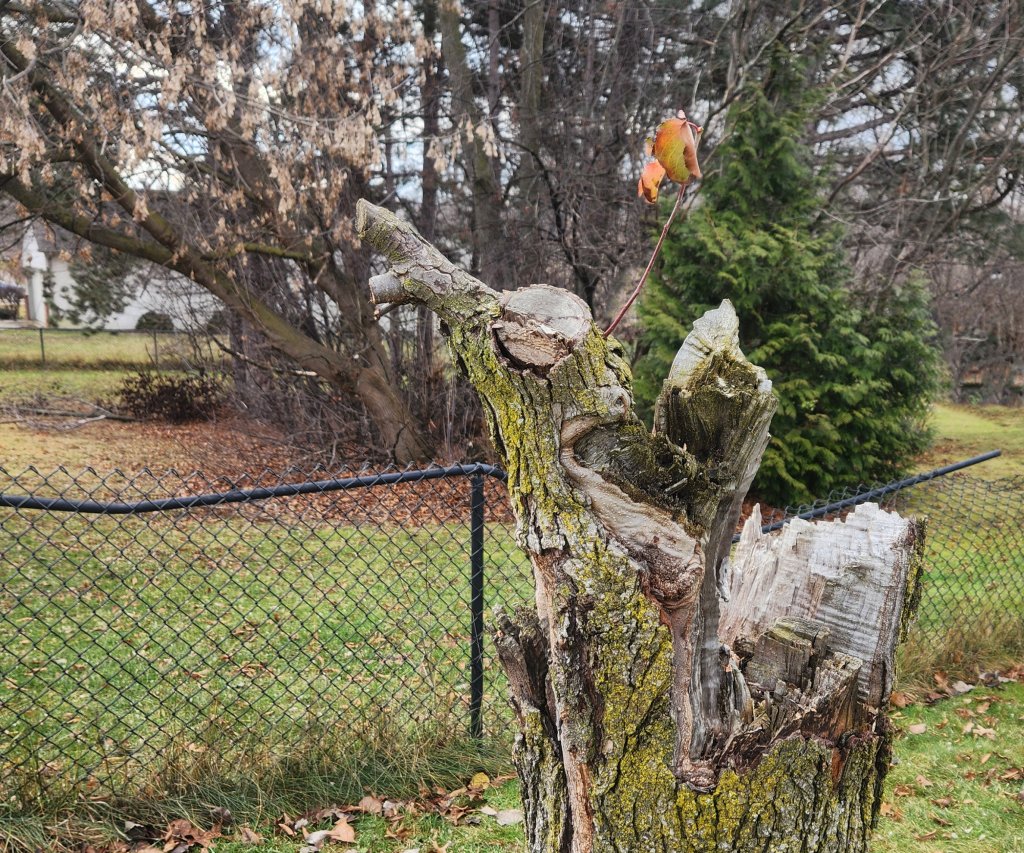
There’s a tree in a yard just down the street from my home that toppled twice this past year during two separate storms. The first was a windstorm that swept through last spring. By the time the ruckus had passed, one of the three stems ascending from the tree’s primary trunk broke free and crushed a nearby fence. The second gale was a late summer thunderstorm that brought equally powerful wind. When it finally quieted, the other two stems had fallen and destroyed another portion of the same fence. All that remained was a four-foot trunk with a splintered top.

It wasn’t long after either storm that the property owners cut and removed the debris, eventually leaving what is now a grayed and seemingly dead stump. I drive past it every day. For me, even in its obtusely pathetic state, the stump has faded into the neighborhood’s landscape, becoming something I no longer even notice.

But then one day last week, I did notice it. Even in mid-winter, it had a shoot growing from its top. Astounded, I circled back around and stopped to take a picture.

I’m not an arborist. Still, I know most deciduous trees in Michigan hibernate in winter. Essentially, they go to sleep at the end of summer. They slip into their dormancy stage, locating their essential nutrients in their roots. Doing this helps to keep them healthy and ready to bloom again in the spring. That’s why the leaves fall in autumn. The trees are shutting down the supply lines to everything but the roots, starving its skyward limbs and keeping the food where it’s needed most.

But this tree is not sleeping. It’s awake and growing in winter. Wearing only a slightness of green on one of its two leaves, a passerby can see by its sprig that it’s struggling against the elements. Its tiny, outstretched appendages are tinged with shades of autumn’s hues. Still, there it is, pushing up from a seemingly lifeless trunk, attempting to snatch every bit of Michigan’s occasional wintertime sunlight.

While barely anything at all, it’s an inspiring scene. Against the bleakest landscape, while everything else around it has given up and gone to sleep, it is awake, as if reaching up from hope’s nutrients with an unwillingness to forfeit.

Seeing this, as a Christian, I suppose my first inclination was to experience echoes of Isaiah 11:1, which reads, “There shall come forth a shoot from the stump of Jesse, and a branch from his roots shall bear fruit.” Isaiah’s words are forward-looking. They refer to Jesus. He is the One who, even as all mortal muscle for rescue was beyond spent, arrived bearing life. There He is. God did not leave us. He acted. He sent His Son, just as He said He would. Hope against all hope has been fulfilled. The Son has brought new life into what seemed to be Death’s dooming winter. And joy of joys! From His person and work, branches emerge and grow where no one thought they could. And this happens no matter life’s seasons, each shoot bearing extraordinary fruit (John 15:5).

I had a before-worship conversation on New Year’s Day with the chairman of our Board of Elders, Harry. Analyzing the societal landscape, we predicted that the forthcoming year would likely be far bumpier than the previous one. For the record, we weren’t being pessimistic but realistic, and in a sense, we were admitting to our need for the fruits that can only be plucked from Christ’s tree. In the New Year, we’re going to need the fruits of love, joy, peace, patience, kindness, goodness, faithfulness, gentleness, and self-control (Galatians 5:22-23). We’re going to need fortitude, the kind that wholeheartedly owns the title “Christian” (James 1:2-4; John 16:1-4). We’re going to need endurance (Romans 5:1-5). We’re going to need wisdom, the kind that can’t be duped by evil disguised as good (Ephesians 5:15-17). We’re going to need persevering strength to follow Jesus when doing so might appear to make very little sense (Hebrews 12:1; Luke 5:4).

We’ll need to be hope-filled sprigs against this world’s dismal backdrop (Romans 15:3).

But there’s another thought to be had. As a perpetual watchman for summer, the tree’s lonely sprig was a “consider the lilies of the field” moment (Matthew 6:28). It had me thinking about how God loves and cares for His people. Taking the stump’s picture, I spoke out loud to myself, “Storms will come, people will cut down the lilies, but nothing can stop spring from coming.” Christians will know what I meant.

No matter how the world rages, God’s promises will not be stopped (Romans 8:31-39). He’s caring for us now. As He does, we know the springtime of eternal life is coming. This means that even in the face of persecution and Death, believers have a limitless wellspring of hope. Like the stump’s sprig, what the world might expect from us in the darker moments is not what we’ve been recreated to do. The world will bear down on us with icy impositions, expecting that we’ll shrink into self-preserving hibernation. But instead, we reach up to the heavens as sprigs in winter. We stretch out in stark contrast to the surrounding world, bringing even the littlest bit of color into the sin-sick grays of this passing world.

We endure when enduring seems impossible.

This is my continued prayer for you in the New Year. God grant it.

Little by Little

I hope all is well with you so far this year. That might seem a strange thing to say, especially since we’re only a week into 2023. Still, we both know a lot can happen in a week. In truth, a lot can happen in mere seconds. Anything can change in an instant. An honest person—someone who knows by faith the inner workings of this fallen world—will not only admit to this but will embrace it as inevitable.

I’m guessing that for those looking in on faith from the outside, a Christian who rolls with change’s inevitability might appear to be living a disinterested life. Amid good or bad change, a Christian can speak alongside Job, saying, “The Lord gave, and the Lord has taken away; blessed be the name of the Lord” (Job 1:21). Such a person might appear to be drifting through life as though it were a mighty river sweeping him away feebly in its current.

On the other hand, perhaps the Christian can roll with life’s punches because he understands the intricacies of life and its changes in a way that onlookers cannot.

Admittedly, I’m somewhat of a mixed bag regarding change. Some people thrive on change. I don’t. I prefer most things to remain the same. There’s certainty in the steady things. Although, like most people, now and then, I get the urge to move things around in my personal spaces. I’ll be sitting at my desk, and then suddenly, I’ll rise and move an entire section of books from one shelf to another. I’ll be sitting at the bar in my basement, and then somewhat abruptly, I’ll rearrange the movie memorabilia sitting on cabinets and hanging on the walls. Those landscape alterations might not seem like a big deal to most. However, the urge that stirs them is genuine, and it acknowledges something deeply relevant to life. The seemingly innate need to change things is a reminder that something is seriously wrong with this world, and whatever it is, it needs to be made right.

But there’s something else proven by the exercise. The urge to rearrange things returns. It might be a week later. It might be two years later. Either way, it returns. This proves that no matter what I do to get things in the right places, the deeper disorder remains.

By faith, Christians can get along in such a world, no matter the changes. Good or bad, we’re the kind of people who endure.

I’m sure I’ve shared before that I appreciate Washington Irving. I read his infamous The Legend of Sleepy Hollow at least once a year. I do this not only because he spends his best energy delving into classical tales from early America but because, unlike modern writers, Irving handles the frightful things with a poetic style. Or perhaps a better way to say it is that he seems to take hold of scary things and presents them nonchalantly, almost as though they ought to be expected even while they are surprising. For a Christian, that kind of storytelling makes sense. As someone fitted by the Holy Spirit to endure, Irving makes sense to us when he writes, “There is a certain relief in change, even though it be from bad to worse…it is often a comfort to shift one’s position and be bruised in a new place.”

Perhaps that’s part of what the Lord meant when He instructed His followers to turn the other cheek (Matthew 5:39). He doesn’t intend for His Christians to be punching bags. He means for us to know we should never expect to be hit only once. More will come. And so, don’t be foolish. Situate yourself for endurance.

Thinking about these things, I should mention that Christians are by no means complacent about change. Christian endurance is far different than giving up and floating helplessly downstream. The knowledge of the deeper disorder keeps us vigilant. Because of this, we’re far more attuned to change than the rest of the world around us. It seems for most people in the world, change is of little consequence so long as it doesn’t bring personal inconvenience. In one sense, that’s how things got so bad in Nazi Germany. The United States Holocaust Memorial Museum attempted to memorialize that reality with a wall plaque of Rev. Martin Niemöller’s words, which were:

“First, they came for the socialists, and I did not speak out—because I was not a socialist. Then they came for the trade unionists, and I did not speak out—because I was not a trade unionist. Then they came for the Jews, and I did not speak out—because I was not a Jew. Then they came for me—and there was no one left to speak for me.”

Little by little, changes were made that targeted particular groups of people. Eventually, those changes crossed over into Niemöller’s sphere. But when they did, it was too late. Collectively, the little modifications had become unstoppable juggernauts. Truth be told, for as many people who lived relatively untouched lives during the 1930s and 40s, Christians were the first to see the dangers and sound the alarm, ultimately doing all they could to trip the Nazi jackboots. Many died trying. Rev. Dietrich Bonhoeffer was one. But he wasn’t the only one. There were plenty of others.

I suppose with the New Year comes both the awareness of and inclination for change. Mostly, I’m guessing a person’s New Year resolutions exist within the Niemöller-type frame. They’re personal, and it’s likely they’ll only allow inconvenience if a personal benefit is involved. People try to eat better, to exercise more, to be healthier. The intent in these things is good. And I’m certainly one to root for their success. I suppose what’s coming to mind this morning is not only the need to encourage continued endurance amid discomforting changes in our world but to encourage awareness of change beyond the safety of self. In other words, just because it doesn’t affect you doesn’t mean it isn’t worth your attention. It might be hurting someone else. That should matter to you. If it doesn’t, the time may come when you’ll have no choice but to be concerned.

For example, back in 2021, Scott Smith could have cared less about the demands of LGBTQ, Inc. in schools. But then his 15-year-old daughter was raped by a transgender student in the women’s bathroom at her high school. He responded angrily against the Loudoun County School Board (as any loving father should have), was arrested, and branded a domestic terrorist by the National School Boards Association, Merrick Garland, and President Biden. Interestingly, it took such a startling tragedy to stoke nationwide parental concerns for these and other issues. Now countless seats on School Boards across America have been seized by parents intent on jettisoning these radical—but already very entrenched—ideologies from our schools. They’re discovering and unbinding the dangerous grip of Critical Race Theory. They’re uncovering and dismantling the attempts by progressive ideologue teachers to read pornographic literature to 1st graders. They’re finding all these things and more, and they’re waging war against the disorder.

As the saying goes, Rome wasn’t built in a day. Little by little, changes were made. And now we’re cleaning up some pretty big messes. As Christians, we know the sources of these messes: Sin, Death, and Satan.

These are the powers at work in the deeper disorder.

Again, be encouraged to pay closer attention in the New Year. Perhaps a personal resolution for change might be to become more aware of what’s changing around you—whether the change is good or bad, who it affects, and what you can do to help. Doing this, I’m certain you’ll find ways to flex the already empowered muscle of faith in a world that desperately needs what you have to offer, not only for the sake of living peaceful and godly lives (1 Timothy 2:2) but for leading others to the only One who capable of bringing an all-surpassing order to the deeper disorder. Jesus accomplished this on the cross. He proved it by His resurrection. Now we live in this Gospel, owning the spoils of His victory, and employing them in the world around us.

We are not drifting through life. We are engaging in it with an altogether different kind—a divinely impenetrable kind—of endurance and discernment amid change.

Jacob’s Ladder

We’re only a few days into 2021. Still, I pray all is well with you so far.

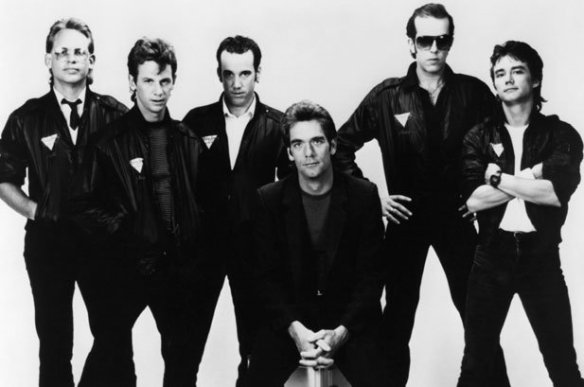
Interestingly, because of my daughter Madeline’s fondness for all things 80s, I crossed into the New Year having reconnected with some favorite music from my youth. While I’m more of a hard rock kind of guy—AC/DC being the typical go-to playlist at any given moment—I found myself emptying the dishwasher to some familiars by Huey Lewis and the News.

“I Want a New Drug.” “The Heart of Rock and Roll.” “Heart and Soul.” “Back in Time.” Let me tell you, I forgot how much I appreciated these songs. They had a memorable style.

For me, I think I found the combination of catchy rhythm guitar riffs and the rasp of Huey Lewis’ voice to be a welcome change to the poppy synthesizers that were saturating the airwaves and making the 80s music scene little more than canned cheese. When it came to skill, it felt lazy, and it was almost unendurable at times. Yes, Huey Lewis and the News used keyboards. But they used them the right way—in a bluesy rock way.

Of course, I don’t mean to insult any of my friends who remain huge fans of shoulder pads and “Bonnie Tyler” hairstyles. I most definitely don’t hold anything against those of you who tap down the road listening to the Pet Shop Boys, Culture Club, or Cyndi Lauper. But truthfully, there were only so many times I could be riding along with someone listening to A-Ha’s “Take On Me” before I actually felt like climbing into whichever comic book I might have been reading, even if it meant being accosted by a couple of brutes wielding chains and a monkey wrench. Seriously. If it weren’t for bands led by the likes of Angus Young, Eddie Van Halen, Joe Elliot, and yes, Huey Lewis, the radio would’ve, for the most part, been dead to me.

Of course I hear these songs through different filters, now. As a kid, it’s the music I remember most. But now I’m listening to the lyrics more intently, and oftentimes, I’m discovering things I missed.

Again, speaking of Huey Lewis and the News, I was listening to the song “Jacob’s Ladder.” There’s no arguing it’s sort of a “works righteousness” song. Lewis sings about being put off by the TV preachers and the aggressive Law-wielding Bible-thumpers. Good for him. They are off-putting to me, too. But because this is now his interpretation of Christianity, he turns to the even less certain spirituality of trying to figure it out on his own. He sings about striving to be a good person, and day by day, doing his best to climb his way to heaven. The insinuation is that ultimately God will smile on him when he finally arrives.

“Step by step, one by one. Higher and higher. Step by step, rung by rung. Climbing Jacob’s ladder.”

It’s a sad premise. The Word of God is pretty clear that no one will gain entrance to heaven by their works. In fact, Saint Paul couldn’t have said it any more straightforwardly than when he scribed:

“For by works of the law no human being will be justified in his sight, since through the law comes knowledge of sin” (Romans 3:20).

On the contrary, God’s Word makes clear that mankind is saved by grace through faith in Jesus Christ alone. Good works are a fruit of saving faith, and even as we do them, it is God at work through His believers. In other words, we can’t even take credit for our good deeds (Ephesians 2:8-10). It’s one reason why you’ll hear so many Christians, namely Lutherans, say the phrase, “Soli Deo gloria,” that is, to God alone be the glory.

I must confess, however, right in the middle of Huey’s messy (but also very popular) theology, he says something of value. By value, I mean it’s genuine, and I’m guessing it resonates with most normal people:

“All I want from tomorrow is to get it better than today.”

As a person, he honestly wants to improve. He just wants tomorrow to be better than the day before it.

I get that. As I said, I think most folks do, especially at this time each year. When the month of December has changed to January, and the old year has become a new one, many are hoping for better days—better relationships, better habits, better character, better selves.

There’s nothing wrong with working to be a better person. I say, if you can make those New Year’s resolutions and actually keep them, great. I made my own, and I intend to charge forth. Just keep in mind that as so many are striving to be what the world would consider better—wealthier, the most popular, the most intelligent and most talented in every way—to be any of these or none of these is as nothing if your innermost hope isn’t built on Christ. Without Him, you will be poor no matter the size of your holdings. Without Him, you are to be pitied no matter how many fawn in your presence. Without Him, you are the most foolish, no matter how many degrees you have on your wall; the most bumbling no matter the trophies.

Whatever comes your way in 2021, let your aim in every circumstance be fixed on Christ and His work to rescue you from Sin. He’s the only One with the divine strength for climbing the rungs of perfection, and He did it in your place. He’s the only One who took every step with perfect precision, and He did it all for your sake. He’s the only One who could take a righteous stand before the Father, and He did so as both your mediator and substitute. The Christmas season we just enjoyed is the foretelling of these things. Christmas preaches the Good News that after the fall into Sin, God didn’t turn away from His rebelliously imperfect world in disgust even as He knew we’d never be able to fix what we’d broken. Instead, He sent Jesus—the Son of God having become Man—who submitted Himself to all that we are and must endure. By His perfect work, He fixed what was broken. Now there is peace between God and man. Now, by faith, we are counted as righteous.

Because of Christ, your eternal tomorrow is guaranteed to be better than today.