Spring is upon us. Do you want to know how I know this? Migraines.
Every year at this time, the migraines set in. I never experienced them growing up in Illinois. Here in Michigan, surrounded by the Great Lakes, the temperature and barometric changes are more drastic, making their probability and frequency more prevalent.
Do you want to know one of the places with the least barometric fluctuation resulting in migraines? Florida.
Yes, Florida is a peninsula, which means it’s surrounded by water. Still, coastal regions aren’t as chaotic when it comes to barometric changes. They’re relatively ordered. I suppose that’s why I feel great while there. In fact, my chronic back pain typically disappears, too.
I read that tropical regions near the equator are the best places to avoid migraines. However, moving to an off-the-grid village somewhere outside of a place like Macapá, Brazil, probably wouldn’t work for me. I know that stress levels play a part in migraines, and I’m guessing my first trip to the bodega for supplies could result in a new kind of headache. While I’m generally disinterested in material things, I do appreciate creature comforts, such as air conditioning and pasteurized milk. My stress levels would almost certainly increase when these things are only occasionally (if at all) accessible. It’s also why I’d last maybe three days before packing up and moving to a place with more reliable electricity and steady internet access. I need to impose my ramblings upon the world around me, if not for you but for me. My constant need to type something—anything—helps maintain my brain’s order. I’ve written before that my need to write is almost disease-like. It’s an itchy affliction. If I don’t scratch it, I’ll unravel.
I wasn’t sure where this was leading just yet, but I think I figured it out. I’m a man who appreciates good order. My body is in complete agreement, and my seasonal migraines are a reminder.
Jennifer insists among our children that they keep themselves in order with calendars, planners, and the like. Our oldest son, Joshua, is married now, has a son, and works a full-time job. It’s funny how he’ll hug his mom and say, “You were right about keeping things organized.” He has come to realize, as many of his age eventually do, that disorder breeds unrest. The Bible certainly affirms this. In fact, it interprets disorder as sin’s regular product.
Saint Paul insists somewhat plainly that rejecting God and His natural law results in a “debased mind,” which is little more than a condition of mental and moral confusion (Romans 1:21-22, 28). Saint James writes, “For where jealousy and selfish ambition exist, there will be disorder and every vile practice” (James 3:16). Isaiah offers, “Woe to those who call evil good and good evil, who put darkness for light and light for darkness” (Isaiah 5:20). The implication is that sin distorts moral clarity, ultimately confusing right and wrong.
Again, disorder is sin’s fruit.
Relative to this, I should say that I appreciate simplicity. Sinful humanity tends to complicate things. Sure, the mechanics of almost any issue are vast. In a way, I attested to that last week when I wrote about the need to read more, not less. Still, the point of sifting through the swirling details of any particular issue is to find a way through the confusion to something better. When we do find that way through, we often discover that the fix was not as complicated as we thought. It may be difficult getting there, but when we do, it won’t be hard to understand the what, why, and how of it all.
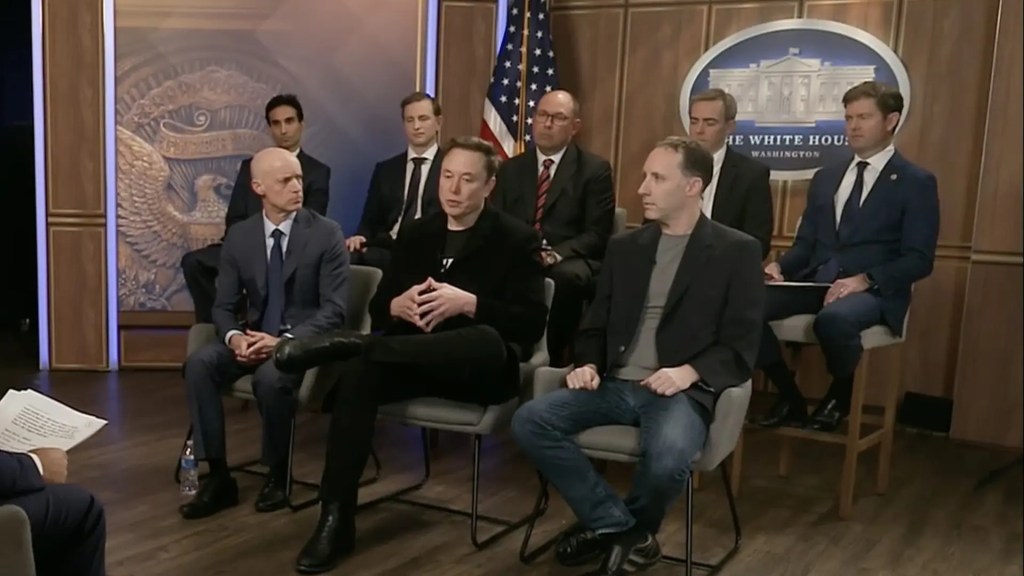
I wonder if this is why I’m oddly captivated by Elon Musk and his Department of Government Efficiency. While the United States government swirls with chaotic dysfunction, here’s a guy who has stepped into the middle of all of it and found a way to make its complicated mess into something crisp. His brainiacs have devised algorithms that can gather the chaos, sort it, identify the good and bad, and find a way through to an objective fix. When I observe this through a Gospel lens, there’s something strangely biblical about what Musk and his nerds are doing. No, not in the “mark of the beast” kind of way that the Revelation-twisting junkies and modern-day prophet-following weirdos try to suggest. First, I’m led to more of a David-and-Goliath image, where the unlikeliest champion throws a stone at the lumbering establishment, and the whole system wobbles. My second inclination goes far deeper.
Whether he realizes it or not, Musk has stumbled into sacred territory. A binding thread inherent to natural law is God’s desire for order. Saint Paul affirms this in 1 Corinthians 14:33 when he writes, “For God is not a God of confusion but of peace.” In Titus 1:5, he tells Titus to “set in order the things that are lacking” in the churches of Crete, making it clear that the Church itself requires structural clarity and good governance. Even in Acts 6, when the early Church faced the initial challenge of caring for widows, the Apostles responded with an administrative order. They appointed deacons to handle the task so that the administration of the Word remained central. It’s here (as it was with 1 Corinthians 14:33) that we see God’s deepest desire for order, which Saint Paul highlights in 1 Timothy 2:1-6 when he writes about the need for Christians to interface with earthly authorities. We do this to help maintain good order. And why? In verses 2 through 4, Paul says the goal is “that we may lead a peaceful and quiet life, godly and dignified in every way” (v. 2). He continues, “This is good, and it is pleasing in the sight of God our Savior, who desires all people to be saved and to come to the knowledge of the truth” (vv. 3-4).
The whole point of order is to provide a context in which the Gospel can be preached freely and without obstacle, all for the sake of saving souls.
With these things in mind, I realize it’s by no means coincidental that, right from the beginning, one of the first mandates God gave to Adam was to maintain order. In one of the most surprising acts of delegation ever recorded, God said, “Fill the earth and subdue it.” Next, He added, “and have dominion” (Genesis 1:28). This was a call to cultivate and maintain order in God’s creation. And so, we do. Certainly, this is an issue of faith relative to obedience. But as with all of God’s commands, there are practical fruits that come from holding to His divine commands. I already told you the most important one: the Gospel’s perpetuation. But there are others.
For example, order is inherent to a stable household. The Thoma family spent most of our dinnertime together on Friday talking about the blessings of a household that’s built in the way God designed it. A household established on God’s orderly design for marriage—a husband and wife—doesn’t just produce more humans. The sacred offices of husband and wife, becoming father and mother, create an ordered framework for children to understand love, responsibility, and many other aspects that make life truly enjoyable, just as God intended. If anything, a stable household becomes a training ground for carrying the kind of order that’s true to God’s heart into the broader world. It isn’t stifling. It nurtures growth while simultaneously instilling a crucial resilience to chaos, which is the space where confusion cooks up division, leading to broad-reaching and long-lasting harm.
As I said, observing through the Gospel’s lens, Musk and his team are in sacred space when they do what they’re doing, if only because they’re trying to bring order to chaos. They’re laboring to establish order’s honest clarity amid falsehood’s confusion.
To wrap this up, I mentioned at the beginning that migraines are a seasonal reminder. Keeping this ailment within the boundaries of God’s Word and beneath the shadow of the cross, my migraines are a natural protest against disorder—my body’s internal revolt against barometric chaos. In that sense, they’re a metaphor. They are proof that sin exists; it’s at work in my body (Romans 7:23). With it comes disorder. They also help me remember that God did not intend them by His design, and therefore, I’m not where I’m meant to be. In a mortal sense, even as I’m better suited for Florida’s climate, in the more extraordinary sense, I’m genuinely meant for the restored order of the new heaven and new earth (Revelation 21:1-5, Isaiah 65:17, 2 Peter 3:13) that Christ brings at the Last Day—the time when my whole self “will be set free from its bondage to corruption” (Romans 8:21).
Indeed, this world’s chaotic brokenness isn’t the final word. Genuine, actual, real restoration of order is coming. Christ has already seen to this by His life, death, and resurrection.

 Cruciform Stuff