
He Knows and Remembers My Name

Make no mistake. I’m a man of many flaws and inabilities. I know this. Truly, there are things I do regularly that I wish I didn’t, and there are things I wish I could do more or better. This is one reason why I appreciate New Year’s resolutions. Every year, I want to do better.

Looking back to the season before Easter for a quick second, Lent’s tendency toward self-examination provided an annual platform for measuring this reality, too, but for far better reasons than a transitioning calendar might stoke. For starters, Lent feeds into us the substance of Ash Wednesday’s appointed Epistle Reading. It’s been a few weeks since we heard it. Still, with apostolic eloquence, Saint Peter encourages his readers to “make every effort to supplement your faith with virtue, and virtue with knowledge, and knowledge with self-control, and self-control with steadfastness, and steadfastness with godliness….” (2 Peter 1:5-6). In other words, actively pursue becoming a good tree that produces good fruit (Matthew 12:33). Peter goes on to suggest that if these qualities increase, an awareness occurs that can see Christ and the surrounding world in the proper perspective (vv. 8-10).

Saint Paul is no slouch here, either. He gives abundant encouragement to fight the flesh for the sake of faithfulness. In Galatians 5:16-17, he describes the ongoing battle between the flesh and the Spirit in the believer’s life. In Romans 8:13, he urges believers to resist their sinful nature through the power of the Holy Spirit. In 1 Corinthians 9:27 and Colossians 3:5, he comes right out in full force, highlighting self-discipline and mandating that Christians actively “put to death” sinful tendencies.

I’m guessing that any sincere Christian wants the perspective Peter described. I sure do. Also, like Paul, I want to put my sinful tendencies in a grave. To do this, an honest examination is required. When one does so, it’s pretty incredible what can turn up. Captured by Lent’s annual gaze, I always find something to fix. For example, here’s something I learned. It’s maybe not that big of a deal. Still, it has the potential to negatively impact my personal relationships.

To be candid, I struggle to remember names. I always have. I can recall conversations almost word-for-word. I can recite entire speeches. I can quote from various poets. I can remember historical events and their significant contextual details that led to other events. I can remember dates and statistics. I can tell you what I learned from a book, documentary, or presentation. In other words, for the most part, I can retain content. Conversely, however, it might take me a minute or two to remember the author of a quotation. Sometimes, I can’t recall a movie character’s name, even after watching the film multiple times. This has long been a frustration of mine. Honestly, it really had me on edge before my doctoral defense last year. To defend a thesis, you not only need to know the content, but you need to have a ready grasp of your field’s primary authors and researchers. I was more than ready with this information during my defense. Still, I promised myself I’d look into it and try to fix this personal deficiency. It certainly can be an exasperating kink in my life.

Lent provided a focused time for this type of relational betterment.

It turns out there is a cognitive phenomenon for this very frustration known as “anomic aphasia” (or “nominal aphasia”). While it typically refers to difficulty recalling specific words in general, for some people, it’s more acutely relative to names. When this is true, it’s sometimes called “proper name anomia” or “nominal dysphasia.” Essentially, it is as I described. A person can remember events, conversations, and details about a situation, but struggles to recall the names of the people involved. Physiologically, this is because names are stored and retrieved differently in the brain than contextual details. Strangely, the brain files and processes proper names more arbitrarily, making them harder to recall. On the other hand, because the various stories and content of life come together to form our existence’s fuller narrative, the content is more closely associated with meaning and is, therefore, filed in a way that’s more readily available.

Perhaps a simplified example would be if a person asks a friend for directions, that friend is going to tell the person which roads to take. He isn’t going to tell him the name of the person who built the road. It’s likely the name of the person isn’t essential for getting from point A to point B.

I don’t want to bore you with this stuff. Instead, I want to return to something I wrote before: “Any sincere Christian wants the perspective Peter described.” This means observing frailty through the Gospel lens. From there, I’m not only trying to push back against and correct my shortcomings, but I want to see Jesus throughout the process.

In this instance, there’s already a glorious contrast becoming visible.

In a broad sense, while I’m plagued by frailties, God has none. In a narrow sense, I can rest assured that God never forgets my name. He never struggles to recall who I am. And by no means is the narrative of my life—the crumbling roads I constructed from my deeds—of most importance to Him. The Gospel is the narrative that matters to God. That’s the story of most importance. Through faith in Christ, the Lord’s narrative becomes my life’s narrative.

Interestingly, Isaiah 43:1 reads, “Fear not, for I have redeemed you; I have called you by name, you are mine.” A little further along, Isaiah 49:16 tells us, “Behold, I have engraved you on the palms of my hands.” One of the ways I can start overcoming my forgetfulness with names is to start writing them down soon after learning them. God claims us by name. To remember us, He engraves us in His hand. Engraving is a far different form of recollection than simple writing. It cuts into the material. Engraving a hand would be painfully unforgettable. And yet, for anyone with Peter’s perspective—a view attuned to Christ—a verse like Isaiah 49:16 is awfully reminiscent of the Lord’s crucifixion. He knew our names, even as He was carved up and pierced on the cross.

One more thought comes to mind.

Just as remarkable as what God remembers relative to my name is what He forgets. Hebrews 8:12 assures me, “For I will be merciful toward their iniquities, and I will remember their sins no more.” God, who is omniscient, forgets His believers’ dreadfulness. He does not recall what can potentially condemn us; instead, His perfect perspective is that of the Gospel. He sees us through the righteousness of His Son, and the result is that our sins are accounted as far as the East is from the West (Psalm 103:12). This is the stunning reality of God’s grace. When we are forgiven, our sins are not filed away in some dark corner of God’s mind, waiting to be dredged up again. They are gone. Forgotten. Forever erased.

I suppose, in the end, human memory may be frail and selective. I may forget names. I may struggle to recall details I wish I could summon instantly. But the God of all creation does not forget His own, and in His mercy, He refuses to remember the sins that once defined us. In that, I find both comfort and the courage to keep striving toward the perspective Peter described—to see Christ and the world rightly, trusting in the One who calls me by name and clothes me in His righteousness.
Pieces of the Puzzle

Did you know there’s an aspect of human development called childhood amnesia? I didn’t. At least, not until I went looking for information on childhood memory formation. Essentially, childhood amnesia is as it sounds. So many things happened to us when we were little that we just cannot remember. As we grow, a pool of various experiences becomes more and more accessible to memory recall. Scientists used to think that this happened around the ages of seven or eight. Now they believe it happens much earlier, closer to two or three years old.

And so, here’s what prompted my memory-formation search.

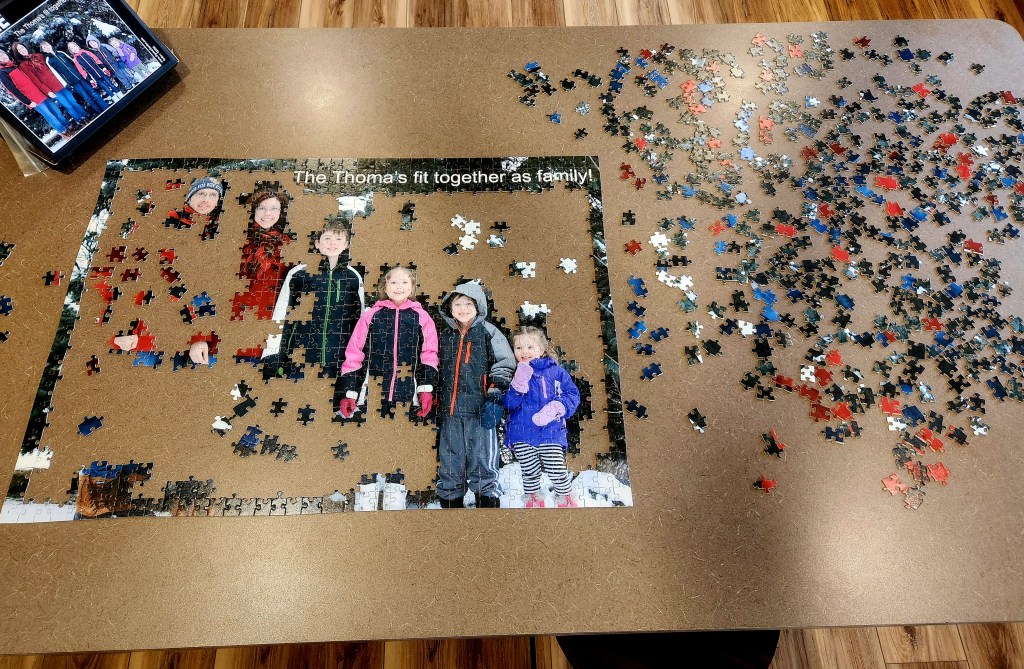
The Thoma family enjoys assembling puzzles. On occasion, Jennifer will fetch one from our shelved collection and dump it on the island in the kitchen. Within minutes, one, two, three, and then all of us are digging through the fragments, looking for the most important startup pieces—the edge pieces. The 1,000-piece puzzle currently occupying our countertop is one I had custom-made as a Christmas gift for the family a few years ago. It’s a wintertime family image taken in front of some pine trees at our former home. The kids were still very young at the time. For perspective, Evelyn is now fourteen. She was a toddler, barely three years old, when the photo was taken.

While assembling herself in the puzzle, Evelyn mentioned that she remembered the image’s moment well. To prove her recollection, she described the event in detail. She remembered Jennifer using one of our old wooden barstools as a camera stand. She remembered her mother taking test shots to sort out the camera’s timer. She remembered snuggling into Harrison beside her. Her ability to recount the details was impressive.

Standing beside her at the puzzle, I attempted silently to conjure my earliest memories. The first that came to mind was sitting in worship at Trinity Lutheran Church in Danville, Illinois. I remember sitting next to my brother, Michael, near the front. I remember flipping through the pages of a book with a red cover. I remember wondering why the people around me said they were “hardly sorry” for their sins. As it would go, that was the 1941 edition of The Lutheran Hymnal, and the word wasn’t “hardly” but “heartily.”

Another that came to mind was being in the bed of a truck at a drive-in. I don’t remember the movie that was showing. Although, I remember explorers, an island, and dinosaurs. It wasn’t King Kong. Kong is hard to forget. If I had to guess, it was The Land that Time Forgot, a film that was instinctively familiar when I discovered it on TV as a Sunday matinee. Concerning the drive-in, I remember a magnificent screen, an expanse of cars, and the tinny sound from a tiny speaker.

There are more memories I could share. I’m sure you have your own, too. What struck me about mine and Evelyn’s is that our earliest memories felt like primitive echoes of who we are today. For example, when it comes to family, Evelyn is all in. She loves her family. If we plan to do anything, the discussion is irrelevant if the whole family cannot participate. This rule remains even now that Josh is married. Interestingly, one of Evelyn’s first memories is a family event captured in a photo. Relative to my first conjurable memories, I’m a Lutheran pastor, and I absolutely love movies, especially the kinds meant to scare.

It’s no secret that a person’s childhood experiences are foundational. Like the puzzle Evelyn and I were putting together, they’re crucial pieces to what will become a more complete picture. I suppose I’m speculating that a child’s first memories mark childhood experiences that had incredibly formative power.

This past week, I had these things in mind while rehearsing with our school children for the children’s Christmas service. The kindergarten and first-grade students, the children who are likely emerging from the amnesia stage right now, sat closest to me. I watched them. As I did, I wondered which among them might have as a first memory what they were currently experiencing. Would any among them remember the twinkling décor adorning every corner of their church’s massive worship space? Would they recall the church’s mighty pipe organ lifting their joyful voices to the very threshold of heaven? Would they one day reminisce about how they were so excited to sing “Joy to the World” that they kept singing too soon? Would they remember their teachers whispering at times, “Just wait, not yet,” gently quieting them for the appropriate moment to start singing? Would little Isabella, a first-grader sitting where she could spy Pastor Thoma behind the Christmas tree, remember how he smiled and winked at her every chance he could and how she smiled so brightly back? 

I hope so.

One thing is certain, though. Children kept from such things won’t have these memories. Ever. And this doesn’t just apply to the more fanciful time of Christmas. It’s true all year long. If parents don’t bring their children to church, it should be expected that a desire for Christ and His gifts will be foreign to their future selves. In other words, it’s more likely the puzzle pieces at the edge of their identities will border a future image that doesn’t include Jesus.

Unfortunately, it’s during these crucial developmental stages that parents are most tempted to stay away from worship. Apart from the dreadful poison of outright unbelief, what would keep a Christian parent from bringing their children to the Lord’s house? Well, that’s an easy one. It’s the struggle. Every parent who has (or had) toddlers knows it. Indeed, the toddling stage is simultaneously the most demanding, and yet, the most fertile.

I wrote a piece in 2020 after seeing something occur during Sunday morning worship here at Our Savior in Hartland. It was the all-too-familiar scene of a young mother wrestling with her toddlers. In short, she got more of a cardio workout in worship that day than she could have at the gym. Still, for as wild as the scene may have been, she was an inspiration to many. I told her as much, being sure to give her glowing encouragement. The very next day, I wrote and posted the note to parents I’ve included below. If you’d like to read (and share) the original, you may do so by clicking here. I ask one thing of you, though. As you read it, keep the “first memories” thought in mind. Remember that every minute of the day for our little ones has first-memory potential. Make it so that times with Jesus in worship will be more than one of them. Make sure they start with these pieces of the puzzle.

___________

Dearest Christian Parents struggling with little children during worship,

I know you feel like a mess on Sunday mornings.

I know you feel like every resonating sound in the church nave is coming from your pew. I know you feel like every eye is aimed at you in disgust. I know you feel like everything you are doing is useless and that the little ones in your care just can’t seem to settle in. I know you feel like you’re not getting anything from worship because you’re just too busy doing everything you can to ensure your children and, perhaps, the people in your immediate blast radius are getting the barest scraps between fidgety whines.

I know you feel overwhelmed—like the struggle is never-ending. I know you’re often teetering at the edge of calling it quits before you even roll out of bed.

But don’t.

Know that your children belong right where they are. Sure, take the kids out when it’s clear they need recalibrating, but get them back into the service as soon as you can. Do this knowing that you’re being faithful. Know that the struggle will end one day, and as you venture toward that day, your kids need you to do what you’re doing right now. Know that your gracious God promises to bless your every effort all the way there.

Know that you are being fed in worship. It may not feel like it but know that you are. Know that all of us—an assembly of people with countless distractions unavailable to human senses—are gathered by faith into the presence of our gracious Savior, assured that His reaching into us with His loving kindness hardly depends on our acumen. Again, rest assured, He’s at work there for you just as much as He is for everyone else in the room.

Finally, you need to know that your pastor is rooting for you. I’ve got your six. I’m watching the folks watching you, and if I ever get the sense they have forgotten what it was like to be in your shoes, I’ll be there in a heartbeat to remind them of the Lord’s words to “Let the little children come to me and do not forbid them,” and to steer them to the familiar relief they experienced when others gave encouragement rather than scowls.

Again, don’t give up. Your laboring—worked by the Holy Spirit for faithfulness to Christ and in love for your children—is by no means in vain.

With gladness, appreciation, and admiration, Your Pastor

The Eve of Thanksgiving

I’m guessing you know what I mean when I say the Thanksgiving holiday has a unique sense about it. Regardless of autumn’s shrouded frigidity, Thanksgiving remains bright and warm, as if the sun leaned closer to the earth for just this one day.

I say this knowing full well that family gatherings at Thanksgiving can be a mishmash of dynamics. I also know from casual reading that division in families from this or that issue is at an all-time high. For some, family get-togethers are more taxing than enjoyable. Still, I meant what I said. Thanksgiving has a unique sense about it. And it’s good.

It’s good, not because the Thanksgiving feast is the meal all other meals only wish they could be. For the pessimists among us, it’s not good because it only happens once a year. Thanksgiving is as it is because of its point: no matter where we’ve come from, where we’re going, where we are right now, what we’re experiencing, or who we’re with, we can be thankful. Thanksgiving’s point is gratitude.

Relative to families, someone once said genuine gratitude is only possible when the memories stored in the heart conquer those in the mind. I don’t know who said it. And yes, I suppose the saying is somewhat Hallmark card-like. Still, I’m fond of the thought, even if only for how I prefer to interpret it, which, as you might expect, is through the Christian lens.

Admittedly, the human heart and mind are both sin-stained in every way. And yet, Christians know something beyond this fact, especially when it comes to the Holy Spirit’s work in us through the Gospel for faith. We understand what Ezekiel meant when he spoke for God, saying, “I will give you a new heart and put a new spirit within you” (Ezekiel 36:26). We know what Jeremiah meant when he shared the similar promise, “I will give them a heart to know Me, for I am the Lord; and they will be My people, and I will be their God, for they will return to Me with their whole heart” (Jeremiah 24:7). We know what Saint Paul meant when he insisted, “Therefore, if anyone is in Christ, he is a new creature; the old things passed away; behold, new things have come” (2 Corinthians 5:17). Paul’s words in Romans 5:5 are not lost on us, either. We know what he meant when he wrote, “And hope does not put us to shame, because God’s love has been poured into our hearts through the Holy Spirit who has been given to us.”

Filtering the adage through these biblical truths, I suppose I like it because it implies that genuine gratitude is out of reach to mental calculation. In other words, as humans, we remember things. Those things shape and reshape us. Remembering how people have treated us—what they’ve done to help or hurt us, whether they’ve behaved as friends or foes—these become the variables we ponder in the calculations of relationship mathematics. And like any equation, sometimes the resulting product is positive. Sometimes, it’s in the negative.

Through the lens created by the Bible texts I shared, the phrase “memories stored in the heart” seems to hint at a different sort of math, an involuntary, grace-filled action uninhibited by human sensibility. It sees things through the Gospel. It understands annoying family members more so as family than annoying, and it’s thankful for them. It knows the time required to prepare a massive meal is exhausting, and yet it’s grateful for the opportunity to serve the ones it loves who’ll be gathering at the table to eat it. Some of those people haven’t been all that nice in the past. Still, it knows that kindness will always be sweeter than malice. It stands on its tiptoes, ready to reconcile. It’s hopeful for it to happen and gives thanks when it discovers itself stumbling into uncomfortable moments that are all but begging for it to be enacted.

In short, the memories of a Christian heart are the memories of Christ. The Holy Spirit puts them there. They are the remembrances that Christ, even when we were utterly unlovable, loved us to the end (John 13:1). They remember that even while we were still sinners, He gave Himself over entirely into Death’s perpetual night (Romans 5:8). They retain the incredibly crucial sense that we are just as needful of Christ’s merciful love as the screwed-up people sitting beside us at the Thanksgiving Day table, and with that, we belong together.

These Christian heart memories stir genuine gratitude, even when gratitude seems nonsensical and maybe even a bit foolish.

My prayer for you this Thanksgiving is two-fold. First, I hope you’ll begin your Thanksgiving Day by going to worship. There’s no better way to be equipped with Godly gratitude than by receiving Christ’s gift of forgiveness through the administration of His Word, both in its verbal and visible forms. Here at Our Savior, the service begins at 10:00 a.m. I hope to see you.

Second, I hope the memories stored in your Christian heart will conquer those in your mortal mind, and as a result, your Thanksgiving Day celebration with family will indeed be brighter and warmer, as if the sun leaned closer to wherever you are standing even if only for this one day.