The Holy Spirit is No Skeptic

At the men’s Bible study in my home two weeks ago, we wandered into a momentary discussion concerning the necessity of sound doctrine. I don’t remember how it happened. We’re currently studying the Book of Acts, and I think it came up while making our way further into Chapter 2. I do remember that it stirred something from Luther’s Bondage of the Will, which I did my best to recall. Here’s what Luther wrote:

“Christians must know for sure what they believe and must witness to their belief. Therefore, if you take away that certain affirmation so that Christians are no longer sure of what they believe, they have ceased to be Christians, and you have taken away their faith. For the Holy Spirit is given to them from heaven in order that He may sanctify the hearts of the faithful and make them firm and sure in their witness to Christ so that they will live and die for it. And is not this the greatest certainty if I stand so firmly by my yes that I am ready to die for it? Yes, it is. The Holy Spirit is no skeptic. He has not written an uncertain delusion in our hearts, but a strong, great certainty, which does not let us waver, and may it please God, will not let us waver, but praise be to God, makes us as sure as we are that we are now alive and that two and three make five.”

My favorite line in the paragraph is, “The Holy Spirit is no skeptic.” Of course, He isn’t. When you know truth in its entirety, there are no in-between spaces of uncertainty. You can move along unfettered, assured that what’s true is true and what’s false is false.

Indeed, the Holy Spirit does not wrestle with ambiguous skepticism.

Part of Luther’s essential point was, first of all, that Christians are only Christians because the Holy Spirit has been given to and abides in them for faith. That said, the faith the Holy Spirit brings isn’t a garment sewn from flimsy fabric. It isn’t a wobbly dwelling built from fragile materials. It certainly isn’t formed from ever-shifting human opinion. It is constructed from divine, knowable, and affirmable doctrines that, no matter the world’s erratic ideas, remain steady and true. Take these doctrinal foundations away, and faith becomes shaky. In fact, Luther warns that without them, faith ceases to exist entirely. That’s what he meant when he said, “Therefore, if you take away that certain affirmation so that Christians are no longer sure of what they believe, they have ceased to be Christians, and you have taken away their faith.”

What does this free-floating anti-dogma ignorance look like in real-time?

Well, it translates into a societal context in which people are susceptible to beliefs that sound Christian doctrine steers to avoid. They become capable of believing pretty much whatever they want while still considering themselves faithful. And I’m not just talking about some of the more ridiculous things, like thinking that people become angels when they die, which I intend to mention during this morning’s sermon. I mean some truly dreadful things that separate them from God altogether—like denying the Holy Trinity or rejecting the premise that Christ was God in the flesh.

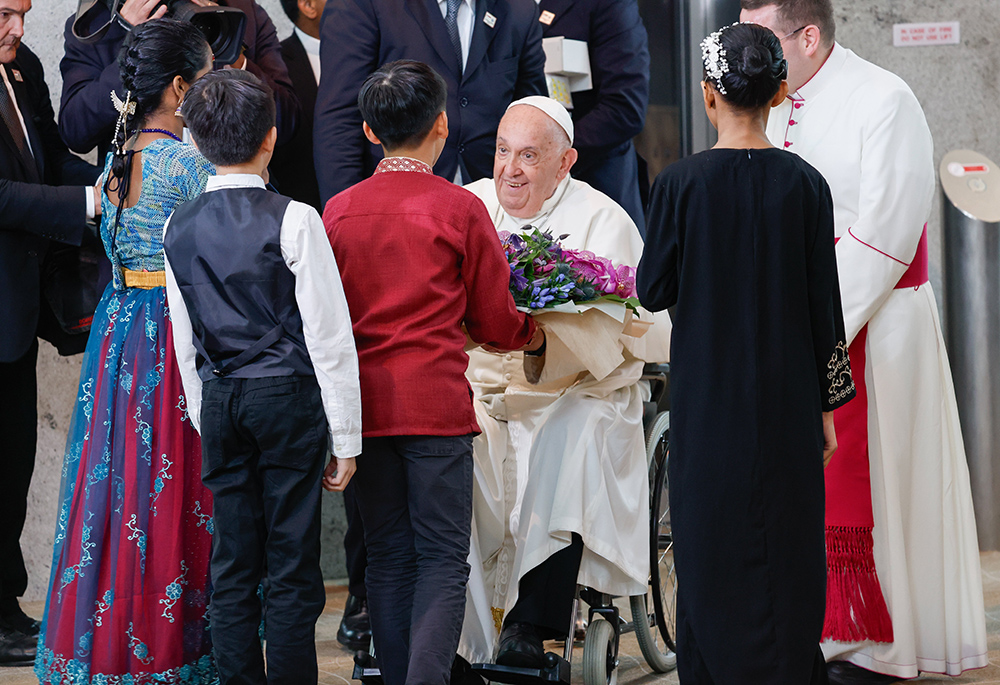
Self-constructed Christianity has other dreadful potentials, too. It produces people who believe abortion is something about which Christ smiles. It mistakenly prattles on social media that Jesus forbade judging anyone or anything. It heralds innumerable genders while encouraging irreversible surgeries for children. Speaking of children, it produces a pope fit for a millstone (Matthew 18:6) as he tells a young boy in Singapore that “all religions are a path to God… and each of us has a language to arrive at God. Some are Sheik, Muslim, Hindu, Christian, and they are different paths to God.”

Regardless of how Pope Francis’ handlers are spinning what he supposedly meant to say, his actual words measured against sound biblical doctrine proved themselves the heresy of religious pluralism, which rejects the essential teaching that Christ is the only way of salvation (John 14:6). Christians do not subscribe to religious pluralism. However, there may be one young boy in Singapore who does now, especially since he heard it from someone who’s supposed to know for sure.

Thinking about last week’s Epistle reading from Ephesians 4:1-6 appointed for worship here at Our Savior, I think Saint Paul indirectly weighed in on these things when he wrote, “I, therefore, a prisoner for the Lord, urge you to walk in a manner worthy of the calling to which you have been called…” (v. 1). Paul says three things here.

First, he insists on faithful abidance in “the calling to which you have been called.” In other words, you’ve been called to something—the Christian faith. That something has a walkway—faithful doctrine. Walk accordingly in it. When you wander past its edges, repent, and go back because the terrain beyond ends in destruction (Matthew 7:13-14).

Second, the walking is to be done in a worthy way. In one sense, it is demonstrative. People will see and hear. A young boy in Singapore saw and heard. Therefore, Paul instructs Timothy, “Watch your life and doctrine closely. Persevere in them, because if you do, you will save both yourself and your hearers” (1 Timothy 4:16).

Finally, Saint Paul already implied from his own situation, which he mentions specifically in Ephesians 4:1, that walking according to our calling could get a Christian into trouble. Behold, Paul was a prisoner for doing what he was even now urging his readers to do.

But here’s the thing.

Neither ease nor trouble affected the stepping stones of sound doctrine for Paul. The path was the path. What’s true was true, and what’s false was false. And so, he walked, and his faith was secure. In fact, it was armor-like. It could lean into and withstand the enemy’s thrusts along life’s way. It became fortress-like. Its resident could stand at the walls and confess truth before the barraging legions that surrounded it, even when standing where the enemy could see him meant imprisonment and eventual death.

Luther’s life was similar. Our lives are, too. And yet, together we have, as Luther described, a faith that is not an “uncertain delusion,” but instead, is a “strong, great certainty, which does not let us waver….” We can bear whatever the world brings our way, even a death sentence, and still retain the same kind of unshakeable trust in Christ that’s as simple as believing that “two and three makes five.” Indeed, that’s a simple analogy Luther made. And yet, it’s profoundly powerful. Even better, it’s unarguably true.


In the Presence of Greatness

I was in the presence of greatness on Thursday evening. I genuinely mean this. Although, I should qualify my words. I know plenty of great people, folks I admire. But their greatness doesn’t necessarily make me nervous. In this particular instance, other than the typical sense of extreme inadequacy and complete unworthiness I so often feel while serving during holy worship, it was the first time in a very long time that I found myself awestruck while standing beside another human being.

The first time I remember feeling it was at my wedding. When Jennifer came around the corner from the narthex and into the nave, my whole body responded. It was as if all of it had suddenly decided, “You don’t deserve this woman.” And yet, there was another, more powerfully gripping sense from somewhere else that nudged, “Rejoice. She is a gift of the Lord.”

Another time I felt somewhat bumbling beside greatness was the first time I met Jack Phillips, the cakebaker from Colorado who has spent the last decade of his life enduring the most dreadful attacks by the LGBTQ, Inc. jackboots for his faithfulness to Christ. Just being around him was a privilege. Going out to lunch and talking with him—really talking—now, those were meals in which my chewing and swallowing required total concentration. Forget the body’s involuntary reflexes. Concentrate, Chris. You’re in the presence of greatness.

This past Thursday, thanks to my great friend Jason Woolford (who, by the way, is running for the 50th District seat in the Michigan House and has my full support), I was privileged to sit beside similar greatness. His name was Jon Turnbull.

Jon is a 38-year-old retired Army Major. He is blind. He is partially burned. He has limited hearing. I did a little research into his life, and I learned he endured more surgeries than most people I know combined. He has spent countless days hospitalized. I can’t even begin to fathom the number of hours he has spent in physical and mental rehabilitation.

I offered the opening prayer at Jason’s event. Major Turnbull got up to speak right after me. His father led him to the podium. He told his story. He (a Captain at the time) and four others in his special forces team, one of whom was an interpreter, were in Syria assisting in the efforts to reopen schools and refurbish and resupply the hospitals. Until one day, a suicide bomber approached and detonated himself beside Turnbull and the others in his team. All but Turnbull were killed. The title of his book, Zero Percent Chance, tells you what the folks on the scene expected of the one soldier who was barely alive. And in a way, they were right. He died and then revived three times on the way to and during emergency surgery. 

After he spoke—which he did in a comfortably disarming way, acknowledging his own dry humor—another gent stood up, grabbed a guitar, and led us in singing the National Anthem. Turnbull’s father led his son back to his seat and helped aim his salute toward the flag. We all sang together. I could barely get the words out. By the time we made it to “gave proof through the night that our flag was still there,” which occurs lyrically right after Francis Scott Key’s description of the barrage against Fort McHenry he witnessed, I was at emotional capacity. I couldn’t sing the rest. I was mere inches away from a man living the daily toll required by Key’s red-glaring rockets and bursting bombs.

After the anthem, we sat down. I reached to Turnbull’s dad, patted his shoulder, and smiled. Surprised at first, he smiled back. I didn’t dare pat Turnbull’s shoulder. I didn’t deserve to be near him, let alone touch him. A humble man, I’m sure he would say differently.

I mentioned before that Turnbull’s words were comfortably disarming. I think this was true because he did two things in particular. First, he made sure his listeners understood he loved America and he wanted to be one of its protectors. He knew the dangers involved, and yet, he wanted to stand in the gap. He wanted to get between the ones he loved and the bad guys. He wanted to be the one awake on the tower so that we could sleep peacefully. He didn’t say it that way, but that’s essentially what he said. I think that eased the audience away from sadness and any potential guilt toward gentler gratefulness.

The second thing he did was express his faith in Christ. He didn’t parade it. He simply sprinkled it here and there (Colossian 4:6), but it was enough to show that Christ had never been just a part of his life. His faith was as real as his wounds. And so, at the podium, he gave thanks to the Lord for His grace and assured everyone listening that God obviously preserved him for a reason, even if only to encourage the rest of us to trust in the same way during inexplicable suffering. Again, he didn’t necessarily say it that way, but that’s what he said.

It was all incredibly Christological.

Anyone who reads my scribblings on occasion is likely familiar with the following term: Gospel lens. I sometimes remind readers to view the world deliberately mindful of Christ’s person and work. Doing this, you’ll see things you didn’t before. C.S. Lewis so famously said, “Every Christian is to become a little Christ.” Luther said the same thing. That said, I think Turnbull was a little Christ in his vocation without even realizing it, ultimately becoming a reminder of the One who saved the whole human race. Indeed, he wasn’t necessarily eloquent. Still, there was a Gospel resonance in his words. Turnbull’s story was almost entirely directed toward concern for others. His faithfulness reflected the story of the Savior, Jesus, who wanted to get between us and all that could destroy us. Our Lord did so fully aware of the dreadful consequences. And yet, Christ’s plan to save us did not include rubbing our noses in the guilt-ridden grime of our sinful filthiness, reminding us that He had to die for an inherently thankless world. Instead, Christ brings consolation. He gives a Gospel that replaces guilt with gladness and shame with thankfulness. It preaches into our hearts that Jesus wanted to be the Savior. He loved us, and that love establishes and ultimately produces an otherworldly ability to endure against “the rocket’s red glare, the bombs bursting in air,” giving proof through this world’s night that our Lord is still and always there (Matthew 28:20).

Turnbull had to leave the event relatively soon after he spoke, so I didn’t get the chance to talk with him. At some point, I’ll reach out to him. I’d like the people in my congregation to meet him and experience what I experienced for themselves. In the meantime, we go forward as God’s thankful people, ready to be little Christs for others (Ephesians 5:1). We do this because we believe. Believing comes with risks. We know what they are (John 16:2). And yet, we go. Somehow, we can stand in the gap against a suicide-bombing world doing everything it can to rid us from the earth. A faith like that is not shaky, shrinking at the first sign of trouble. Instead, it can speak alongside Saint Paul, saying, “For if we live, we live to the Lord, and if we die, we die to the Lord. So then, whether we live or whether we die, we are the Lord’s” (Romans 14:8).

I started this morning’s jaunt by saying I was in the presence of greatness this past Thursday. I don’t intend to lessen what I’ve said. Still, Christ gets the final word on greatness. Knowing we’ll apply greatness to those who really stand out—for example, someone like John the Baptist—Jesus said things like, “Truly, I say to you, among those born of women there has arisen no one greater than John the Baptist. Yet the one who is least in the kingdom of heaven is greater than he” (Matthew 11:11). The Lord’s reference to the “least in the kingdom” is a wink to something He’d say later: “Truly, I say to you, unless you turn and become like children, you will never enter the kingdom of heaven. Whoever humbles himself like this child is the greatest in the kingdom of heaven” (Matthew 18:3-4).

In other words, the world is filled with impressive people. Indeed, they exhibit unique forms of greatness. But child-like faith is true greatness.

Indeed, being around Jon Turnbull on Thursday was an exceptional experience. Still, there’s rarely a moment when I’m not in the presence of greatness. Surrounded by believers, a pastor’s life is quite privileged in that sense, one that is so often nudged, “Rejoice. These people are gifts of the Lord.”

A Turkey Flag

Turning left out of my subdivision, a few houses down on the left, there’s a home with a flagpole bracket attached to a tree in the front yard. The homeowners change the flag with the seasons. In the spring, they have a more flowery flag. On the approach of Christmas, the flag is appropriately festive. At other times, the flag demonstrates team pride, flapping their favorite football or baseball team’s symbol and colors in Linden, Michigan’s breezes. Right now, the flag is taking aim at the forthcoming Thanksgiving holiday, displaying a bright-eyed and smiling turkey character surrounded by all the Thanksgiving feast’s usual food suspects. Across the front of these things, in colorful letters, are the words, “Be thankful!”

Of all the flags this home displays, the first time I saw it, I laughed. I’ll tell you why in a moment. However, the more I thought about it, the more the flag became my favorite in the homeowner’s collection. It isn’t my favorite because I appreciate the style of cartoony banners it exhibits. I’m fond of it for its deeper message.

If you’ll allow me an extra minute or two, I’ll offer its explanation this way.

I know plenty of stories from Christian history, but what immediately comes to mind is one I just shared in passing with my wife, Jennifer, and my daughter, Madeline, this past Friday. It’s the story of Antonio Herrezuelo and his wife, Leonore. Herrezuelo was a lawyer in 16th-century Toro, Spain. He and Leonore had converted to Lutheranism, joining the secretive congregation of only seventy Christians in Valladolid. Relative to the times, this was, by nature, dangerous. The Reformation’s contention was in full bloom, and so was the Spanish Inquisition, which, as you may know, was an already well-established conquest intent on purifying the Church through brutality.

As the account would go, the little congregation was discovered, and all its members were accused of heresy—that is, they were accused of believing as Luther believed, which is that one is justified by faith apart from works of the law (Romans 3:28). At this point, accounts begin to differ somewhat. Some say that nearly all the church’s members recanted to save their lives. Other reports say that many did not. Either way, what’s common to most accounts is that as a principal nobleman in the region, Herrezuelo, along with thirteen others of similar status, was imprisoned and brutally tortured. In the end, only Herrezuelo maintained without recanting.

Leonore was kept separate from her husband throughout the ordeal. One account records that eventually, the two stood together before a final court of inquisition. The tribune interrogator is the only one among the court who spoke, and he did so with merciless brevity. He offered the couple what were essentially three choices. First, they could recant immediately and accept imprisonment, trusting that perhaps, in time, a pardon might be granted. Second, if any hesitation occurred relative to their recantations, they would be shown mercy, but only in that they’d be strangled to death before being burned at the stake. In other words, when asked, an immediate recantation was required. Third, if they refused to recant altogether, they would straightway be burned alive.

The interrogator turned first to Leonore and demanded, “What will you do?” Her words were soft between trembling gasps. “I will recant,” she said.

“Repeat it for God and Emperor!” the inquisitor fiercely demanded.

“I recant,” she said, this time with more fervor.

Without pause, the same question was put to Antonio, who, at that moment, stood captured in a frozen stare at Leonore. Prompted again, this time more vehemently, Antonio turned to his ferocious questioner. Still stunned by his wife’s words, it’s said he gave barely an intelligible slur, tearfully offering, “I cannot. I cannot recant.”

He was not asked a second time. A motion from the chief inquisitor stirred the guards to immediate action. Antonio was shuffled from the room to the nearby square. Another account depicts Antonio reprimanding his wife as he left. Others do not. Others portray a man led to a pine post on a readied platform at the center of a town swelling with as many as 200,000 onlookers. Tied to the post still nubbed and sap-sticky from branches hastily pruned for the event, a blindfold was added. Antonio’s last words were an unrelenting plea to his wife, “Leonore! I thank God for you! Please return to Christ, my love!”

Unable to see, he called in every direction, doing all he could to shout above the taunting noise from the gathered spectators, some even crowding the rooftops. Indeed, and surprisingly, Leonore heard him.

“Please return,” he continued crying. “We will be united together in heaven!” Annoyed by his persistence, one guard shoved a burlap wad into his mouth. For good measure, another stabbed him with a spear.

After a ceremony that included an hour-long sermon against the so-called heresy of salvation by grace through faith alone, the fire was set. The flames were stoked. Dreadful moments passed, and Antonio was dead.

Still in prison several years later, Leonore called to the guards from her cell early one morning. She requested an audience with a magistrate. Eventually, a court representative arrived. With the same quivering voice as years before, she informed her visitor, first, of her thankfulness for her husband’s steadfast faithfulness to Christ at his death, and second, she expressed gratefulness to Christ for His continued grace measured against even her dreadful betrayal. With that, she demanded her visitor send word that she had rescinded her recantation.

The message was delivered. Leonore was judged, condemned, and executed the next day.

It’s said she whispered to her executioner as he tied her to the post, “My first words to Antonio will be, ‘I have returned to our Jesus, my love.’” Her last words were, “Oh, give thanks to the Lord, for He is good, for his steadfast love endures forever.’”

So, what does this have to do with the flag adorning the tree around the corner from my subdivision’s entrance—the one with a smiling turkey?

The story I just shared has both of its victims giving thanks when thankfulness seems wholly inappropriate. When you think about it, a turkey is the one guest at the Thanksgiving Day feast who is killed, cooked, and eaten. And yet, there he is on the flag announcing to every passerby, “Be thankful!” Again, for as cartoony as the banner is, this is an extraordinarily rich image. It is a Christian image.

A lot is happening in America right now; there are some incredibly dreadful things. For one, Christianity is more than being pushed further and further into the shadows of criminalization. People are considered backwater bigots for holding to the truth of God’s Word. As this devolution continues, the temptation increases among us to ask, “What, exactly, is there to be thankful for?”

Many churches don’t offer a Thanksgiving Day service. That’s unfortunate. We do here at Our Savior. In case you’re interested, it happens on Thanksgiving Day at 10:00 a.m. Interestingly, one of the appointed texts for the day is the same as Leonore’s last words. At some point during the liturgy, God’s people will sing, “Oh give thanks to the Lord, for he is good, for his steadfast love endures forever” (Psalm 107:1). Why would we sing these words? Well, it isn’t because of what we see occurring in the world around us or because of what we must endure day after day. Instead, it is because of what we know by faith.

By the power of the Holy Spirit at work in believers for faith, even as everything around us may be coming undone—even as the fires of persecution rage, as we are betrayed, slandered, unjustly maligned, and brutally mistreated by the powers and principalities of this fallen world—we can and will be thankful to the Lord. Why? Because the most insurmountable of all insurmountables was conquered by Christ. He defeated Sin, Death, and the powers of hell for us. By His person and work, through faith in Him, we’ve been made His own. Knowing this, let the world kill, cook, and eat us. From among all on this transient blue ball hanging in space, we’re the only ones with an otherworldly viscera enabling us to lay our heads on the chopping block the same way we’d lay them on a pillow to rest. We can close our eyes in peace, knowing we are not inheritors of this world. We are inheritors of the world to come (Matthew 25:34, Luke 12:32, Romans 8:17). For a believer to live is to do so beneath Christ’s gracious benediction, no matter what we suffer. For a believer to die is not loss but gain beyond measure (Philippians 1:21).

Remember this. And when you forget it, may God be so gracious as to remind you. He reminded me this past week while driving past a flag with a turkey on it.

A Better Season

October has essentially come and gone. November is at the door. With it comes Novembery things. Into the trash, the weeks-old jack-o-lanterns will go. In exchange, some Thanksgiving décor will adorn front porches, bookshelves, and kitchen windowsills. Some among us won’t be able to resist putting out a few Christmas-leaning decorations, not necessarily a fully decorated tree. Maybe just a miniature Dickens-style village here and a snowman character there. Perhaps a wreath on the front door.

Henry David Thoreau called November the calendar’s mite, reminiscent of the gift given by the widow in Mark 12:41-44. He implied it doesn’t give much, but what it does offer—the last yellowing lights of autumn—are “more warming and exhilarating than any wine,” ultimately making it “equal in value to the bounty of July.” I’m not so sure I agree, being the summer man I am. July offers a steady repertoire of pleasantries that few other months can match. Although I suppose following Thoreau’s poetic lead, if I did have to compare November with July, one thought does come to mind. I’d say July gives us one particular day with a splash of color: Independence Day. The annual fireworks celebrations typically conclude with a minutes-long sky-filling grand finale. Autumn renders a far lengthier and much more extravagant array of colors, and November is its grand finale. Until the first snow pulls what’s left of autumn to the ground, November will spend its days bursting with fantastical hues.

The only other real praise I’m willing to give to November is for my wife’s birthday. I’m thankful in that regard.

Still, apart from playing a role in my wife’s entrance into this world, I prefer to look past November. Better yet, I prefer to look past winter altogether. Although, it’s been said that if you’re always looking to the future, you’ll ruin the present. Or maybe it’s the other way around. Either way, the autumn and winter months weigh heavily on me. They have me wishing for sun-beaming warmth pouring down from cloudless skies, days when I need to be more concerned about sunburn than bone-stinging windchill.

As you may already know, I was pretty sick for almost two weeks. I didn’t start feeling like myself again until this past Friday night. I went to bed at 10:30 p.m. and woke up twelve hours later. It was obvious I needed the sleep. I share this because I spent almost every day during this recent illness looking to the future, continually reminding myself, “This is only a season. Another season is coming, a better season. Tomorrow will be better.” This was not an exercise in the power of positive thinking. I would speak this way only after praying to my Lord for the hope He alone can provide. In other words, my regular exercise was one of anticipating something better.

I know I can only reach spring and eventually enter summer once I have first traveled the blustering valley of winter. Similarly, I know I must pass through the harder seasons of mortality before entering something better. But no matter the circumstance, whether the melancholy of actual winter or the failing flesh in sickness, I’ll have no strength to endure anything this world wields against me without the hope Christ provides. And each challenge will be nothing less than a microcosmic image of God’s promised grace in struggle and deliverance for eternal life. This is the ongoing exercise of Christian hope, a challenging but powerful regimen. It not only teaches us to trust that God has us well in hand right now, but it has eyes for a far better tomorrow, one where hope is no longer necessary because it has been completely fulfilled in the glories of eternal life.

Considering Titus 2:13, Luther described it this way:

“But how long shall we wait for that blessed hope? Will it remain but a hope forever, and will it never be fulfilled? No, [Saint Paul] says, our blessed hope will not always remain a hope, but it will eventually be made manifest, so that we shall no longer only hope and wait for it, but what we now believe and hope for will then be made manifest in us, and we shall possess with full certainty what we now await. But meanwhile, we must wait for that blessed hope until it be revealed.” (Sermons from the Year 1531, W.A. 34. II. 117.)

The waiting is the hard part. It’s life’s winter. It’s the season of bodily illness, job loss, dysfunctional families, persecution, and so much more. Still, we know by faith we bear an otherworldly strength that can “rejoice in our sufferings, knowing that suffering produces endurance, and endurance produces character, and character produces hope, and hope does not put us to shame, because God’s love has been poured into our hearts through the Holy Spirit who has been given to us” (Romans 5:3-5).

I pray you are well and enduring whatever the world insists on throwing at you right now. Winter is coming. But it’s only a season. Another season is coming, a better season.

Imperishable, Undefiled, and Unfading

One would think I should’ve been a weatherman because I’m so obsessed with the seasons. Although, it isn’t an obsession. It’s frustration. I live here, but I’m not meant for this climate, especially not the back-and-forth Michigan is currently enduring.

I dare say even the ones who adore autumn in this state will know what I’m talking about. The days are becoming wildly different.

I suppose one way to describe this is to say that, indeed, summer is over, and as a faithful doorman, autumn is watching for winter, preparing to hold open the gates when it arrives. Until then, autumn fidgets. It keeps opening and closing the door, stepping out to scan the horizon for winter’s caravan, and then stepping back inside again to watch and wait. By this, autumn stirs wildly different weather, sometimes all in one day.

Again, Michiganders will know what I mean. One moment, the sky is clear, and the sun is shining, warming all within reach of its bright array. It’s as if August locked the door, barring September and its followers from entering. But with little more than a glance to the horizon, thick clouds are invited over and into view. The door is thrown open. The sun is nudged away, its beaming warmth exchanged with chilly darkness and drizzling rain. In other words, to endure Michigan’s autumn means to be in August one minute and then October the next. One moment, the sky’s sapphire happiness is vast and cheerful. The next, you’re in deep space, a hundred million miles from our solar system’s star.

But then winter finally arrives, and that’s that—no more confusion.

I began by saying I’m not meant for this climate. I mean that in more ways than one. Interestingly, one of those ways, in part, explains why I’d never willingly leave Michigan. In truth, physically, I’m suited for Florida. My body feels better when I’m there. My back feels better. I have fewer migraines. However, God put me in Michigan. This is where my vocation’s muscle is flexed. I’ve come to realize my vocation—my combined roles as a husband, father, pastor, and the like—are less about location and more about devotion. I really can live just about anywhere when I’m confident that God has me right where He wants me. Where He puts me is a part of what He wants for me. What He wants leads to eternal life (John 6:40), which is eternity’s joyful location—an inheritance far beyond this life’s comforts.

When a Christian trades interest in this life’s comforts for the joy of the life to come, it’s incredible what can be endured. This world, steeped in its undoneness, is seen for what it is. Still, even as we endure, it’s amazing how the sun perpetually shines when, by faith, you know you’re not an inheritor of this world but of an altogether different sphere.

Saint Peter referred to this inheritance as “imperishable, undefiled, and unfading, kept in heaven for you” (1 Peter 1:4). He went on to say that this remains true, even as we are “grieved by various trials, so that the tested genuineness of your faith—more precious than gold that perishes though it is tested by fire—may be found to result in praise and glory and honor at the revelation of Jesus Christ” (vv. 6-7). Luther explained:

“This means that our hope is not set on possessions or an inheritance present here on earth, but we live in the hope of an inheritance which is at hand and which is incorruptible, and which is undefiled, and that does not fade away. We possess this good eternally, only we cannot see it yet. … All things that are on earth, even though they may be as hard as iron and stone, are perishable and cannot last. Man, as he grows old, grows ugly; but the eternal good does not change, but remains fresh and green forever. On earth, there is no pleasure so great that it does not pall in time. We see that men grow tired of everything, but this good is of a different nature.” (Luther’s Works, Weimar Edition, 12:269.)

“…there is no pleasure so great that it does not pall in time.”

In this life, the seasons change. The cold moves in. The clouds pall the landscape. The light dims. And yet, eternal life’s season—our inheritance—remains unphased. It’s ready and waiting (John 14:2-6). It stands sturdy and cheerful and sure, beaming brightly beyond this world’s veil of tears (James 1:17). What’s more, as Luther remarked, not only do we know this, but we own its resplendence right now. “We possess this good eternally,” he wrote, “only we cannot see it yet.” It’s true. Our mortal eyes cannot see heaven’s glory. But faith sees it. And it’s aware that the light feeding heaven’s extraordinary brilliance—Jesus Christ—is alive with us right now, and He’s radiating luminously through us to a darkened world in dreadful need of rescue (John 8:12; Matthew 5:14-16).

For Christians, when life in this world becomes attuned to this hope-filled future, there’s little that the temporal darkness can disrupt. Knowing I’m not an inheritor of this world—that my time here is quite temporary—I see everything this life throws at me differently. More importantly, courage for faithfulness to Christ, my Savior, is within reach every moment of every day (Ephesians 6:10).

Having said all this, I need to be clear. I still intend to live in Florida one day. If God intends it, it’ll happen. Until then, I’m where I need to be.

A Shelter, Fortress, and Resting Place

Near the end of the Lutheran marriage liturgy, a prayer is prayed. Technically, three prayers are prayed. The first is for the groom and bride. The second is for all marriages and the homes they produce. The third is the Lord’s Prayer. The prayer I’m thinking about right now is the second prayer. It reads:

“O God, our dwelling place in all generations, look with favor upon the homes of our land. Embrace husbands and wives, parents and children, in the arms of Your love, and grant that each, in reverence for Christ, fulfill the duties You have given. Bless our homes that they may ever be a shelter for the defenseless, a fortress for the tempted, a resting place for the weary, and a foretaste of our eternal home with You; through Jesus Christ, Your Son, our Lord, who lives and reigns with You and the Holy Spirit, one God, now and forever. Amen.”

I suppose the prayer comes to mind for a few reasons. First, my son, Joshua, and his fiancé, Lexi, will start their premarital counseling classes with me soon. Anyone who wants to be married in this congregation must take these classes. Being related to the pastor provides no exception. Of course, I did offer to step aside and let someone else do it. Nevertheless, they insisted that I be the one, and I’m happy to help.

Perhaps the second reason is that very soon, two longtime and beloved members of this congregation will celebrate their 65th wedding anniversary.

Wow. Sixty-five years.

We can all admit that such marital spans are almost unheard of today. Not necessarily because it’s sixty-five years, but because marriage has more or less become disposable. Before I continue, I should say right away that I appreciate the folks who work hard to preserve marriage, especially those whose marriages may have been undone by divorce. It’s a sensitive subject, I know. Still, I commend the ones who did as their Lord required. They endured a proverbial meatgrinder, pursuing every avenue to preserve the sacred bond. Emotionally thrashed, they didn’t give up, even when they had the biblical license to do so. They kept their eyes fixed on what God said was better. They’ve more than demonstrated their verve as spouses. They’ve more than proven their desire for a home described by the above prayer, one that is “a shelter for the defenseless, a fortress for the tempted, a resting place for the weary….”

I suppose these things relate to another reason this prayer came to mind. Each time I’ve prayed it during the marriage liturgy, I’ve been moved by the words. In a sense, it isn’t necessarily describing a perfect home, but instead, the kind of home produced by marriage to a perfect friend. Or maybe a better way to say it would be the home God makes possible when He pairs a person with a genuine best friend.

For as uncertain and cruel as so many circumstances and relationships in this world can be, in marriage, God provides that one unfailing friend with whom to endure all of it. “It is not good that the man should be alone” (Genesis 2:18). God was right. Speaking from experience, my wife has been a reliable shelter whenever I’ve needed refuge from the pelting world. Through times of seemingly endless attacks, Jennifer has been a fortress. Through one exhausting event after another, going home to my bride has been the fulfillment of promised rest.

I’ll bet if I asked the folks who’ll be celebrating their sixty-fifth year of marriage about these things, they’d likely agree.

Now, don’t get me wrong. Even the best marriages aren’t perfect. Whether one day or sixty-five years into the marriage, trouble is likely to appear. There’s a saying that few men or women are so perfect that their spouses do not regret marrying them at least once daily. Maybe that saying bears a little bit of truth. Humans are born sinful. I can promise that I give Jennifer plenty of reasons for strapping me to a golf tee, pulling out her driver, and thwacking me into the woods. Of course, I’d never say the same thing about her—at least, not in print. (I’d likely need a sand wedge with her.) Still, with the Lord’s promised grace enveloping a marriage, the kind born from the person and work of Jesus Christ—a divine grace that immerses both the husband and wife in a tidal wash of daily forgiveness—not even the worst of marital catastrophes can parch such a relationship, let alone the annoyances that plague one day to the next.

This is what the above prayer means when it talks about being embraced in the arms of God’s love. It’s a good prayer. Of course, it stands in the shadow of the greatest prayer: the Lord’s Prayer. The Lord’s Prayer says all this and more, especially when you consider that everything it asks passes through the hope-filled words “Thy kingdom come, Thy will be done….” If you’re familiar with Luther’s explanation in the Small Catechism, then you know that to ask for God’s kingdom to come is to pray that “our heavenly Father gives us His Holy Spirit, so that by His grace we believe His holy Word and lead godly lives….” To ask, “How is God’s will done?” is to hear Luther reply:

“God’s will is done when He breaks and hinders every evil plan and purpose of the devil, the world, and our sinful nature, which do not want us to hallow God’s name or let His kingdom come; and when He strengthens and keeps us firm in His Word and faith until we die. This is His good and gracious will.”

A marriage rooted in God’s mercy delivered by His Gospel Word for faith rests in the Savior’s wonderful embrace. His protective care is a sturdy bastion capable of withstanding the devil’s terrible assaults. This is true not because the spouse He gives in marriage is perfect but because the Lord is. With Him, a marriage has everything it needs. With Him, sixty-five years with the same person becomes an immeasurable life-long joy shared with a best friend.

Making Plans

It feels like the summer is flying right by. Thankfully, I do have things to show for it. I’m certainly not wasting time.

As a parent, I keep on my kids about things relative to time. For example, I occasionally remind them in my own way that someday will eventually become today, and unless you’ve planned accordingly, what today requires will be entirely inaccessible. A person simply cannot live without thinking of the future.

In some discussions with my kids, I try to steer them toward calculating one’s self-sufficiency relative to backup plans. In other words, you cannot always rely on other people. They will let you down. In the same way, you cannot always count on the things you think you can count on. Things wear out and break. Apart from syncing to a cloud-based drive, it’s why I have two external hard drives, each backing up from my computer’s working drive every four hours. It’s why I always bring my laptop to my church office every Sunday morning. If my office computer has problems, I can use my laptop to write and send the eNews and, if necessary, finish my sermon and the service prayers. It’s also why I’ve learned how to use my cell phone as a hotspot. If the internet is down on Sunday morning, I can still get this eNews message sent. It’s also why I have a second printer in my office. If the office printer is down, I can still print anything I might need in a pinch.

I didn’t always live my life this way. But I do now. A few unfortunate circumstances over the years taught me just how right Ben Franklin was when he said that failing to prepare is to prepare to fail. As a result, I do what I can to have a backup plan. Most often, I have two, and sometimes, even three.

I don’t mean to say that the future is controllable. It isn’t. Only the Lord knows what will or will not be, and plenty of people have prepared for the future in every imaginable way, only to suffer future-shattering tragedies beyond their control. For all my planning, I once showed up to the office on a Sunday morning and, attempting to print my sermon manuscript, discovered the office printer was down, the ink in my second printer had dried up, and I had zero replacement cartridges. I had to write it by hand. Twenty-eight years ago last week, my twenty-four-year-old brother Michael was killed in a car accident. Here I sit today, still astounded that he’s not around. His absence was something my family and I never expected.

Simple or grand, even when you prepare, tomorrow is never for sure.

I read a portion from Luther this morning in which he wrote, “Christ has not freed us from human duties but from eternal wrath.” He goes on to say that even as we strive and prepare, the only certainty we’ll ever truly have is situated in Christ. Faith receives that certainty. It can receive it because it understands what laboring in this fallen world as a responsible human being means, even when we know everything we’re doing could be for naught and could all come crashing down. Before it even begins a task, faith admits to human brittleness and life’s uncertainty. From there, it plods along diligently, knowing that you win some and you lose some. Faithfulness, not success, is key. It can live this way because its mortal future isn’t its final future. It is secure in Christ for a future beyond all futures. Destruction is not the last word for believers, not because we worked hard or devised a plan to avoid Sin’s inevitable wage, but because God had a plan for carrying us through it. He enacted that plan in Jesus, the God-man in whom faith is placed.

Relative to this, Christians do work hard. And they plan. Leaning on Luther, he mentions God’s gifts of reason and sense in his explanation of the First Article of the Creed in the Small Catechism. Our reason and our senses make these things possible. But remember, as Christians prepare, they measure their futures by looking through Gospel lenses. Faith doesn’t make plans apart from looking to Christ. Faith does not plan a vacation without planning a way to be present in worship while away. Faith does not invest financially without mindfulness for Christ and His bride, the Church. Faith considers the Gospel’s perpetuation for future generations when voting today. Faith plans, all in faithfulness to Christ and the benefit of the neighbor.

Again, do the plans always succeed as we intend? No. Remember: faithfulness to Christ, not success. Faithfulness to Christ is blessed. Saint Paul assured us that “all the promises of God find their yes in Him” (2 Corinthians 1:20). Of course, that truth is a theme throughout God’s Word (Proverbs 28:20, 1 Thessalonians 5:23-24, 2 Thessalonians 3:3-5, and others).

By the way, by blessing, God is not promising health, wealth, and other sorts of earthly things. Again, He promises the future beyond all futures—the eternal reward that’s inedible to moths, out of reach to thieves, and impervious to Death itself (Matthew 6: 19-20, 25-33). When a person has this divine schematic (God’s greater plan for an eternal future) in one’s pocket, what terrors can threaten with any real significance?

There aren’t any. And the ones that try are toothless. Read Romans 8:31-39, and you’ll see.

Indeed, Luther was right to measure all our future concerns and their subsequent plans against God’s promises in Christ, referring to all of it collectively as “true freedom” and then continuing that “no man can value it high enough. For who can express what a great thing it is that a man is certain that God is no longer angry with him and will never be angry again, but for the sake of Christ is now, and ever will be, a gracious and merciful Father?”

Theological Etiquette

I don’t know about you, but my early morning startup process is a mixture of ingredients. Coffee in hand, it typically involves a brief interaction with the Bible as prompted by a devotional resource. After that, as long as nothing is pressing, I spend a few minutes reading, whether that be an article or a casual scroll through social media. Last Sunday’s routine enjoyed a visit with John 1:14 followed by commentary from Luther, a portion of which encouraged believers to “further and increase [God’s] kingdom, which is in so many suppressed and hindered by the devil and the world.” Luther continued by saying this happens when we “open to Christ our treasures and present them to Him, as the wise men did. And how? Behold, His Word is written (Matthew 25:4): ‘Inasmuch as ye have done it unto one of the least of these my brethren, ye have done it unto me.’”

Not long after visiting with these things, I read a relatively intuitive quotation from Edmund Burke, a member of the British Parliament during the American Revolution and a critic of Britain’s treatment of the colonists. He said, “All men that are ruined, are ruined on the side of their natural propensities.” In other words, pay close attention to your natural inclinations in any particular situation. Doing so can spare you some of life’s biggest headaches, the kinds that will inevitably do you in.

This is incredibly insightful, so much so that it came to mind later that morning during the Adult Bible study. We’re currently studying Saint Paul’s letter to the Ephesians. Last week, we continued our walk through chapter 5, which began with revisiting:

“Therefore, be imitators of God, as beloved children. And walk in love, as Christ loved us and gave himself up for us, a fragrant offering and sacrifice to God. But sexual immorality and all impurity or covetousness must not even be named among you, as is proper among saints. Let there be no filthiness nor foolish talk nor crude joking, which are out of place, but instead let there be thanksgiving. For you may be sure of this, that everyone who is sexually immoral or impure, or who is covetous (that is, an idolater), has no inheritance in the kingdom of Christ and God. Let no one deceive you with empty words, for because of these things the wrath of God comes upon the sons of disobedience. Therefore, do not become partners with them; for at one time you were darkness, but now you are light in the Lord. Walk as children of light (for the fruit of light is found in all that is good and right and true), and try to discern what is pleasing to the Lord” (vv. 1-10).

Relative to this, Burke’s words seemed strangely appropriate. They understand that restraining the types of behavior Saint Paul forbids requires self-awareness, the kind born from genuine honesty.

I didn’t know it, but philosophically, Burke appears to have been a man after my own heart. He wrote a book entitled A Vindication of Natural Society. I managed to read about ten pages of it on Google Books before ordering a hard copy for myself. In the book, Burke chisels away satirically at deism’s popularity while also showing how proper manners help steer and uphold morality while fortifying the boundaries of natural law. He doesn’t necessarily use the following example, but it came to mind as I read those ten pages—and I shared the thought with the Bible study attendees.

Consider a man opening a door for a woman. When a man does this, he isn’t just being properly polite. He’s also acknowledging essential distinctions between men and women. There are things men can and should do that women cannot and should not. The same is true in the opposite direction. There are things women can and should do that men cannot and should not. And yet, while these things might be otherwise offensive to some, the distinction is acknowledged and upheld by an act of humility. Burke argues that the practice of manners—which are, for all intents and purposes, societal rites and ceremonies—restrain darker inclinations.

Now, think back to Burke’s original quotation insisting that one’s natural propensities, if unguarded, can be ruinous.

Everyone has improper tendencies. Let’s say a particular man has a propensity for lording over women, treating them as shameful lessers. By making a conscious effort to begin opening doors for women, this man takes a step toward restraining this unfortunate inclination. He’s submitting himself respectfully to the role of caretaker without unnaturally emasculating himself. The process acknowledges a man’s biblical role of headship, yet it does so in love. The practice of manners—the societal ceremony—helped maintain this framework. I’ll give you another, more personal, example.

I had a good circle of friends in my earliest high school years in Danville, Illinois. Believe it or not, even as testosterone-enriched athletes, we were never inclined to swear. The rest of our teammates were. Outnumbered in this regard, as a result, there came a time when swearing began infecting our circle. To stop it, the four of us pledged to punch one another anytime an inappropriate word crossed our lips. A few days and lots of bruises later, we brought what was becoming a natural propensity under control.

It’s too bad I cannot continue employing such tactics as a clergyman. But I digress.

In short, my friends and I knew ourselves. We were honest about what was becoming a dreadful propensity. We were Christians, and we sensed foul language’s incompatibility with our faith (and, as Burke might suggest, its erosive effect on a moral society). With that, we warred against the tendency with a ceremony capable of maintaining the boundaries (Ephesians 4:29-30, 5:1-13). We did this before the propensity ruined us. Interestingly, the ceremony was unpleasant when used. It hurt. But it was worth it. I should say, it’s likely even Saint Paul would have approved. In 1 Corinthians 9:27, the verb for “discipline” (ὑπωπιάζω) means to strike something physically. Paul appears willing to use extreme techniques to keep his own body under control. Getting punched, perhaps by Timothy, wasn’t off the table.

During last week’s Bible study, I wondered out loud if any of this was relevant to worship style. Of course, my wondering was rhetorical. How could it not be? That’s one of the benefits of traditional worship’s maintaining of historic rites and ceremonies. In a way, they’re theological manners.

Tradition understands man’s propensities. It knows we want things to be our way (anthropocentrism). To restrain this more-often-soiled-than-not tendency, rites and ceremonies—spiritual etiquette—carry the worshipper along in ways designed to exchange anthropocentrism with Christocentrism. In other words, their purpose is to force man out from the center of his own universe and put Christ firmly in the middle.

Understandably, rites and ceremonies are multifaceted, and like getting punched by three friends all at once, they can sometimes be uncomfortable. I get that. They’re strict means of exercise. But the most rigorous kinds of training often produce the best results. In this case, the singular goal of each word and motion is a heart fixed securely on Christ by faith and a new propensity—a Spirit-driven inclination—to imitate Him in the world around us (Ephesians 5:1).

Man’s Deepest Need

Merry Christmas to you and your family!

I wanted to take a quick moment to interrupt your morning festivities by sharing a few potent sentences from a Christmas Day sermon given by Martin Luther in 1531. He wrote, and subsequently preached:

“The world is happy and of good cheer when it has loaves and fishes, means and money, power and glory. But a sad and troubled heart desires nothing but peace and comfort, that it may know whether God is graciously inclined toward it. And this joy, wherein a troubled heart finds peace and rest, is so great that all the world’s happiness is nothing in comparison.” (W.A. 34. 11. 505.)

Luther’s words demonstrate a firm grasp on the meaning of our Lord’s arrival at Christmas. Within a relatively short span, he describes how the world sees Christmas as little more than a passing opportunity for happiness born from selfish indulgence. Not much has changed in the last five hundred years. The world still takes comfort in transient things—food, money, earthly authority and the prestige that accompanies it, and so many other trappings. It does this forgetting that all of it has an expiration date. In contrast, Christians know that when it comes to meeting the challenges faced by an honest heart cognizant of its eternal predicament and its absolute inability to do anything to change it, something more than what the world can give is needed.

Christmas is the first movement of the divine “something” put in place to meet the need.

The birth of the Savior, Jesus Christ, is God taking aim at Mankind’s deepest need in preparation for pulling the Good Friday trigger. And when this ferocious need is finally met on Calvary’s cross—when Sin, Death, and the devil are taken down once and for all by the provision of God’s Son—for whoever believes this, Luther describes the eruption of an otherworldly joy that simply cannot be outclassed by anything the world might think to offer in trade.

A troubled heart will never know more peace than what the Gospel gives. Money can’t surpass it. Power cannot compare. Not even a life of glorious ease will ever come close to the rest God promises that lasts through and into eternity.

As it meets with this wonderful Gospel, my prayer for you this morning is two-fold. Firstly, I hope as you are opening gifts you will remember the temporary nature of such things, and as such, will know to give thanks to the One who has given you the greatest gift this world could ever know. Secondly, I hope you’ll be moved to interrupt the temporal moment of gift-exchanging in order to join with your brothers and sisters in Christ in an eternal moment—holy worship—meant for receiving the merits of the greatest gift given.

The Lord bless and keep you.

And again, Merry Christmas.

Sometime, Just Sometimes

Considering that today is Reformation Day—a day marked by actions resulting in events that changed the course of the entire world—I suppose I’ll just go ahead and put this out there to see what happens.

I sure am glad that Martin Luther didn’t just pray for his enemies, but that he actually fought back, having engaged them in ways that eventually stopped the wheels of a dreadful machine intent on stripping humanity completely clean of the Gospel of salvation through faith in Christ alone.

Thanks, Martin, for reminding us that there’s more to Christian faithfulness than prayers, pious intentions, and potlucks. Thanks for showing us that sometimes—just sometimes—blades need to be sharpened and armor needs to be fastened as battle lines are drawn against the cosmic powers aligned in opposition to Christ and His Church.

Allow me to keep going.

I suppose while I’m sharing these things, I’ll add that I’m glad David went toe to toe with Goliath instead of staying home and figuring that God would sort it all out in His own way (1 Samuel 17). And speaking of this same future monarch, I’m glad the prophet Nathan was willing to risk his own life to confront King David regarding his murderous affair with Bathsheba. I imagine a prophet facing off with a king would be quite the sight.

I should say I appreciate the trifecta of Shadrach, Meshach, and Abednego. When King Nebuchadnezzar imposed mandates that stripped away their religious liberty, they stood against him. Indeed, rather than simply—and much more easily—excusing themselves from faithfulness by saying it was their duty to obey the governing authorities, they demonstrated a better sense, one proving that sometimes the government is genuinely honored when it is resisted (Daniel 3:1-30).

I’m sincerely thankful for John the Baptist’s exemplary stand before King Herod, namely his unequivocal devotion to God’s moral and natural law in relation to marriage. Too many clergy believe it isn’t their place to deal in such things. Sure, they give their theological reasons. And they sound really smart, too. Personally, I think it’s because they’re scared. And why wouldn’t they be? They know, just as John knew, that their actions might spell their end (Mark 6:17–29).

Oh, what will it profit a man if he gains the whole world and forfeits his soul (Matthew 16:26)? I’ll say this can start when a person gets over his or herself.

Let’s keep going.

I’m grateful that Saint Peter finally put his often misplaced boldness to a better use, having told the Sanhedrin to go fly a kite when they attempted to strip the Apostles of their freedom to preach and teach the Gospel. “We must obey God rather than men,” Peter said, so dryly, and yet so robustly by faith (Acts 5:29).

I really appreciate Saint Paul. For example, right after Saint Paul and his fellow missionary, Silas, had been unjustly beaten and thrown into prison, once the treachery to their rights as Roman citizens was discovered, rather than letting their persecutors off the hook, Paul demanded they be paraded through the city in their shame (Acts 16:35-37). I don’t know if such scenes in the Scriptures are supposed to make me smile, but admittedly, this one does.

Even better, while standing before Festus, instead of accepting what seemed to be the inevitable fate of the “little man,” Paul refused to go quietly into the night, as the poets would say. He worked the system, appealing his rights as a citizen before Caesar, rather than sheepishly shrinking into the easier assumption that he was outclassed and done for, relegating his fate to the simpler hope that God would just have to handle it (Acts 25:9-12).

I suppose lastly, I’m also quite fond of the fact that Paul wasn’t beyond calling out the Church’s enemies by name in his Epistles, effectively neutralizing particular characters’ attempts to corrupt or destroy the Gospel both in public and private (1 Timothy 1:19-20). In other words, move in ways that hinder or pervert the people of God and the Gospel for faith and Paul won’t hesitate to make you famous.

I’m not sure if it’s a good thing, but that, too, has the potential for making me grin.

Now, please don’t misunderstand. You should pray for those who are enemies of the Church, offering regular petitions to God that He would change their hearts. This means laboring in love for them, not only trusting that God will keep His promises to work things for the benefit of salvation, but also bearing in mind that you, too, were once at enmity with your Creator, and yet He loved you enough to redeem you by the life, death, and resurrection of Jesus Christ. It’s by His sacrifice that Christians have real peace, and as a result, they’ve been recreated to desire peace with their foes. Still, having said all of this, I sure do appreciate Amelia Earhart’s practical observation, which offered, “Courage is the price that life exacts for granting peace.” I think she was right by these words. And the examples from God’s Word I described above are proof. They remind us we shouldn’t step from the Gospel assuming that the postures of a bowed head or a turned cheek will be all that’s required when engaging with the world around us. There may be times God shows His love for the world through you by putting you out in front of a giant. It may be that He expects you to take an uncompromising, and quite possibly a personally damaging, position against a bully. He may expect you to be a shield for Christian liberty. He may lead you into an unexpected fray to speak a firm word to a liar, or expose a shameful parade of fools, or publicly decry false theology, or call someone out by name who must be marked and avoided by others.

He may require that you demonstrate genuine honor for the government by resisting it.

In short, faithfulness to Christ may mean stepping up. It may actually mean getting in the way of the Gospel’s enemies and doing what you can to crush them. Yes, crush them. It may mean warring against them, not only to bring their godless ways to a halt, but to do so through deliberate actions that confuse their efforts, threaten their power, and eventually retake the fields they’ve seemingly conquered.

As a side note, clergy who preach against this—or do what they can to get in the way of Christians engaging in these ways—are wrong, and they should be told as much. Perhaps at a minimum, they need to read Saint James’ Epistle in its entirety, being sure not to skip over the more uncomfortable portions describing the loveless spirit that would say to a person in need, “Be warm and well fed” (James 2:16). After that, they might give Luther a quick perusal. They’ll find more than enough content relaying something similar to:

“Our works are God’s masks, behind which He remains hidden, although He does all things. If Gideon had not obeyed and gone to battle with Midian, the Midianites would never have been conquered, even though God could, of course, have conquered them without Gideon. He could also give you corn and fruit without your plowing and planting, but that is not His will” (Exposition of Psalm 138, W.A. 31. I. 435 f.).

Finally, after a little light reading from Luther, may I be so bold as to suggest listening to what I said at our recent conference? Click here to view the video.

Remember, the opposite of Biblical love is not hate. It’s apathy. It’s inaction. For God to have lacked love means for Him to have forsaken us in our condition of Sin. But He didn’t. He reached to us. He acted. Even better, God recreated us by His Gospel to be people who are ready to respond when things are out of kilter. Some of the required actions sting. Some of the required actions are very hard to do. No one wants to be wrong. No one enjoys being told they’re out of line. No one prefers to be told “no.” But God’s holy Law reminds us of just how wrong we are in ways that reach into our very cores. In a sense, the discipline God shows us in this regard is an emanation of His love. It is a warning given to those He’d rather not to lose to eternal condemnation. Because we’ve been recreated by that same love, this is our desire, too. If it isn’t, then we need to check our faith.

And so, to bring this morning’s thoughts to a close, Christians love through action, whether that be by rebuking and correcting, or through gentleness and care. Either way, through the Word of God, the Holy Spirit provides discernment, all the while reminding us that such love will take different forms in different contexts. And part of my point: sometimes—just sometimes—this love must roll up its sleeves and get dirt under its fingernails.