
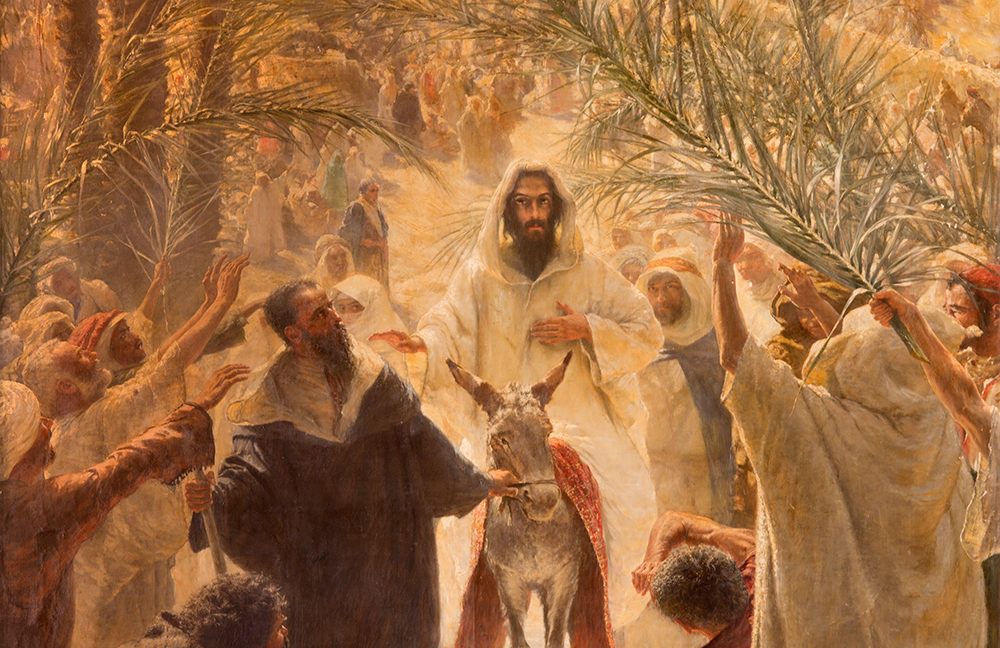
Go With Jesus

For the Church, Holy Week begins today. Christ is in His final approach. The excitement is thick. The gates are open. Nothing obstructs His entrance. The crowds have gathered. Their songs of Hosanna ricochet and resonate from the narrow pathway’s structures. Some have laid one of their few possessions on the road. A colorful mosaic of cloaks paves His way. Others scurried up nearby trees and then down again, having cut palm branches to share. The people wave them in celebration. Men, women, and children—all are praising His arrival. His disciples go before and after the Lord. A donkey carries Him.

Why isn’t He smiling? Why are His eyes bloodshot and swollen? The Gospel writer, Luke, tells us the celebration within the city had already begun on the outside road going down from the Mount of Olives. Making His way, Jesus came to a place before the city’s entrance where He could see Jerusalem in its fullest landscape. Luke records:

“As he approached Jerusalem and saw the city, he wept over it and said, ‘If you, even you, had only known on this day what would bring you peace—but now it is hidden from your eyes. The days will come upon you when your enemies will build an embankment against you and encircle you and hem you in on every side. They will dash you to the ground, you and the children within your walls. They will not leave one stone on another, because you did not recognize the time of God’s coming to you’” (Luke 19:41-44).

The Lord sees what the onlookers cannot, and He is troubled. They hoot and they holler without the slightest awareness of the peace He comes to exact. He’s traveling into and through the “hour and the power of darkness” (Luke 22:53) that erupts when He’s arrested and beaten, when the people will call for His sentencing and death. For them, at this moment, He is a bread king. They’re expecting Him to ride through and into the courts of the powerful—to rid Jerusalem of the Romans and restore Israel’s might among the nations. But that’s not what He has come to do. He is in His final approach toward something magnificently gruesome, and few, if any at all, will know what’s happening when it finally arrives. Oh, its dreadful midpoint on Golgotha’s hill. The ground will shake, the sky will become nighttime at noonday, the temple veil will tear, the rocks will split, and tombs will open, and still, they will not see. A centurion and a handful of guards will exclaim, “Surely, this man was the Son of God” (Matthew 27:54, Mark 15:39, Luke 23:47), but the rest will leave the horrific scene wagging their heads in disgust.

There’s more Jesus sees in that panoramic moment coming down from the Mount of Olives. He knows more as He rides into and through the crowds. He weeps because of it. He knows that a demonstration of the Last Day’s unbearable judgment for unbelief is coming. It will be awful, and yet, it will be little more than an atom-sized ember of rejection’s blue-hot reward, a recompense He does not want to bring.

In the very near future, in A.D. 70, Emperor Titus, the Caesar, will surround and level the city. The historian Flavius Josephus would one day describe the aftermath:

“Now, as soon as the army had no one left to kill or to plunder because no one was left to be objects of their fury (for they would not have spared any had there remained more work to be done), Caesar gave orders that they should now demolish the entire city and temple… much of the wall as enclosed the city on the west side, this wall was spared, in order to afford a camp for the remaining garrison. The towers were also spared, in order to demonstrate to posterity what kind of city it was, and how well fortified, which the Roman valor had subdued; but for all the rest of the wall, it was so thoroughly laid even with the ground by those that dug it up to the foundation, that there was left nothing to make those who came to see believe it had ever been inhabited. This was the end which Jerusalem came to… a city otherwise of great magnificence, and of mighty fame among all mankind” (Wars VII:1-4).

And so, Jesus weeps this first day of Holy Week. His Lenten travelers weep with Him. But our tears are a strange amalgamation of sorrow and joy.

We cry with our Lord in His sadness. We cry for those who remain in darkness and in the shadow of death. We cry because we know the inevitable wage for sin—eternal Death and separation from God—is entirely avoidable. Christ has made a way through. He has redeemed the world! Still, we cry because we know ourselves. Even as He would have us as friends, in our inherent sinfulness, we are at enmity with God. And so, we know our need. We know, by faith, He does for us what we would never think to do for Him.

But therein lies our Palm Sunday joy. He’s the only One who can do it. He’s the only One who would. And we’re so happy that He did. We watch Him make His way, and we’re thankful. He does not necessarily ride on in majesty because He has to, but because He wants to. He loves His world. He loves all of humanity, and as Saint John will very soon experience and then record from the forthcoming Maundy Thursday night in the upper room, “He loved them to the end” (John 13:1).

The end will very soon be upon Him. Follow Him there. Watch what He does. Listen to His words along the way. Turn an ear toward the cross and hear Him remain completely others-focused until His very last breath.

But how will you watch and listen if you do not follow Him there?

The Word carries you (John 1:1-2,14; Luke 24:27; John 6:68; Isaiah 55:10-11; Romans 10:17; Hebrews 4:12; and others). Do not be divided from it. The Word of God—both the person of Christ and the Scriptures that testify to Him—is what leads believers to the cross, sustains them in faith, and delivers the message that is the power of God unto salvation that reveals the depths of Christ’s love (Romans 1:16).

Let it carry you now. Let it lead you through the hosannas and into the coming darkness, that you would not be found unbelieving, but believing, that you would ultimately see—really see!—and rejoice in the light of His resurrection victory. He went there for you. Go with Him and see.

Here at Our Savior Evangelical Lutheran Church in Hartland, we have opportunities every day in Holy Week to be carried by God’s Word through the Lord’s Passion—Holy Monday, Holy Tuesday, Holy Wednesday, and Maundy Thursday at 6:30 pm, Good Friday Tre Ore at 1:00 pm and Tenebrae at 6:30 pm, Holy Saturday’s Great Vigil of Easter at 6:30 pm, and of course, the Resurrection of Our Lord, Easter Sunday, at 9:30 am.

Now, if I might make a suggestion. Please take a chance and share this eNews message with someone you care about.

To the person who just received it: If you don’t have a church home—a place and a people among whom you can regularly receive and give the care of God’s blessed Word—if ever there was a time to consider finding one, Holy Week is that time. You’ll know the theological heart of a congregation from the way it navigates the Lord’s Passion. Beyond this encouragement, there are other things to know. First, the Scriptures mandate this fellowship; it is not optional (Hebrews 10:24–25, Acts 2:42, 1 Corinthians 12:25–27, and others). And speaking practically, look at the titles of Paul’s Epistles. They are written to congregations in places like Ephesus, Corinth, and Rome. Consider the content of each. Apart from teaching,  he provides instruction for good order and sound doctrine in a precise locale—a congregation—established for the Gospel’s perpetuation. Second, and perhaps the best reason to join a faithful congregation: you will be blessed (Psalm 133:1-3, Matthew 18:20, Galatians 6:9–10), just as the Lord has promised.

God Is Not Mocked

Someone asked me this past Wednesday before midweek worship if I was ever concerned about the possible outcome of the national election. I told her I was but that there was a distinct moment for me when my uneasiness became something more like attentive anticipation. By “uneasiness,” I mean that it looked to be anyone’s game. President Trump was doing relatively well. But so was Kamala Harris. For as weak a candidate as she was, donating gaffe after gaffe to Trump’s campaign, her numbers still looked strong.

But then, as I said, my concern went away, instead becoming attentive anticipation. By this, I mean I was no longer wondering who would win but rather what was going to befall the Democrats for something they’d done.

Here’s what I mean—and by the way, I shared these same things with my questioner and a few others who’d gathered to listen.

On April 15, 1912, the captain of the Titanic, Edward John Smith, was reported to have said of his new charge, “Not even God can sink this ship.” Hubris was at the helm, and Captain Smith made good on his taunts. He barreled dangerously through icy North Atlantic waters. However, he sideswiped an iceberg at 22 knots. The unsinkable Titanic sank on April 15, 1912, the ship’s maiden voyage.

Another similar story came to mind. Tancredo Neves ran for the Brazilian Presidency in the mid-1980s. During his campaign, he famously noted that if his party managed to rally 500,000 votes, not even God could prevent him from the Presidency. He was elected on January 15, 1985. He was to be inaugurated a few months later, on March 15. However, the night before his inauguration, he got very sick. He died thirty-eight days later, having never assumed the office.

There are other stories like these that I could have shared. But I didn’t. And I won’t do so here, either. I think you get the idea. That said, Saint Paul wrote rather crisply in Galatians 6:7, “Do not be deceived: God is not mocked.” When God scribbled these words through Paul’s pen, He wasn’t kidding around. Come to think of it, Jesus more than tipped His hat to potential repercussions for mocking Him in the Gospel reading appointed for this morning’s worship. In Mathew 9, just as the Lord enters Jairus’s house to raise his daughter from the dead, Jesus tells the professional mourners to leave, implying their services were no longer required. Specifically, the Lord said, “Go away, for the girl is not dead but sleeping” (v. 24a). But what was their response?

“And they laughed at him” (v. 24b).

The next verse is crucial. We learn that before working His miracle, Jesus put the crowd outside (v. 25). Interestingly, the word used for “put outside” is ἐξεβλήθη. It’s the same word used to describe Jesus’s actions relative to demons in texts like Matthew 9:34 and Mark 16:9. It means to cast out or expel. In other words, it’s an exorcism term. In the situation involving Jairus’s daughter, the scoffers were treated like demons and cast out.

Before I tell you why I’m sharing these things, let me say two things. First, Jesus was mocked horribly during His passion, and He did nothing about it. It had to be that way. He submitted Himself into the domain of darkness (Luke 22:53), letting it have its way with Him for our rescue. Second, I should admit that God is mocked daily. Every time we sin, we mock Him. Unfortunately, that’s the sin-nature’s way. Only by the power of the Holy Spirit given by the Gospel for faith are we enlivened to repent of this disposition and instead be found desiring to love and seek faithfulness to Him. Furthermore, God reminds us that when this re-creation happens, it’s very likely we’ll join Him in being hated (John 15:18-27). We’ll be mocked, too.

But remember, this also works in reverse. When we’re mocked, God is mocked. Indeed, Jesus said, “The one who hears you hears me, and the one who rejects you rejects me, and the one who rejects me rejects him who sent me” (Luke 10:16).

In most cases, I think we can say that people rejecting us, ridiculing our supposed backwater ways as Christians, and calling us names is no big deal. You know, “Sticks and stones may break my bones, but words can never hurt me” and all that. Sure, the words sting a little, but we survive. Nevertheless, America is on an increasingly aggressive trajectory toward employing those sticks and stones alongside the hurtful words. Christians are being physically attacked, going to court, losing their jobs, suffering permanent reputation damage, and so many other dreadfulnesses, all for the sake of faithfulness to Christ. Some of you may remember I just received a rather offensive glitter bomb in the mail this past Thursday. Still, that’s nothing. I’ve been spit on before, too. My point: The contempt for God and His people is no longer harbored secretly, only revealing itself in conversation at elitist cocktail parties. It’s out in the open, and it’s getting worse. Concerning those at the highest levels of government, for the most part, it seems they’ve been careful enough politically to avoid vocalizing the contempt. However, not anymore. In the same spirit as Captain Smith, Tancredo Neves, my glitter-bomb-sending fan, the lady who spit on me, and the laughing crowd thrown from Jairus’s house, Christ and His followers were brazenly mocked on the world’s stage by the Vice President of the United States, Kamala Harris.

On October 17, 2024, Grant Beth and Luke Polaske, two college students attending a Harris campaign rally, were moved to call out “Christ is King” and “Jesus is Lord” when Harris began a full-throated commendation for abortion during her speech. Immediately, the surrounding crowd began taunting and shoving them. No sooner than this happened, Harris paused and spoke directly to Beth and Polaske, saying laughingly, “You guys are at the wrong rally.” Stoked by her seemingly pithy words, thousands of event-goers erupted in jeering applause.

In one sense, and likely unwittingly, Harris betrayed her secret belief. Christ and His people were not welcome at her rallies. In another sense—and somewhat ironically—she affirmed the truth of Saint Paul’s rhetorical questioning, “For what partnership has righteousness with lawlessness? Or what fellowship has light with darkness?” (2 Corinthians 6:14). Indeed, Christ is the light of the world (John 8:12). He calls His Christians the same thing in Matthew 5:14. Harris and her crowds behaved as darkness. But what should anyone expect from the party that calls for abortion on demand and at every stage of fetal development, the spreading of LGBTQ Inc.’s infectious mind virus ideologies, and the promotion of so many other atrocities? What fellowship can there be between light and darkness, between Christians and such ungodliness?

In his own words, Polaske remembered Harris offering a wave and an accompanying “evil smirk” as security escorted him and Beth from the arena. Go figure. Beth told Fox News, “We were heckled at, we were cursed at, we were mocked, and that’s the biggest thing for me personally. In reflection of the event, Jesus was mocked. You know, his disciples were mocked.”

But God is not mocked.

Harris lost her election bid. In fact, I heard on the news driving into the office this morning that she lost by margins in particular states few believed were historically or mathematically possible.

I will not assume that I know the hidden will of God. Candidates win, and candidates lose. Still, God’s revealed will—His holy Word—has declared, “God is not mocked.” This is not a complicated saying. Knowing this, when I first heard about Harris’s words to Polaske and Beth, I went and listened for myself. As I said at the beginning, what I heard turned my uneasy concern into attentive anticipation. I was no longer anxious that Trump might lose. Strangely, I knew in my gut he wouldn’t. Instead, I waited and wondered what might happen in response to the broad-sweeping mockery demonstrated by a world leader with mass influence. I assumed an electoral exorcism at minimum.

Observing only the election results, it sure seems like the “Christ doesn’t belong here” position was cast out. Still, I think more is coming. But that’s just me. I’m not necessarily looking for something more, but as I said, I am attentively aware.

In the meantime, we go forward and rejoice in what promises to be a breath of fresh air in America. But whether it is or isn’t, we go “not as unwise but as wise, making the best use of the time, because the days are evil. Therefore, do not be foolish, but understand what the will of the Lord is” (Ephesians 5:15-17).

I can tell you one thing for sure: mocking God is not in accordance with His will. If you do it, there will be consequences.

Satan is a Toothless Punk

Last week’s eNews prompted an interesting response from one of its readers. The part that stirred discussion was my apparent disregard for Satan’s significance. Referring to the Lord’s words in Luke 22:53, I insisted that Jesus was not referring to Satan by the phrase “power of darkness.” I claimed sin was the power Jesus was talking about, implying I’m not one to give Satan credit as an all-consuming “power.” I did say that Satan is a big deal. Of course, if he weren’t, the Lord wouldn’t have needed to face off with him in all the ways He did. That certainly means the Devil is not to be trifled with. Still, he’ll forever be an agent of sin and nothing more. And so, when the Lord says to Judas, “This is your hour,” He’s speaking to Judas directly and engaging with the one actively inspiring his deeds—Satan. However, when the Lord adds, “and the power of darkness,” He’s referring to sin’s consuming reign in this world. I might consider adding death to the equation. Saint Paul certainly noted its relationship to sin. He wrote that sin once had dominion over us. Within this dominion, he explained that “just as sin came into the world through one man, and death through sin, and so death spread to all men because all sinned” (Romans 5:12).

Looking at what I just wrote, I think I’ll add it to this morning’s sermon manuscript. It certainly fits. One of my goals is to paint a portrait of sin’s deepest significance for the listeners.

Getting back to my original thought, I suppose if I’m wrong about this detail concerning Satan, I’m sure others will be willing to say so. Either way, we’ll find out on that great and glorious day. In the meantime, I won’t go looking for reasons (even biblical ones) to stroke Satan’s ego. He’s been defanged. I have nothing to fear from him, the toothless punk that he is.

Regardless of the person, if someone writes or says something worth remembering, I’ll file the truth of the words away. I do this mentally and physically. That said, I have various quotations printed and taped to the bookshelves in my office. I’ve had one for over a decade from Father Gabriel Amorth. He was the Roman Catholic Church’s chief exorcist for many years. It seems he’s somewhat popular, having become the subject of a recent film starring Russel Crowe. I appreciated something he said during a 2001 interview with an Italian news magazine. The interviewer asked Amorth, “Are you afraid of the Devil.” His response was as it should be:

“Afraid of that beast? He’s the one who should be afraid of me. I work in the name of the Lord. He is only an ape of God.”

As I acknowledged, Satan is a big deal. He’s clever. He’s tenacious. He’s strong. Even Jesus admitted this. In Luke 10, the Lord told His listeners, “When a strong man, fully armed, guards his own palace, his goods are safe” (v. 21). The term “strong man” was a familiar reference to Satan, and so, Jesus’ listeners knew who he was talking about. Still, the Lord concluded the acknowledgment of Satan’s strength as quickly as He began it, turning His listeners’ attention toward Himself, “But when one stronger than he attacks him and overcomes him, he takes away his armor in which he trusted and divides his spoil” (v. 22).

Yes, the Devil is strong. But Jesus is stronger.

In the scheme of things, the Lord spoke the words in Luke 10 well before venturing toward His death on the cross. Doing so, He assured us that the Devil was about to be disarmed and stripped of everything. Later in Luke 22, the time finally arrived for head-to-head combat. The strong man led a contingent to meet the Stronger Man praying in the Garden of Gethsemane. Strangely, the Stronger Man said to the strong man, “This is your hour” (v. 53). In other words, Jesus submitted at that moment and, as such, invited the Devil to do his level best to lay the Lord low. If you keep reading, you’ll see that the Devil embraced the challenge, ultimately delivering measures of dreadfulness we’ll never fully know.

But the strong man’s fun ended when the Stronger Man cried out, “It is finished” (John 19:30). Of course, the Lord’s cry was declarative. He was announcing that the price for our redemption had been fully paid. With a sense for Easter, His words can be heard as, “Alright, that’s enough. It’s my turn, now.” Because it was. By His death, the Stronger Man endured in our place against the strong man’s fury. In that same moment, the unholy trinity of sin, death, and Satan was ultimately taken to the mat and pinned. The Stronger Man walked away at the end of the three-day count, leaving the strong man defeated.

As believers, the Stronger Man is with us (Matthew 28:20). He claimed us as His own in our baptism (Matthew 28:19, Romans 6:3-8, Galatians 3:27, Revelation 7:14-17). We are not apart from Him. We are in Him, and He is in us (John 14:19-20), and greater is the One we bear (1 John 4:4). Because of this, the Devil has every reason to fear God’s people and not the other way around. We confessed as much at Lent’s beginning when we prayed the Litany here at Our Savior in Hartland last Sunday. At one moment along the way, we boldly petitioned that God would continue “to beat down Satan under our feet.”

By the power of the Holy Spirit for faith, that’s precisely what Christian feet can do.

Scan the Church’s hymnody. You’re sure to discover this kind of Christian confidence. You’ll likely experience just how penetrating this reality has been for Christians throughout history. Luther’s great hymn, “A Mighty Fortress Is Our God,” is a perfect example. Stanza three offers with astounding conviction:

Though devils all the world should fill,
All eager to devour us,
We tremble not, we fear no ill.
They shall not overpower us.
This world’s prince may still
Scowl fierce as he will,
He can harm us none.
He’s judged; the deed is done;
One little word can fell him.

Another is Erdmann Neumeister’s “God’s Own Child I Gladly Say It.” A middle stanza of this exceptional hymn demonstrates the same certainty, proving itself emboldened enough to impose demands on Satan:

Satan hear this proclamation:
I am baptized into Christ!
Drop your ugly accusation,
I am not so soon enticed.
Now that to the font I’ve traveled,
All your might has come unraveled,
And, against your tyranny,
God, my Lord, unites with me!

Perhaps another—Jacob Fabricius’ “O Little Flock, Fear Not the Foe”—spends a stanza mocking the Devil and his crew, calling their might “a joke, a mere façade!” Indeed, for those grafted to Christ (John 15:5), Satan is a joke, the kind that prompts regular laughter throughout heaven’s gloriously cavernous halls.

I don’t necessarily want to belabor the point. Suffice it to say that while I’ll admit the Devil is trouble, I do not fear him. By God’s gracious care, I can live with no small measure of certainty that he should fear me. And why? It’s not because of who I might claim to be of myself. It’s because of who claimed me and now stands between me and the strong man: The Stronger Man! And so, just as Luther so famously said, if the Devil would pull me down, he would first need to overcome the One who is my Redeemer and Defender. Christ is mine, and I am Christ’s. Period. I’m happy to let the Devil put that in his pipe and smoke it while I move on to more important things.