
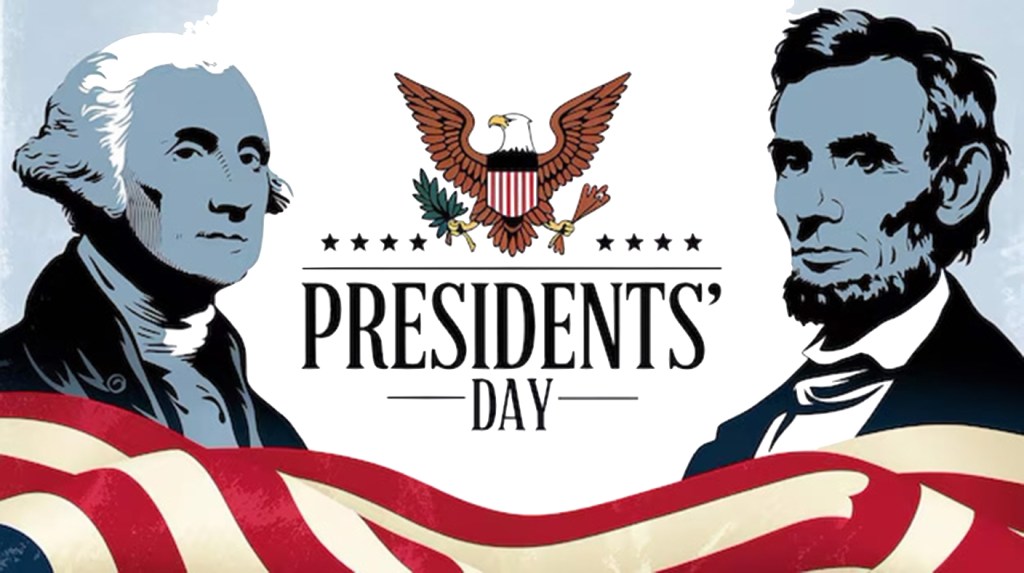
The Thoma family wandered into a discussion about President’s Day this past week at dinner. The nerd that I am, I interrupted the conversation with, “Did you know that Presidents’ Day is not the official name of the holiday?” I went on to nerdily explain that since its inception in the 1880s, it’s only ever been officially recognized legislatively as “Washington’s Birthday.” It wasn’t until the 1960s that a bill was introduced to move all federal holidays to Mondays, and one of the discussion points was to combine Abraham Lincoln’s birthday (February 12, which many states were already celebrating) and Washington’s birthday (February 22, which the whole country had long been celebrating) into a standard date. The combination was successful, becoming the third Monday in February. However, the name change for the holiday failed to pass. Officially, it’s still on the books as “Washington’s Birthday.”
I went on to ask, “Do you know why Congress ultimately failed to associate Lincoln’s name with the holiday formally?” I knew the answer to this question because I’d read some of the congressional floor discussions that encapsulated the essential argument.
As expected, there remained a strong ideological and regional opposition to Lincoln from southern Democrats. While the nation’s 16th president was revered by pretty much all of the northern states, he was still controversial throughout most of the South, even a hundred years after the Civil War. Essentially, and almost unanimously among Democrats, there remained a harbored resentment for Lincoln relative to the war and the national reconstruction that followed. In short, he wasn’t as beloved as you’d think, and it was often instinctual for the Democrats to slight his legacy whenever the opportunity presented itself.
As a result, while the bill’s consolidation efforts succeeded, any on-the-books remembrance of Lincoln failed. That said, the nation’s citizens adopted the name “Presidents’ Day” anyway, and when promoting and celebrating it, both Washington and Lincoln are almost always represented in its imagery. Stop by a furniture store that’s having a President’s Day sale. You’ll likely see images of Lincoln and Washington in its promotional posters.
I like that this is true. It speaks volumes. It’s a nod toward history’s eventual disregard for a government’s ideological foolishness, and it’s a defiant wink to the nitwits at the helm.
The Christian Church understands this contentious existence well, especially when it comes to its holidays. It seems the historical revisionists and liberal progressives have forever attempted to forget Christ, doing what they can to reshape or redefine the origins of Christian holidays. One needs only to consider Christmas and the forthcoming Easter celebration. Year after year, the Church anticipates attempts to impose confused narratives that diminish these holidays’ Christian foundations. In the end, the perpetrators only end up betraying their real intentions: an innate hatred for Christ; at least, it’s betrayed to those of us who’ve studied Christian history. That same history displays a pattern. Christ’s opponents either repackage His celebrations as pagan festivals or distract from them with secular innovations, coming up with goofy activist holidays like Kwanza.
And yet, despite these seemingly never-ending efforts, the revisionist interpretations put forth by truth’s opponents never seem to catch on. Human beings continue to celebrate Christmas as the birth of Christ and Easter as His resurrection, just as they have for centuries upon centuries. Across the world, they still say “Merry Christmas” and call to one another with “He is risen!”
While not precisely the same, this tendency is at least somewhat reflected in the Presidents’ Day celebration. No matter how much the overarching goodness inherent in Lincoln’s efforts was deliberately opposed, the American people appeared to know better, and as a nation, we have instinctively maintained a healthier understanding of the holiday, even calling it by its unofficial and ultimately rejected name.
I suppose one particularly worthwhile angle emerging from today’s rambling is that some things, it seems, are too deeply ingrained in the fabric of tradition and truth to be rewritten by ideological trends. Indeed, truth always has its day.
Are we experiencing this right now as a nation? Maybe. It sure seems like President Trump, a man who was accosted by unjust lawfare for years, is having his day. Musk and the Department of Government Efficiency certainly are having their day relative to long-hidden deviance in government. But that’s just it. Truth has a way of resurfacing and pushing back against worldly foolishness. This should be no surprise for Christians. Truth’s strength figures into our hope. Indeed, Jesus already told us, “For nothing is hidden that will not be made manifest, nor is anything secret that will not be known and come to light” (Luke 8:17). And so, whether in the Church’s steadfast preservation of its holy days or in the American people’s instinct to honor history rightly, truth remains a feisty contender. It refuses to be buried beneath the agendas of the moment.
I find this to be somewhat comforting. I know I live in a world bent on obscuring what is good, hoping to reshape reality itself. It calls a man a woman. It prefers workers based on gender (if they can figure out how to define it) and skin color rather than skill. It rewards liars and penalizes honesty. That said, history continues testifying that such efforts eventually fall short.
Again, this doesn’t surprise Christians. We have God’s Word, and so we know the “grass withers, the flower fades, but the word of our God will stand forever” (Isaiah 40:8). We know we “are afflicted in every way, but not crushed; perplexed, but not driven to despair; persecuted, but not forsaken; struck down, but not destroyed” (2 Corinthians 4:8-9). In other words, we know God’s Word remains, His truth prevails, and His people endure.
Applying this to life, whether it be the remembrance of faithful leaders, the celebration of our Lord’s birth and resurrection, or the whole of the very Gospel itself, no earthly power can rewrite what God has already written or undo what God has done. Jesus said, “It is finished” (John 19:30). And it is.
 I’m once again taking the opportunity to get a jumpstart on the eNews for this week.
 Cruciform Stuff