

Unbroken Consistency

Before Jennifer and I were married almost 28 years ago, we attended pre-marital counseling sessions with our pastor. Rev. Dr. Jon Vieker conducted them. I was serving alongside him as his DCE (Director of Christian Education) at St. Mark Lutheran Church in West Bloomfield, Michigan, at the time. On occasion, Jennifer recalls a question he asked during one of the sessions. It went something like, “Do you sometimes feel like Chris’s personality is different among the congregation than it is when it’s just the two of you?”

Thankfully, Jennifer declared with confidence, “Not at all!” Interestingly, I think she remembers that question more than the others because she gets asked similar questions by folks here at Our Savior in Hartland, Michigan. They want to know if the guy in the pulpit and at the front of the Bible study class is the same around the dinner table or changing a tire on his Jeep.  When the question is posed again, thankfully, her answer remains the same today. Although I’m guessing it sounds a little more like, “He’s still the same doofus in public that he is in private.”

Admittedly, every relationship has its nuances. Unique personality traits emerge among close friends and remain subdued among first-time acquaintances. Still, there’s nothing more troubling than knowing a person’s truest self, only to see it transform into something completely different when others are around.

I know people who are this way, and it bothers me more than most. In my own circles, I know a pastor who is well-beloved as a theologian and scholar, and yet, behind closed doors, he’s the first to break confidences and share every dreadful detail about others he does not like. I know a public figure who carries the same prestige before crowds, and yet, in private messages or by phone, he is unendurably condescending, as though he’s the parent and I am the child.

I know everyone is flawed. This is true because everyone is thoroughly infected by sin. I certainly know I fit into the “everyone” designation. Nevertheless, if I were to categorize everyday human dreadfulnesses, I’d put habitual duplicity near the top of my list of off-putting flaws. A duplicitous person is incredibly hard to trust.

This is true because you can never be sure the version you’re experiencing is real—or worse, if any of the versions actually are. This kind of shifting personality can cause others to walk on eggshells, constantly second-guessing conversations and motivations. It’s difficult to build meaningful relationships with someone who wears different personas depending on the audience. Why is this? Because integrity, which is little more than honesty and consistency stirred together, is the bedrock of trust. Without this, suspicion can take root. Concerning the pastor I mentioned, I sometimes wonder: Regardless of what he says to me in friendly conversation, is the moment genuine, and if not, then what is he saying about me when I’m not around? That kind of unpredictability doesn’t just strain relationships. It poisons them.

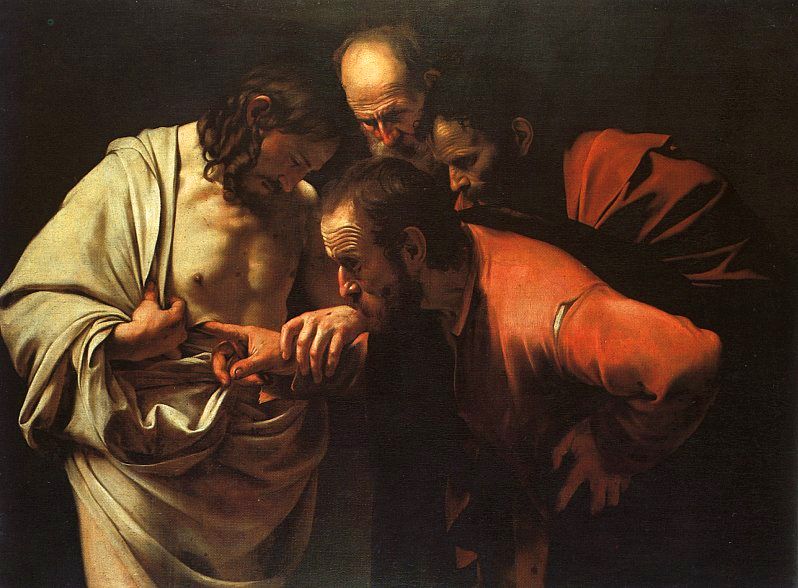
Those who know me best will attest to Thomas being my favorite apostle. I think this could be true, in part, because for all his flaws, he wasn’t duplicitous. He was as genuine as genuine gets. When Thomas questioned the Lord’s resurrection, he didn’t pretend otherwise to save face. He said plainly, “Unless I see in his hands the mark of the nails… I will never believe” (John 20:25). Even better, his demand expects a non-duplicitous Savior. He expects Jesus to be exactly who He said He’d be—crucified, risen, and real—someone Thomas could touch and, once again, embrace. And when Jesus meets him in that upper room of honest inquisition, Thomas doesn’t deflect or backpedal. He doesn’t hide his unfortunate disbelief behind a persona of, “Yeah, well, I actually did know all along you were alive.” Instead, he confesses his surprise with even more excitement than his doubt. “My Lord and my God!” he cries out (John 20:28).

When I visit with other accounts that mention Thomas, I think this authenticity shines through. All along, the disciples often present personas of boldness. But in John 11, when Jesus speaks of returning to Judea, a place where He’ll almost certainly be captured and killed, the disciples express hesitation, fearing their own deaths, revealing they’re not as tough as they like to put forward. But not Thomas. He alone says, “Let us also go, that we may die with him” (v. 16). That’s not theatrical courage. It’s unbroken loyalty.

Authenticity matters. And so, I suppose in the end, that’s really what I’m aiming for—not just as a pastor, but as a man, a husband, a father, a grandfather, a friend, and a neighbor. I want to be the kind of person who doesn’t require others to guess which version of me they’re going to get. I want to be the same guy in the pulpit that I am when I’m elbow-deep in a personal struggle or riding high on joy’s sunlit upland. In other words, onlookers will know I believe what I’m preaching and teaching, and not just in public, but when no one else is around and every moment in between.

Of course, none of us can present such things with unblemished or unbroken consistency. We are all awfully imperfect. Still, by faith, believers cling to the One who is perfect—Jesus Christ—the One who is the same yesterday, today, and forever (Hebrews 13:8). Holding fast to Him, we can shed our masks. Besides, He already knows us better than we know ourselves. For me, there’s great peace in knowing this. It means I don’t need to stage my persona, but I can confess my transgressions honestly. When there’s not a minute to perform, there’s every minute to behold and follow the One who never wavers, never plays a fictitious role, and never fails to be precisely who He promised to be.
Apologizing to Thomas

There is the rather elementary saying that one thing leads to another. It’s elementary because it’s true, and I have the perfect example to share.

You may or may not know this, but I’m a fan of 80s and early 90s sci-fi and horror films. I’ve seen them all, both the A and the B list—from Academy Award winners like “Silence of the Lambs” to straight-to-VHS gems like “Attack of the Killer Tomatoes.” Watching them now, I have to say that many are still very good. They’ve stood the test of time. Others were trash before they ever became a script, and they remain trash long afterward. The special effects were terrible, often intentionally. The dialogue was just as bad. It’s easy to tell that many were made just to be made. Trust me, “Friday the 13th” could have been put to rest after “Part IV, The Final Chapter.” Still, they gave us seven more and an attempted reboot. The same goes for the “A Nightmare on Elm Street” series. “Dream Warriors,” the third movie in the series, was the last of the franchise’s serious attempts. But the thing is, even the cringe-worthy sequels remained great fun. Their hokeyness only made the good films seem better.

Not long ago I was watching a documentary series called “The Movies that Made Us.” One episode focused on James Cameron’s masterpiece “Aliens.” Anyone who’s been in my basement will confirm the film as an absolute favorite of mine. I mean, it did win seven Academy Awards, one of which was for best visual effects.

Anyway, after watching the documentary, I did a little reading about James Cameron. In comparison to his accomplishments, I was fascinated with his beginnings. Interestingly, after seeing “Star Wars” on the big screen, he was inspired to leave his job as a truck driver and take aim at making movies in Hollywood. Personally, I’m glad he took the chance.

Reading about his life, I came across a TV interview he did with a California news station in what I believe was the early 2000s. During the interview, he said something along the lines of, “If your goals are set ridiculously high and then you fail, you’ll already be well past everyone else, having failed well above everyone else’s successes.”

Remember how I said one thing leads to another? Well, here’s why I said it. That comment reminded me of the disciple Thomas. By the way, apart from Jesus, Thomas is the most important character in the resurrection narrative from John 20:19-31, which is also the appointed Gospel reading for the Second Sunday of Easter. Essentially, Thomas is the one who continues even now to get a bad rap for doubting the Lord’s resurrection. But the thing is, his seemingly greatest failure was far above the successes of everyone else in the bunch. Here’s what I mean.

All the disciples deserted Jesus. Peter denied the Lord. Still, it would appear that after the crucifixion and burial, all but Thomas were gathered together in the upper room. The narratives say this happened because the disciples were afraid of what the Jews would do to them, too. But where was Thomas? I’m willing to bet that the answer is assumed by the ease with which the disciples retrieved him after the Lord’s first resurrected appearance among them. They went to where they knew they’d find him—at home. Thomas went back to his life, apparently having already accepted his fate concerning a failed messiah.

But Jesus hadn’t failed. And so, the disciples went to Thomas to tell him the Lord had risen. What were Thomas’ words in reply?

“Unless I see in his hands the mark of the nails, and place my finger into the mark of the nails, and place my hand into his side, I will never believe” (John 20:25).

These words prove Thomas’ failure was well above everyone else’s successes. While everyone else was stowed away in fear and asking questions bent on self-preservation, Thomas had subscribed to his fate. But he did this bearing the embers of a faith that was asking for the only proof Jesus had ever promised to give. In other words, Thomas knew (whether consciously or subconsciously) that his faith could only be rekindled when he met a living Jesus with crucifixion wounds.

I was asked a few weeks ago who I’d like to meet first in heaven. Apart from the Lord Himself, and then my brother, I hope to meet Thomas. I intend to apologize to him on behalf of any human in history who ever used the title “Doubting Thomas” to describe him. Indeed, Thomas’ failure was well above the rest of our so-called successes. In the darkest hour of Good Friday and Holy Saturday’s deepest confusion, Thomas was asking the right questions. Everyone else was asking for personal safety. Thomas was asking to see the One who would eventually say by Revelation 1:18, “I died, and behold I am alive forevermore, and I have the keys of Death and Hades.” He believed as Saint Paul would eventually preach foundationally: faith in Christ crucified and raised (1 Corinthians 1:23, 15:1-26).

If only we could be as clear-sighted for receiving the risen Christ as Thomas, who is also the same one who gave what is perhaps one of the most moving confessions of joyful faith ever recorded in the scriptures. When Thomas took the strangest of chances at rejoining his fellow disciples in the upper room, the Lord gave Thomas what he asked for—the opportunity to touch His wounds. And again, what were Thomas’ words?

 “My Lord and my God!” (John 20:28).

I dare say that as we so often live our lives beneath a shroud of deeper doubt than even that of Thomas, not trusting that the Lord will care for us as He’s promised, there will come the day when the Lord shows us His wounds in the glories of heaven—wounds that will forever be the proof of His triumph in and over all things. I’m guessing there’s a good chance we’ll sound a lot like that one disciple with the millennia-long bad reputation.