
Almost Winning

Ask my family, and they’ll tell you I don’t like to lose. I’m a “go big or go home” kind of guy. When I endeavor to do something, I expect to pursue and achieve it in a top-tier fashion. When an A is possible, a C is not an option. If my potential is not A-worthy, I’ll go sleepless until it is.

In a way, I demonstrated this personal boundary several Sundays ago during worship. My voice was struggling because of a lingering (but not contagious) cough. During the sacramental liturgy, when I arrived at the Words of Institution (which I usually chant), for the first time in a while, I elected to speak them. Why? Because I could feel the itch in my throat getting worse, and I knew it wouldn’t go well. Second-rate chanting is not edifying. It’s a distraction. I knew if I couldn’t do it well, I’d wait until I could.

Good or bad, this stickler mentality is one reason why the game of Monopoly is also relatively off-limits in our home. I’ve shared with you before that it can get pretty brutal. When it’s possible to buy every property on the Monopoly board and fill all but the utilities and railroads with hotels, why not do it? And while we’re at it, win big. Drain each player of every dime. Do not win some. Win all. Is there a strategy that accomplishes this? Yes? Then use it. Go big or go home.

But for as driven as any among us might be, a lesson I learned early in life is that losing is incredibly important. In other words, winning is nice, but almost winning is sometimes better. This is true because it often prompts self-analysis leading toward the determination needed to improve. Sure, hitting a home run may be the batter’s ultimate goal. Nevertheless, the road to home run hitting is one of insight and opportunity for actual betterment. Babe Ruth, a champion home run hitter, insisted that there was nothing so motivating as a bunch of strikes. In his words, every strike is one swing closer to a home run.

I watched a video last week while walking on the treadmill. It was a compilation of youthful progressives tearfully complaining about Trump’s victory. It was clear they simply could not process the loss. They just didn’t have the skills. As a result, one by one, they droned toward and over illogic’s cliff. For example, one insisted that anyone who opposed Trump was destined for a concentration camp. Another mentioned she was fearful she might have to spend time in prison for the multiple abortions she’s had. Still, another chimed in with Oprah Winfrey’s ridiculously obsolete warning that because Trump won, all future elections would cease. Humorously, some of the video’s teary-eyed characters threw their faces into pillows and screamed as loudly as they could. Honestly, I felt like I was watching a documentary about the participation-trophy generation—or a research study of toddlers who’ve only ever been told they’re the best of the best and can never lose.

As I watched, I was also reminded of something else.

An artificial victory is no victory. While occasionally playing a video game in “god mode” might be fun, there’s no invulnerability in real competition. In other words, the video game “Call of Duty” in no way compares to actual combat. I was listening to Joe Rogan interview a former CIA operative who executed countless missions in the Middle East. He told Rogan that when he had to go to the bathroom in a firefight, he went in his pants. That’s it. He didn’t say it, but I’m guessing he knew well enough that there’s no pressing pause in a firefight. There’s certainly no game reset button when you die.  Real victory is dangerous, and it is sometimes unpleasant. In all, it takes effort. It takes perseverance through struggle. It requires diligence even when diligence seems foolish.

Victory takes a whole lot of almost winning to reach.

People who somehow avoid second place’s more arduous road—whether it’s because they’ve insulated themselves against loss or because what they have was given to them without any effort or personal risk—are missing out on growth’s genuine joys. I suppose relative to faith, this leads me to something else.

For starters, don’t get me wrong. Salvation has nothing to do with our efforts. We do not earn it. Through the person and work of Jesus Christ, we actually do receive a magnificent “get out of jail free” card. However, after faith (or perhaps better said, because we’ve been grafted to Jesus [John 15:5, Romans 6:3-6]), some pretty unearthly struggles will likely come (Matthew 5:11-12, John 15:20, Mark 10:29-30, 2 Timothy 3:12, and countless more). Jesus did not hide this prospect from us. And yet, Saint Paul offers an intriguing perspective concerning these struggles. He writes in Romans 5:1-5:

“Therefore, since we have been justified by faith, we have peace with God through our Lord Jesus Christ. Through him we have also obtained access by faith into this grace in which we stand, and we rejoice in hope of the glory of God. Not only that, but we rejoice in our sufferings, knowing that suffering produces endurance, and endurance produces character, and character produces hope, and hope does not put us to shame, because God’s love has been poured into our hearts through the Holy Spirit who has been given to us.”

His first point is to make sure we understand that when bad things happen, we are not to think we’re somehow at war with God. He clearly states that we have been justified by faith in Jesus Christ and are at peace with God. His very next point is a crisp reminder that we exist now by God’s grace. This grace brings about something extraordinary.

First, we’re found capable of finding hope in the glory of God. Do you know what the “glory of God” is? It’s the gruesome death of Jesus for the sins of the world (John 12:23-28, Mark 10:35-38). It’s the absolutely dreadful cup of suffering that Jesus tipped back and gulped down in its entirety. Saint Paul insists we can rejoice in this glory primarily because Jesus endured it. The cup’s contents were ours to consume, but the Lord took them for us. However, even as Jesus made it clear that we could not endure absolute suffering’s cup—the kind that wins salvation—He did say we’d at least sip from it on occasion (Mark 10:39). That’s where Paul goes next. However, his tone remains constant. His mood is joyful. With a grammatical smile, he describes faith as having the ability to rejoice when rejoicing seems ridiculous.

Who can rejoice during suffering? Christians can. And this is where my previous thoughts about winning and losing come back into view.

Paul describes an essential process of spiritual maturation that can only occur through suffering. He describes suffering for Christ as a seed that produces endurance, character, and, ultimately, hope. But not just any hope. It’s the kind of hope that genuinely knows the value of the Lord’s work to save us. It’s a hope that knows the Lord’s road was not easy. It’s a hope that gathers more and more strength as our own roads become seemingly less and less navigable. It kind of reminds me of another video I happened upon demonstrating the properties of a substance called Oobleck. It’s a non-Newtonian fluid that, when pressure is applied, gets stronger. In the video, a person dips his hand into it like water. But then he punches it, and suddenly, the substance is like a rock. Oobleck might just be Christian hope’s best mascot. It steers through and meets the mortal journey’s end, and no matter how hard the world beats on it, the Lord continues bolstering it to stand victorious above shame, eventually receiving the gold medal of triumph gifted entirely by the love of God through the Holy Spirit for faith.

In short, God had no intention of making us earn our salvation. He did all of it. However, He does train us to embrace and live in its value. Before we receive Christ’s first-place prize, we should expect to spend a lot of time almost winning—or, in other words, enduring struggle. But again, the struggle is good for us. And we can rejoice through it. We keep our eyes on the prize, equipped with faith’s otherworldly tenacity for knowing that a home run is fewer strikeouts away today than it was yesterday.
A Hope-filled Sprig

There’s a tree in a yard just down the street from my home that toppled twice this past year during two separate storms. The first was a windstorm that swept through last spring. By the time the ruckus had passed, one of the three stems ascending from the tree’s primary trunk broke free and crushed a nearby fence. The second gale was a late summer thunderstorm that brought equally powerful wind. When it finally quieted, the other two stems had fallen and destroyed another portion of the same fence. All that remained was a four-foot trunk with a splintered top.

It wasn’t long after either storm that the property owners cut and removed the debris, eventually leaving what is now a grayed and seemingly dead stump. I drive past it every day. For me, even in its obtusely pathetic state, the stump has faded into the neighborhood’s landscape, becoming something I no longer even notice.

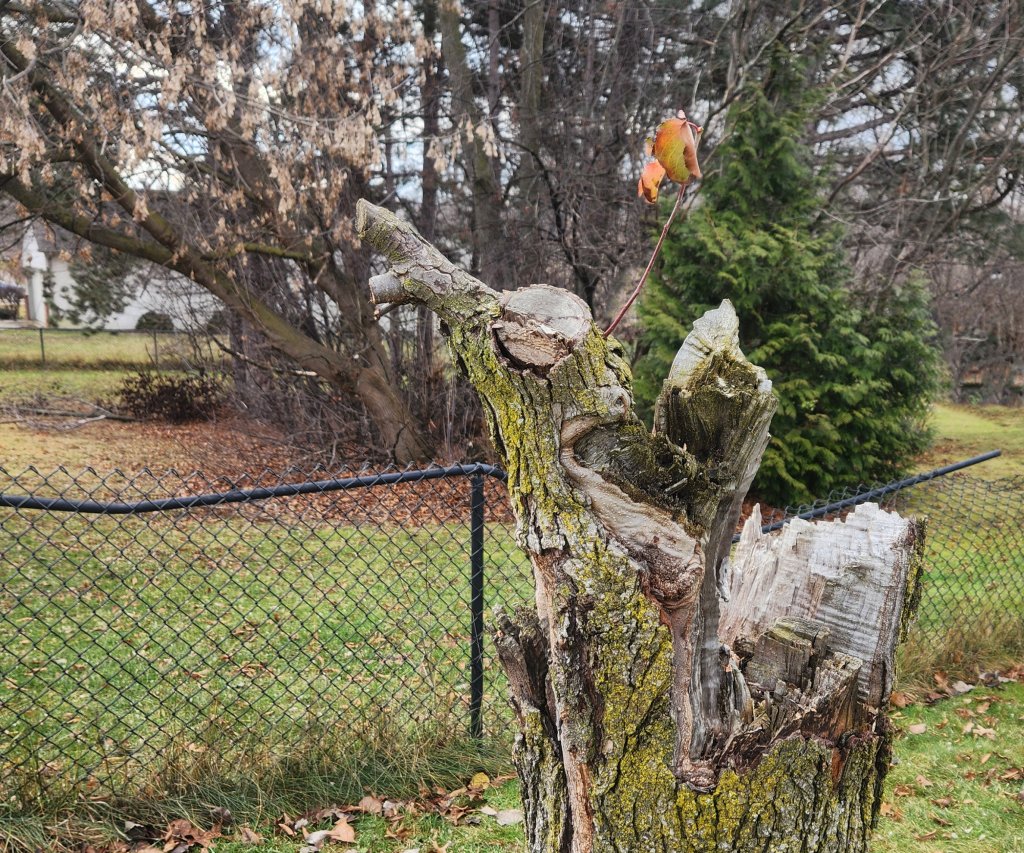
But then one day last week, I did notice it. Even in mid-winter, it had a shoot growing from its top. Astounded, I circled back around and stopped to take a picture.

I’m not an arborist. Still, I know most deciduous trees in Michigan hibernate in winter. Essentially, they go to sleep at the end of summer. They slip into their dormancy stage, locating their essential nutrients in their roots. Doing this helps to keep them healthy and ready to bloom again in the spring. That’s why the leaves fall in autumn. The trees are shutting down the supply lines to everything but the roots, starving its skyward limbs and keeping the food where it’s needed most.

But this tree is not sleeping. It’s awake and growing in winter. Wearing only a slightness of green on one of its two leaves, a passerby can see by its sprig that it’s struggling against the elements. Its tiny, outstretched appendages are tinged with shades of autumn’s hues. Still, there it is, pushing up from a seemingly lifeless trunk, attempting to snatch every bit of Michigan’s occasional wintertime sunlight.

While barely anything at all, it’s an inspiring scene. Against the bleakest landscape, while everything else around it has given up and gone to sleep, it is awake, as if reaching up from hope’s nutrients with an unwillingness to forfeit.

Seeing this, as a Christian, I suppose my first inclination was to experience echoes of Isaiah 11:1, which reads, “There shall come forth a shoot from the stump of Jesse, and a branch from his roots shall bear fruit.” Isaiah’s words are forward-looking. They refer to Jesus. He is the One who, even as all mortal muscle for rescue was beyond spent, arrived bearing life. There He is. God did not leave us. He acted. He sent His Son, just as He said He would. Hope against all hope has been fulfilled. The Son has brought new life into what seemed to be Death’s dooming winter. And joy of joys! From His person and work, branches emerge and grow where no one thought they could. And this happens no matter life’s seasons, each shoot bearing extraordinary fruit (John 15:5).

I had a before-worship conversation on New Year’s Day with the chairman of our Board of Elders, Harry. Analyzing the societal landscape, we predicted that the forthcoming year would likely be far bumpier than the previous one. For the record, we weren’t being pessimistic but realistic, and in a sense, we were admitting to our need for the fruits that can only be plucked from Christ’s tree. In the New Year, we’re going to need the fruits of love, joy, peace, patience, kindness, goodness, faithfulness, gentleness, and self-control (Galatians 5:22-23). We’re going to need fortitude, the kind that wholeheartedly owns the title “Christian” (James 1:2-4; John 16:1-4). We’re going to need endurance (Romans 5:1-5). We’re going to need wisdom, the kind that can’t be duped by evil disguised as good (Ephesians 5:15-17). We’re going to need persevering strength to follow Jesus when doing so might appear to make very little sense (Hebrews 12:1; Luke 5:4).

We’ll need to be hope-filled sprigs against this world’s dismal backdrop (Romans 15:3).

But there’s another thought to be had. As a perpetual watchman for summer, the tree’s lonely sprig was a “consider the lilies of the field” moment (Matthew 6:28). It had me thinking about how God loves and cares for His people. Taking the stump’s picture, I spoke out loud to myself, “Storms will come, people will cut down the lilies, but nothing can stop spring from coming.” Christians will know what I meant.

No matter how the world rages, God’s promises will not be stopped (Romans 8:31-39). He’s caring for us now. As He does, we know the springtime of eternal life is coming. This means that even in the face of persecution and Death, believers have a limitless wellspring of hope. Like the stump’s sprig, what the world might expect from us in the darker moments is not what we’ve been recreated to do. The world will bear down on us with icy impositions, expecting that we’ll shrink into self-preserving hibernation. But instead, we reach up to the heavens as sprigs in winter. We stretch out in stark contrast to the surrounding world, bringing even the littlest bit of color into the sin-sick grays of this passing world.

We endure when enduring seems impossible.

This is my continued prayer for you in the New Year. God grant it.

Misplaced Concerns

I received word that a childhood friend passed away recently. She wasn’t a best friend, but she was part of a circle of families close to my own. Hearing the news, more than a few memories were stirred—summertime at the public pool in Danville, Illinois, where I grew up; riding together like a gang through the neighborhoods on our mag-wheeled Huffy bikes; jumping dirt hills on KX-80s; trick-or-treating as our favorite Star Wars characters; Friday nights at the roller rink; all of these were wafted to remembrance.

I suppose my first reaction was to wonder what Death was doing by reaching out to such a young woman. But then I rose from my chair, heard my knees crack, and remembered my own age. Naturally, I humbly withdrew my reaction to Death’s dealings. Perhaps my departed friend wasn’t as young as I preferred her to be, and as it would go, what did that mean for me?

It means I’ve arrived at the edge of a shadowy land where, both chronologically and biologically, Death is making more rounds among the citizenry.

I could say I don’t want to think about it, but that would be foolish. I’m not going to live forever, that is, there’s no gate strong enough, no lock steely enough, no wall sturdy enough to keep Death out when its carriage arrives at my door. As it was with my childhood friend, no matter what I think is right or fair with regard to Death’s dealings, the exchange will be made, and I will go. To believe differently is to live by lies.

Of course, it’s just as inappropriate for me to dwell on these things as it is to ignore them. To dwell on Death would be to live in fear. To live in fear is to be cursed with finding Death and its dread hiding behind everything. It would be to epitomize an insightful line from Don Quixote, the one that goes something like, “Fear is sharp-sighted. It can see things underground, and even more in the skies.”

Besides, I’m a Christian. Living in fear is not what Christians do. And why? Because even though I said I won’t live forever, the truth is, I will. Yes, Death will arrive. I don’t know when, where, or how, but it will. When it does come, I will go. Still, Death won’t own me in that exchange. I have another Master to whom the fateful carriage will transport me. By the power of the Holy Spirit in faith, I can live and breathe and move within each day apart from a strict attachment to this world knowing that even though “in Adam all die, so also in Christ shall all be made alive” (1 Corinthians 15:22). That awareness from Saint Paul is nothing less than a faithful interpretation of Christ’s promise to Martha in John 11:25-26:

“I am the resurrection and the life. Whoever believes in me, though he die, yet shall he live, and everyone who lives and believes in me shall never die.”

Death had come for Martha’s brother, Lazarus. It sounds like it came in a dreadful way—through illness. Jesus didn’t debate the fact of Death or its means. Instead, He comforted Martha with a better fact—a Gospel-fact—not only that Death wasn’t the end-all, but that the One who was stronger than Death was now on the scene. With Him, Death is defenseless. With Him, the bright-beaming rays of eternal life on hope’s horizon are visible. From that vantage, Death and its fear are neutralized by the Christian confidence of faith. Faith in Jesus is the antidote for fear.

Re-reading what I just wrote, I wonder if there’s more to consider when it comes to how the world around us views Death and its fear. I sometimes wonder if too many people have things somewhat out of order. What I mean is that perhaps people have lost sight of the seriousness of Death’s finality and what comes after it because they’re too distracted by the concern for the ways it might arrive—COVID-19, a school shooting, cancer, or whatever. Again, Death is coming for everyone. What happens beyond that moment is the more crucial concern. Still, so many have traded the momentousness of Death’s eternal irrevocability for the temporary nature of its occurrence. They’re afraid of dying, not necessarily the specter of Death itself.

It would seem this misplaced concern has given birth to a sharp-sighted and irrational fear strong enough to prevent people from actually living. They see danger in everything, and as a result, they’re afraid to visit family and friends, they’re afraid to return to work, they need this and that preventative measure in place before feeling safe enough to do just about anything. I read just this morning that the State of Oregon is considering establishing a permanent indoor mask mandate.

Perhaps worst of all, this fear is still keeping some Christians distant from Christ and the gifts He gives in worship.

But remember, with Jesus—and being strengthened by the Gospel means He provides—Death and its fear is counteracted. Christians don’t have to be afraid of COVID-19 or any future variants. They don’t have to live in fear of a school shooter. Certainly, Christians are mindful, using their reason and senses attuned by God’s Word to watch, discern, serve, protect, and defend against Death’s means. Indeed, we are mindful of Death. And we should be. Compared to the world around us, we know and understand its dirty dealings the best.

But we don’t dwell on them.

By faith, we have been grafted into the One who defeated Death (John 15:5). We have the One who has given us the promise that “neither death nor life, nor angels nor rulers, nor things present nor things to come, nor powers, nor height nor depth, nor anything else in all creation, will be able to separate us from the love of God in Christ Jesus our Lord” (Romans 8:38-39).

With promises like these in hand, when we feel the creeping nudge of fear’s tendrils, we can know to run to, not away from, Jesus. It’s only with Him that we’ll receive what’s necessary for facing off with Death and its fear. It’s only with Jesus that we’ll have what we need for living in Christian confidence, come what may.