Stay Put and Hold On

While this past week was a little jagged, it really wasn’t anything out of the ordinary for a guy like me. Each week brings its own challenges. Each is filled with opportunities for people to take hold of something and run it into the weeds. That said, I still feel more like talking about something harmless.

And I know just what to share. I was telling Jennifer the story yesterday while we were out and around town together.

Just the day before, while walking to the center of the chancel to begin Matins with our day-school children, I noticed a ladybug on the floor. It stood out. It was a small red dot in a sea of taupe tile heading away from me when I approached. At first, I paid it no mind, except to avoid stepping on it. There were plenty of other things happening in the space before the service began. Pages turning and pews creaking. Not to mention it was Grandparents Day for our school, so the noise was a little more than usual. A ladybug hardly registered.

We began the Office of Matins. The people sang. The liturgy rose and fell in its usual way. A few minutes in, when it came time to sit for the Hymn of the Day, I looked down again. There it was, only now it had traveled nearly twenty feet, journeying straight toward where I was sitting behind the pulpit.

Throughout the hymn, I watched it advance across the tile—slowly, down and then up again through grout lines, seemingly unbothered. Almost determined. Eventually, it reached my shoe. I tried to keep singing. But at the same time, I watched this little thing pause, as if considering its options. And then, suddenly, it climbed aboard. It climbed up onto my shoe and kept heading north. I reached down to tuck my pant leg against my leg so it wouldn’t end up crawling somewhere it shouldn’t. I even shook the pant leg a little to get it to drop back to the floor. But apparently, its presence wasn’t up for negotiation. And so, up the outside of my pant leg it went.

A little more than halfway up my shin, it did something unexpected. It turned in a tiny circle, as though settling itself, and then stopped. That was it. No more wandering. No more exploring. It just stopped. Seemingly content, it stayed put throughout the rest of Matins. In fact, it stayed with me back to my office. It stayed for over an hour as I answered a few emails, made a few phone calls, and then headed out for the rest of the day’s business. Eventually, before leaving the building, I nudged it gently onto the fake palm tree in the corner of my office, figuring its tenacity should be rewarded. Indeed, it had earned a safe place to relax nearby.

That was the end of our little fellowship. I checked the palm tree this morning, but couldn’t find the little guy. Nevertheless, the brief interaction’s memory remains.

I suppose what really stayed with me was its simple insistence on getting to me. As I said, it was headed away from me at first. But then it’s as if it turned to follow. No hesitation. No sign of fear. No instinct to keep at a safe distance. It just crawled across the nave floor until it reached me. And there it stayed.

You know me. You know I’m already looking at this insignificant moment through the lens of the Gospel. Peering through the promises of God, that tiny act of creaturely persistence starts to take on a clearer shape. It’s not that the ladybug somehow found me interesting. It was that, in a space full of motion and sound, it kept a straight course. It didn’t dart sideways. It didn’t steer away when shoes scuffed past it. It simply took aim at one fixed point and then stayed the course.

That steadiness is what matters to me right now, especially in light of the conversations I’ve had this past week about so many different things, some of which led to some unfortunate hand-wringing. It was all very loud sometimes. But that’s more likely to happen in a world where folks react to the noise first and then reconsider the substance later. And then along the way, others get swept into the churn, too. People interpret “likes” as devoted association to one side or the other, rather than the actual content of the messages shared. Social media is toxic in that sense.

But beneath all the commentary, the same question keeps surfacing—at least for the Christians. It’s simply this: Where do Christians anchor themselves when the world becomes chaotic and full of crosscurrents?

That’s where the ladybug wanders back into view. It’s not a theological illustration. Again, through the Gospel’s lens, it’s seen as more of an unexpected reminder of something simple.

The road is uneven before us. We are surrounded by noise, too. Arguments. Opinions. Warnings. Accusations. Some of it is legitimate. Some of it is dreadfully misguided. All of it can be harmful, that is, if it’s allowed to distract.

And heaven knows that none among us are immune to drifting into darker places insulated by sin’s shady perspectives—opinions we think are godly but really aren’t. We end up there because it’s so easy to get pulled sideways by personalities, controversies, or as I said before, the pressure to simply react—to justify one’s position and oneself for the sake of saving face or protecting our own, not necessarily to learn, or to shore up one’s rightness or turn away from error.

In other words, we can get caught up in these things, all the while drifting from Christ and, maybe, never even noticing we’ve drifted until we’ve hit the self-destruct button on a friendship.

But the place we’re meant to be all along—close to Jesus—is not unclear. He has already planted Himself within reach. His Word, His sacramental gifts, His promises, His crucified and risen presence for sinners. Ultimately, the task is not to maneuver around every controversy perfectly, or even successfully. The task is to stay oriented toward Him. To know, even as He’s already with us in the truest sense, still, there is that Christian desire to move closer to Him in the noise, to cling to Him in the confusion. And when we have Him, just stay. Don’t let go. Hold onto Him and go with him where He goes. Eventually, He’s going to nudge you into a place of eternal rest from the busyness. But until then, stay put and hold on.

I suppose that’s the point I eventually came back to, and it’s one far more fitting for us, God’s people, than for the tiny creature that accidentally taught it.

Stay near Jesus. Keep toward Him, even when the world is noisy and uncertain, whether the ground is level or suddenly pitching low and then high—those moments of distraction that seem to come out of nowhere during life’s regular moments. Draw close to the One who has already drawn close to you. Don’t wander. Don’t negotiate terms. Don’t look for somewhere “better.” Hold onto Him. And then, just stay. Nestle in and stay. Because the safest place for any creature in God’s world is with Jesus.

A ladybug on a tile floor reminded me of that. And maybe, no matter what your week was like, it can be a reminder for you, too.

Easter 2025

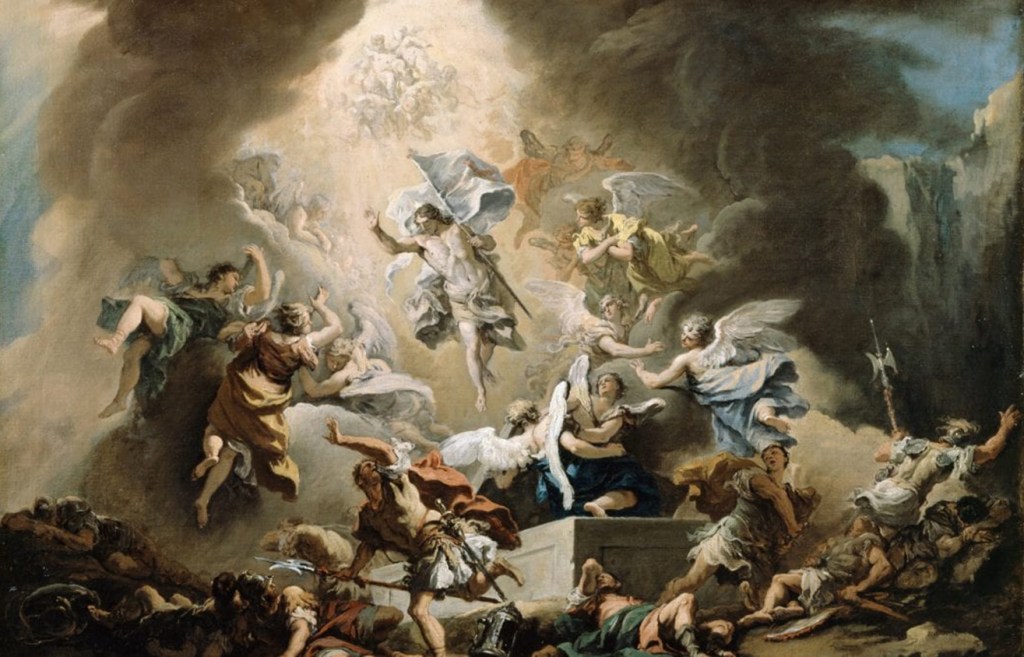
What else is there to say except, “Christ is risen!” Indeed, He is no longer dead but alive, and because this is true, Death no longer holds sway for those who put their faith in Him!

But there’s more to the Lord’s resurrection than knowing Death is no longer our brutal master. Now that He has throttled and subdued it, the fear Death seeks to impose upon every man, woman, and child continually is now rendered silly. We no longer have any reason to fear Death, and so Saint Paul can say full-throated, “For me to live is Christ, and to die is gain” (Philippians 1:21). He can call out with certainty, “Death is swallowed up in victory. O death, where is your victory? O death, where is your sting? The sting of death is sin, and the power of sin is the law. But thanks be to God, who gives us the victory through our Lord Jesus Christ” (1 Corinthians 15:54-57).

Even better, the risen Lord Himself can say to Martha at Lazarus’s tomb, “I am the resurrection and the life. Whoever believes in me, though he die, yet shall he live, and everyone who lives and believes in me shall never die” (John 11:25-26).

But that’s not all Jesus said to her. Before calling her brother from his tomb, He asked Marth a final question, “Do you believe this?” (v. 26). Doing so, He looks to her while also looking up from the page at all of us, prompting a moment of contemplation. In other words, just what does it mean for you that, through faith in Jesus, Death can never claim you? The answer isn’t a lonely point on the Christological map. It is a vast frontier of wonderfulness that reaches into life in this world with an aim for the world to come.

Its topography is comprised of valleys and mountain peaks, bogs and beaches, deserts and dense forests. Steering into and through each, it understands that if Christ has conquered Death, then what else is there to fear in any circumstance? The same power that shattered the grave empowers God’s people to withstand all tyrannies and endure every terror the mortal world could ever think to conjure. Even further, a life lived in the resurrection of Christ is capably bold. It does not cower before worldly powers or bow to the culture’s demands. It does not shrink from faithfulness to the Word of God but instead stands up straight, lifts its head, and keeps an eye open for the One who is coming again in glory to judge both the living and the dead.

Indeed, the frontier of faith is lived fearlessly. Again, if Death holds no claim, then neither do its troubling underlings of persecution or suffering or loss. They may shake their fists in a rage, threatening trouble. But the threats will forever be empty. Christ is risen! Everything else is decaying transience.

Now, the Church—God’s people—marches forward toward the final and eternal day when everything else reaches its expiration. We go there, not in trembling hesitation, but with the confidence of battle-hardened soldiers who know the war has already been won, and have been, all along, awaiting the victory celebration with their King.

Christ is risen! Do you believe this? I do. Therefore, let the world (and everything in it) threaten me as it sees fit. My hope is in Jesus, the conqueror. I will not be silenced, stilled, or afraid.

Filling and Trimming Your Lamp

The introduction in the current draft of my sermon for this morning includes a warning. I offer the warning because, sometimes, the deepest intention of a particular portion of God’s Word isn’t so gentle with its recipients. Sometimes, it’s razor-sharp, cutting us in ways we’d prefer it wouldn’t.

This morning’s Gospel reading appointed for the Last Sunday in the Church Year—the parable of the Ten Virgins in Matthew 25:1-13—is one such text. It steers into and ends with some words that Jesus has warned in other texts He’ll inevitably use on the Last Day. To have them directed at oneself would be to experience terror above all terrors. Time will have run out. All bets will be off the table. The divine lights of God’s standards will beam with unmatchable brightness, incinerating all disbelief or untruth. Nothing will be hidden. Those who are prepared will be welcomed into eternal glory. With chilling brevity, He will look to others—the unprepared—and say, “I do not know you.”

This whole scenario carries in its pocket a particularly crucial assumption. As the Creeds have long maintained, when Jesus returns, He will do so as the divine Judge, saying yes to some and no to others during eternity’s first few moments.

For some, this is an uneasy image. Why? Because it opposes everything human sinfulness prefers of its gods. It meets a certain kind of Christian, too. The Jesus embraced by some in American Christianity is mushy, being more than willing to let us shape Him to fit our preferences. He doesn’t get annoyed when we twist His Word. He’s not the least bit uneasy when we muddy His natural law. He isn’t so bothered when we skip worship Sunday after Sunday, arguing that we can be His people on our own time and our own terms. He’s certainly not going to be so arrogant as to tell us we’re wrong—that we’re headed for destruction. The Jesus some prefer could never bring wrath, only hugs. He doesn’t decide what’s good or bad. He lets us decide. And then, no matter what we choose, He smiles with satisfaction that we’ve done what makes us happy and pursued personal fulfillment.

The Gospel reading for this morning would say, if this is your Jesus, you’re done for. Or, more akin to the parable’s intention, you’re unprepared to meet the real Jesus on the Last Day.

I’ll say that today. It’ll be tough to hear, even for me. Why? Because I’m no different than the folks in the pews. I’m so often a self-interested sinner.

We’re all in this together.

Something I won’t specifically say in the sermon but will share with you here is that Jesus often measured His hardest words against hypocrites, which is probably why only a few paragraphs after this parable, the reader discovers, “Then the chief priests and the elders of the people gathered in the palace of the high priest, whose name was Caiaphas, and plotted together in order to arrest Jesus by stealth and kill him” (Matthew 26:3-4). Jesus regularly pointed to these men as being those who, and they knew it. This parable about preparedness certainly has hypocrisy in mind.

Preparedness is impotent without self-reflection. The whole point of readiness is genuine self-honesty. It asks, “What do I know is true about my situation and condition? What, where, and how will I acquire what I need to be prepared?” It’s not far from Jesus’s point that Christian endurance will be one of self-reflection resulting in repentance and faith. Christians will know by faith to confess, be absolved, and recalibrate—to continually refill and trim our lamps.

On the other hand, hypocrisy is the absolute manifestation of self-deceit. It lives a dangerously duplicitous existence, believing it has enough of what it needs in itself. It believes one thing, most often for self-exemption, while being something altogether different.

Examples of hypocrisy are all around us. We all do it. A perhaps minor, yet still relevant, example that comes to mind concerns a photo I posted on Facebook of our family’s nativity scene. One or more kids and I will add various action-figure characters from around our home to the display each year. We’ll put Star Wars characters, aliens, you name it, all standing at attention before the Christ-child cradled in Mary’s kindly arms. We do this mindful of Christ’s return at the Last Day, paying closest attention to Saint Paul’s Advent nod to the Lord’s return in Philippians 2:5-11:

“Have this mind among yourselves, which is yours in Christ Jesus, who, though he was in the form of God, did not count equality with God a thing to be grasped, but emptied himself, by taking the form of a servant, being born in the likeness of men. And being found in human form, he humbled himself by becoming obedient to the point of death, even death on a cross. Therefore, God has highly exalted him and bestowed on him the name that is above every name, so that at the name of Jesus every knee should bow, in heaven and on earth and under the earth, and every tongue confess that Jesus Christ is Lord, to the glory of God the Father.”

Paul just told us that Jesus, the Son of God, crossed from the divine sphere to ours in absolute humility, His trajectory being that of the cross. A nativity scene teaches these things. Christ arrived in lowliness, emerging from the Theotokos among animals that feed from a manger. Advent—a time when someone might set up a nativity scene—makes visual the message’s connective tissue. Traditional churches celebrating Advent will know the season’s historic purpose is to rejoice in the Lord’s first coming while penitently anticipating His return. It’s no wonder that, after noting the incarnation and death, Paul moves straightway to the events of Last Day. Our nativity scene has these things in mind. It knows the incarnation. By its traditional characters, it knows the Gospel texts that make clear His purpose (Luke 1:26-38, 2:8-18; Matthew 1:18-25, 2:1-12; John 1:1-14). By the stranger figures we add (which, when choosing them, admittedly, sprinkles in some humor), it understands Paul’s conclusion, which is that everything—visible or invisible, angel or demon, believer or unbeliever, all human fictionalities and all absolute truths, all things in heaven and on earth and under the earth—will bend in submission to the crucified and risen Christ at the Last Day. Prepared or unprepared, all will call Him Lord.

Again, I posted a picture of our nativity scene on Facebook. I even added the relevant text from Saint Paul’s letter to the Philippians. Shortly thereafter, a fellow pastor who enjoys trolling me added a sarcastic comment (which I deleted) implying that by putting fictional characters into the scene, I was making unholy that which is holy, and thereby insinuating Jesus Himself was fictional.

That’s a stretch, even for some of my worst critics.

My point here: It was a hypocritical response on his part, especially since he’s no stranger to enjoying Babylon Bee memes portraying Jesus saying things He didn’t say. By the way, I see those articles and laugh, too. Why? Firstly, because I have a sense of humor. Secondly, what I see, while out of the ordinary on the surface, has a far deeper meaning, pointing to something truthful. That’s how satire works. However, since the Babylon Bee’s fictional words are attached to Jesus as a direct quotation, sometimes even in a way that might be offensive to some, is the image making unholy and mythical that which is holy and true? No. But again, you need to be capable of genuine self-reflection that can see one’s beliefs and actions rightly. Devout hypocrisy cannot do this. It holds blindly to its own agenda, unable to see anything else, often resulting in an equally devout hatred for others—just like the Chief Priest and elders in Matthew 26:3-4.

At the end of the parable, Jesus says, “Watch therefore, for you know neither the day nor the hour” (Matthew 25:13). The Greek word used for “watch” is γρηγορεῖτε. It’s an imperative verb. It means to stay awake. But it doesn’t just mean to wake up and pay attention. It means to remain alert, ever ready, and on one’s tiptoes, looking to the horizon. Jesus chose this word because His aim is vigilant preparedness.

At its center, preparedness means faith in Jesus. But Jesus’s parable included many more details than the flickering flame of faith. He also spoke of a mindfulness that acts. This action starts with self-reflection. The wise virgins began and stayed there. The foolish virgins didn’t.

Again, and indeed, the Lord makes clear that faith in Christ saves. The arriving bridegroom identifies the wedding party by its lighted lamps, and they are the ones ushered into the wedding feast. But don’t forget the rest of the parable’s details. Don’t lie to yourself. Admit to your tendency to believe one way but live another. Then, go to church. Fill your lamps with the oil of God’s merciful love through Word and Sacrament—the preaching and administration of the Gospel in its verbal and visible means. You’ll hear the Lord’s instruction to be ready and be immersed in the bountiful gifts that make it so.

Even at Walmart

I hope you don’t mind, but I have marriage on the brain this morning. Jennifer and I will celebrate our 26th wedding anniversary this week.

I don’t know about you, but the further we travel into marriage’s future, the more content it seems we are to let the occasion be the occasion amid life being life. In other words, we’ll likely go out for dinner to celebrate, but we’ll also just as likely stop at Walmart on the way home for milk, cereal, toilet paper, or anything else a family of six might need. It sounds inconsequential, I know. Some people celebrate by going on trips. Others spend lavish amounts on gifts. That’s not really our way. Last year, we hoped to get away for a few days (since it was our 25th anniversary), but too many other things prevented us from doing so. Several weddings were scheduled, the English District Convention occurred, Vacation Bible School unfolded, and a whole host of other obligations landed on us. We barely managed to sneak away for dinner on a day close to our actual anniversary.

In the end, I think Jen and I have realized that no matter what we might do to celebrate, one exceptional day, while nice, can never really outmatch the everyday blessings we enjoy. Theodor Seuss Geisel—better known as Dr. Suess—was close to describing what I mean when he said, “You know you are in love when you don’t want to fall asleep because reality is finally better than your dreams.” I get his point. There’s very little that exceeds love’s discovery. In its moments, life and its possibilities exceed imagination.

One problem with Geisel’s words is that they don’t completely emerge from emotion’s shifting realm. I’d be on board if he defined reality as a willingness to completely spend oneself for the other in both good and bad times. That would better describe the profound mystery of marital love. It’s one reason why the traditional marriage vows include phrases like “for better, for worse, for richer, for poorer, in sickness and in health….” By the way, in my experience, people who choose to write their own marriage vows, typically turn them into syrupy emotional goo, ultimately missing the mark on what the vows are designed to communicate. For the record, don’t even think about writing your own vows if you want me to preside over your wedding. The longstanding traditional ones are more than sufficient, mainly because they do a fine job of communicating a commitment to something other than self. Two phrases, in particular, cement this commitment: “till death us do part” and “according to God’s holy will.” The previous phrases of the vow set reality’s tempo, acknowledging that there will be good times and bad times. These two insist that emotional love—purely human love—is not equipped to navigate real life to its very end. But love aligned with God’s will is. Love aligned with God’s will can stare death in the face.

Jesus told us straightforwardly what God’s will is. He said, “For this is the will of my Father, that everyone who looks on the Son and believes in him should have eternal life, and I will raise him up on the last day” (John 6:38-40). These words are not far from Jesus’ gentle description to Nicodemus of why God would send His Son in the first place: “For God so loved the world, that he gave his only Son, that whoever believes in him should not perish but have eternal life. For God did not send his Son into the world to condemn the world, but in order that the world might be saved through him” (John 3:16-17).

God knew that human love would be forever insufficient. Loving God and neighbor rightly—the Law’s strict demand—would never be met. But God’s love can do it. And so, that same love moved Him to send His Son. Christ fulfills the demand by His perfect life according to the Law and His sacrificial death on the cross. Jesus demonstrates that God’s love is a perfectly committed, selfless love. It insists that no matter what’s required, the self will never mean more than one’s beloved, even if it means completely emptying itself of all divine prerogatives and going down with the ship in death. Christ did this. And why? Because He loves you. This love is epicentral to His will. Taking a spouse “according to God’s holy will” is to pledge that God’s redeeming love—His forgiveness—will be the marriage’s template. When this is true, a marriage can steer through and around obstacles that might otherwise terrify human love.

But still, there’s more.

Regardless of what the culture believes, God established marriage. He owns it. As such, and whether anyone realizes it, His will naturally permeates its design. First and foremost, marriage is to be a divine snapshot of the Gospel. Saint Paul says as much, describing marriage as a mysterious image of Christ, the Groom, and the Church, the bride—an otherworldly relationship established and maintained by impenetrable commitment. It begins with the One who submits Himself to the death of deaths for the bride. Empowered by that Gospel love, it results in the bride submitting herself in all things, not as one cruelly shackled to an overlord, but as one who loves the Groom for all that He is and has done to make her His own (Ephesians 5:1-2, 22-33).

In a natural law sense, God’s inherent will remains. Marriage is the essential building block of every society throughout human history. The union of one man and one woman—inseparably committed and typically producing children—provides worldwide stability. Everything necessary for an ordered perpetuating society can be found within marriage’s boundaries. Saint Paul hints at how important societal order is when he instructs Timothy to pray for and intercede with the authorities put in place to manage it. He insists Christians do these things so that “we may lead a peaceful and quiet life, godly and dignified in every way. This is good, and it is pleasing in the sight of God our Savior, who desires all people to be saved and to come to the knowledge of the truth” (1 Timothy 2:2-3).

Paul’s point: God wants societal order so that the Gospel will spread.

Marriage not only stabilizes societies, but it is a fundamental conduit in each for communicating the Gospel from one generation to the next. When a society’s marriages begin steering away from God’s holy will—when devotion to self overtakes commitment to spouse and children, when marriage’s biological components become confused, when its sanctity becomes negotiable or irrelevant—the blocks begin to crumble, and the conduits fracture. When that happens, the Gospel—the message of the only kind of love that lasts into and through death—begins slipping into obscurity, eventually securing societal doom.

As I said, Jennifer and I will celebrate 26 years next week. We’ll likely celebrate by doing something special together. Still, even if we don’t—even if life suddenly gets in the way—the marriage won’t be any lesser than before. This is only true because the marriage is “according to God’s holy will.” With His love ordering each of our days, the inevitable road through a reality of good and bad, fading physicality, and unpredictable emotional seasons will continue to prove far better than dreams. It’s the kind of love that finds itself just as refreshed and content holding hands in the breakfast cereal section at Walmart as it does in a classy restaurant.

Good Friday, 2023

It was a Friday of unimaginable viciousness and cruelty, leading to a horrible death. And yet, the Church has forever named it “good.”

At first, it certainly seems counterintuitive to do so. Referring to such horror as good appears to grant dreadfulness a license. It seems to give a coaxing nod to all that makes for this world’s misery, allowing it a certain measure of liberty to run wild, letting it off the chain to choose and devour its victim.

In a way, there’s an element of truth to these things. I think the Gospel writer, Luke, meant for us to sense it when He recorded the Lord’s words to the ones who’d arrived at Gethsemane to take Him into custody. His words were plain. Before giving Himself over, Jesus said, “Now is your hour and the power of darkness” (22:53). In other words, “You’ve been granted this time. Make the most of it and do your worst.”

We are to know that absolute devilry was let off its chain in those moments. In the truest condition of godforsakeness—the Heavenly Father mysteriously abandoning the Son—absolute ghastliness was granted permission to unleash its most devastating weapons from its cruelest arsenal.

This was the terrible license allowed that unique Friday, a day we call good.

Jesus would have called it good, too. He hints at this during His arrest. When Peter takes his sword to prevent the engagement, Jesus asks him rhetorically, “But how then should the Scriptures be fulfilled, that it must be so?” (Matthew 26:54). He sternly commands Peter to sheath his sword, questioning again rhetorically, “Shall I not drink the cup that the Father has given me?” (John 18:11). Again, this is to say, “Peter, this must happen. If I don’t endure darkness’ fury and drink the cup of wrath owed to those who brought the powers of Sin, Death, and hell into the world, then it will be left to its rightful owners. That’s you and all of humanity. But you cannot meet what’s due. None can endure it. None can defeat it. For your sake, Peter, what’s happening is good. It must be me. It has to be me.”

And so, it was.

Good Friday stands in history’s record as the moment when everything that had every right to consume and destroy everyone for all eternity turned its fullest attention on Jesus. It was a horrific day for the Lord—so horrible that human language can never describe it sufficiently. Knowing this, give the day your attention. Approach it with care. Know that something much deeper is happening to the Lord than what mortal eyes or ears can receive. It isn’t just physical or spiritual cruelty of the worst kind. It’s far more than that. It’s cosmic in proportion and beyond anything anyone could have ever endured.

Embracing this fact with all solemnity, if you feel the need to let out a sigh of relief at some point along the way home from worship, please feel free to do so. Good Friday was a good day for humanity. It was the day the ultimate punishment for Sin was endured, and its eternal price tag was fully met. Jesus did it. He wanted to. Good Friday sees Jesus’ arms stretched on the cross as far apart as they can reach. This is more than His death. It is the image of a world-encompassing embrace from the Divine. He loves you. He gives His life for all.

I mentioned worship a moment ago. Be sure to go. Here at Our Savior in Hartland, Michigan, there will be two services. The first is at 1:00 p.m. This is the Tre Ore service. Tre Ore means “three hours.” It symbolizes the Lord’s three hours of suffering at midday on the cross. The second is the Tenebrae service at 7:00 p.m. Tenebrae means “darkness.” We know the meaning of this title. It’s everything into which the Lord goes for our rescue. These services will lead their visitors into and through the details of the Lord’s work. If you can, immerse yourself in them. I promise you’ll be blessed. You’ll certainly be imbued with a more profound sense of Easter’s acclamation, which, together with the forgiven Church, we’ll sing out two short days later.

They Saw Jesus

He is risen! He is risen, indeed! Alleluia!

There is a special sort of energy to this saying, isn’t there? When a believer says it, there is a sense of the world spinning in the opposite direction, as if what was once undone is now being turned back, as if our view of Eden has become a little less blurry.

Amen. The resurrection of Jesus changes everything.

“He is risen” is the cheering of the Church of all ages. She sings out to the world in praise of her Savior who died, and yet, did not fall short of His goal, no matter the apparent dreadfulness of the Good Friday wreckage. Jesus gave Himself over into Death. He did it willingly and without our asking. He turned His face toward the events with an unmatchable steadfastness, and like a juggernaut, He could not be stopped. He pressed through and into Death’s deepest hideousness, ultimately defeating it for all time from the inside.

Saint Paul makes clear for those who may still be wondering what the resurrection has to do with God’s plan of redemption, saying, “The last enemy to be destroyed is death” (1 Corinthians 15:26). He says this so his readers will know there’s nothing left to be accomplished between sinners and God. Christ has done it all.

How do we know? Indeed, Paul warns of the concern if Christ hasn’t been raised, having already announced, “And if Christ has not been raised, your faith is futile and you are still in your sins” (15:17).

But Christ has been raised. Paul is a witness. And not only Paul but hundreds of others were visited by the bodily-resurrected Jesus (15:3-8). Would Paul lie? Would he trade his life of promise and ease for prison and execution? Would they all lie? Would they all be able to maintain such deception, keeping the story straight among such a large number? Perhaps like Paul, when the lives of these firsthand witnesses, and the lives of their families, were found teetering at the edge of grisly death, with their only safety being found in recantation, would courage built on a lie be able to see them through the moment?

Of course not, because they saw Jesus.

So, rejoice. It’s all true. Christ is risen, and your Easter faith is secure. You have staked a claim in the Lord who faced off with Death and won. His labor removed your Sin, and His resurrection victory justified you before the Father (Romans 4:25), granting to you the first-fruit spoils of eternal life (1 Corinthians 15:20).

God bless and keep you in this peace, not only today but always.

Misplaced Concerns

I received word that a childhood friend passed away recently. She wasn’t a best friend, but she was part of a circle of families close to my own. Hearing the news, more than a few memories were stirred—summertime at the public pool in Danville, Illinois, where I grew up; riding together like a gang through the neighborhoods on our mag-wheeled Huffy bikes; jumping dirt hills on KX-80s; trick-or-treating as our favorite Star Wars characters; Friday nights at the roller rink; all of these were wafted to remembrance.

I suppose my first reaction was to wonder what Death was doing by reaching out to such a young woman. But then I rose from my chair, heard my knees crack, and remembered my own age. Naturally, I humbly withdrew my reaction to Death’s dealings. Perhaps my departed friend wasn’t as young as I preferred her to be, and as it would go, what did that mean for me?

It means I’ve arrived at the edge of a shadowy land where, both chronologically and biologically, Death is making more rounds among the citizenry.

I could say I don’t want to think about it, but that would be foolish. I’m not going to live forever, that is, there’s no gate strong enough, no lock steely enough, no wall sturdy enough to keep Death out when its carriage arrives at my door. As it was with my childhood friend, no matter what I think is right or fair with regard to Death’s dealings, the exchange will be made, and I will go. To believe differently is to live by lies.

Of course, it’s just as inappropriate for me to dwell on these things as it is to ignore them. To dwell on Death would be to live in fear. To live in fear is to be cursed with finding Death and its dread hiding behind everything. It would be to epitomize an insightful line from Don Quixote, the one that goes something like, “Fear is sharp-sighted. It can see things underground, and even more in the skies.”

Besides, I’m a Christian. Living in fear is not what Christians do. And why? Because even though I said I won’t live forever, the truth is, I will. Yes, Death will arrive. I don’t know when, where, or how, but it will. When it does come, I will go. Still, Death won’t own me in that exchange. I have another Master to whom the fateful carriage will transport me. By the power of the Holy Spirit in faith, I can live and breathe and move within each day apart from a strict attachment to this world knowing that even though “in Adam all die, so also in Christ shall all be made alive” (1 Corinthians 15:22). That awareness from Saint Paul is nothing less than a faithful interpretation of Christ’s promise to Martha in John 11:25-26:

“I am the resurrection and the life. Whoever believes in me, though he die, yet shall he live, and everyone who lives and believes in me shall never die.”

Death had come for Martha’s brother, Lazarus. It sounds like it came in a dreadful way—through illness. Jesus didn’t debate the fact of Death or its means. Instead, He comforted Martha with a better fact—a Gospel-fact—not only that Death wasn’t the end-all, but that the One who was stronger than Death was now on the scene. With Him, Death is defenseless. With Him, the bright-beaming rays of eternal life on hope’s horizon are visible. From that vantage, Death and its fear are neutralized by the Christian confidence of faith. Faith in Jesus is the antidote for fear.

Re-reading what I just wrote, I wonder if there’s more to consider when it comes to how the world around us views Death and its fear. I sometimes wonder if too many people have things somewhat out of order. What I mean is that perhaps people have lost sight of the seriousness of Death’s finality and what comes after it because they’re too distracted by the concern for the ways it might arrive—COVID-19, a school shooting, cancer, or whatever. Again, Death is coming for everyone. What happens beyond that moment is the more crucial concern. Still, so many have traded the momentousness of Death’s eternal irrevocability for the temporary nature of its occurrence. They’re afraid of dying, not necessarily the specter of Death itself.

It would seem this misplaced concern has given birth to a sharp-sighted and irrational fear strong enough to prevent people from actually living. They see danger in everything, and as a result, they’re afraid to visit family and friends, they’re afraid to return to work, they need this and that preventative measure in place before feeling safe enough to do just about anything. I read just this morning that the State of Oregon is considering establishing a permanent indoor mask mandate.

Perhaps worst of all, this fear is still keeping some Christians distant from Christ and the gifts He gives in worship.

But remember, with Jesus—and being strengthened by the Gospel means He provides—Death and its fear is counteracted. Christians don’t have to be afraid of COVID-19 or any future variants. They don’t have to live in fear of a school shooter. Certainly, Christians are mindful, using their reason and senses attuned by God’s Word to watch, discern, serve, protect, and defend against Death’s means. Indeed, we are mindful of Death. And we should be. Compared to the world around us, we know and understand its dirty dealings the best.

But we don’t dwell on them.

By faith, we have been grafted into the One who defeated Death (John 15:5). We have the One who has given us the promise that “neither death nor life, nor angels nor rulers, nor things present nor things to come, nor powers, nor height nor depth, nor anything else in all creation, will be able to separate us from the love of God in Christ Jesus our Lord” (Romans 8:38-39).

With promises like these in hand, when we feel the creeping nudge of fear’s tendrils, we can know to run to, not away from, Jesus. It’s only with Him that we’ll receive what’s necessary for facing off with Death and its fear. It’s only with Jesus that we’ll have what we need for living in Christian confidence, come what may.

Settling in with Christ

Glancing around my office while sitting here, if you were to ever stop by for a visit, apart from the books on my shelves, you’d also discover a strange variety of things scattered across the space, eye-candy type things I keep on display that make me smile.

Of course, I have things you’d expect—crucifixes and various Christian images, both on the walls and on the shelves. But I also have a few full-sized Star Wars helmets. These are accompanied by statuettes of Winston Churchill, the Ark of the Covenant, R2D2, and other things sharing space with matryoshka dolls, wood carvings, and Russian military hats. I have a replica of a 9th century Teutonic knight’s helmet serving as a bookend to my books on the liturgy. A few paces away and perched beside my computer printer is a Yautja’s bio mask from the film “Predator.” A few feet from that is a disposable M72 shoulder-fired rocket launcher from the Vietnam era—no longer usable, of course. Strewn among all these things are watercolor portraits my wife has painted, pictures of my family, photos with friends, and greeting cards from so many people I cherish.

Let it be said, there’s a lot in my office besides books to explore and enjoy. And while it might all appear somewhat out of place and weirdly disconnected, together it forms a comfortable matrix for me—a peaceful asylum, of sorts—a physical context apart from the world’s swirling spaces where it so often feels like everything is coming undone. It’s a place where I can settle in and get my bearings for keeping my head about me.

Amusingly, it was Jean Kerr who wrote in her splendid little book Please Don’t Eat the Daisies, “If you can keep your head when all about you are losing theirs, it’s possible you haven’t grasped the situation.” I find Kerr’s words so funny because in their context, they’re spoken by someone who just can’t understand how certain people can be so calm during times of crisis. Her satirical answer: They must not fully comprehend what’s going on around them. Her words are even funnier when you realize their broader insinuation, which is that unless you have a frantically unsettled mind like everyone else, you’re weird.

By this definition, Christians are noticeably weird. At least we’re supposed to be. On one hand, God calls for us to be fully aware of the world’s treacheries—to be actively engaged, and in some circumstances, found steering right into the heart of its tempests. We are not to be ignorant of the seriousness of it all. And yet at the same time, God promises we will know and exhibit a peace that surpasses all understanding, no matter what we are facing or what our mortal futures may hold.

Saint Paul says the axis of this peace is Jesus (Philippians 4:6-7). But that’s just one item among many on the Biblical shelf.

Looking around, we see it was Jesus who so gently encouraged believers not to be anxious about life in this world (Matthew 6:25; John 16:33). He did this by reminding us of the Heavenly Father’s careful concern for those who are His by faith in the life, death, and resurrection of His Son on their behalf. With Jesus Himself not only being the actual embodiment of God’s Word, but also its absolute centerpiece, it makes sense, then, that we’d continue to find this same comforting reminder taking various shapes and sizes, and being scattered across the bookshelves of the entire Bible. Every single book of the Bible, though each may be unique in its details and style, will at some point along the way bring the light of divine encouragement to the darkness of concern. Together, these reassurances make a space for us to settle in, get the proper bearings, and keep our heads about us.

If I could be certain that you’d take time to read a longer than usual note from me, I’d provide an illustration from every single book. That being said, I can at least provide a few samples.

Starting with Genesis, we’re barely into the Bible before the comforting promise of a Savior is given (Genesis 3:15). Further in, Moses records God’s heart-strengthening pledge that He will not abandon His people (Deuteronomy 31:8). Randomly glancing from shelf to shelf, we see Isaiah proclaiming peace to all whose minds are fixed on the Lord (Isaiah 26:3). Jeremiah delivers the promise that, like a green leaf in the middle of drought, God will calm the anxious hearts of His believers (Jeremiah 17:7-8). The Book of Proverbs is absolutely brimming with the same assurances (Proverbs 3:5-6; 29:25). The Psalms are, too, with so many of them being in place to lift and sustain the fearful (Psalm 23, 27, 34, 46, 56, and others). Of course, the Gospel writers never fail to keep this same comfort before us (Matthew 11:28-30; Mark 13:11; Luke 10:41-42; John 14:27). How could they not, since they bring to us the very narrative of salvation through the person and work of Jesus Christ. Saint Paul continues this powerful cadence by his epistles (Romans 8:38-39; Hebrews 13:6; Colossians 3:15; 1 Corinthians 10:13; 2 Thessalonians 3:16). Saint Peter and Saint John do the same (1 Peter 5:7; 1 John 4:18; Revelation 21 and 22).

As I said, I could list countless more, venturing from cover to cover, but I think you get the idea.

In the end, and I suppose as it was sparked by observing the various smile-inducing knick-knacks I keep in my office, the promises of God’s ever-present care given in various circumstances throughout His Word join to form the only sure place we can go to truly get our bearings and keep our wits about us in this world’s turbulence. Without God’s Word of comfort in Christ, we would be without hope.

But we’re not without hope. For Christians, hope is the key ingredient for keeping a level head in any situation of concern. It’s something that will forever be a species of divine confidence that can exist in any environment, no matter the climate or terrain. My prayer for you today is that this same hope born from faith in Christ will be yours in the days ahead.

Take Hold

Have you ever had one of those days when no matter how hard you tried to interpret life through the lens of positivity, there was an itinerant itch of crankiness that just wouldn’t let it happen? Of course you’ve had such days. You’re a human being. I know I’ve had days like that. I just had one last week, which I guess is why I’m bringing it up—and why I’m about to examine it.

I remember feeling the grouchy cogs begin to turn when I heard that we were likely to get a few inches of snow. I know for a fact I whispered the words, “I want to move to Florida.” Following those words with a bit of daydreaming, I was so easily undercut by the harsh reality that I have neither the funds nor the general flexibility for being in Florida for any great length of time beyond the twelve or so days we, the Thoma family, enjoy there each summer. The futility of this harsh realization began draping my world in negative hues almost immediately, and the subsequent events of the day bore witness to it.

I was easily frustrated by other drivers on the road. Little mistakes in my everyday labors became sizable. I lost interest in things that might normally bring me joy. I found myself scrutinizing humanity with far less grace. For example, I found myself in conversation with a fellow clergyman regarding Church and State issues. As we talked, I recalled silently the familiar thought that dialogue is indeed dead, that general conversation involving differing viewpoints has become illusionary, that the modern exchange of ideas has evolved into little more than crisscrossing monologues between people incapable of actually listening to anyone but themselves.

I don’t like feeling this way. I don’t like viewing the world this way. It’s a hard way to go about life, and in the end, it can do little more than to devolve into sadness. So, how does one get free from this?

Well, for me it wasn’t anything I was able to do, but rather the doings of others. It was an unexpected email from a friend offering some encouragement. A little later that afternoon, it was an unanticipated and bright-eyed “Hey, Pastor!” coupled with a high-five from one of the second-graders passing in the school hallway. That night it was an enjoyable conversation during a game of pool with my son, Harrison. Before bed, it was an exceptionally tight and lengthy hug and “I love you” from my daughter, Madeline, followed by the same from Evelyn.

In a sense, I didn’t find a way out of the gloom. I was lifted out.

There is the saying that there is no tomorrow when a friend asks today. This means that when a friend is in need, there is nothing in our future that we can’t put off until we’ve attended to that friend. But sometimes that friend can’t ask. Sometimes he doesn’t even know he needs to ask. Sometimes he is unaware he’s been slow-boiled into his darkest identity, and with this, he doesn’t realize the identity is consuming him.

We all know people like this, folks whose essential personalities were one way, but then when we encountered them again after some time apart, they were noticeably different. They had changed. Their happiness had somehow become muted and the vibrancy of their light had become a little dimmer.

I wonder if this is becoming more common in a society shaped by digital communication and social distancing. Well, to be honest, I’m certain it is. While plenty of studies have provided mounds of data inferring it, as a pastor, I can see it for myself. I don’t really need the studies to confirm what’s right in front of my face. Having interacted with people here at Our Savior who, previously, hadn’t been out of the house or come to worship in over a year, it was easy to see the change. Yes, they were glad to be back, but it was a reserved gladness held in check by a foreign specter—almost as if it had convinced them to reconnect only because the inevitable “death by virus” was better than insanity in seclusion.

You may question this interpretation, which is fine, but I’m here to tell you that if you thought the world was becoming a negative place before the pandemic, COVID has hit the gas pedal on society’s emotional downturn toward instability.

Thinking back to what raised me from my own melancholy sulk, it was the people around me who did the heavy lifting. From that casual example, I sure hope you realize just how much you need to be with other people on a regular basis—how humans need not only to see each other’s faces, but to experience each other’s physical presences. Regular togetherness is no small thing to God, and so He urges His Church to gather for worship, making sure we’re not “neglecting to meet together, as is the habit of some, but encouraging one another, and all the more as you see the Day drawing near” (Hebrews 10:25). Of course He does this for the sake of giving Himself to His people through the richest of fare—Word and Sacrament ministry. But there are other reasons hovering in the realm of practicality that He has in mind, too.

We’re human. He knows what this means better than we do. He scribbled togetherness into our framework. Individuals were not designed to be alone in seclusion (Genesis 2:18). We’re meant to be out and among others. And why? Well, it’s the reason that before Adam gave Eve her formal name, God called her “helper.” God knows that when we’re together—whether it be in a marriage, a family, a friendship, a bible study group, serving on a board at church, or any other situation involving human togetherness—there will always be those around us who are in tune with our real selves and who will be ready to reach out to lift us up when they sense we are falling. In fact, God said this very thing about togetherness rather precisely in Ecclesiastes 4:10: “For if they fall, one will lift up his fellow. But woe to him who is alone when he falls and has not another to lift him up.”

I didn’t expect that email from the friend who sent it. But he noticed something about me on Sunday that left him thinking he should. I get tight hugs from my daughters all the time, but I didn’t expect the tight hug from Madeline that lasted three-times as long as normal. In that moment, for some reason, she was moved to give me a little extra love, and it helped. And as God would so generously provide through such faithful Christians, these happenings arrived at just the right moment, ultimately beginning the Lord’s divine effort to begin holding back the wave of negativity that was making its way toward my spiritual shore and, quite possibly, pull me out into the inescapability of deeper waters.

I pray you’ll consider these words and take them to heart. The first of which to take in is that if you sense someone is falling down or slipping away, reach out to help them. A gentle word will do. An act of kindness will help, too. A confident explanation of the courage Christ gives will prompt.

Second, if you’ve been away from your church family for a while, maybe it’s time to start making your way back. At the time of this writing, it’s been over four-hundred days since the first of the lockdown and mask mandates. It’s been over four-hundred days since a smile and a friendly embrace have been openly available between people without shame. It’s been over four-hundred days since people started unnaturally touching elbows instead of reaching out to make bare human contact by shaking hands. It’s been over four-hundred days since almost everything humanly personal about mankind since the beginning of time was relegated to the impersonal and dead-spaced world of Zoom meetings and virtual learning. Maybe it’s time to reconsider what’s separating you, not only from the places and means by which God is pleased to dwell and operate, but from the ones God has put into place as the hands and feet of His care and intended community in your life. Maybe it’s time to admit that perhaps—just perhaps—God isn’t a fan of what the last four-hundred days has produced: skyrocketing depression, a spike in suicides and domestic violence, and so much more. Perhaps God isn’t happy about what the last four-hundred days has so easily convinced us to accept as either virtuous or shameful, of the division the last four-hundred days has produced among His people, a body of believers who claim to confess Christ and the certainty against Death that faith by the power of the Holy Spirit gives. That’s what Easter is all about—which means that, if anything, you’re in a church season that is most certainly nudging you in this regard right now.

Yes, get vaccinated if you want. Wear a mask—or two, even. Social distance. Do whatever. But maybe consider that it’s time to come back.

Whatever conclusion you come to, I can assure you that you’re missed, even if you’ve somehow convinced yourself you’re not. We have on average about 250 people here in worship every Sunday, and I promise they are asking about and missing those who’ve been away. The negative feelings suggesting you need to continue to stay away or that you haven’t been missed are nothing more than slow-boiled changes in your identity. The devil is fooling you. They’re most certainly not anything being emitted by your church family.

Come back. Be together with the rest of us. Know that when we see you, it’ll stir the joy you’d expect from Christian friends intent on drawing you close and not pushing you away. And on your part, be ready to be overwhelmed with the delight such a reunion will provide. It truly is a magnificent elation that togetherness in the Lord unleashes. Plenty have experienced it. I bet you will, too.

Gospel Dominance

For those whose Easter is little more than an annual go-round with chocolate rabbits and painted eggs, the fanfare of the celebration has come and gone. Not so for the Christian Church. For us, it remains. We actually live each day in the wake of the ultimate enemy’s defeat.

Death has been conquered. Jesus has done it. Therefore, Death no longer has standing among us. No room for mastery. No room for terrorizing. No room for demands. No room for negotiation. It really is finished. Easter is the proof. And now through faith in Christ, we are His and He is ours. Living in that redemption, what’s left to frighten us?

Nothing.

The more I experience life in this fallen world, the more and more I become glad for this wonderful reality born from a Gospel of great power. It’s a Gospel that changes me. It changes the way I see the world. It changes the way I understand people. It changes the way I maneuver from task to task each new day. It changes the way I suffer during struggle. It alters the way I endure hatred from others.

By the loving promise of Death’s defeat, I can steer into all of these knowing that while I might not pass through them unscathed, I won’t go into them or come out on the other side without hope. Christ has cemented my hope, and with that, I can be content. I can have joy.

Before this contentment took root in me, it wouldn’t have been uncommon for me to get worked up in caustic situations. Not so much anymore. Take for example a recent circumstance in which my reputation was being maligned by deliberate deceit. In the past I might have run headlong into the fray to defend myself. Not so much anymore. I don’t feel the need to do so. I have a dominance in those situations that’s hard to unseat.

Yes, dominance.

There’s a saying that people only talk behind the backs of those who are dominant. Whatever that proverb might mean to the world, for me it has been reinterpreted by the Gospel. Yes, I am in a seat of dominance. But it’s a dominance that has been granted to me—a dominance of contentment in Christ. It’s a certainty that drives away worry, leaving me to know I’m completely surrounded by the Lord’s loving care. Even as I’m behind His flag, He’s also covering any and all of my exposed flanks. With this assurance in hand, I really can say, “World, do your worst.” I am content to live according to the promise of the Easter Gospel. This means that even when things seem their darkest and I begin to feel the blunt end of injustice, even if things don’t turn around in this life, one thing remains true: I’m not an inheritor of this world. I’m an inheritor of the world to come—an inheritance won by Jesus, one in which He is sure to flip the switch of the divine lights and expose all things done in darkness. In the meantime, I can be at peace in all circumstances, strengthened for continuing forward in faithfulness.

Once again, the resurrection Gospel imputes this. It imputes it today. It’ll be there imputing it again tomorrow. And the next day. That’s the promise. If the last enemy, Death, has been conquered, what else is there to concern or harm us?

Believers know the answer to this question as they go about their lives in the perpetual sunshine of Easter, and the world will squirm with frustration around us as we do.

I want you to know that when I go to the altar of God this week at Our Savior to pray privately for His people, this will be the precision of my petitions. I will pray on your behalf, asking God that in the coming days, by the power of the Holy Spirit, He will grant for you to remember these things. My prayer will be for you to be emboldened by the same Gospel that emboldens me, that you will have taken into yourself the joyful promise of the Lord’s mighty resurrection for your justification before the Heavenly Father, which is also an ultra-confident—nay, dominant—slap in the face of Death itself.

By faith, all of this is certainly yours for the taking.