I tell myself every year I’m not going to write and send an eNews message while on vacation. Every year, I fail to keep this pledge. I know why. There are two reasons.
First, it’s because I’m a writer at heart. For me, writing is far more than a byproduct of my task as a pastor. It’s in my DNA. Somewhere along the twirling genetic strand responsible for my development as a human being is a switch. In the off position, writing is a chore. But mine’s been flipped to the “on” position. I do it because it’s who I am, and as such, it’s harder to avoid writing than it is just to sit and do it.
My wife, Jennifer, more or less highlighted the second reason I continue to fail at keeping the “no eNews” pledge. It happened during a relatively recent conversation between us concerning death. She asked where I’d like to be buried. Assuming the conversation wasn’t hinting at a secret desire to off me in the pool while away, I floated along in its stream, implying I didn’t really care where the family returned me to the ground. My only two requirements have been that I not be cremated and that the mortician embalms me with my remaining whisky, fully aware that, even as I’m friends with many of the funeral directors in the area, the former is more probable than the latter. Beyond that, the family can sink me in the pond in the backyard for all I care.
From there, Jennifer asked if our church had ever considered using some of its property for a cemetery. I told her it had been discussed at one time years ago, but nothing ever came of it. It was then she betrayed a profound love for the people in our congregation and how she didn’t want to be buried in a random cemetery somewhere. When it came time for her burial, she wanted a place where she, and perhaps the generations of Thoma kin to follow, could be laid to rest together with their realest family—their church family. When she said that, not only did I know she was describing something I somehow knew I also wanted but never realized, but I understood why I would continue writing a message like this on vacation when I really don’t have to.
It’s because I love my family. The hundreds of people who receive this eNews every week at Our Savior Evangelical Lutheran Church in Hartland, Michigan, where I serve as pastor, are a part of that family—my realest family. Along with my immediate family, these are the people who, when the final trumpet sounds and our corrupted bodies are raised incorruptible to stand before the throne of Christ (1 Corinthians 15:51-57), I will count it all joy to experience this beside them. I’d count it a privilege to be alongside the Christians among whom I lived and breathed and served and worshipped in this life.
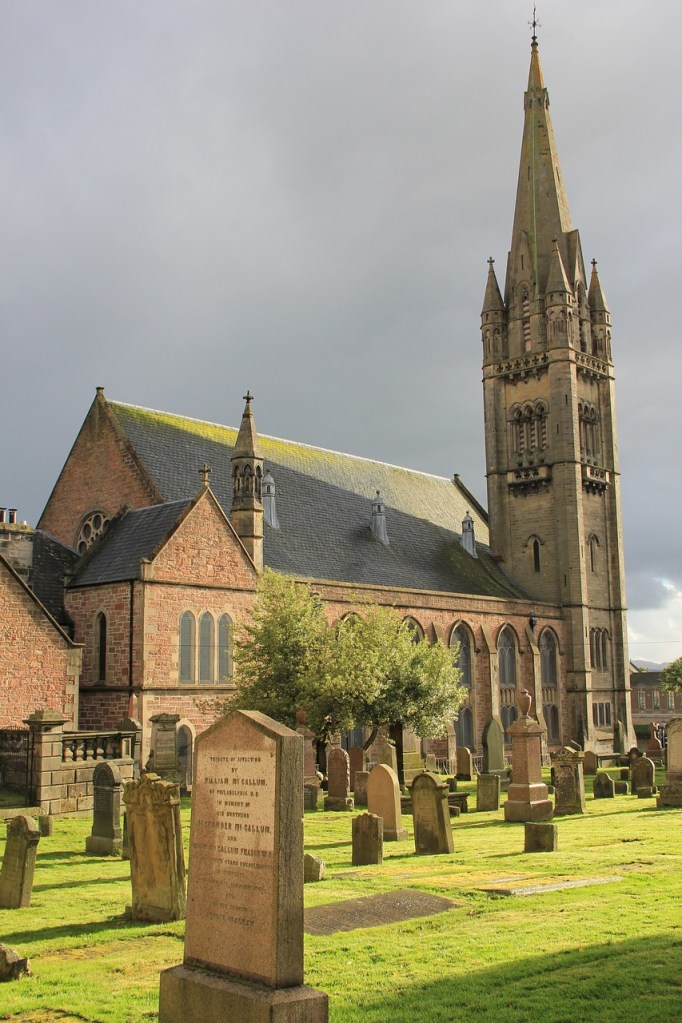
Maybe it’s time to revisit the idea of a church cemetery. With twenty-six acres, we certainly have the space. I’ll leave that to the church leaders at Our Savior, who may be reading this right now. To everyone else, I’ll simply encourage you to give thanks to God for your church family. In this life and the next, they’re the realest family you’ll ever know.
By the way, for the editors out there, I know “realest” isn’t a word. I just like how it sounds.
This past Friday was somewhat chilly and yet beautifully sunny. Even if only for a moment, it was as if spring welcomed summer to the podium for a few words of encouragement. Smiling brightly, he comforted his onlookers, promising eventual warmth.
“It’s nice to see all of you,” he said to his winter-worn Michigan audience. “Not to worry,” he continued. “I’ll be back soon, and I intend to stay for a while.”
Evelyn and I smiled at summer’s joyful appearance, the sun beaming brightly as we made our way to the church and school. I would spend my Friday as I usually do, catching up on the previous week’s unfinished business. Evelyn would enjoy the fast-fleeting days of her eighth-grade school year.
Thankful to the Lord for the lovely day, we cued an appropriate song for the morning’s travel: “Mr. Blue Sky” by Electric Light Orchestra. Singing along, the morning’s joy was seemingly impenetrable. I smiled. Evelyn smiled. Another song played. It was “Brown Eyed Girl” by Van Morrison. Still, nothing changed. We sang and smiled and enjoyed the sun-filled landscapes passing along beside us.
But then, near the end of our journey, as is our way, we took a moment to listen to the news.
The first and only story we could stomach was about a man on trial for beating his five-year-old daughter to death. Living in their car, it seems she soiled herself one time too many in her sleep. In a rage, he pummeled her brutally. After a few moments of gurgling moans, the little girl went quiet.
“I think I really hurt her this time,” he said nonchalantly to his wife before taking a bite from a sandwich. Unaware that he’d killed her, he shot up with heroin and then continued along his way.
For as effortlessly happy as the morning had begun, suddenly, the sun’s rays annoyed my eyes, and the sky wasn’t as cloudless and blue as before. It was motionless and empty. The passing trees no longer adorned but loomed. There were more shadows than sunlit spaces.
While just as dreadful as so many other atrocities available to this devolving world, child abuse is the one crime that cooks my arteries more than most. It’s the epitomized juxtaposition of powerful and powerless, strong and weak, predator and prey. Evelyn’s first words were that the man should pay dearly for his crimes. I agreed. However, I didn’t interpret my agreement for her. The newscaster noted he’d been sentenced to 56 years in prison. Prison wasn’t a part of my initial calculation. I had something much, much worse in mind. And so, my initial words to Evelyn were, “It’s a good thing God is in charge.” Evelyn
Why am I sharing this with you? I suppose partly because today is Mother’s Day, and I’ll while driving to the church this morning, I was thinking about all the ways my wife, Jennifer, is such a wonderful parent to our children—how she loves them with all that she is. Anyone thinking this way will make comparisons, whether they realize it or not. The newscast, still fresh in my mind, interrupted my thoughts. I couldn’t imagine a parent doing what that man did.
I suppose another reason I’m sharing this is because there’s a better point to be made. Friday morning’s happenings coalesced as a reminder relative to faith’s presence.
I described a beautiful day unexpectedly charred by tragedy’s flame. And yet, our initial inclination to rejoice in God’s beautiful creation, even as it turned dark, remained steady into and through the tragic news. We had a choice of proverbial replies in that shocking moment. Our shared response could’ve been, “How could God let this happen?” But it wasn’t. We didn’t blame Him. Intuitively, we both knew better than to think we could manage this world and its inevitable dreadfulnesses more skillfully than God. Instead, we gathered around the position, “It’s a good thing God is in charge.” In a way, this was both confession and thanksgiving. It confessed darker inclinations toward another human being while showing gratitude for God’s gracious hand in all things. It admitted that while we may not know what’s going on, God knows, and with that, we can rest assured.
Now, I’m not going to examine the problem of suffering. Indeed, the girl’s death is terrible. Again, it’s a good thing I was not in charge of the universe when it happened. In the meantime, I’ll simply say that such tragedies should not surprise us in this fallen world. Sin enjoys many capable hands, and each perpetrated awfulness is just one more fingerprint proving sin’s infectious reach. God told us it would be this way (Romans 5:12; 1 Corinthians 15:21). Following the fall into sin, He said to Adam, “Cursed is the ground because of you” (Genesis 3:17). Regardless of what you may have learned, this is not God cursing the earth. It was resultant. בַּֽעֲבוּרֶ֔ךָ is the word God used. “Because of you” is its translation. Adam was to blame. His action (or, more precisely, his inaction during Satan’s interaction and allure with Eve) injected the fatal poison. Still, we know that two short verses before in Genesis 3:15, God promised He would reach into and fix what was broken. The Messiah would come, and the curse would be turned back.
Having said these things, I’ll aim toward a conclusion by offering two quick observations. First, and similar to something I already said, when Christians don’t know what’s going on, not only can we trust in God’s perfect awareness and care, but we are empowered by the Holy Spirit for recalling what we do know, which is that God is by no means distant from this world. The most extraordinary proof is the cross. Behold the fulfillment of Genesis 3:15. Behold the suffering and death of God’s Son. Behold His intimate and inreaching love for a humanity mired in sin and destined for eternal condemnation.
Second, by the power of the Holy Spirit, Christians are equipped to endure this world’s bipolar mess. And it’s just that, a bipolar mess. No matter the road before you, life has sharp ups and downs. It swings back and forth suddenly. Still, by the Spirit’s power, a Christian can navigate both. In the good times, a Christian holds tightly to God, giving thanks for His kindliness. During the upheavals, a Christian holds tightly to God, too, assured that we are never left to our own devices and glad for His gracious care in all things, especially the care He showed by sacrificing His Son to save us from this temporary world for the unending world to come.
Did your mother ever tell you it’s rude to stare? I’m pretty sure mine did. Granted, it was typically an instruction given relative only to people. Parents experience an entirely different form of concern when their children sit and stare at nothing. Good thing I’m the only parent in the entire building right now. Here I sit, staring out my office window. Although, I am not entranced by a strange-looking person, nor am I being drawn into a void of nothingness. Instead, a reasonably hefty groundhog is wandering around outside my window doing whatever groundhogs do. He appears to be busy scurrying and popping up and scurrying again. At one point, he popped up to look in my window. We saw each other. I said hello and told him he looked well-fed. He dropped back down to scurry away, only to pop up again as if to say, “Same to you, buddy.”
There are plenty of other things I should be doing right now. For one, I should be tidying up my sermon for this morning. It’s written, but it isn’t ready. And yet, I’m watching a groundhog. It’s not as if I haven’t seen one before. Or that groundhogs are all that interesting. It’s something else. It’s more that feeling one gets on occasion. I’m guessing you know the one. You begin looking at something, and after a time, you realize you’re locked on it in a lazy stare. You’re not necessarily interested in whatever you’re observing. You’re just looking. And as you do, you leave yourself for a moment.
Have you ever been doing this when someone suddenly asked you a question? One way to know it’s happening is that it takes several seconds to realize you’ve been asked a question and then a few more seconds to answer. And when you give a somewhat disjointed reply (because you began speaking while climbing back into yourself mentally), the person doesn’t thank you but inquires, “Are you okay?” I suppose it wouldn’t be out of order to respond, “Everything’s fine. I just stepped away from the control panel for a moment.”
Returning to the fact that I’m staring at the local wildlife when I should be working on my sermon, I get the sense that staring at someone can’t be all that bad. The Gospel reading for today is Mark 8:1-9. As Jesus directed the hungry multitude to sit, I imagine His disciples were staring at Him. Aware of the dire situation, they’d already asked Him, “How can one feed these people with bread here in this desolate place?” (v. 4). Rather than initiating a food search, the Lord instructed them to stay right where they were. That was weird. It invited astonishment, the kind that could easily become staring because it didn’t want to miss what might happen next.
My wife, Jennifer, is a gifted photographer. She’ll never admit it, but she has a visual sense about her that few others do. It’s a sense that employs staring—not the lazy kind I admitted to this morning, but the intently honed kind. Jennifer can spot things among casual scenery that most others will miss. Genuine photographers have this skill. Painters and poets do, too. They see things that others miss and then lock onto them. They look without flinching, observing the microscopic details. They learn by staring. They know a glimpse isn’t enough. They know you must look intently to truly see. By looking this way, they know they’ll be led to better, more substantial things.
When it comes to Jesus, this should be everyone’s rule. He’s worth far more than a superficial glance. Everything He says, everything He does, you don’t want to miss. There’s a purpose in all of it, and it’s entirely for His onlookers. That’s one reason any seasoned preacher will admit that even the most uncomplicated Gospel narrative can provide a lifetime of sermons. Every little detail relative to Jesus’ person and work—every single motion and word in every single context or conversation—aims for the miracle of humanity’s salvation. That salvation, and all its accessory minutia, must be examined and preached. To do so is to connect with the instance being studied and be prepared to understand other instances.
For example, observing Jesus here in Mark 8:1-9, I imagine that later on in the upper room on Maundy Thursday, when the Lord took the bread, gave thanks, and then broke and gave it to His disciples (just as He did with the multitudes in the wilderness), there were words and actions used that the disciples had seen before. It was an entirely different context, yet it was reminiscently similar. At a minimum, having paid close attention in the wilderness with the starving crowds, they’d know the Lord’s ability to take a single piece of bread in hand and, prior to giving it to anyone else, make it so much more than before He touched it. In the wilderness, one piece in the palm of His hand became five, and then ten, and then thousands upon thousands, enough that the uneaten leftovers filled seven baskets. Surely, a single morsel in the Lord’s Supper, surely a tiny sip from the Lord’s chalice, could be more than well-wishing symbolism. Certainly, Jesus can take hold of mundane things and extend their potential beyond human faculties for reason or comprehension.
Either way, these things are lost on those who are only willing to give Jesus a superficial glance, one that assumes it can sufficiently sort Him out in a drive-by interaction, ultimately considering Him to be just one spiritual guru among many. You can’t just pop up for an occasional peek, fitting him into your scurrying, and expect to be called a Christian. It’s better to stop and stare. You should watch Him closely. You should listen to Him carefully. You should mind what He’s doing, and as He does it, hang onto His every word (Luke 19:48).
Knowing that Christ is the Word made flesh, the same rule naturally applies to the Holy Scriptures. God’s Word is more than worth an irregular glance. Luther is the one who said, “If you picture the Bible to be a mighty tree and every word a little branch, I have shaken every one of these branches because I wanted to know what it was and what it meant.” In a mere practical sense, for Luther, a tree is a tree—until you examine it. When you stare into its branches with investigative eyes, you’ll see far more than a forgettable object with a trunk and green stuff growing out of it. You’ll discover details. You’ll see one branch leading to another—flowering adornments reaching out from countless stems covered in intricately contoured surfaces. You’ll find things living among the tree’s branches, lively creatures that call the tree home.
By the way, I think most pew-sitters can tell the difference between a pastor preaching from a drive-by glance at Jesus and one who has stopped to stare at Him. It’s not only revealed by the preacher’s care with words, but by the details his words are in place to carry. Telling the listeners about a tree is nothing compared to using words that lift them from the earth to set them into its branches. A tree remains an inconsequential construct until the preacher examines and then introduces you to it. That’s a reality relative to language.
Having said that, I should get back to the sermon-writing effort. In the meantime, consider your own willingness to stop and stare at Jesus. Is He of more interest to you than an occasional visit to church? Driving by, is He more than just another object decorating your intellect’s limited landscape? Is His value for life in this world and the next far more substantial than your rarely-opened Bible would betray? I hope so.
How about this? Pick a narrative from any of the four gospels. Long or short, read the same narrative every day for a week. After each textual visit, take some time to savor it. Think about what you read. Let yourself stare into it for a while. Do this with the same text each day for a week, taking a moment to jot down something you notice with each visit. My guess is that each interaction will provide a unique “something.” You might not understand the something right away. Still, you will have taken it in. And you’ll likely recall it right in the middle of another narrative somewhere else that may lead you toward understanding it. You may even begin to notice particular trajectories, ones that lead you from simple uses for water, food and drink, and so on, to other, more substantial truths—ones suggesting that there may be more to faith’s origin than you knew; or there may be more to baptism than you first thought; or there may be more to the Lord’s Supper than the one-size-fits-all church or the meme-assembled theologies have taught you.



 Cruciform Stuff