
I received my fair share of hate mail for what I shared last week about the church in Evanston, Illinois. Even a few business owners from the town reached out to give me a verbal slap. And yet, it is as I’ve said countless times before. Writing for public consumption is risky. And so, be ready to endure what goes with it. Of course, knowing what to expect helps. Most of the messages bore a tired spirit, the kind that only knows accusations like, “You’re a heartless human being,” or “You’re a hypocritical Christian.”
However, I found one email rather interesting. I’ve copied and pasted it here for you.
“With all due respect Mr. Thoma (I will not call you doctor or reverend because you are not) you are just one more fantic [sic] who does what you tell others not to do. You make the bible say things it does not. It does not talk about genders the way you do. It does not say anything at all about abortion. That church can make there [sic] manager [sic] scene say whatever they want. There is no rule to understand it the way you do. And didn’t Jesus say to judge not?”
There’s a lot in that message. It has a lot of the same trite prattling I’ve endured a thousand times before. That said, I’ll admit I have very little interest in responding to most of it, especially the first, third, and fourth concerns in the message. Those are easy. Yes, the Bible does speak rather precisely about gender. No, you cannot make the Gospel and its narratives into whatever you want. Lastly, you just judged me and then said Jesus insisted we not do such things.
But the second concern—that the Bible does not say anything specifically about abortion—is worthy of some attention.
This particular comment exposes a genuine hermeneutical problem—a way of interpreting God’s Word. It holds that if something is not loudly foregrounded in a familiar verse, then the Bible must intend for us to do whatever we want with it. To be fair, many within the prolife camp inadvertently reinforce this misunderstanding. This is where the prolife movement could use some help. What I’m saying is that when confronted by these same arguments, most in the prolife camp go for the low-hanging fruit. We quote Psalm 139, Jeremiah 1, Luke 1—verses about God forming life in the womb, about knowing us before birth, about children leaping for joy beneath a mother’s ribs. To be sure, these are beautiful passages. But they do not yet fully address the challenge posed in the message, which is the claim that the Bible doesn’t say anything specifically about abortion, like, at all.
And yet, the Bible does. Saint Paul himself is the crucial proof here.
A few years back, I spoke at a Right to Life banquet, and I spent most of my presentation dealing with this point. In particular, I focused on a word Saint Paul uses in 1 Corinthians 15. Before I share that word, we need to know the capabilities of the man who used it, not merely as an Apostle, but as a writer who knew the innate power of language and its ability to carry theological freight. In other words, Paul understood how one well-chosen term could do what a thousand explanations could not. And so, when he does this, we are wise to pay attention, being sure not to soften his intent, or to do what we can to explain it away.
First, Paul was fully aware he was writing Scripture (see Galatians 2:1–9). That matters. It means he knew what he wrote was not only inspired but also immutably authoritative. It wasn’t just for his time. It was aimed directly at the saints of every generation, including our own.
Second (and as a writer, I just love Paul for this), he was no dull penman. In fact, whenever I want to show the students in my religion class just how much fun the Scriptures can be, I take them into Saint Paul’s writings. The Holy Spirit’s allowance for a biblical writer’s mind, wit, personality, experiences, and education really shine through with Paul. His epistles breathe with imagery and rhetorical devices. Sometimes he thunders. Sometimes he sings. Sometimes he jokes. Sometimes he pokes with stinging sarcasm. Sometimes he rambles, as if wrestling with himself out loud. He laughs at himself on occasion. Sometimes the Holy Spirit leads him to write some really hard news, leaving him feeling slimy. When that happens, you can almost guarantee you’ll discover a strange doxological sentence afterward, as if he felt the need to take a verbal shower.
Aware of these things, Saint Paul is great fun to read.
But it also enables the reader to see those places where Saint Paul drops plainspoken word-bombs. There is one such place where the word he chooses, one that the prochoice world hopes no one will notice, is meant to rattle the teeth in a reader’s skull.
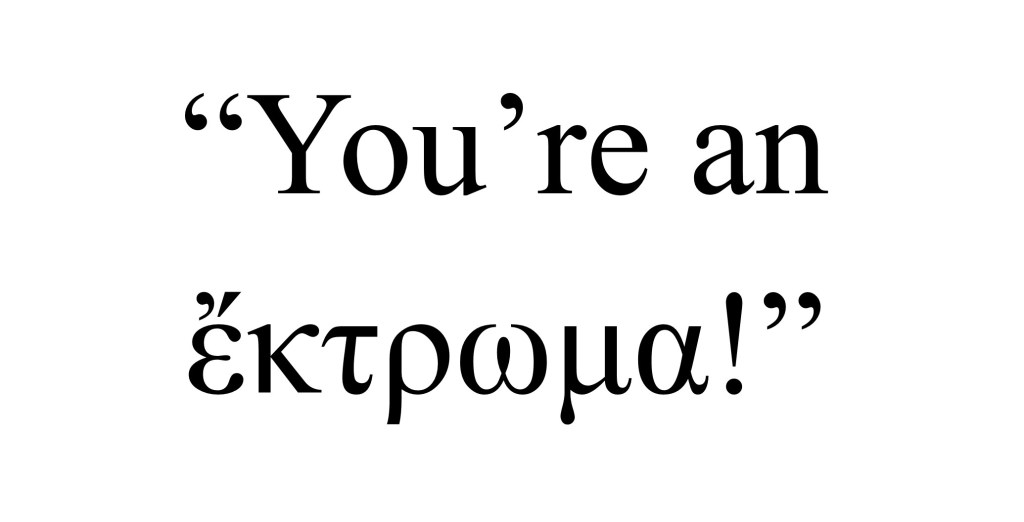
In 1 Corinthians 15:8, Paul describes himself as τῷ ἐκτρώματι. This is typically softened to “one abnormally born” or “untimely born.” Unfortunately, most assume Paul just meant he arrived late to the apostolic party, as if he were the last hired or least deserving. But that’s not at all what the word means.
Admittedly, ἔκτρωμα (ektroma) is a rare word in the New Testament. In fact, this is the only place it appears. But outside of Scripture, it is common enough in Hippocrates, Dioscorides, and other early medical writers. And there it rarely means “one abnormally born” or “untimely born.” It’s the word used for an aborted child—a baby expelled dead, and often deliberately. In other words, this is not just miscarriage or tragic happenstance language. The word includes the idea of killing a baby in the womb.
Now, let your stomach turn a little. I get the sense that’s the response Paul wanted. It’s an ugly comparison. Contextually, Paul is not mildly saying, “I was late to the apostles.” He is calling himself an abortion by comparison—a repulsive example of something terrible, the only thing he could be in his time apart from Christ, before his appointment as an apostle. Now, here’s why I think this matters to the discussion.
Years ago, I read an article in The Telegraph recounting a sermon by Rev. Katherine Ragsdale, then-Dean of the Episcopal Divinity School in Cambridge, Massachusetts. In front of an abortion clinic, Ragsdale said everything in public that the email I shared above implies. She called out from a microphone that the Bible was silent on abortion, and by its silence, a person’s freedom to have or not have one is implied. Stepping from that twisted assumption, she declared that abortion is actually a blessing given by God, and then she invited everyone in the crowd to chant, “Abortion is a blessing and our work is not done!”
Wow.
Of course, Ragsdale is not some persona plucked from modern Christendom’s fringe. Her ideas have actually taken root like invasive weeds throughout the denominational spectrum. I know this, not only because of the email that came my way, but because of the stereotypical points that “prochoice Christians” lean on to support their ungodly position. It’s a common defense to say that the Bible doesn’t even mention abortion, and since that’s true, it belongs in the category of adiaphora—something neither commanded nor forbidden by God’s Word. Furthermore, if something is neither commanded nor forbidden, we are free to do with it as we’d prefer—maybe even consider it a blessing.
Well, unfortunately for them, the Bible does mention abortion explicitly and by name—ἔκτρωμα. And by the way, I should add that it’s the theology of toddlers and thieves to shove genuine ungodliness into adiaphora’s category. I don’t care what the topic is. Besides, it is irrational to think that if any source, let alone the Bible, uses a word as an insult, the concept attached to that word could ever be considered good. Paul did not call himself a hug or a sunrise. He called himself an abortion—a grotesque image meant to reveal what sin makes of us, and what God has every right to do to us as children. In our sin, we deserve death before we even take our first breath. Grammatically, if abortion is used in this way to portray humanity’s depravity, then for Christians to call it a blessing or declare it holy is to declare altar fellowship with Molech.
The Church must know and understand this. And she must be ready to say it without stuttering. No, abortion is not a blessing. It is an abomination. It always has been, and it always will be. The Bible specifically refers to abortion as something dreadful. If your Bible translation calls it holy, go bury it somewhere. If your pastor calls it a blessing, well, don’t bury him, tempting as the thought may be. Instead, confront him and demand repentance. If he refuses, leave. Find a church that still believes the Word means what it says
 Cruciform Stuff