
The World’s Theatrics

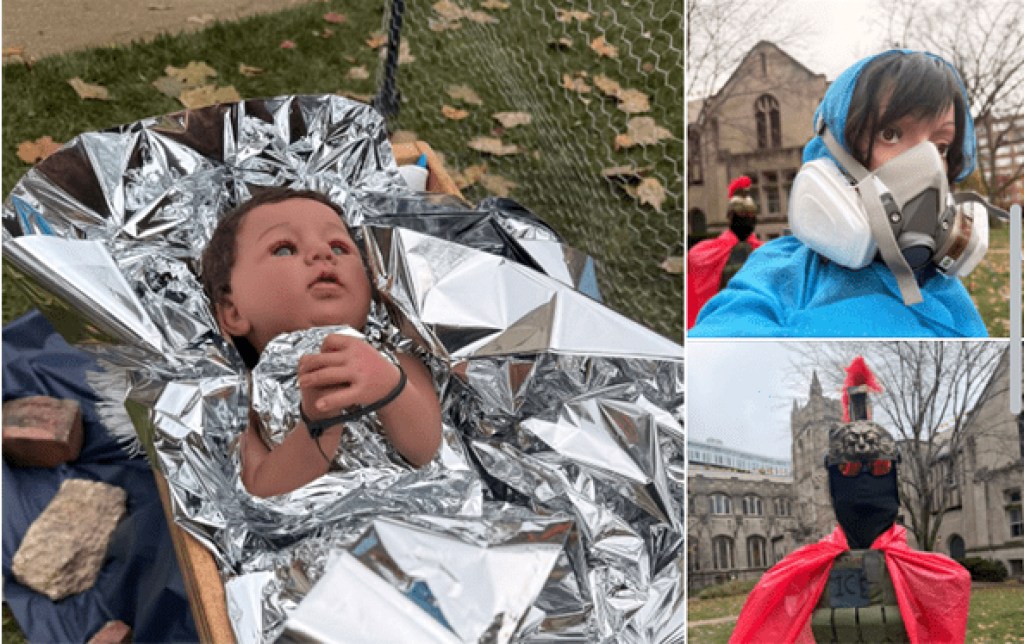
Did you happen to see the article from Breitbart last week describing how a Christian (and I use the term loosely) congregation in Evanston, Illinois, put out a rather provocative nativity scene? My friend, Bob, sent it to me. I’m glad he did. Essentially, the church is displaying an infant Jesus bound with zip ties. Mary and Joseph are wearing gas masks. Roman soldiers are depicted as modern-day ICE agents, wearing insignia vests and all.

The first thing I’ll say is that it sure seems tempting for some to turn sacred things into public spectacles, especially in a culture that not only enjoys but rewards sensationalism. For those who know where I stand on worship styles, that’s really what sits at the heart of my beef with contemporary worship. I just can’t get past the anthropocentric exhibitionist nature of it all. Why would any of us need Hollywood theatrics to “encounter” the Lord? Why strain so hard to manufacture emotion when we know, by faith, that Christ Himself is truly present by His visible and verbal Word to deliver forgiveness, life, and salvation? But even as contemporary worship teeters on the edge of spectacle, I’m willing to admit that most who prefer it still at least want to tell the Lord’s story. They’re reaching, even if thinly, for Christ.

The church in Evanston, not so much. Their goal isn’t proclamation. It’s provocation. It is to deliberately exchange the holy mystery of Christ’s birth with a political message that the Christmas narrative was never meant to carry. And not just a little exchange. But a complete conversion into the ridiculous. The entire goal is to fashion Jesus’s birth into a statement about immigration. That’s it, and nothing more.

Ultimately, the heart of the Christmas narrative is that God became Man, thus the longstanding practice of reading John 1:1-14 as the appointed Gospel text for Christmas Day. The birth of Jesus Christ is not an allegory. It’s not a political metaphor. It’s not a social-justice image. It’s an all-encompassing historical and spiritual reality. Not one single inch of it is a backdrop for the progressive silliness we’re seeing in Evanston, Illinois. It’s the humble cradle of the One who became as us, that He might take our place in judgment (Isaiah 53:4-6; 2 Corinthians 5:21), and win for us eternal life (John 3:16). All of its themes and sub-themes circle this truth.

By the way, I think the response to this nonsense by some in the Church has been too kind. I saw a note on a Facebook post calling it an “unfortunate demonstration done in poor taste.” It is not poor taste. It is unbridled sacrilege.

But here’s the real catch. The display’s orchestrators claim we ought not miss the parallels between the Holy Family’s escape to Egypt and the plight of modern immigrants. However, any objective person, even one who spends only a minute or two on the Christmas narrative, will see this as a gross oversimplification and, ultimately, a distortion. The flight into Egypt was not a matter of contemporary geopolitics or border enforcement. It had nothing to do with social justice policy. It was divine choreography. It was the unfolding of God’s redemptive plan. To equate that salvific narrative with today’s immigration debates is to cram sacred things into the mold of secular activism, ultimately betraying progressive Christianity’s real geist.

Progressive Christianity is not interested in who Jesus is and what He’s done, except to convert Him into a mascot when convenient—or a moral illustration helpful only insofar as He endorses the activist agenda. Progressivism does not proclaim Christ crucified for sinners (1 Corinthians 1:23). It can’t. The theologies of sin and grace would undermine the Marxist premise that some are inherently unforgivable and some are inherently oppressed by those same unforgivables. Straying too far from that premise risks a finger pointing back in the direction of progressivism’s false “righteousness.” Jesus is a much safer Christ when He can be conscripted for slogans. And so, they do. And they do it for everything.

So keep digging. Read, don’t skim. The Breitbart article’s author was right. Their public “covenant” omits the Trinity, the divinity of Christ, His atoning death, and salvation by grace through faith.

Aware of these things, this ungodly nativity scene makes a little more sense. Not to mention, the omissions can be understood rightly. They aren’t incidental. They are foundational. Once the person and work of Jesus Christ cease to be central, the Gospel becomes malleable. And if the Gospel is malleable, it can be reshaped into any form that suits the latest progressive cause. You name it, and Jesus is a social warrior for it. Immigration, BLM, gender fluidity, and the list goes on.

But now, before I say anything else, I should circle back around to something I said already.

You can pretty much count on the progressive churches this time of year to roll out the ol’ “Jesus was a refugee” campaign. Unfortunately, many folks fall for it. That’s because it sounds compassionate on the surface. It’s also because people are biblically illiterate. It trades on half-remembered Sunday School summaries rather than what the Scriptures actually say. But once you step past the slogan and back into the sacred text, the whole construct collapses. A person can see that biblically, historically, and most importantly, theologically, the refugee narrative simply does not fit into the Christmas story. And the only way to bring them into stride is to do some serious rewriting.

First of all, the Holy Family’s escape was not an immigration crisis. It was, as I already said, divine choreography. Mary, Joseph, and the infant Jesus fled to Egypt because God commanded it through an angel (Matthew 2:13). They also returned because God commanded it through an angel (Matthew 2:19-20). Their escape was not a search for asylum. It wasn’t a reaction to immigration laws. It wasn’t a political protest. It was God preserving the Messiah so that He could accomplish His appointed work (Galatians 4:4-5). What we’re watching in the Christmas narrative is redemptive history, not social justice rhetoric.

Second, Egypt was not a foreign nation in the modern political sense. The first-century world wasn’t divided into modern nation-states. Egypt and Judea were both under Roman rule. There were no checkpoints or passports. There were no visas or asylum protocols. The Holy Family’s movement was absolutely nothing like border migration. It was, quite simply, movement within a unified structure, and about the only noticeable differences were the regional variations. In fact, it would be more honest to compare it to moving from one state in the U.S to another.

Third, the Holy Family was not homeless or destitute. Progressives love to depict them this way. But God’s Word doesn’t do that. After the Magi arrived bearing their gifts of gold, frankincense, and myrrh (Matthew 2:11), Joseph and Mary went into Egypt with some significant financial means. And don’t forget that Joseph is described as a τέκτονος (Matthew 13:55), which is a word that’s often translated as “carpenter,” but can also indicate a craftsman who works as a builder with various materials. In other words, Jesus’s adoptive father was a skilled tradesman. Those were in demand everywhere in the first century. Joseph was more than able to provide for his little family, which is to say our beloved Savior and His family were not impoverished migrants trying to survive. They were a well-cared-for, God-guided family under divine protection.

And it was all in place for one purpose: to preserve the Messiah.

Christ was spared from Herod so that He could die for the sins of the world at the appointed hour (John 10:17-18). This is the epicenter of the escape narrative, and to recast it as commentary on modern immigration is to betray no small ignorance of salvation history’s details and eventual arc.

But again, what should we expect from these goofy activist churches?

That said, I should warn you against the churches on the other side of the political aisle in this regard, too. Indeed, ours is a nation undeniably shaped by Christian principles, and for that we should give thanks. Patriotism, rightly ordered, is a gift—an expression of gratitude for rights we don’t deserve and didn’t earn, and yet God gave. With that, we rejoice in this nation because it’s free. Ironically, even as progressive ideologues are forever trying to silence conservative bible-believing churches, these same Bible-believing churches rejoice in religious liberty—the same principle that guarantees the sleazy progressive churches the freedom to hang LGBTQ, Inc. flags and put up activist nativity scenes.

Still, we have to be clear and consistent. The faithful churches must guard against any and all tendencies to allow anything to eclipse the Gospel (1 Corinthians 2:2). We must maintain that the Church’s calling is higher, older, and holier than any one nation’s story, even when we’re considering America’s uniquely Christological heritage. We’re glad for it. We rejoice in it. We do everything we can to prevent it from slipping into forgotten history. But it’s not the primary message of our lives in Christ. It’s a piece of who we are, not the thrust of our Christian identity (Philippians 3:20).

Now, again, don’t misunderstand me. (Of course, those who know me best won’t do such a thing.) We can and should talk about political things from the pulpit. In fact, I wrote a book that Fidelis Publishing is set to release in February, entitled Christ Before Caesar: Faithful Public Witness in an Age of Retreat. I more than mention throughout the importance of pastors concerning themselves with these things, if only because, just as Abraham Kuyper, the late nineteenth-century pastor and Prime Minister of the Netherlands, so rightly said: “There is not one square inch in the whole domain of our human existence over which Christ, who is Lord, does not cry ‘Mine!’” But I do this mindful that I am to preach the Word of God, and nothing is to get more airtime or airspace in the pulpit than the Gospel. In the churches that give more to politics than Christ, even the conservative ones, I dare say Christ is just as absent in the preaching there as He is in the Evanston church’s nativity scene.

The Church must preach a Christ unshadowed by any agenda—One whose kingdom is not of this world (John 18:36), yet who rules this world all the same for the good of His people (Ephesians 1:22-23).

In the end, that’s a key indicator of what separates the real Church from every cheap imitation of it. The world can dress Jesus in zip ties or put Him on an eagle’s back with a flag in His hand. It can drag Him into its activism, shrink Him into a mascot, or draft Him into its political crusades. But the real Christ didn’t take on flesh to validate movements. He came to save sinners (1 Timothy 1:15).

Full stop. The Church’s task is also not to improve the Lord’s image or update His mission. It is to be faithful to His Word. It is to proclaim the Gospel—what He’s done, is doing, and will continue to do for sinners relative to their dreadful predicament in judgment (Hebrews 13:8). Knowing this, we can strip away the theatrics. When we do, we’ll see Jesus there—the Holy Child in the manger, the Man on the cross, the Lord at the empty tomb. That Jesus—unrevised and unshadowed—is the only One who gives life (John 11:25). And if a church cannot preach that Christ purely and without alteration, it is not a church at all (Revelation 2:4-5).

First Impressions

I’m writing this morning’s note from an Airbnb in Morton, Illinois. Rather than rent a hotel room, for barely a fraction more, Jennifer managed to locate a spacious two-bedroom first floor of an early 20th-century home just around the corner and down the street from where I used to live. It has a full kitchen, dining room, and living room to boot. As I said, Jennifer found it. Although, she isn’t here. My daughter, Evelyn, is traveling with me. We’re in town to visit my family.

For starters, I just got back from a quick trip to the local McDonald’s for my usual Sunday morning coffee. You can be pretty sure I’m sipping one while tippity-tapping these Sunday messages. It took a little longer than normal to get the coffee. Usually, I’d just zip through the drive-through and be on my way. However, after sitting for a while unnoticed, I decided to go inside.

It doesn’t matter where you are; there’s something about restaurant dining rooms. They’re either bustling with vigor—people coming and going, conversations echoing from the walls—or they’re eerily quiet, as though the building itself is holding its breath. This morning, it was the latter. It felt as though I was the only one awake in the town—well, besides the three workers I saw behind the counter and one other person who was already inside ordering something, too. Where I am right now, a house on Adams Street, is just as still. Evelyn is still sleeping, and the only noticeable sounds are the taps at my keyboard and a faint machine hum coming from what I’m guessing is the furnace.

I don’t mind the quiet. Stillness has its charm. Because I’m almost always on the move, when I do have a moment like this, especially one that occurs in a relatively unfamiliar location, it becomes an opportunity for a unique kind of reflection. Typically, I’m in my office when I write these notes. I can observe my surroundings—or whatever might be swirling around in my head—without distraction almost every Sunday from my computer chair. But in this particular space—a hardwood chair at a small round table in a unique corner of a much wider world—there’s an exclusive character to its ordinariness. This is to say, while the room’s décor might not win awards, and the coffee I drink ritually is barely up to par, there’s no place like this place right now. If I’m willing to consider that even the simplest things bear a treasure trove of inspiration, then I’m just as blessed to be where I am at this very moment as I would be if I were roaming the gilded halls of the Hermitage.

But to grasp this, I need to pay attention. I need to look around and take notice of what’s happening—what others are doing, what objects are involved in the moment’s stillness as well as its commotions. For example, I mentioned before that I wasn’t the only one who stopped at McDonald’s this morning. Another person was there. Admittedly, he looked rigidly serious in his dark suit. If I’m being completely honest, he reminded me of a funeral director—or maybe a character from the film Men in Black. Had the shadow government sent an agent to Illinois to abduct and mind-wipe me? Who knows. Either way, I wondered further when taking his two bags of food in hand, he followed me out the door. But then I watched him climb into a silver minivan with two bumper stickers on it that made me laugh out loud. One sticker read, “I identify as a toaster,” and the other, “Citizens Against Bumper Stickers.”

For as serious as the man appeared to be, I’m guessing we have a similar sense of humor. Or he’s married to someone who has the same sense. Either way, I’ll bet if we spoke, we’d get along just splendidly. But to know this, I had to let more than first impressions determine our future. I had to give him a little more time and space to be his fuller self.

I suppose the congealing thought this morning is that as Christians intent on bringing the Gospel into a world of countless personalities, this is important to keep in mind. People are complex. They rarely fit neatly into the categories we might initially assign them. I’ve told my own children on occasion that when I first see a homeless person—or anyone who might be relatively off-putting—I try to remember that the person was once someone’s baby, and then eventually a toddler, and then eventually a child, and so on. This person was given life just like the rest of us. That alone deserves reverence. Stepping from there, even as someone’s first impression might communicate a hard and filthy life, or even an all-business and rigidly humorless demeanor, a closer look can reveal a human being with personality and depth, someone with an undiscovered past and an untold future, and among all of it, a human being who bears the fingerprints of the Creator’s artistry in ways we might never expect.

This is just one more example of something I continue to insist among any and all who read the things I write. I’m pretty consistent in encouraging my readers to look at the world through the lens of the Gospel. When the Gospel becomes a way of seeing, our surroundings become more than things, and people become more than strangers, acquaintances, or friends. Saint Paul knew this. He at least winked at it when he wrote, “From now on, therefore, we regard no one according to the flesh…. Therefore, if anyone is in Christ, he is a new creation. The old has passed away; behold, the new has come.” (2 Corinthians 5:16-17). He knew that observing the world and its inhabitants through the lens of Christ’s life, death, and resurrection was to see beyond humanity’s exterior to its divine value. To do otherwise is the old way—sin’s way. In Jesus, the new way has come.

Of course, and once again, Jesus is the ultimate demonstration of this perspective. The first example that comes to mind this morning is Zacchaeus, a despised tax collector in the sycamore tree (Luke 19:1-10). The Lord saw him for all that he was in his sinful past and present, and yet, He called to him, fully intent on giving him a better future. Why? Because Zacchaeus was innately valuable. Another example is the woman at the well in John 4:7-26. He knew her past. In fact, He proved it by telling her things about her life that no stranger would ever know, not even from a first impression’s hints. And yet, His goal was not to harness her to that past. It was to give her a new future. Again, why? Because she was His divine creation, and she was valuable.

In the end, my point is one of encouragement. I’ve written before that I have no problem finding plenty to write about every Sunday morning. That’s because there’s plenty around me to observe and investigate through the Gospel’s lens. And so, again, be encouraged to do the same, especially when it comes to people. Pay attention. Do so, remembering that each is a unique creation of God. I mentioned before that Saint Paul knew this. Truth is, the whole Bible knows it. The Psalmist certainly did, reminding us, “For you created my inmost being; you knit me together in my mother’s womb. I praise you because I am fearfully and wonderfully made” (Psalm 139:13-14). Every individual carries this intrinsic worth. With that as the starting gate to any first impression, no one should be dismissed offhand, but rather, there’s always room for second, third, and fourth impressions.

The Possibilities

It has begun. Multiple times a day, the Thoma children announce how many days remain until the last day of school. I bet they’d be ready with the hours, minutes, and seconds if I asked any of them. I’m certainly not annoyed when they do this. I know why they do it. For youth, summer and freedom are synonyms. Besides, I did it, too. As a kid, I counted the days until my only schedule-consuming responsibilities would be jumping ramps on my bike, hunting crawdads in muddy creeks, playing army in the forest behind my best friend’s house, participating in socially recalibrating neighborhood scuffles, watching late-night scary movies, and just about anything else summer could conjure.

Thinking back to those days, even though I stayed up pretty late almost every night, I don’t really remember sleeping in the following day. I remember wanting to get as much from my summer as possible. And so, I’d hop out of bed no later than 8:00 or 9:00 a.m., throw on the cleanest clothes from my floor, have a bowl of cereal, and then fly out the back door to the rusty shed where I kept my bike. I’d throw up a dust trail speeding down our gravel driveway or go off-roading through our bumpy backyard, my bike clanking and rattling all the way. But whichever direction I went, the horizon’s possibilities were limitless.

Some of the summer’s possibilities were great. Others, not so much. I remember one summer hearing that my friend, Todd Smart, fell from the tree in his front yard and died. It was July of 1983. I was ten years old at the time. My dad told me the news. I certainly knew the tree. I’d climbed it, too. If I had to guess, I’d say it was at least twenty feet tall. Although, things seemed so much bigger when you were a kid. As the story goes, Todd had just about reached its peak when the branch he was standing on broke, and he fell to the ground, hitting branch after branch all the way down. A couple of days later, my friend, John, told me he’d heard Todd looked like a pinball bouncing off the bumpers as he fell. Oddly, John and I had that conversation about ten feet from the ground in a tree near my grandmother’s apartment.

It’s strange the things one remembers from childhood. Before telling me the news about Todd, I remember the look on my dad’s face. It was uniquely unordinary. I knew I was going to hear something I didn’t expect. I remember the tree near my grandmother’s apartment. I remember which branches a kid needed to grapple with to climb it. I remember my friend John’s home phone number. I just typed it into Google. A woman with an extraordinary name—Drewcylla—appears to own it now.

Whether winter, spring, summer, or fall, each season holds more across its horizon’s boundary than what’s right in front of us at any given moment. What we experience in those lands will be with us well into the future—well into forthcoming seasons. Some things we’ll remember in detail. Other parts we’ll forget. Some we’ll observe from this side of life and realize how we didn’t fully comprehend the event’s particulars because of our immaturity at the time. Remember, my friend died climbing a tree, and a few days later, another friend and I discussed the tragedy while climbing a tree. I’m well past ten years old, and I only recognized the irony just now as I typed this. Still, the Christopher Thoma tapping on this keyboard this morning is the same one who dangled from that tree near Valleyview Heights Apartments in Danville, Illinois, forty years ago. And yet, I’m not the same person. I’m entirely different after meeting each season’s moments. That’s life. That’s development. That’s growth. And it’s normal.

Seasonally speaking, I’m absolutely certain that growing up in the 1970s and 80s barely compares to childhood today. For one, I don’t remember any of my classmates identifying as cats. (Honestly, the neighborhood scuffles I mentioned before would’ve fixed that weirdness in a hurry.) I don’t remember any of my teachers encouraging me to explore my gender identity or encouraging anyone I knew to consider gender reassignment surgery. The 70s and 80s could get crazy, but not this kind of crazy. I certainly don’t recall any of my teachers attempting one of the worst kinds of crazy: to undermine my Christian faith or divide me from my parents. For example, my son, Harrison, came to me this past week to tell me that his AP US History teacher at Linden High School overheard him talking to a friend about a scene from the Monty Python film “The Life of Brian.” Harrison hasn’t seen the movie, but I have shown him a few of its more hilarious scenes. The conversation unfolded something like this:

“Isn’t your dad a priest or something?”

“He’s a Lutheran pastor,” Harrison answered.

“He actually let you watch that movie?” the teacher pressed.

“No, I haven’t seen it. I’ve only seen a few scenes. They don’t really want me watching it.”

“Of course not,” the instructor replied. “He probably doesn’t want you watching it because it’ll challenge what he’s taught you to believe and teach you another way to look at the Christian religion.”

Nice try. But most certainly a hit and a miss. Jennifer and I haven’t kept the movie from Harrison because we’re his cruel overlords. Thankfully, he knows this. And thankfully, he talks to us openly about things like this. For the record, Mr. History Teacher, his mother and I don’t want him to watch the movie because it employs a few choice words we’d prefer for him to avoid and has full frontal male and female nudity. Other than that, it’s hilarious. And if anything, the “I want to be called Loretta” scene makes you and your dreadfully woke automaton colleagues look imbecilic by comparison.

Right now, even as Harrison is sixteen, he’s developing. It’s our job to help him along. We do this by ensuring he knows we love him more than anything, second only to Christ. When Harrison’s beyond this season of our responsibility, we’ll be happy to let him take the helm. That’s how it works. He’s already proving his ability to make his way without us. He’s already showing that he’s seeing and enjoying the world in ways far different than what the world would prefer. I’ll come back to this in a second.

In the meantime, as sure as I am of the vast differences between the 1970s/80s and today, I’m just as confident that the nature of humanity hasn’t changed all that much. Kids are developing—spiritually, socially, physically, and psychologically. What happens right now—how we talk to them, what we allow to happen to them, whom we allow in their circles, whom we allow to teach or influence them—all these things might seem irrelevant in the moment. And yet, like it or not, every one of the atom-sized occurrences relevant to each situation is affecting them. Twenty years, thirty years, forty years from now, each situation’s truest impact will be remembered and likely demonstrated. As I already said, that’s life. That’s development. That’s growth. And it’s normal.

But know this: The Lord’s normal differs from the world’s normal. And so, with Christ as one’s north star, “normal life” itself is affected. Both the good and bad seasons meet first with the One who promises to go before us, pledging to never leave nor forsake those who are His own (Deuteronomy 31:8). With that, all things meet the child quite differently. In any given moment, recognizable or not, this Gospel will be doing what our faithful God says it’ll do: cultivating joy, resilience, and a necessary endurance that will only strengthen as one matures toward a final breath and then enters eternal life (Proverbs 22:6; Deuteronomy 6:7; Isaiah 54:13; Jeremiah 29:11; Matthew 19:4; 2 Timothy 3:14-17; and the like). As parents, we bear no insignificant role in this exchange. God included us in His baptismal mandate, insisting that we teach our little ones the Christian faith and support them in it (Matthew 28:19-20).

I suppose one reason I’m probably thinking about these things leads back to where I began. We’re coming to the end of the school year. My kids are counting down. As I look around at the children in this congregation’s school, I’ll bet they are, too. Even so, I’m hopeful for their forthcoming summers. I can be. For any of our good or bad seasons (which every community experiences), each child and his or her family has enjoyed the opportunity to meet first with the Gospel of our faithful Savior. Myriads of parents and children in countless schools worldwide don’t enjoy that. In our little corner, on this fractional portion of each of our students’ developing timelines, they do—and in abundance. Forty years from now, when I’m ninety—if I’m still alive—I expect to hear retellings of the memories associated with these things. I’m sure it’ll make me smile then, just as it does right now.

Misplaced Concerns

I received word that a childhood friend passed away recently. She wasn’t a best friend, but she was part of a circle of families close to my own. Hearing the news, more than a few memories were stirred—summertime at the public pool in Danville, Illinois, where I grew up; riding together like a gang through the neighborhoods on our mag-wheeled Huffy bikes; jumping dirt hills on KX-80s; trick-or-treating as our favorite Star Wars characters; Friday nights at the roller rink; all of these were wafted to remembrance.

I suppose my first reaction was to wonder what Death was doing by reaching out to such a young woman. But then I rose from my chair, heard my knees crack, and remembered my own age. Naturally, I humbly withdrew my reaction to Death’s dealings. Perhaps my departed friend wasn’t as young as I preferred her to be, and as it would go, what did that mean for me?

It means I’ve arrived at the edge of a shadowy land where, both chronologically and biologically, Death is making more rounds among the citizenry.

I could say I don’t want to think about it, but that would be foolish. I’m not going to live forever, that is, there’s no gate strong enough, no lock steely enough, no wall sturdy enough to keep Death out when its carriage arrives at my door. As it was with my childhood friend, no matter what I think is right or fair with regard to Death’s dealings, the exchange will be made, and I will go. To believe differently is to live by lies.

Of course, it’s just as inappropriate for me to dwell on these things as it is to ignore them. To dwell on Death would be to live in fear. To live in fear is to be cursed with finding Death and its dread hiding behind everything. It would be to epitomize an insightful line from Don Quixote, the one that goes something like, “Fear is sharp-sighted. It can see things underground, and even more in the skies.”

Besides, I’m a Christian. Living in fear is not what Christians do. And why? Because even though I said I won’t live forever, the truth is, I will. Yes, Death will arrive. I don’t know when, where, or how, but it will. When it does come, I will go. Still, Death won’t own me in that exchange. I have another Master to whom the fateful carriage will transport me. By the power of the Holy Spirit in faith, I can live and breathe and move within each day apart from a strict attachment to this world knowing that even though “in Adam all die, so also in Christ shall all be made alive” (1 Corinthians 15:22). That awareness from Saint Paul is nothing less than a faithful interpretation of Christ’s promise to Martha in John 11:25-26:

“I am the resurrection and the life. Whoever believes in me, though he die, yet shall he live, and everyone who lives and believes in me shall never die.”

Death had come for Martha’s brother, Lazarus. It sounds like it came in a dreadful way—through illness. Jesus didn’t debate the fact of Death or its means. Instead, He comforted Martha with a better fact—a Gospel-fact—not only that Death wasn’t the end-all, but that the One who was stronger than Death was now on the scene. With Him, Death is defenseless. With Him, the bright-beaming rays of eternal life on hope’s horizon are visible. From that vantage, Death and its fear are neutralized by the Christian confidence of faith. Faith in Jesus is the antidote for fear.

Re-reading what I just wrote, I wonder if there’s more to consider when it comes to how the world around us views Death and its fear. I sometimes wonder if too many people have things somewhat out of order. What I mean is that perhaps people have lost sight of the seriousness of Death’s finality and what comes after it because they’re too distracted by the concern for the ways it might arrive—COVID-19, a school shooting, cancer, or whatever. Again, Death is coming for everyone. What happens beyond that moment is the more crucial concern. Still, so many have traded the momentousness of Death’s eternal irrevocability for the temporary nature of its occurrence. They’re afraid of dying, not necessarily the specter of Death itself.

It would seem this misplaced concern has given birth to a sharp-sighted and irrational fear strong enough to prevent people from actually living. They see danger in everything, and as a result, they’re afraid to visit family and friends, they’re afraid to return to work, they need this and that preventative measure in place before feeling safe enough to do just about anything. I read just this morning that the State of Oregon is considering establishing a permanent indoor mask mandate.

Perhaps worst of all, this fear is still keeping some Christians distant from Christ and the gifts He gives in worship.

But remember, with Jesus—and being strengthened by the Gospel means He provides—Death and its fear is counteracted. Christians don’t have to be afraid of COVID-19 or any future variants. They don’t have to live in fear of a school shooter. Certainly, Christians are mindful, using their reason and senses attuned by God’s Word to watch, discern, serve, protect, and defend against Death’s means. Indeed, we are mindful of Death. And we should be. Compared to the world around us, we know and understand its dirty dealings the best.

But we don’t dwell on them.

By faith, we have been grafted into the One who defeated Death (John 15:5). We have the One who has given us the promise that “neither death nor life, nor angels nor rulers, nor things present nor things to come, nor powers, nor height nor depth, nor anything else in all creation, will be able to separate us from the love of God in Christ Jesus our Lord” (Romans 8:38-39).

With promises like these in hand, when we feel the creeping nudge of fear’s tendrils, we can know to run to, not away from, Jesus. It’s only with Him that we’ll receive what’s necessary for facing off with Death and its fear. It’s only with Jesus that we’ll have what we need for living in Christian confidence, come what may.

Backroad Cemeteries

It’s very early, 5:30am to be precise. I’m writing this note from Cantrall, Illinois. Again, to be precise, I’m at Camp CILCA, which is just outside of Springfield.

A summer camp I attended in my youth, I know this place well. Even better, I eventually became CILCA’s head counselor in the early nineties, having held the position for four consecutive summers. I should add that during those same years I was also the head lifeguard, music leader, sports director, and weekend maintenance assistant to a wonderful man I’ll forever consider a friend, Derald Sasse, may his soul rest in peace.

I stayed here at CILCA this weekend, having spoken last night at the camp’s annual banquet at Our Savior Lutheran Church in Springfield. I received a kindly invitation last fall from the current Camp Director, Reverend Joshua Theilen, to be the banquet keynote speaker. I was certainly glad to accept. And of course, the topic being something along the lines of Christian engagement in the public square, I was certainly ready to drive down and prattle on about such things. I pray my words last night were of benefit to the people in attendance.

Interestingly, I’m staying in the Christian Growth Center here at the camp, which back in my day, was the only building on the camp property with air conditioning. The funny thing is, in all my years here at CILCA, I never once spent a night in this building. I maintained it. I helped clean the rooms for various groups that came through. I fixed broken windows and repaired faulty electrical outlets, but I never actually enjoyed the fruits of my labor. And yet, here I am twenty-five years later. Life is weird that way, I guess.

As soon as I finish typing this note, I’ll be hopping into the Jeep and heading back to Michigan. To get here to Illinois, I took the backroads. I’ll probably do the same thing going home. I like driving the backroads. While they’re pleasantly uneventful, there’s plenty to see. Driving along through the sleepy farmlands provides more than enough opportunities for thoughtful observation. Thinking back to these travels a few days ago, I can think of at least two things I remember pondering.

The first thing I spent some travel time thinking about was the Old Testament reading from Genesis 22 appointed for the Fifth Sunday in Lent, which tells the story of God commanding Abraham to take his son, Isaac, to a yet undisclosed place and sacrifice him. I’d call this event dreadful if I didn’t already know its substance and ultimate conclusion. As a father, could I follow through as Abraham did? And yet, if the listener is paying attention as Abraham speaks, the comfort of trust in the promises of God is woven into the narrative. Once Abraham and Isaac arrived at the place God commanded, Abraham told the servants who journeyed with them that he and his son were going to go and worship God and then return to them.

That moment is a clue as to what Abraham knew would happen. He would unreservedly follow God’s commands already knowing something of God.

God promised Abraham that Isaac would be the one through whom the Messiah would come. God assured Abraham of this. Abraham knew that God doesn’t break His promises, and so no matter what approached from the horizon, Isaac would be fine. Abraham trusted this. If you doubt this analysis, then take a look at Hebrews 11:17-19. The writer to the Hebrews acknowledges this as he digs a little deeper into Abraham’s faith, describing him as knowing full well that if he was indeed forced to follow through with the frightful deed, God would give Isaac back to him alive. He’d have to. God would reverse Death, and preserve Isaac’s life.

This is a very rich moment, both emotionally and theologically, especially as we prepare to wrap up Lent and rejoice in the Easter celebration of Christ’s resurrection. I suppose that thinking about these things probably influenced the second thing I remember pondering along the way.

While tooling along through the farmlands of Indiana and Illinois, I noticed something familiar to each of the little towns along the way. They all have conspicuous cemeteries.

Now, you might be thinking that just about every city or town in America has a cemetery. Believe it or not, they don’t. But these backroad towns do, and each is noticeably prominent, often pitched on a hill at the edge of the city, perhaps adorned with an elderly oak tree or two. And if the cemetery isn’t standing guard at the edge of town, it’s situated somewhere along the town’s main street, making it impossible for anyone to miss while passing through. In either, the collection of headstones is a community of both old and new, and from a reasonable distance, against a setting sun, their mutual silhouette looks almost city-like.

I remember when I was a kid in the seventies and eighties, my friends and I would hold our breaths when passing a cemetery. The lore was that by breathing, there was a chance we might make a wandering spirit jealous. Another version of the myth claimed that you might accidentally inhale a spirit and become possessed. Silly, I know. Good thing I know better, because now that I’m far from those youthful fooleries, I passed a particularly lengthy cemetery on Saturday evening near Lincoln, Illinois as I was making my way to Cantrall from Morton, Illinois, where my parents and sister live. Had I held my breath as I passed, I might have ended up unconscious and in a ditch. Or worse, in a cemetery.

And yet, having said this, the fact that every town has its cemetery is a reminder that at some point, my body will end up in one. There’s no avoiding it. Read the poets. Christian or not, they get the inevitability of Death. Percy Shelley called Death the veil that is finally lifted during the deepest sleep. John Donne described Death as mighty and dreadful, and yet without pride, portraying it as simply doing what it does almost boringly even as it is unstoppable. Robert Browning describes the knowledge of unavoidable Death as motivation for living life fully. Emily Dickinson, of course, is famous for portraying Death as unstoppable, being the carriage that will one day arrive for all. And when it knocks at your door, you will be unable to keep from opening it.

Since I’ve suddenly shifted to considering the poets this morning, I’ll admit to appreciating Lord Tennyson’s description of Death:

Sunset and evening star,
And one clear call for me!
And may there be no moaning of the bar,
When I put out to sea.

Tennyson doesn’t describe Death fearfully. Instead, he sets it before his reader as something of a story’s ending. It’s the sunset to an eventful day. It is an open sky with a view to the evening star. It is a clear call of his name, and a drawing to a vessel setting sail into the open sea, a place that he loved.

I don’t know what influenced Tennyson’s perspectives on things, but I’ll say his consideration of Death is comforting. It evokes the Lord’s even more so reassuring words throughout the Gospels.

Now, don’t misunderstand the Lord’s position on Death. Jesus knows full well it’s a big deal. He knows it isn’t pretty. He knows Death is an ugly ordeal, that it’s a terrorizing power. Following His lead, Saint Paul describes it as the worst of all enemies of Man. But pretty much all of the biblical writers go out of their way to make sure we know that through faith in Christ, we don’t need to be afraid of Death. We don’t need to be fearful because Christ has defeated it. Like Abraham, we can face off with its dreadfulness with the promises of God well in hand. And so the Lord can say to Lazarus’ sisters that whoever lives and believes in Him, will live even though he dies. Saint Paul can mock Death, courageously poking at it with the Word of God’s promises, asking, “Where is your sting?” Job can speak so joyfully that even in the midst of Death, at the last, he will stand and behold God with his own eyes of flesh.

I like Tennyson’s description because he has this similar verve. It’s almost as if he’s equipped with the knowledge of faith, which we as Christians know by the power of the Holy Spirit through the Gospel enables us to see Death for what it has now become for the believer: a turning from one page to the next.

And the next page holds an unending chapter that is far better than any that came before it.

I like that. And again, the season of Lent is certainly teaching this very point, making sure we’re ready to fully embrace the significance of the Lord’s resurrection—His conquering of Death—all for us!

To use Tennyson’s imagery, Easter is the clear call. Easter doesn’t allow for moaning of the bar. Easter sets sail for the unending horizons of eternal life through faith in the One who was crushed and killed for our iniquities, and yet was found alive on the third day, having wrestled Death and won.

Here in a few moments I’ll be packing up my car and making my way back to Michigan. I’ll be passing many of those same cemeteries I encountered on the way here. I won’t be holding my breath when I pass, just as I won’t be looking on them as fearful markers signifying hopelessness. I’ll observe them as Abraham looked upon Isaac. God is faithful to His promises. He is our hope in the midst of Death. Through that lens—the lens of faith—each of the tombstones whizzing past me will herald particular truths. The first is that unless the Lord returns first, I will die someday. There’s no way of getting around that fact. The second is that even as Death would come calling, it is not my master. Christ has won my eternal life. I am not consigned to the grave forever, but rather with my last breath, I will set sail into the joys of eternal life with my Lord at the helm.

Strumming the Chords of Memory

I’m once again taking the opportunity to get a jumpstart on the eNews for this week.

You know how it goes for me. The sermon is done, and so now whatever comes to mind this morning is going to be quarried for gems.

I suppose with today being the 66th anniversary of our congregation, and since anniversaries are something of meaning, how about this?

It might sound somewhat absurd, but last week I spent about $12 to buy specialized batteries for a ramshackle calculator I’ve had since high school. But that’s only the half of it. I spent another $10 to buy three weirdly-sized batteries for a miniature, and equally bedraggled, R2D2 toy I’ve had for nearly as long.

For reference, the calculator’s screen is being held together with tape. The device’s black metal face is more than well-worn, with plenty of age-betraying scratches and dents. Honestly, it isn’t much to look at. And technologically speaking, it’s not even that advanced, especially in comparison to the calculators of today. For the twelve dollars I spent to revive it, I could’ve bought a brand new one with far greater capabilities.

The same goes for my R2D2, which by the way, sits on my desk just below my computer monitor. His white plastic case has yellowed with time, not to mention at some point along the way, the foot from one of his robotic legs came loose. It took superglue and surgeon-like skill to repair and reattach it in a way that it could still function. Like my calculator, he’s pretty beat up, which means he’s not going to be winning any astrodroid beauty pageants in this galaxy anytime soon. And yet, with the new batteries, at least he continues to be as I remember and expect. When you press his button, he whirs, boops, and beeps with glee. Even better, the tiny light on his dome still twinkles magnificently.

To look at these items, you’d think I was crazy for keeping them around, let alone spending as much as I did on batteries to keep them functioning. The thing is, for as immaterial as they might seem, they’re mine. They mean something to me.

I remember the store in my hometown of Danville, Illinois, where I bought the calculator. The last time I visited, I discovered the store no longer exists. Nevertheless, the calculator I got from one of its shelves is still helping me with math problems. I remember loaning the calculator to an old girlfriend—Estella—who, by the way, is the reason behind the tape holding it together.

As far as R2D2 goes, sure, I could buy another miniature figure just like him to adorn my workspace, and it would probably have more articulating parts and cooler sounds. But this is my R2D2. Again, he might not be much to look at, but he’s mine. And truth be told, even if he somehow loses all functions, or I discover him in a completely unrepairable state, I’ll never throw him away. He means something to me. I have memories stored away in my brain that only he can stir. Rest assured that even if he becomes nothing more than a pile of parts to be scooped up and put into a ziplock bag, I’ll keep R2 for as long as my mind will recognize him.

I suppose in a broad sense, when I consider all of this as a Christian, I can’t help but be reminded of how our God thinks on all of us in love. The human race is coming undone, and for the most part, it isn’t much to speak of. We lie. We cheat. We steal. Heck, we even have it in us to grind up babies in the womb. Overall, if there’s a line marking the borderland of horribleness, at some point along the way we’ll cross it. Still, God thinks on us in love. Even Saint Paul, at one time a devilish persecutor of Christians, couldn’t help but share how astounded he was with God’s mercy.

“For I am the least of the apostles, unworthy to be called an apostle, because I persecuted the church of God. But by the grace of God I am what I am, and his grace toward me was not in vain” (1 Corinthians 15:9-10).

Of course Paul didn’t just aim that honesty at himself. He turned it toward the entire human race, making sure we’re all fully aware of the predicament we’re in, while at the same time showing the divergence of God’s actions.

“God shows his love for us in that while we were still sinners, Christ died for us” (Romans 5:8).

The contrast is astounding. Paul didn’t use the term “sinners” lightly. He knew the core of the word. He knew he was referring to all of mankind, himself included, as rebelliously hateful enemies of God and completely dead to righteousness with every fiber of our being. And yet, it’s in this condition that God reached to us. Our yellowing nature, our lives barely being held together by the flimsy tape of human frailty, our broken efforts and our pummeled pasts—God sees all of this. And yet He doesn’t throw us away. We mean something to Him, and so He was willing to do the work and to pay the seemingly craziest price to restore what would otherwise be considered as junk.

That has me thinking from another perspective.

As I noted already, when I plink away at my old calculator or I admire my old R2D2 toy, some pretty substantial memories are stirred. I did quite a bit of reading last fall from Abraham Lincoln’s various writings, and at one point along the way I remember him saying something about how memories are like mystic chords that swell a chorus when strummed. This pathetic old calculator, this silly little R2D2, as trivial as they both may be, are tools for strumming. When I see them, I remember former days. When I reach out to touch them, I reconnect with a vastness of people, places, times and the like, all of which—through the lens of faith—leave me marveling at what, how, and to where God has carried me along the timeline of my own life.

Everything along the way has value. Unfortunately, and as the French novelist Georges Duhamel once said, it’s often true that we don’t know the true value of our life’s moments until they have undergone the test of memory. In other words, what’s happening right now matters, and it will either be remembered with fondness, or it will haunt us like the chains strung around the neck of Jacob Marley’s ghost.

As we navigate life, this can be a petrifying thought, even for Christians.

But be comforted. One thing is for sure, God thinks on and reaches to us in love. The death of Jesus Christ for sinners is the all-surpassing Gospel announcement of this. The One who was given over for our redemption, He is the Alpha and the Omega, the first and the last, the beginning and the end (Revelation 22:13). I don’t know how it is for you, but knowing He was and is always with me, I can look back at the things in my life that I regret and be reminded that I meant something to Him then and I mean something to Him now, that the steadfast love of the Lord never ceases, that His mercies never come to an end, that each day is a new day in His loving kindness, that His grace is fresh and bountiful every morning (Lamentations 3:22-24). I can ponder the fact that even my worst day filled with my most grievous Sins has been long forgotten by the One who, by virtue of His atoning sacrifice, looks me in the eye through the words of Isaiah 43:25 and says with a certain and thundering voice, “I, even I, am he who blots out your transgressions, for my own sake, and remembers your sins no more.”

With this Gospel at the ready each and every day, when my course in this life finally comes to an end and I draw my final breath, both the joys and regrets of life will all be found resting in the promise of a tearless future in the nearest presence of Jesus Christ, my Savior—the One who promised never to leave or forsake me (Deuteronomy 31:6; Hebrews 13:5). Through this lens of faith, even my calculator can be a reminder—a weird reminder, but a reminder nonetheless. It whispers that the same Savior who was with me as I tapped away in 10th grade math class in Danville, Illinois, is the same one who is with me now as I prepare to do a little computing with the average attendance numbers for a church and school four hundred miles away in Hartland, Michigan.

And a small, motionless R2D2 with a similar story looks on in twinkling affirmation.