Put the Wisdom to Work

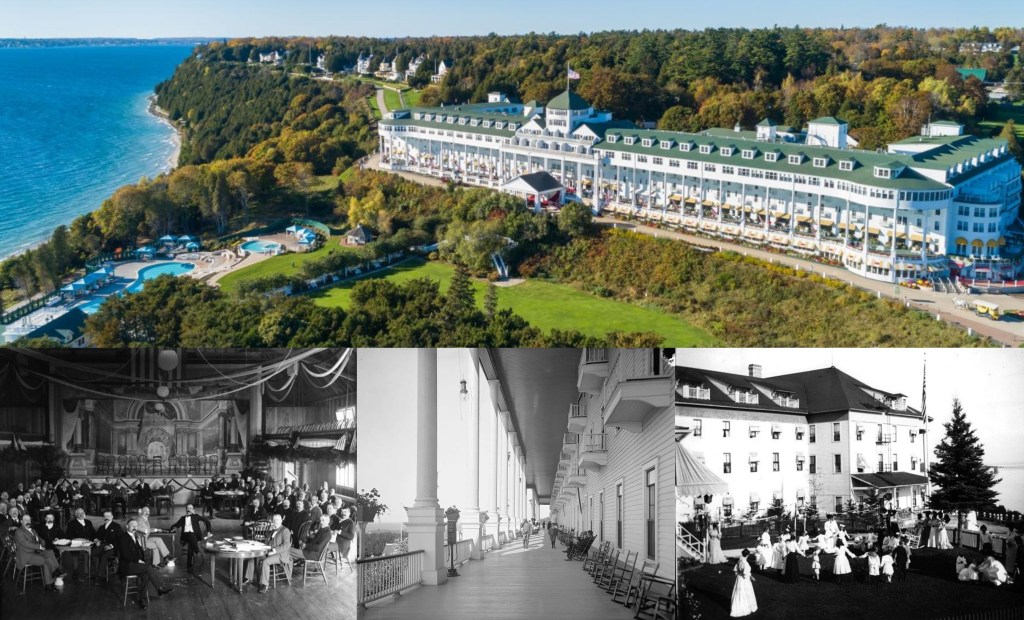
I just moved from the same parlor chair in the Grand Hotel on Mackinac Island that I sat in last September. I’m in the Audubon Wine Bar now. It’s a classic library-style lounge a few paces from the parlor. I’m not in here because the doors were open. I’m here because I saw an early morning passerby in a security hat on his way to fetch coffee. I asked if he wouldn’t mind granting me similar benefits, and he was kind enough to oblige. I only stepped into the Audubon room to wait. Coffee in hand, I decided to stay. It’s more my style, anyway. And now that I have coffee, I can begin.

No matter the space I’m occupying, this early morning eNews is often only as sensible as it is because of coffee.

Some of you may recall that I was invited to speak at the GOP Policy Conference held at the Grand Hotel last fall. I agreed and took along my family. Well, most of them. Jennifer, Madeline, and Evelyn went along. My daughters fell in love with the place. It’s hard not to. Unfortunately, and candidly, the only way the Thoma family would be able to afford time at the Grand Hotel is if Dad was invited to speak and the accommodations were the reward. That said, as we were leaving the hotel last fall, the girls commented sadly, “We’ll probably never come back here.”

That stung a little. On the other hand, my kids know not to use the word “never” around me. Remember: there were snails on the ark. It took some time, but they made it.

Last December, I sold three antique whisky bottles I’d been keeping for a special occasion. That, combined with the graciousness of congregation members who care, we had everything we needed to enjoy three days and two all-inclusive nights at the Grand Hotel for its opening weekend. I went online and secured the dates. I made copies of the reservation, put them into envelopes under the Christmas tree, and surprised the family on Christmas Day. 

Again, don’t tell me it can’t be done. Instead, let’s talk about how it can. And besides, God has a way of opening doors for me to find a way. 

Speaking of “never,” while looking around the room at all the books, I’m reminded that I’m very near the end of my doctoral studies—something I never thought I’d ever get the chance to do. God willing, I’ll defend my dissertation sometime this summer. It’s been a challenging experience. For one, I didn’t want to drag it out, and so, in my typically self-torturing way, I doubled up on coursework and study at almost every turn. As a result, a five-to-seven-year journey was accomplished in a little more than two.

Apart from content digestion, in a human sense, the one thing I have going for me in such circumstances is that I can write a lot in a very short time. For example, I wrote my book Ten Ways to Kill a Pastor in five days. I’m not looking for praise by saying this. I’m just saying that the time I need for tippity-tapping away at things gives me a unique advantage while schooling. This is especially helpful since my life is already a cosmos of full-time obligations. Before enrolling, just the thought of adding one more twirling solar system of responsibility made me sweat. Still, there’s something I knew about myself. When it comes to the paper writing, give me three hours, and I’ll give you twenty double-spaced pages. Whether or not they’re good pages, as with anything else I’ve ever scribbled, I would leave that determination to the reader.

As I said, it’s been a challenging experience. All of it has been beneficial, with only a few parts here and there that I didn’t necessarily enjoy. In one sense, it reminds me of the saying, “A man who carries a cat by the tail learns something he can’t learn any other way.” I shared the same quotation in last Sunday’s adult Bible study. I mentioned Mark Twain as its author, but I don’t know that for sure. What I do know is the accuracy of its implied practicality. Doctoral work provides opportunities for learning that no other avenue provides. That said, I’m glad I’ve done it. But I’m also happy it’s concluding.

Jennifer has asked me more than once what’s next, not as in what other self-tortures she should expect to endure with me, but how I intend to use what I’ve done. That remains to be seen. However, I’d say in a broad sense that pre-seminary and seminary curricula could be improved by adding my efforts as stand-alone courses. At a minimum, additional modules could be added to existing systematic and pastoral care courses. In a narrower sense, I certainly intend to use what I’ve learned to my congregation’s benefit and maybe even a few other organizations with which I associate. Either way, we’ll see, and therein lies the tension in Jennifer’s original question. Relative to my daughters’ Mackinac Island concerns, what’s the use of having a few valuable whiskies on the shelf if I’m not going to put the value to work when and where it’s needed? Similarly, what’s the point of acquiring knowledge if the acquirer fails to use it? Knowledge is weaponry, and I intend to open-carry.

Regardless of its broader applications, I’ll use what I know wherever I am. At a bare minimum, it’ll be at the ready in every instance in the ever-unfolding war against truth.

This is an essential thing for Christians to keep in mind.

Christians bear knowledge. We know something of Christ and His immeasurable love for a world steeped in sin. We know how the Devil and the world are active powers laboring to smother truth, most especially the Gospel of salvation through faith in Christ. That said, we have access to the greatest reservoir of wisdom the world has ever known: God’s Word. And so, we are encouraged to dig deeply into it, to digest it (2 Timothy 3:14-17). 

And then we are called to put the wisdom to work (James 1:22).

Now, don’t misunderstand me. This is not an encouragement to see the Bible as a moral handbook for living. Even as the norma normans (the standard for all other standards) and the sole source for faith, life, and practice, the Bible’s epicentral purpose is the divine revelation of God’s work to save mankind from sin, culminating in the person and work of Jesus Christ. This is the molecular substance of the Bible’s wisdom, and its goal is faith. But here’s the thing: the wisdom the Bible brings and instills cannot sit idly by. It engages. It acts. It shines outwardly in ways that others can observe (Matthew 5:13-16; James 2:14-26), thereby allowing others to light their torches from your faith’s flame.

In other words, Solomon was right when he wrote, “The fear of the Lord is the beginning of wisdom, and the knowledge of the Holy One is insight” (Proverbs 9:10). Therefore, be wise. Believe. Therein is knowledge. Knowledge produces insight. Insight isn’t for the knowledge bearer alone. Insight is for others. It is meant to be shared. So, again, put your wisdom to work. Do so in faithfulness to Christ and for the benefit of others.

Be someone who openly carries the knowledge that saves.

Somewhere in Time

I’m writing this note from the lobby of the Grand Hotel on Mackinac Island. I was one of the invited speakers at the Michigan Republican Party’s leadership conference. In truth, I almost didn’t feel like writing this, mainly because when I crept from my room at 5:00 a.m., not only did I discover I was the only guest awake in the whole place (as you can see from the photo), but the landscape was entirely void of coffee. If there’s one thing I require before typing this early morning note, it’s coffee.

Now, for a relative story before moving on to something else.

Carlos, a man traveling through and cleaning the lobby light fixtures, greeted me warmly. I asked if he knew where I might find a cup of the elusive brew. His apologetic answer: None would be available until 6:30. Downcast, I situated myself in a chair to begin typing. However, barely a moment passed before Carlos, having just climbed a ladder to start cleaning a chandelier, descended that same ladder and invited me to the workers’ cafeteria. He poured me a fresh cup of the elixir I so desperately craved. Of course, I expressed my deepest gratitude, and after chit-chatting for a few minutes, I promised Carlos that no matter what I decided to write, I’d be sure to mention his kindness.

Thanks, Carlos. As is often the case, God is gracious to me through others. Sometimes, something as simple as a cup of coffee and a moment of kindly conversation is the glorious proof. And now, on to something else.

At the present moment, it would seem I’m sitting not all that far from where the character Richard Collier slept while trying to meet his love interest, Elise McKenna, in the film Somewhere in Time. Christopher Reeve played Collier. Jayne Seymour was Elise. I’ve seen the movie and appreciate both actors. This being my first visit to the Grand Hotel, I can see why the filmmakers chose the location. Few places compare, especially when displaying the reverence that tradition is due. The Grand Hotel is a moment in time no longer accessible yet seemingly still visible.

Men are not called guys or bros but gentlemen. Women are nothing less than ladies. In stride with these standards, there are rules. The rules maintain while at the same time catechizing. Gentlemen or ladies are forbidden from classless attire. None may don mid-riff baring tops or sleeveless shirts. Why? Because modesty is extolled, and public displays of sensuality are dissuaded. Sweatpants and cut-off shorts will see you sent to your room to change. For what reason? Because self-attentiveness and its production are lauded, while slothfulness should be no respectable person’s way. After the 6:30 p.m. hour, what was politely casual must reach even higher. In all corners of the hotel, suits and dresses are expected for adults. Any attending children must wear the same.

I’m fascinated by this. For a guy like me who sometimes spends his energy writing and speaking about things relative to these lessons, it’s just short of magical. It makes me wonder how the hotel’s management has continued to get away with doing it for so long, especially since such practices are contrary to the nature of the world in which we currently live. Few get away with telling anyone else what they can or cannot do. All are free to be, do, and say whatever they want without consequence. Moreover, men are not men, let alone gentlemen. They’re women. Women are not women, let alone ladies. They’re men. Few are willing to contest this. Even fewer, if any, are eager to pinpoint morality’s demonstration genuinely. A young girl’s parents smile as she receives her diploma wearing little more than a stripper’s dress. A young man’s parents shout expletive-adorned congratulations from the audience to their son. Show more skin, not less. Say whatever you want as loudly as you want. Be a self-serving individual, not an others-minded part of a community.

Indeed, the Grand Hotel is somewhere else in time. Or maybe a completely different world altogether.

In a roundabout way, it reminds me of what I’m seeing happen to northern Michigan’s trees as summer turns the corner into autumn and eventually winter. It won’t be long before Michiganders will see with their own eyes a divided cosmos. One day, we’ll climb into our beds, the scenery beyond our chilly windowpanes completely unobstructed. The next, we’ll awaken to a thickly covered landscape blanketed in drifting snow, the phone ringing for some of us with school cancellation news.

It’ll be like crossing from one world to another, both having different rules.

Inherent to winter’s rules is the awareness that while the season can be beautiful, it can also be perilous. Mindful of these dangers, a winter’s drive can be calming. Playing in the snow can be joyful. A walk in the woods can be refreshing. Doing any of these things as though the rules don’t apply—as though one’s preferences will be best—could cause terrible things to happen. A winter’s drive at 80 miles per hour could kill you and others around you. Building a snowman with your bare hands could result in frostbite and permanent nerve damage. Walking through the wintry woods wearing your favorite summer clothes could end in frozen death. For anyone denying these realities, a person willing to step up and enforce rules is an asset.

I experienced a combative conversation a few weeks ago. The person called more or less to let me know what a horrible person I was for saying publicly that certain behaviors were indeed sinful. According to this person, I had no right to impose morality on anyone, especially since I am just as imperfect as everyone else. This is a typical argument many make and often aim at the clergy. She went on to say that she’d never think of imposing morality on anyone. I asked her if such thinking applied in her home with her children. She stuttered a little at that point. She did everything she could to make “yes” her answer, explaining how she raised them to be free thinkers unbound by legalistic principles. I asked what she would have done if her daughter had come to her, admitting she intended to kill a friend at school. Would she say her daughter was wrong, that killing someone was against the rules? Her answer was one of avoidance: “My daughter would never do that. Because of the way I raised her, she’d know better.”

“So, there is such a thing as ‘better’? What or who established that better standard, and why does it appear to apply to everyone, including you?”

The conversation didn’t proceed much further. I didn’t expect it would, anyway. And by the way, I wasn’t trying to win an argument. There’s no winning in such situations. There’s only giving a faithful witness while enduring. Still, I suppose this came to mind because of what I’ve said here. If we establish our own standards apart from reality, not only will we discover ourselves in conflict with natural law, but we’ll never be able to see beyond ourselves what’s actually true. Perhaps worse, we’ll never know what it’s like to be part of a community held together by that truth—a group naturally built to outlast all others.

Still, there’s another angle to this that comes to mind.

While the rules here in the Grand Hotel’s world do not apply to the mainland’s rules, both are held by the same standards, whether or not they acknowledge it. Summer or winter, right is right, and wrong is wrong. They may look different by context, but they’re rooted in truth, and they are what they are. One day, everyone will realize this. In a sense, it’ll be like the scene I described before. You’ll close your eyes in one world and open them in another. When you do, you’ll realize that human standards never applied in either. Instead, there was all along a deeper standard—God’s standard. It will be the only standard of measurement at that moment. A world of people choosing unbridled sensuality, gender confusion, and so many other dreadful standards will finally discover if they were right in their cause. They’ll learn, in a sense, if the Grand Hotel’s rules were better than Walmart’s.

Thankfully, we have Christ. He’s the hope we have for that inevitable day. He’s the One who forgives us of anything that might make that day a dreadful one (Luke 21:28). He’s also the One who gives His Holy Spirit so that we are remade into those who desire His will and ways, not our own (Romans 5:5; Galatians 5:22-23). That’s important. When I want what I want, the Spirit fights that fleshly inclination, making it so that I prefer instead what Christ wants. I want what Christ wants because, by faith, I know it will always be better. It is a higher standard. According to Saint James, it’s the law of liberty (James 1:18,25-27)—the freedom from sin’s guilt and the liberty to live according to God’s way of righteousness (2 Corinthians 3:17). This is a change in eternity’s conversation. In Christ, I don’t have to keep God’s rules perfectly to save myself. Jesus did that. But now, through faith in Him, I want to keep his rules. I know they’re good. In fact, I know they’re not just better but the best.