The story of our redemption begins in quiet simplicity tonight. While the world expects fanfare before a king’s arrival, the Son of God—the King of kings and the Lord of lords—enters our world wrapped in humility. He takes a feeding trough as His throne. His attendants are a young virgin and an adoptive father. His courtiers are whatever creatures that live in the stalls. His reverent nobles are backwater shepherds.
Saint John, the inspired author of the Christmas Day Gospel, writes of the Child, “The true light, which gives light to everyone, was coming into the world. He was in the world, and the world was made through him, yet the world did not know him. He came to his own, and his own people did not receive him” (John 1:9-11).
Tonight, another inspired author, Saint Luke, tells us that, regardless of His humble beginning, the residents of heaven know who He is. The newborn is their Lord. Like Saint John, they know “all things were made through him, and without him was not anything made that was made” (John 1:2). And they say as much that first Christmas evening, piercing its pitch-black sky with celestial luminescence and an otherworldly song heralding God’s magnificent inbreaking (Luke 2:8-14). I suppose, in one sense, their knowledge and song are essential. If heaven did not claim Him, ultimately announcing His identity as the perfect Son of God, then He’d be just another human being who was equally incapable of saving us.
But He isn’t just another human being. He’s God in the flesh. And it’s here, in this tender scene, that heaven’s greatest gift is revealed—Immanuel, God with us—which is to say, the manger serves a profound role. God rests in it. It doesn’t seem possible. And yet, there He is. He is not distant. He is near, very near, right there in the manger. He has stepped into our brokenness, our struggles, and our longing. He is not above us. He is us.
Still, the manger hints further to His trajectory. Who among us was born and then placed where animals feed? See, He’s willing to go even lower. He does not shy away from the mess of life but enters into it fully, becoming all that we are and worse in the most incomprehensible way. Indeed, Saint Paul writes, “For our sake [God] made him to be sin who knew no sin, so that in him we might become the righteousness of God” (2 Corinthians 5:21).
What the Christian Church across the world celebrates tonight is by no means a mere Hallmark holiday or theological abstraction prompting tinseled gift-giving and goodwill for a few days of the year. It celebrates something extraordinary—a person—the divine Person, Jesus, a gift of the Heavenly Father, who left the realms of His eternal glory to exact what the angels declared: peace between God and mankind. That’s no ordinary act of goodwill they’re proclaiming. That’s no ordinary gift-giving. Jesus is the end of all that divides mankind from God. The angels direct the shepherds to find His beginning wrapped in swaddling cloths and lying in a manger. As we follow, the Lord’s humble lowliness resonates. We know what the hymn writer means when he scribbles, “Sacred Infant, all divine, what a tender love was Thine, thus to come from highest bliss, down to such a world as this” (LSB 373, “See Amid the Winter’s Snow,” stanza 3).
Behold, the passion of Good Friday and the weight of the cross are not far off.
Until then, tonight, we glorify Christ, knowing that His birth, even as it lacks all fanfare, is the greatest the world will ever know. This is true because, by the incarnation, the world received the only One who could save it.
With that, and by all means, I hope the genuine wonder of this night and everything it gives is revitalizing. I pray you’ll contemplate God’s Word proclaimed and the Gospel preached so that by the Nativity’s powerful message, the flames of an already pyre-like faith are fueled to burn even brighter for all in this desperate world to see.
God bless and keep you by His grace. And Merry Christmas!
Ask my family, and they’ll tell you I don’t like to lose. I’m a “go big or go home” kind of guy. When I endeavor to do something, I expect to pursue and achieve it in a top-tier fashion. When an A is possible, a C is not an option. If my potential is not A-worthy, I’ll go sleepless until it is.
In a way, I demonstrated this personal boundary several Sundays ago during worship. My voice was struggling because of a lingering (but not contagious) cough. During the sacramental liturgy, when I arrived at the Words of Institution (which I usually chant), for the first time in a while, I elected to speak them. Why? Because I could feel the itch in my throat getting worse, and I knew it wouldn’t go well. Second-rate chanting is not edifying. It’s a distraction. I knew if I couldn’t do it well, I’d wait until I could.
Good or bad, this stickler mentality is one reason why the game of Monopoly is also relatively off-limits in our home. I’ve shared with you before that it can get pretty brutal. When it’s possible to buy every property on the Monopoly board and fill all but the utilities and railroads with hotels, why not do it? And while we’re at it, win big. Drain each player of every dime. Do not win some. Win all. Is there a strategy that accomplishes this? Yes? Then use it. Go big or go home.
But for as driven as any among us might be, a lesson I learned early in life is that losing is incredibly important. In other words, winning is nice, but almost winning is sometimes better. This is true because it often prompts self-analysis leading toward the determination needed to improve. Sure, hitting a home run may be the batter’s ultimate goal. Nevertheless, the road to home run hitting is one of insight and opportunity for actual betterment. Babe Ruth, a champion home run hitter, insisted that there was nothing so motivating as a bunch of strikes. In his words, every strike is one swing closer to a home run.
I watched a video last week while walking on the treadmill. It was a compilation of youthful progressives tearfully complaining about Trump’s victory. It was clear they simply could not process the loss. They just didn’t have the skills. As a result, one by one, they droned toward and over illogic’s cliff. For example, one insisted that anyone who opposed Trump was destined for a concentration camp. Another mentioned she was fearful she might have to spend time in prison for the multiple abortions she’s had. Still, another chimed in with Oprah Winfrey’s ridiculously obsolete warning that because Trump won, all future elections would cease. Humorously, some of the video’s teary-eyed characters threw their faces into pillows and screamed as loudly as they could. Honestly, I felt like I was watching a documentary about the participation-trophy generation—or a research study of toddlers who’ve only ever been told they’re the best of the best and can never lose.
As I watched, I was also reminded of something else.
An artificial victory is no victory. While occasionally playing a video game in “god mode” might be fun, there’s no invulnerability in real competition. In other words, the video game “Call of Duty” in no way compares to actual combat. I was listening to Joe Rogan interview a former CIA operative who executed countless missions in the Middle East. He told Rogan that when he had to go to the bathroom in a firefight, he went in his pants. That’s it. He didn’t say it, but I’m guessing he knew well enough that there’s no pressing pause in a firefight. There’s certainly no game reset button when you die. Real victory is dangerous, and it is sometimes unpleasant. In all, it takes effort. It takes perseverance through struggle. It requires diligence even when diligence seems foolish.
Victory takes a whole lot of almost winning to reach.
People who somehow avoid second place’s more arduous road—whether it’s because they’ve insulated themselves against loss or because what they have was given to them without any effort or personal risk—are missing out on growth’s genuine joys. I suppose relative to faith, this leads me to something else.
For starters, don’t get me wrong. Salvation has nothing to do with our efforts. We do not earn it. Through the person and work of Jesus Christ, we actually do receive a magnificent “get out of jail free” card. However, after faith (or perhaps better said, because we’ve been grafted to Jesus [John 15:5, Romans 6:3-6]), some pretty unearthly struggles will likely come (Matthew 5:11-12, John 15:20, Mark 10:29-30, 2 Timothy 3:12, and countless more). Jesus did not hide this prospect from us. And yet, Saint Paul offers an intriguing perspective concerning these struggles. He writes in Romans 5:1-5:
“Therefore, since we have been justified by faith, we have peace with God through our Lord Jesus Christ. Through him we have also obtained access by faith into this grace in which we stand, and we rejoice in hope of the glory of God. Not only that, but we rejoice in our sufferings, knowing that suffering produces endurance, and endurance produces character, and character produces hope, and hope does not put us to shame, because God’s love has been poured into our hearts through the Holy Spirit who has been given to us.”
His first point is to make sure we understand that when bad things happen, we are not to think we’re somehow at war with God. He clearly states that we have been justified by faith in Jesus Christ and are at peace with God. His very next point is a crisp reminder that we exist now by God’s grace. This grace brings about something extraordinary.
First, we’re found capable of finding hope in the glory of God. Do you know what the “glory of God” is? It’s the gruesome death of Jesus for the sins of the world (John 12:23-28, Mark 10:35-38). It’s the absolutely dreadful cup of suffering that Jesus tipped back and gulped down in its entirety. Saint Paul insists we can rejoice in this glory primarily because Jesus endured it. The cup’s contents were ours to consume, but the Lord took them for us. However, even as Jesus made it clear that we could not endure absolute suffering’s cup—the kind that wins salvation—He did say we’d at least sip from it on occasion (Mark 10:39). That’s where Paul goes next. However, his tone remains constant. His mood is joyful. With a grammatical smile, he describes faith as having the ability to rejoice when rejoicing seems ridiculous.
Who can rejoice during suffering? Christians can. And this is where my previous thoughts about winning and losing come back into view.
Paul describes an essential process of spiritual maturation that can only occur through suffering. He describes suffering for Christ as a seed that produces endurance, character, and, ultimately, hope. But not just any hope. It’s the kind of hope that genuinely knows the value of the Lord’s work to save us. It’s a hope that knows the Lord’s road was not easy. It’s a hope that gathers more and more strength as our own roads become seemingly less and less navigable. It kind of reminds me of another video I happened upon demonstrating the properties of a substance called Oobleck. It’s a non-Newtonian fluid that, when pressure is applied, gets stronger. In the video, a person dips his hand into it like water. But then he punches it, and suddenly, the substance is like a rock. Oobleck might just be Christian hope’s best mascot. It steers through and meets the mortal journey’s end, and no matter how hard the world beats on it, the Lord continues bolstering it to stand victorious above shame, eventually receiving the gold medal of triumph gifted entirely by the love of God through the Holy Spirit for faith.
In short, God had no intention of making us earn our salvation. He did all of it. However, He does train us to embrace and live in its value. Before we receive Christ’s first-place prize, we should expect to spend a lot of time almost winning—or, in other words, enduring struggle. But again, the struggle is good for us. And we can rejoice through it. We keep our eyes on the prize, equipped with faith’s otherworldly tenacity for knowing that a home run is fewer strikeouts away today than it was yesterday.
There is something I’m very much looking forward to tomorrow. It’s something for which I am incredibly thankful. Without simply telling you what it is, I think the best way to describe it is to consider its comparisons.
Have you ever been going about your day and stumbled upon something that made you chuckle? I have. Has someone ever told you something that was so intuitively funny that you couldn’t help but laugh out loud? That has happened to me. Have you ever watched a comedy and found yourself in stitches at the outlandish interactions between characters? I have.
All of these are patterns of happiness resulting in happiness’s chief expression: laughter. That said, none of the examples I shared can compare to what will be happening at the Thoma family Thanksgiving Day table. We’ll be laughing. However, the laughter’s source will be far different than the prompts I previously described. It won’t need a joke to coax it. It won’t necessarily be prompted by comedic behavior or a funny story. It’ll just be there. That’s because its prompt is genuine joy, the kind that not only understands the Thanksgiving feast on the dinner table as a gift from the Lord but also because it knows the people gathered at the table as gifts, too.
I’m thankful for this, and I’m looking forward to experiencing it tomorrow after worship. But still, there’s something else.
Whether it’s a holiday feast or just any ordinary day, our family dinners are always very lively. We laugh a lot. Jennifer will sometimes pester me for remaining strangely quiet when it’s happening. For the record, it’s not that I’m disinterested or disengaged from what’s happening. It’s just that I’m often overwhelmed by a profound awareness of God’s goodness to me unfolding in real-time. When this happens, I become very nearly entranced. To snap me out of it, Jennifer abruptly says my name or nudges me with a look. It’s good that she does. If she didn’t, I’d remain fixed in my distant pondering, ultimately missing out on priceless opportunities to actually participate—to interact with these walking, talking gifts of God. Missing out would mean forfeiting the blessings God intends to bestow upon me through them.
I suppose I’m sharing this with you today because the Thanksgiving Day holiday has a way of being a pestering nudge, too, making it worth our attention. Personally, I find it strange that some in the Christian Church would be bothered by a National Day of Thanksgiving being treated by some congregations with the same reverence and devotion that other Christian holidays receive. Here at Our Savior in Hartland, we gather on Thursday, Thanksgiving Day, for a Divine Service at 10:00 AM. We have done so since 1955. And why wouldn’t we? Yes, it’s a civil holiday. Still, for us, it’s just one more opportunity to consider and express gratitude for the many gifts God has given us. We recognize it for the pestering nudge it is—a moment to remember Christian gratitude’s trajectory. In other words, being thankful for God’s gifts (family, togetherness, food, vocation, home, and everything else we have) is not apart from the source of the gifts: God. We don’t sit back and thank Him while forgetting to actually interact with Him. And so, Christians go to church on Thanksgiving Day. Who cares if it’s a civil holiday? It just seems right.
In the Bible, the greatest gift is Christ and His Gospel. God has established a way of distributing the Gospel. Referring to one of the avenues, Saint Paul described the heart of his own preaching by saying it was “to bring to light for everyone what is the plan of the mystery hidden for ages in God who created all things, so that through the church the manifold wisdom of God might now be made known… (Ephesians 3:9-10). What Paul means by “the plan of the mystery” and “the manifold wisdom of God” is not complicated. He means the Good News of the death and resurrection of Jesus Christ for the forgiveness of our sins. Here in Ephesians 3, he makes sure to tell us who has been officially tasked with making sure this Gospel gets into the world. Paul wrote plainly that the manifold wisdom of God is made known through the Church.
This is more than just an abstract point of awareness. It’s an actual point on a map. It’s a place with a table. It’s a place where God promises to be present. You’ve been invited to join God at that place. Certainly, we can take a day devoted to giving thanks, sit back, and marvel at His gifts. But even better, we are called to come and get them, thereby receiving the blessings God intends.
God has invited us to His feast. And so, we go to church (Hebrews 10:24-25). We go to His house. We encourage one another to go. We join Him at His table. We do so surrounded by our Christian family—fellow baptized believers we know and love and cherish. Except at this table, we experience so much more than a holiday meal. We sit with our Lord. He’s there by His verbal and visible Word—the Gospel preached and proclaimed, and the Sacraments administered. We participate in a foretaste of the heavenly feast to come, where fellowship is unbroken and joy is everlasting.
I encourage you to consider joining your Christian family for worship tomorrow morning. Don’t just sit by pondering your thankfulness. Go to the Lord’s house. Engage in the feast. Receive the blessings. Regardless of what some might say, for Christians, the National Day of Thanksgiving can be so much more than a few days off from work or school. It can be assumed into the posture of faith, becoming one more opportunity to taste and see that the Lord is good (Psalm 34:8) and that His mercy endures forever (Psalm 107:1).
Some of you may recall that I received a glitter bomb in the mail about ten days ago. I mentioned in a Facebook post that I sensed the letter’s unusual heft, and with that, I opened it carefully. Thankfully, it didn’t explode all over me. Instead, the exceptionally fine glitter remained in the greeting card’s internal pouch. Only a tiny bit spilled into the card’s crease. For the record, it was a hate mail prank. The card’s cover said, “Just because.” But inside, just below the glitter pouch, was the image of a hand extending to me the middle finger. No words. Nothing else. Just that and a potential mess.
In passing, someone mentioned that the Fates had smiled upon me that day. I don’t believe in fate. Well, not as the ancient mythological perspectives that birthed the term mean. The idea comes from the Graeco-Roman belief that three Fates—the goddesses Clotho, Atropos, and Lachesis—control each person’s conception and birth and that an individual’s life is essentially a thread being spun, measured, and eventually cut by one of the three.
I don’t believe in fate, but from a biblical perspective, I suppose I could say I believe in destiny. In a broad sense, without Christ, all of humanity was inherently destined for eternal death. However, that destiny was altered on Calvary’s cross. Faith in Christ receives the merits of that alteration. Apart from faith, a person’s destiny is set.
Beyond that, the scriptures are plush with texts describing one’s temporal destiny, both good and bad. Typically, this happens in terms of behavioral consequences. In fact, the Bible begins this way. God told Adam, “You may surely eat of every tree of the garden, but of the tree of the knowledge of good and evil you shall not eat, for in the day that you eat of it you shall surely die” (Genesis 2:16-17). God tells Cain something similar, speaking of the good and bad relative to wrestling with sin, saying, “If you do well, will you not be accepted? And if you do not do well, sin is crouching at the door” (Genesis 4:7). He goes on to say that sin’s desire is to control Cain, and as such, Cain should fight against it.
I suppose if you don’t appreciate what I’ve suggested so far, take a quick trip through the Book of Proverbs. You’ll get a consolidated glimpse of the premise, running into texts that say things like, “Whoever sows injustice will reap calamity” (22:8), and “A man ‘s folly brings his way to ruin” (19:3). There’s plenty more in the New Testament. The first one that comes to mind (especially as it meets with the greeting card I received in the mail) is Paul’s reminder to those who pit themselves against the Gospel. He describes their inevitable destiny, writing, “For many, of whom I have often told you and now tell you even with tears, walk as enemies of the cross of Christ. Their end is their destruction” (Philippians 3:18-19). The word used for “end” is τέλος. It means the purpose of an event or process has reached its inevitable consequence.
The insulting greeting card I received—spun in cowardly anonymity—was likely sent because of what I’m willing to say openly, which is that Christ crucified and risen is the only way of salvation, and empowered by the Holy Spirit for faith in the Lord’s wonderful sacrifice, Christians can and should live their lives in open faithfulness in the public square. Unlike the card’s sender, I bear a message born from light, not darkness. It doesn’t belong in the spineless shadows of anonymity. But there’s a reason for this.
Because of Jesus’s work to save me, temporal consequences are by no means holistically representative of my eternal destiny. Good and bad consequences will come and go. I speak in faithfulness to Christ, and as you can see, bad things can still happen. Conversely, I also know that when I fall short in sin, God forgives me, sometimes even recrafting my sin’s consequences for my good. In all of this, there’s something I know without doubt. My baptismal destiny in faith is tied to the Savior’s destiny (Romans 6:3-6, Galatians 3:27). We see the Lord’s fate unfolding on Good Friday. It is, therefore, no coincidence that Jesus used the same word from the cross that I mentioned before. When humanity’s salvation was accomplished, which Christ was destined from all eternity to achieve (1 Peter 2:18-21), He announced it, crying, “τετέλεσται,” or, “It is finished” (John 19:30). This word is the perfect indicative form of τέλος.
My spiraling fate toward separation from God was reversed at that moment, and as a result, this world’s treacheries have no hold on my future. I speak openly from that platform.
G. K. Chesterton once wrote, “I do not believe in fate that falls on men however they act.” I appreciate those words, especially as they relate to the all-surpassing knowledge and power of the Gospel of forgiveness in Christ. But that’s not all Chesterton said. He continued, “But I do believe in a fate that falls on men unless they act.” This takes me back to why I received the glitter bomb in the mail. Regardless of the micro-consequences, unless people of faith engage in the opportunities before them—whether it’s speaking up in the public square or serving the precise needs of our neighbor—destinies will occur that could have otherwise been prevented. Concerning one’s neighbor, Saint James takes rhetorical aim at this, writing, “If a brother or sister is poorly clothed and lacking in daily food, and one of you says to them, ‘Go in peace, be warmed and filled,’ without giving them the things needed for the body, what good is that?” (James 2:15-16). His point is that your action-less well-wishes are, for the most part, like a finely wrapped Christmas gift with nothing in it.
Jesus widens the lens. In a general sense, He declares to His Christians that faithfulness has consequences. In Matthew 5:11-12, He said, “Blessed are you when others revile you and persecute you and utter all kinds of evil against you falsely on my account. Rejoice and be glad, for your reward is great in heaven, for so they persecuted the prophets who were before you.” That doesn’t sound so nice. However, in the very next breath, He said:
“You are the salt of the earth…. You are the light of the world. A city set on a hill cannot be hidden. Nor do people light a lamp and put it under a basket, but on a stand, and it gives light to all in the house. In the same way, let your light shine before others, so that they may see your good works and give glory to your Father who is in heaven” (vv. 13-16).
In other words, whether the earthly consequences are good or bad, our destiny is sealed. Knowing this, we can endure a glitter bomb or two (or, heaven forbid, something worse) and be just fine. Standing firmly upon the Gospel’s platform, we can live unshakably against the world around us. We can even do it in the more challenging spheres that exist beyond anonymity’s gutless borders.
Now, before I end, I should mention that I got another “glitter bomb” of sorts in the mail this past Friday. Like the previous one, the envelope was heftier than usual. However, I employed less caution this time because I recognized the return address. Indeed, it was a smile-inducing message. Lacy, a 12-year-old member here at Our Savior, learned about what her pastor received in the mail and asked her mom if she could send him something. Inside was a round and glistening Pop Socket (at least I think it’s a Pop Socket) stuck to the page, along with a heart sticker, a thumbs-up sticker, and a message that read, “You’re the best!” Lacy wanted me to know there’s an altogether different kind of concern out there for what her pastor says and does.
Thanks, Lacy. You’re awesome. You made your pastor’s day. For the record, I don’t know how it is for other pastors, but it’s been my experience that we’re more likely to be sent negative comments before receiving positive ones. That’s not a complaint. It’s just the way people work. Folks are more often silent when they agree but vocal when they don’t, and because much of what pastors do is out in front of people, if they aren’t ready to endure this unbalanced dynamic, then they should reconsider the calling altogether. That said, I’ll admit it’s a breath of fresh air when the criticism table gets turned. You did that. Once again, you’re awesome, and you made your pastor’s day.
Now, forward we go in faithfulness, good criticism or bad, knowing God has us well in hand and that we are destined for something far greater than the venom this world intends to spew.
I received an email this morning from someone I met for the first time at a dinner in early October. Seeing her name reminded me of something she asked during our in-person conversation. Essentially, she wondered if I was at all concerned with people knowing so much about me. Her point was that I share an awful lot about my life and family across multiple online platforms. She was right. I do.
I told her that writing for public consumption does have its dangers. Anyone familiar with my writing efforts will know my wife, Jennifer, is not above reminding me, “Chris, you’re only ever one sentence away from making people angry.” She’s right. I am. Still, I do it.
My new friend asked me if I have limits to what I share. Of course I do. Although, I don’t really think about them. I just know them. For example, while the more uncomfortable and sometimes even embarrassing lessons I’ve learned in life are just as likely to be shared as a humorously insightful comment from one of my kids at the dinner table, you’ll never hear about anything shared with me in confidence. You’ll never know the intimate details of anyone in my circles. Excluding my family, I’m not above sharing my own. I’m also not above analyzing general contexts that relate to most human beings. I know this sometimes makes folks feel like I had them in mind while writing. But I didn’t. I won’t share anything that isolates or identifies one person’s secrets, even if they give me permission to do so.
My conversation partner asked if there was anything about myself that I hadn’t shared. Yes, there’s plenty. For example, I’ve never shared that I have an observable “tell” when I’ve reached my combined physical and emotional level of exhaustion. You’ll know I’m there when my right ear turns bright red. If you were to walk up to me and touch the ear, you’d know it gets hot, too. It’s weird, I know. But it’s been happening for years. One day, I looked it up. It’s called “Red Ear Syndrome.” There are plenty of theories about what causes it, even though no one really knows for sure. Some say it’s thalamic-related. Others say it’s a form of migraine—which I do suffer on occasion. Some theorize that it’s just one more way the body collects and demonstrates stress. I’m not a doctor, but after years of one plus one equaling two, I can assure you it’s my body’s red alert. When my right ear gets warm and red, it’s my body saying, “Chris, you’re done. Go home.”
I mentioned before that writing for public consumption has its dangers. But there are just as many blessings, too. For example, when I’m warmly greeted in public by someone I’ve never met but knows the things I’ve written, in a way, I realize a friendship is already half-formed. They know my family and church, my peculiarities and interests, my likes and concerns. With that already in place, I’m standing on the welcome mat of opportunity to enter their lives—to walk in and form the other half of the friendship by getting to know them. That’s pretty great because, in a sense, we already have a history together. They were already invited to the Thoma family dinner table. They’ve already been laughing alongside us about this or that. They already went with me to the hospital to meet my grandson, Preston, for the first time. They sat beside me during a Church Council meeting when tough decisions were made. They now know that if my ear starts turning red, I need a break, and they can be sensitive to the need and maybe even offer some help.
That said, there’s another layer of significance to this process, especially when it comes to our lives together in Christian community, most especially as it relates to the forthcoming presidential election.
In these critical times, what any of us might tap through our keyboards for public consumption is about far more than sharing personal anecdotes or life experiences. It’s also about using those stories to communicate what’s true and what isn’t. It’s an opportunity to visit someone’s home and in casual conversation, to demonstrate for them how faith in Christ informs every aspect of our lives. Whether a menial event or a life-altering moment, faith in Christ is the lens you use for interpreting and acting on both. Some would put politics into the carefully guarded silo they call “non-sharable.” Of course, you already know I disagree. Again, the Christian faith—built on God’s holy Word—informs every aspect of our lives, especially life’s unavoidables.
The realm of politics is one of life’s most expansive and invasive unavoidables. It affects everything. Therefore, discussions about candidates and their positions are not off-limits. And so, Christians talk about these things. They openly include in their conversations God’s opinion concerning the sanctity of life, religious freedom, human sexuality, the importance of family, and so on. They encourage support for candidates who most closely align with God’s opinions.
Yes, these conversations can be dangerous. For example, I once received an email from an elected member of the Democrat Party in Florida who read what I wrote about abortion and threatened to drive up and curb-stomp me. But curb-stomped or not, our open confession of Christ in public conversation offers blessings, too. Sometimes friends are convinced, and when they are, lives are changed. Sometimes families are preserved. Sometimes moral and natural law are reinforced, not weakened.
The stakes are high in this current election, and the consequences of silence are too great. Be who you are in Christ. Do this out in the open, not in the shadows. The dangers and blessings will vary, but in the end, it’s the blessings that matter most.
I turned fifty-two years old yesterday. Rather than celebrating, I managed to get food poisoning the day before and spent most of yesterday enduring it. Unfortunately, I’m still dealing with it today. Not good.
Oh well. Fifty-two. For some, I’m still a spring chicken. They hear that number and think, “I wish I were turning fifty-two.” On the other hand, some of the children in our church’s school hear it and think I’m very nearly a funeral’s guest of honor. In a sense, both are admitting that time is short or, as Yeats so famously said, “From our birthday, until we die, is but the winking of an eye.”
Indeed, time is brief—abruptly so.
I don’t know about you, but as I get older, especially on my birthday, I experience a tension of sorts. There’s a strange pushing and pulling between anxiousness and contentment. I’m anxious because I know it’s very likely I’ve passed the halfway point of my life, and when I compare that knowledge with what the next fifty years are likely to bring—marriages, grandchildren, great-grandchildren, gatherings with an ever-increasing Thoma family, and so many other joyful things—I want so much to share in as much of those times as possible. And yet, I know my end will come during or before many of those times’ beginnings, so I probably won’t.
I know Jennifer feels the same way. We’ve talked about it, sometimes with tears. And while it’s not a constant topic of conversation, when we do find ourselves wandering along this garden path of discussion—our joints popping and our muscles getting sorer than they used to—there’s a contentment to be had by the surrounding flora. Life will forever be so much more than what we see in the distance. It’s here and now, and its slowly unfurling blossoms are just as splendid as its flowers in full bloom.
Birthdays are nice. And yet, I wonder sometimes if it is better simply to celebrate life without the numbers. I mean, if calendars were no more, would I even know my age? I suppose what I would know is that through faith in Christ, whether twenty-two, fifty-two, or ninety-two, I’m God’s child, and I live by His grace alone. Indeed, it would be for me to know that the “steadfast love of the Lord never ceases; his mercies never come to an end; they are new every morning” (Lamentations 3:22-23). Indeed, Christians live each day’s unfurling hope, and “we do not lose heart. Though our outer self is wasting away, our inner self is being renewed day by day” (2 Corinthians 4:16).
For the believer, Saint Paul describes another tension here—a better tension of “right now but not yet.”
For Paul, hope longs for a particular future even as it owns and exists in that very future right here and now. Another way to think of it is that Christians, while mortal, do not enter eternity when they die. They are in it right now. Baptized into Christ Jesus and believing in Him, eternity has already begun. Sure, we see our bodies wasting away as though time is running out. In a purely mortal sense, it is, and with its wasting away goes all the hopes and dreams tied to this world’s timeline. However, Paul noted previously in 1 Corinthians 15:53-54 that mortality is already swallowed up and owned by immortality, or quite literally in verse 53, that which is “death-like” (θνητὸν) must “eventually put on” (ἐνδύσασθαι) and be seen and exist in “deathlessness” (ἀθανασίαν).
That’s the “not yet” future that we own and exist in right now.
Just like everyone else, I’m wasting away with each birthday. I know that whatever mortal futures are in store for the forthcoming Thoma generations are something I won’t see or experience. However, the outward undoneness that seems to suggest I’m only getting further and further from that future simply cannot keep pace with the inner renewal being worked within me by the power of the Holy Spirit for faith. This renewal is sourced from the horizon of eternal life with Christ. Faith has already situated me in and for a time and place outside of time where all the generational blooms in my Christian family that I didn’t see in this life will be gathered into a splendid bouquet of grandeur at the table of the Lamb’s high feast. I’ll be surrounded by generations that I never walked or talked with in this life, and yet we were already bound together by faith for eternity and destined for an incredible family reunion.
Until then, I intend to enjoy as many of the blooms and forthcoming blossoms as the Lord allows, giving thanks to God for all of it.
The feeling is always the same. The day after the conference here at Our Savior, there’s a lingering sense of exhilaration and anticipation. For most in attendance, I’d say the exhilaration erupts not only from the opportunity to meet people they usually only see on TV but also from a newfound passion to engage in the world for the sake of preserving our nation’s founding ideals, which is nothing less than the societal context Saint Paul insists that Christians pray for and intercede to maintain (1 Timothy 2:1-6). He said we do this so that “we may lead a peaceful and quiet life, godly and dignified in every way” (v. 2). But to what end? Again, Paul helps us, writing that such a context “is good, and it is pleasing in the sight of God our Savior” (v. 3) because He “desires all people to be saved and to come to the knowledge of the truth” (v. 4).
All of this is to say that when religious liberty is secure, the freedom to preach and teach the most important message the world has ever known is more widely available. And what is that message? Paul tells us: “For there is one God, and there is one mediator between God and men, the man Christ Jesus, who gave himself as a ransom for all, which is the testimony given at the proper time” (vv. 5-6).
There’s an excitement that comes with playing a role in this preservative action, especially when it so often seems at every turn that Christians have their backs up against the wall. Of course, we’re not inserting ourselves because we somehow think God needs our help to maintain His world. We engage because He invites us to. Interestingly, the same Gospel we’re supporting has already moved us to love Him in ways that embrace His invitations, no matter where they may lead. Luther referred to this Spirit-driven compliance as a believer’s duty. In his explanation of the First Article of the Apostles Creed in the Small Catechism, he wrote that in response to God’s “divine goodness and mercy, without any merit or worthiness in me… it is my duty to thank and praise, serve and obey Him.”
Indeed, this is most certainly true. And so, we do.
I talk with a lot of people at our conference every year, and each conversation is an enlightening one. I learn something from every person I meet. One particular takeaway from this year’s conversations happened after everything had concluded and we were cleaning up. I spoke with a woman who expressed feeling helpless to change things for the better in America. But no sooner than she said this did she thank God for what she received from our conference, describing it as superbly educational and, thereby, motivational. And then, as if wrestling with her own premise while speaking, she found herself insisting that even the slightest, most insignificant effort to engage has a way of eclipsing that helpless feeling.
I grew happier as she spoke. Why? Because without even referencing it, she essentially reiterated the conclusion to the speech I’d given only a few hours prior. She was even now digesting what was said and talking herself toward the realization that faithful engagement comes in different shapes and sizes. The size and shape are determined by God and the gifts He gives.
Stepping from this point of origin into the public square, worry’s inevitable hopelessness is overshadowed by hope’s possibilities born from God’s gracious care.
That’s what I meant at the beginning of this note when I mentioned the lingering sense of exhilaration and anticipation. Again, the exhilaration comes from getting into the game and playing hard. The anticipation is the perpetual hopefulness that, while I might not be the best player by any worldly league’s standards, God still put me on His team. His squad is not made from this world’s muscle. If you doubt this, consider Saint Paul’s perspective in 1 Corinthians 1:26-30:
“For consider your calling, brothers: not many of you were wise according to worldly standards, not many were powerful, not many were of noble birth. But God chose what is foolish in the world to shame the wise; God chose what is weak in the world to shame the strong; God chose what is low and despised in the world, even things that are not, to bring to nothing things that are, so that no human being might boast in the presence of God. And because of him, you are in Christ Jesus, who became to us wisdom from God, righteousness and sanctification and redemption, so that, as it is written, ‘Let the one who boasts, boast in the Lord.’”
Paul isn’t just implying that each and every Christian is on God’s team by faith, lest any of us think that our salvation is based on deeds. He’s also making sure we understand that to look in the mirror and determine one’s value or potential for service to His kingdom according to worldly standards is to make a grave error. God doesn’t work that way. If He did, then the innocent Son of God would not have been given over to death for the sins of the guilty. He’d have left us behind right after the events in Eden, inevitably allowing us to get what we deserve. Instead, Jesus, the epitomizing demonstration of God’s backward way—God’s Son pinned to a cross in what appears to be pathetic weakness—is the mightiest of death blows to Sin, Death, and Satan.
This Gospel is itself the muscle and skillset that outmaneuvers our wisest and strongest opponents. It strengthens its team to suffer the heaviest tackles while still getting up and getting back into formation. It is, by all means, the best play in God’s playbook—the one that, since the beginning of time, Satan and his knuckleheads just can’t seem to figure out how to stop.
We are on God’s team. We didn’t get there by trying out. He baptized us into our respective positions. He has endowed us with what’s necessary for making a difference. And so, we play as hard as we can. We use the gifts God has seen fit to grant us, putting them to work to move the ball down the field toward the goal.
The after-conference conversation I mentioned began with a sense of individual irrelevance and ended with courageous invigoration. For as challenging as it is to assemble and administer a conference like ours, I’ll be forever glad that we do it if only to be reminded that, as the saying goes, where there’s one, there are another five. In other words, my momentary conversation partner—a relatively small woman by human measurements—was by no means the only one refreshed for gameplay. And the thing is, if God continues maneuvering as He does (which I know He will), the world is never going to see this tiny but divine juggernaut coming.
At the men’s Bible study in my home two weeks ago, we wandered into a momentary discussion concerning the necessity of sound doctrine. I don’t remember how it happened. We’re currently studying the Book of Acts, and I think it came up while making our way further into Chapter 2. I do remember that it stirred something from Luther’s Bondage of the Will, which I did my best to recall. Here’s what Luther wrote:
“Christians must know for sure what they believe and must witness to their belief. Therefore, if you take away that certain affirmation so that Christians are no longer sure of what they believe, they have ceased to be Christians, and you have taken away their faith. For the Holy Spirit is given to them from heaven in order that He may sanctify the hearts of the faithful and make them firm and sure in their witness to Christ so that they will live and die for it. And is not this the greatest certainty if I stand so firmly by my yes that I am ready to die for it? Yes, it is. The Holy Spirit is no skeptic. He has not written an uncertain delusion in our hearts, but a strong, great certainty, which does not let us waver, and may it please God, will not let us waver, but praise be to God, makes us as sure as we are that we are now alive and that two and three make five.”
My favorite line in the paragraph is, “The Holy Spirit is no skeptic.” Of course, He isn’t. When you know truth in its entirety, there are no in-between spaces of uncertainty. You can move along unfettered, assured that what’s true is true and what’s false is false.
Indeed, the Holy Spirit does not wrestle with ambiguous skepticism.
Part of Luther’s essential point was, first of all, that Christians are only Christians because the Holy Spirit has been given to and abides in them for faith. That said, the faith the Holy Spirit brings isn’t a garment sewn from flimsy fabric. It isn’t a wobbly dwelling built from fragile materials. It certainly isn’t formed from ever-shifting human opinion. It is constructed from divine, knowable, and affirmable doctrines that, no matter the world’s erratic ideas, remain steady and true. Take these doctrinal foundations away, and faith becomes shaky. In fact, Luther warns that without them, faith ceases to exist entirely. That’s what he meant when he said, “Therefore, if you take away that certain affirmation so that Christians are no longer sure of what they believe, they have ceased to be Christians, and you have taken away their faith.”
What does this free-floating anti-dogma ignorance look like in real-time?
Well, it translates into a societal context in which people are susceptible to beliefs that sound Christian doctrine steers to avoid. They become capable of believing pretty much whatever they want while still considering themselves faithful. And I’m not just talking about some of the more ridiculous things, like thinking that people become angels when they die, which I intend to mention during this morning’s sermon. I mean some truly dreadful things that separate them from God altogether—like denying the Holy Trinity or rejecting the premise that Christ was God in the flesh.
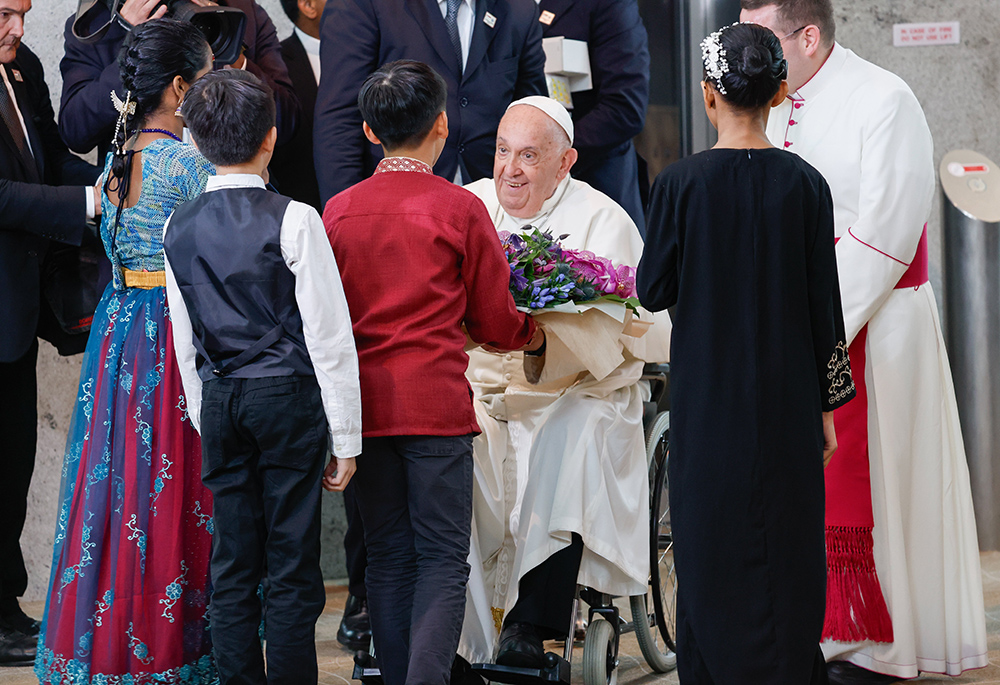
Self-constructed Christianity has other dreadful potentials, too. It produces people who believe abortion is something about which Christ smiles. It mistakenly prattles on social media that Jesus forbade judging anyone or anything. It heralds innumerable genders while encouraging irreversible surgeries for children. Speaking of children, it produces a pope fit for a millstone (Matthew 18:6) as he tells a young boy in Singapore that “all religions are a path to God… and each of us has a language to arrive at God. Some are Sheik, Muslim, Hindu, Christian, and they are different paths to God.”
Regardless of how Pope Francis’ handlers are spinning what he supposedly meant to say, his actual words measured against sound biblical doctrine proved themselves the heresy of religious pluralism, which rejects the essential teaching that Christ is the only way of salvation (John 14:6). Christians do not subscribe to religious pluralism. However, there may be one young boy in Singapore who does now, especially since he heard it from someone who’s supposed to know for sure.
Thinking about last week’s Epistle reading from Ephesians 4:1-6 appointed for worship here at Our Savior, I think Saint Paul indirectly weighed in on these things when he wrote, “I, therefore, a prisoner for the Lord, urge you to walk in a manner worthy of the calling to which you have been called…” (v. 1). Paul says three things here.
First, he insists on faithful abidance in “the calling to which you have been called.” In other words, you’ve been called to something—the Christian faith. That something has a walkway—faithful doctrine. Walk accordingly in it. When you wander past its edges, repent, and go back because the terrain beyond ends in destruction (Matthew 7:13-14).
Second, the walking is to be done in a worthy way. In one sense, it is demonstrative. People will see and hear. A young boy in Singapore saw and heard. Therefore, Paul instructs Timothy, “Watch your life and doctrine closely. Persevere in them, because if you do, you will save both yourself and your hearers” (1 Timothy 4:16).
Finally, Saint Paul already implied from his own situation, which he mentions specifically in Ephesians 4:1, that walking according to our calling could get a Christian into trouble. Behold, Paul was a prisoner for doing what he was even now urging his readers to do.
But here’s the thing.
Neither ease nor trouble affected the stepping stones of sound doctrine for Paul. The path was the path. What’s true was true, and what’s false was false. And so, he walked, and his faith was secure. In fact, it was armor-like. It could lean into and withstand the enemy’s thrusts along life’s way. It became fortress-like. Its resident could stand at the walls and confess truth before the barraging legions that surrounded it, even when standing where the enemy could see him meant imprisonment and eventual death.
Luther’s life was similar. Our lives are, too. And yet, together we have, as Luther described, a faith that is not an “uncertain delusion,” but instead, is a “strong, great certainty, which does not let us waver….” We can bear whatever the world brings our way, even a death sentence, and still retain the same kind of unshakeable trust in Christ that’s as simple as believing that “two and three makes five.” Indeed, that’s a simple analogy Luther made. And yet, it’s profoundly powerful. Even better, it’s unarguably true.
Lying to others is wrong. Lying to oneself is deadly. These were just a few of several recurring thoughts I experienced while watching the film Gender Transformation: The Untold Story, which the Life Team here at Our Savior in Hartland, Michigan, presented during a public forum this past Friday. Our world is right now living the dreadful compounding of lie upon lie to others and to self concerning God’s magnificent design of male and female.
But here’s the thing. While perhaps not as conspicuously awful or with such unalterably horrible results as the deceit presented in the film, we all lie to others and ourselves. If we believe we don’t, then we’ve already proven we’re self-deceived.
I think one reason we end up self-deceived is because of the way we so often prefer to process reality. We have interpretive filters. We experience something, and as we do, rather than its meaning simply being its meaning, we wittingly or unwittingly recraft it to fit us more comfortably.
For example, have you ever said something you intuitively knew was hurtful, and even as you meant the words to cut your opponent, when they did, to protect yourself from feeling bad, you insisted he or she misunderstood you? That was an interpretive filter you used. Specifically, it’s called gaslighting. Most folks might say gaslighting is more others-deceptive than it is self-deceptive. Perhaps. Either way, it’s a self-insulating barrier preventing what’s real from getting through as it should.
But enough psychoanalysis. The better exercise is figuring out why things are this way and what to do about it.
The “why” is easy. The Bible says it’s because of Sin (Psalm 51:5, Romans 3:23-24, Ephesians 2:3, etc.). Concerning self-deception, Saint John digs into the why’s soil and discovers the contaminant’s results, writing, “If we say we have no sin, we deceive ourselves, and the truth is not in us” (1 John 1:5). Paul digs beside John and finds more ruined soil: “For if anyone thinks he is something when he is nothing, he deceives himself” (Galatians 6:3). Shovel in hand, James hops into the hole and discovers the same, adding: “But be doers of the word, and not hearers only, deceiving yourselves” (James 1:22).
Again, the why is easy. But now, the harder part. What do we do about it?
I have two things to say in this regard. The first is Christological. We must always start with Christ and His Word.
As John, Paul, and James went deeper into the strata, other discoveries were made. Right after discovering Sin’s potential for self-deception, John also found the fertile soil of God’s gracious invitation, noting, “If we confess our sins, [God] is faithful and just to forgive us our sins and to cleanse us from all unrighteousness” (1 John 1:9). Paul found something else, too. Back in Galatians 3:11, he wrote, “Now it is evident that no one is justified before God by the law, for ‘The righteous shall live by faith.’” James made the same discovery. After nudging his readers from complacency, urging them to be more than just hearers but also doers of what the Lord desires, he dusted off a glistening stone etched with the words “the perfect law, the law of liberty” (James 1:25), which is James’ rhetorical way of pointing his readers to Jesus, the One who is the law’s perfection, the One who sets us free from the law’s burden so that we can be those who not only hear His Word but keep it (Luke 11:28).
While the three dig deeper still, the Psalmist arrives singing a faith-filled work song, one that asks God for help against deceit. The Psalmist sings, “Put false ways far from me…” (Psalm 119:29), and “Save me, O Lord, from lying lips and from deceitful tongues” (Psalm 120:2).
The second thing I want to say is as practical as it is Christological. Essentially, the Gospel nuggets are enough for faith (Romans 1:16). The faith it produces results in repentance. That’s what it does. The word “repent” (μετανοήσατε) literally means to turn around and go the other way—to change the direction of one’s mind or purpose. From a human angle, repentance is incredibly self-analytical. It wants to rid itself of faulty filters. It wants to remove anything that might deceive the self. It wants to boil things down to their mineral elements, see what’s actually there, and fix what’s broken.
For example, consider the following scenario.
Let’s say one of my daughters was troubled about something and asked for a moment of my time, but I reasonably replied, “I’m sorry, honey, but maybe later. I just don’t have time right now.” I had a sermon to write. I had a phone call to make. I had a meeting to attend. Repentance removes the filters and sees the situation for what it is. Relative to this situation, among the long and varied list of things a person should do, repentance understands the role of priority. And so, it hears what was said as, “I’m sorry, honey, but you’re just not a priority to me right now.”
Saying it that way doesn’t feel so good. That’s true, in part because of repentance’s natural direction. Remember, repentance is a reversal. The process of going one way becomes one of moving in the opposite direction. As a preacher, I think there’s more than one way to experience this reversal’s impact. Similar to exchanging the phrase “I don’t have time” for “you’re not a priority,” the same astonishing swap is possible when we invert our language, saying out loud the opposite of what’s actually true. Here’s another example.
I mentioned to Jennifer last week that one day, I’m going to preach a sermon in which everything I say is the exact opposite of what the listeners would expect me to say. The reason? It’s one thing for the average pew-sitter to make excuses for sinful behavior. But what if those same excuses were being commended from the pastor’s mouth? I can only imagine the congregation’s response to me preaching that presence in worship isn’t all that important. How startling would it be to hear me say from the pulpit that fidelity to Christ is just as important as fidelity to all the other things taking up space on our calendars? Would there be wide eyes as I say there’s nothing wrong with putting God’s Word in the back seat on occasion? Would there be gasps when I say God knows we sometimes need a break from Him and that He’s perfectly content playing second fiddle in our lives?
I’d go on and on, never once saying what you’d expect from a Christian pastor. I think the language reversal would be overwhelmingly eye-opening. Like telling my daughter she’s not a priority, it just wouldn’t feel right.
The people here at Our Savior will undoubtedly know if and when I attempt this. Until then, think about what you’ve read so far. Ask yourself, “Do I have interpretive filters that make lying to myself easier? Do I shield myself with excuses that do little more than keep me comfortable doing the things I know I shouldn’t?” If the answer is yes, then contemplate the dangers of insulating yourself in this way and repent. Turn around and go the other way. If the answer is no, then consider that you may already be self-deceived and don’t know yourself as well as you think you do. And then, as with the first answer, repent.
Grace is an amazing thing, especially when you are fully aware you need it and yet, in every way, are undeserving of it. If you don’t know what I mean, then the only thing I can think to say is that you’re a textbook narcissist who’ll never know grace’s fuller impact because you sense no need for it. That’s unfortunate. Most normal people know the downcast feeling of causing harm. Most folks likely even sense the need to admit it. When they’re all alone with their thoughts, they experience the familiar urge to ask themselves, “Why did I do that? What on earth was I thinking?”
It’s also likely that most normal people know the overwhelming exhilaration that comes from expecting retribution but receiving grace instead. I’ve certainly had my share of moments when, whether in a flurry of imposed frustration or I was just being me, I acted in ways I later regretted. I said something I wish I hadn’t. I did something I wish I hadn’t. I remember once saying something to one of my children that I felt so bad about later that I nearly couldn’t sleep for a week. I felt so terrible afterward. Still, on the very same day of my crime, there was no lack of love bestowed upon me by the one I hurt. I was treated graciously, even hugged, long before a lowly father’s sad heart materialized with a verbal apology.
Yes, grace—undeserved kindness—is an amazing thing. When you experience it, you’re different afterward.
I read somewhere that grace is proof that a person means more to you than what he or she did to you. I suppose that’s another way of saying you love them no matter what. Mark Twain wrote something somewhere about how forgiveness is the fragrance a flower leaves on the boot that crushed it. If I had the power to recraft Twain’s words, I’d swap “forgiveness” with “grace.” Grace and forgiveness are two very different things. Grace—undeserved kindness—can be extended to both the penitent and the impenitent. Forgiveness is the actual removal of sin from the sinner (Psalm 103:12). God won the whole world’s forgiveness through the person and work of Jesus. It’s there and available. Penitent faith receives it. A person who is not penitent sees no need for forgiveness. In that sense, it remains apart from him. In the meantime, grace more than sets and maintains the stage for it. When we show grace, we’re showing patient love. We’re making it so that when penitence emerges, we’re ready to bestow the kind of forgiveness that knows the full removal of guilt and the beginning of a brand new day.
Lots of folks disagree with me on this point. They point to texts like Matthew 6:15, Ephesians 4:32, and so many others. I would argue they’re missing the penitent undertow of the texts. In other words, these texts understand we ought never to withhold forgiveness from anyone desiring it. If they request forgiveness, we give it, no matter if we think the penitence is real or fake.
There’s an element of this in Jesus’ answer to Peter’s question about how many times he was required to forgive a penitent brother. “Lord,” he asked, “how often will my brother sin against me, and I forgive him? As many as seven times?” Jesus essentially responds by saying people who ask for it get from us as much as they want. “I do not say to you seven times, but seventy-seven times” (Matthew 18:21-22). That’s hyperbole. It means we never stop doling it out.
In Luke’s version of the same narrative, Jesus turns the challenge back upon the forgiver. He says, “Pay attention to yourselves! If your brother sins, rebuke him, and if he repents, forgive him, and if he sins against you seven times in the day, and turns to you seven times, saying, ‘I repent,’ you must forgive him” (Luke 17:3-4). The point here is that we should determine our own motives in the exchange. We’re not in the business of reading a person’s heart. We’re not the ones to determine if the person genuinely desires reconciliation. We’re also not in the business of making it hard for someone to be forgiven. No matter how mad at them we may be, or how much we want to get them back for their crimes, or what we think their motives might be, we get out of forgiveness’ way. We stand infinitely ready to forgive, no matter how many times they reach out to us for it.
That said, can forgiveness be given to someone who sees no need for it or, worse, rejects it outright? Knowing that human-to-human forgiveness is to be an imitation of God’s forgiveness, is that how it works between us and God (Colossians 3:13, Matthew 6:14-15)? The text from Luke 17:3-4 assumes no. John 20:23 assumes no, too, saying, “If you forgive the sins of any, they are forgiven them; if you withhold forgiveness from any, it is withheld.” The doctrine of excommunication taught in Matthew 18:15-18 and Titus 3:10-11 assumes the same. So does 1 John 1:8-9.
“But what about the Lord’s words from the cross?”
Even the Lord’s words to His Father from the cross to “forgive them for they know not what they do” (Luke 23:34) is not an insistent decree that those who were murdering Him in absolute unbelief should somehow be granted the privilege of skirting unbelief’s result. For starters, the word here for forgive is ἄφες, and it’s equally translatable in this context as “dismiss” or “disregard.” In fact, a language scholar and commentator I trust, R.C.H. Lenski, wrote concerning this verse:
“‘Forgive’ is not expressive enough: ‘remit,’ ‘dismiss,’ ‘send away’ render the true sense. The object is not stated but is plain from the added clause: dismiss ‘what they are doing.’”
Essentially, Christ is asking His Father to be what He already knows He is: gracious. He is asking Him to put aside His wrath at this moment, knowing full well that if there was ever a time for wrath, it was now. Still, the Lord tearfully pleads for the Father to look away, to dismiss what they’re doing, to let this one go by unpunished.
By the way, grammatically, the pronoun “them” refers to the Roman soldiers performing the crucifixion. They’re its antecedent, not the Pharisees and crowd demanding the Lord’s torture and death. That’s no small detail.
In the end, this is not complicated. Christ did not upend what we know of forgiveness. He simply continued doing what He always did during His earthly ministry. He was gracious, continuously showing concern for others before the self. On the cross, He unwaveringly emitted this others-focused grace perfectly, wanting the Father to look away, perhaps even giving His fiercest enemies time to come to their senses. Again, why? Because the Lord knows better than all of us the truest nature of Sin. He knows that humanity is influenced and held captive by something we cannot fully grasp. Indeed, far too often, we do not know what we do.
I think some of my theological critics—the ones who will say I’m mistaken in this regard—believe as they do more so because pop psychology’s understanding of forgiveness has been so ingrained in our post-modern psyche. For many therapists, forgiveness is more about personal healing and the ability to move on with a normal life. For example, forgiveness has come to mean that to get beyond a traumatic marriage, a woman must learn to forgive her abusive husband. I read a story last spring about a mother who confronted her son’s smirking murderer in court, saying, “I forgive you for what you’ve done.” The killer was by no means sorry. In fact, he was glad he did it. Can he lay claim to the forgiveness she offered? No.
But her grace can be imposed on him, whether he wants it or not.
The mother can pray for her son’s killer, asking the Heavenly Father to grant him what’s necessary to come to his senses and repent. She can write Gospel-rich letters to him in prison, knowing that the Gospel is “the power of God unto salvation” (Romans 1:16). She can visit him in prison, too, and share that Gospel face-to-face. She can show him that, as a human being, he means more to her than what he did to her son. That’s grace, and it smears a perpetrator’s filthy bootheel with the kind of scent that can lead a person to the One who, ultimately, bestows the only kind of compassion capable of instilling repentance and faith (Matthew 5:13-16, 43-45; John 13:35).
I’m sure you have situations in your life to which this little rambling might be applied. We all do. The Lord knows we’re neck-deep in a political season that’s going to require a lot of grace between so many. Of course, to those who wrong you, don’t be a pushover. Make sure they know what they’ve done. Beyond that, be gracious, and then step back and see what happens. You may be surprised. There may come a time when you hear them say with sincerity, “I’m sorry.” And because you were still immersed in grace’s patience, what a joy it will be to say, “I forgive you.”










 Cruciform Stuff