Words are Important

You may or may not know, but the infamous virus has managed to invade the Thoma residence.

Currently, Madeline seems to be on the upswing. She was pretty sick, but now is bright-eyed and symptom-less. Harrison is still struggling a bit, but as of last night, I think he’s turning the corner. His asthma was a concern. Although, he’s only had to use his nebulizer once. Jennifer felt terrible pretty much all day yesterday. She hadn’t yet experienced a fever, but woke up early this morning with one. I’m keeping a close eye on her. As for Evelyn and me, I think Evelyn has already had it, and with that, is doing fine. I’m not experiencing any symptoms. I tested negative on Christmas Eve, and once I get a batch of quick tests tomorrow, as the days go along, I’ll keep checking to make sure.

Once we knew it was in our midst, we started a regimen of care: Ivermectin, Zithromax, and vitamins D, C, and Zinc. In addition to these, I’ve maintained my evening dose of vitamin W, typically about two ounces of something at least twelve years old, and usually from the highland pharmacies of Scotland. Still, your prayers are coveted by the Thoma family. We pray to be through this, soon. Of course, our most fervent prayer is that the Lord’s will would be done among us.

Now on to something else worth considering this morning.

You’ve heard me say it before: Words are important.

Now, I know what you’re probably thinking. You’re thinking, “Of course you’d say that, Thoma. You’re one of the wordiest people I know.”

Well, whatever. The premise stands. Words are important.

I’m one to believe that while words are essential for basic communication, the best words in the best order can and will do so much more. They become a means for carrying ideas so that not only the mind is listening, but so that the heart is listening, too. With this, words can do so much more than bridge two humans. They have a deeper power. Ask the poets. Or ask the Twain’s, Dickens’, Austen’s, and Hawthorne’s of this world. The right words well placed can move to sadness, stir anger, sow joy. They can rally to a cause. They can tease even the stoniest temperament of a would-be enemy into amity.

Just as words matter between humans, they matter to the Lord, too. Any honest student of the Bible will affirm the unfathomable depths of divine genius displayed by the simplest of words chosen and placed so precisely on a page; plainspoken truths found to be so piercingly deep, and all set into an arrangement that has nothing less than our salvation in mind. This is proof of a God who cares.

Words are important. They should be wielded with care. If we cannot, we must not. In an age of social media, this is even more so important.

That being said, I don’t need to tell you that the Church Militant—the body of believers in Christ on this side of heaven—is facing unprecedented challenges. Or perhaps I do need to tell you. It seems the more I bring the Word of God to bear on these challenges, even among my own church members, the more resistance I get. Nevertheless, believe what you will. With the forthcoming New Year, while it promises new possibilities, it also guarantees no escape from the same recycled evil that continues to haunt us.

Essential to facing off with these challenges, the Lord of the Church calls so simply for faithfulness.

The Lord calls for this faithfulness in countless locales throughout His Word (Matthew 24:13, Jude 17-25, Revelation 2:10, Hebrews 10:23, 2 Thessalonians 3:5, Psalm 37:28, and so many more). One place in particular, by way of the inspired words of the Apostle Paul, God reminds us that we can actually be faithful, not because we are somehow impervious to whatever we’re facing, but because “God gave us a spirit not of fear” (or equally translated, “cowardice”). Instead, we’ve been given a one “of power” (2 Timothy 1:7). Paul’s words assume courage by that power, and then he names two more things in particular as its fruits.

Paul writes that the spirit of power is demonstrated in “love and self-control”—or better translated, “sober-mindedness.” Interestingly, neither the types of challenges nor their ferocity are defined in relation to these characteristics. Paul doesn’t see the need for that here. God, the One inspiring his words, has already shared that information in plenty of other portions of His Word, being sure never to veil the fact that the challenges will sometimes be terribly troubling and horrifyingly painful. But no matter what we’re facing, it’s unquestionable that we have been given courage for leaning fearlessly into every ungodly obstacle, armed with love and self-control. And why wouldn’t this be true of God’s people? The Lord not only prepared us for such things by His gracious forewarning, but by His Gospel, He has placed into us a knowledge that we have nothing to fear even if the challenges overtake us. Through faith in Jesus, we are His. He is ours. And great is the reward in heaven for His faithful people (Matthew 5:11-12).

But consider where this morning’s conversation started. What does faithfulness look like when it comes to our words? What does it mean in relation to using those seemingly artless devices meant for carrying what’s in the heart and mind of one person and putting it into the heart and mind of another?

I’d say we are to remember that however we use language, we must remember it is powerful. Aware of this, its usage must bud and blossom from love and self-control.

That being said, let’s clarify something. Does love and self-control mean that we must tiptoe through hostile moments requiring a clear confession of truth?

Indeed, there are those times when the Lord took swift and seemingly vicious strokes, pointing His divine finger at others and speaking in ways that brought stinging clarity. But as we behold our God in the flesh doing this, we notice He usually did it to those who should already know better, namely church leaders who are well-equipped for understanding and exhibiting faithfulness to His Word but aren’t—the Chief Priests, the Teachers of the Law, and sometimes even His apostles. He demonstrated a thinning patience for such people who, knowing the truth, made deliberate choices to side with evil. In these instances, the Lord was rarely gentle, having no commendation for those out front who willingly reject Him, and by doing so, pall the Gospel, thereby injuring an observing world He desires to save. He is saddened by this behavior, seeing the confused onlookers as “harassed and helpless, like sheep without a shepherd” (Matthew 9:36).

As all of this meets with the words we use from day to day, we remain mindful that where Jesus is always the capable surgeon, we are forever the bumbling assistants with very dull skills. The Lord knows our ineptness, and even so, still He leaves no loopholes for us to avoid sharing the truth with the neighbor, no matter the situation or the level of sting the truth might bring (Ephesians 4:25). We keep in mind that He rarely gives license for cutting at the weeds (Matthew 13:24-30), and He almost never gives the charge to attack. Instead, He gives us a spirit of fearlessness for explaining and persuading (Acts 19:8; 2 Corinthians 5:11). He urges us to season our speech with grace (Colossians 4:6), and to speak even the hardest of truths in love (Ephesians 4:15). To make sure we haven’t missed this crucial mandate relative to our words, He fills the pages of His Scriptures with this preempting extension of the Gospel mandate, with Jesus always being the first to demonstrate it (Mark 12:34), and thereby showing us a perfect Word in the perfect order from the perfect heart of God. This kind of word-slinging has the power for converting and convincing the heart of enemies of God to become His friends (Romans 1:16).

So, why am I writing this? Because the New Year is upon us, and as usual, I intend to make at least one resolution that leads to a deeper faithfulness to my Lord.

This year’s resolution is relatively simple. It first involves having no intention of relenting in my efforts to communicate God’s Word of truth as it meets with the world around us. Only by Christ’s truth can anyone in this world be set free to become an inheritor of the world to come (John 8:32). This has me eager to explore 2022, and along the way, observe its corridors with a readiness to either encourage or warn my fellow travelers, so that together, alive or dead, we would emerge in 2023 with a tale of faith to tell, one that demonstrated Godly endurance steered by steady courage.

Secondly, I intend to do all of this by giving even more care to the words I use, both in spoken and written forms. Understandably, I’m not so foolish as to think I can change laser-focused, opinion-driven minds by what I write or say—especially not in an American kingdom blistering with radical individualism. In that regard, I am a Christian intent on leaving the converting and convincing to the Holy Spirit while I take every available care for crafting my words with love and self-control. I want what I’ve said to be received in a way that persuades rather than incites. Again, will this even be possible in 2022? I don’t know. But what I do know is that God blesses faithfulness, and with that, I’m going to stay the course. I hope it serves us both well.

In conclusion, if you are making a New Year’s resolution for 2022, may I suggest something on the flip side of this discussion? Perhaps you could make a deliberate effort to read and/or hear the words of others through the divine filter of love and self-control. Be intentional with your efforts to discover the avenues for peace between your assumed opponents.

Man’s Deepest Need

Merry Christmas to you and your family!

I wanted to take a quick moment to interrupt your morning festivities by sharing a few potent sentences from a Christmas Day sermon given by Martin Luther in 1531. He wrote, and subsequently preached:

“The world is happy and of good cheer when it has loaves and fishes, means and money, power and glory. But a sad and troubled heart desires nothing but peace and comfort, that it may know whether God is graciously inclined toward it. And this joy, wherein a troubled heart finds peace and rest, is so great that all the world’s happiness is nothing in comparison.” (W.A. 34. 11. 505.)

Luther’s words demonstrate a firm grasp on the meaning of our Lord’s arrival at Christmas. Within a relatively short span, he describes how the world sees Christmas as little more than a passing opportunity for happiness born from selfish indulgence. Not much has changed in the last five hundred years. The world still takes comfort in transient things—food, money, earthly authority and the prestige that accompanies it, and so many other trappings. It does this forgetting that all of it has an expiration date. In contrast, Christians know that when it comes to meeting the challenges faced by an honest heart cognizant of its eternal predicament and its absolute inability to do anything to change it, something more than what the world can give is needed.

Christmas is the first movement of the divine “something” put in place to meet the need.

The birth of the Savior, Jesus Christ, is God taking aim at Mankind’s deepest need in preparation for pulling the Good Friday trigger. And when this ferocious need is finally met on Calvary’s cross—when Sin, Death, and the devil are taken down once and for all by the provision of God’s Son—for whoever believes this, Luther describes the eruption of an otherworldly joy that simply cannot be outclassed by anything the world might think to offer in trade.

A troubled heart will never know more peace than what the Gospel gives. Money can’t surpass it. Power cannot compare. Not even a life of glorious ease will ever come close to the rest God promises that lasts through and into eternity.

As it meets with this wonderful Gospel, my prayer for you this morning is two-fold. Firstly, I hope as you are opening gifts you will remember the temporary nature of such things, and as such, will know to give thanks to the One who has given you the greatest gift this world could ever know. Secondly, I hope you’ll be moved to interrupt the temporal moment of gift-exchanging in order to join with your brothers and sisters in Christ in an eternal moment—holy worship—meant for receiving the merits of the greatest gift given.

The Lord bless and keep you.

And again, Merry Christmas.

What Child Is This?

Once again, the night of nights is upon us. Tonight the Church of all ages and locations, of all time and space, marks and celebrates the inbreaking of the only One who could ever do what was necessary for our rescue.

Tonight we are reminded in no uncertain terms that God has acted. The fabric between heaven and earth is torn. Angels step through it. By God’s authority, they tell us He sent His Son, Jesus Christ, to bring peace between God and man. We hear these details from the Gospel writer, Luke. In his divinely-inspired way, it’s the Gospel writer John who so eloquently records that this Son of God is the very Word that “became flesh and dwelt among us, and we have seen his glory, glory as of the only Son from the Father, full of grace and truth” (John 1:14).

The angels speak of an accomplished peace. John refers to an unmistakable emittance of glory. Together, these do not mean what many might think they mean.

Perhaps like me, you have favorite hymns. One of mine is “What Child Is This.” This caressing Christmas hymn is one of the few that stirs me emotionally every time I hear it. It’s a hymn that is not only meant to be sung in solemnity and reverence, but at certain moments along its course, it invites a measure of vigor that few other hymns do. I’d say this is true because of the hymn’s innate understanding of the newborn Christ-child’s task for establishing peace through the display of His truest glory.

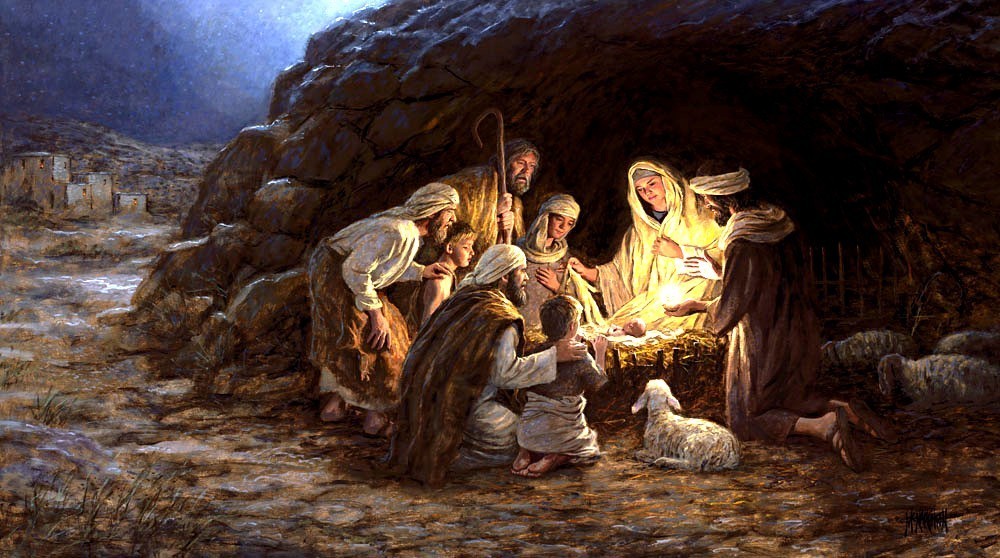
Right in the middle of the fantastical scene described by stanzas one and three—a scene that portrays the Virgin Mary holding the newborn Jesus close to her bosom, all the while shepherds are kneeling beneath a glistening nether sphere filled with invisible angels swirling on divine melodies—suddenly, there is the abrupt contrast brought by a more sinister sketch. Shattering the landscape’s serenity, stanza two crashes into the hymn like a meteor impacting the surface of the world. It wonders rhetorically why the divine Child has so crassly begun in the mean estate of society’s dregs. It even implies mortal embarrassment at the Son of God having little more than a manger—a feeding trough—to serve as His first cradle.

And then it hits.

“Good Christian fear, for sinners here,” stanza two continues, its momentum beginning to build, “the silent Word is pleading.”

The hymnographer refers to the Word made flesh sleeping in Mary’s arms as an imploring that’s aimed at the whole world, but even more so the Church. It calls for us to pay attention. We are urged to remember that the very presence of God in the flesh is a visible admission to what’s coming, to what absolutely must be accomplished. For as lovely as this night might seem, this Child was born to die: “Nails, spear shall pierce Him through, the cross be borne for me, for you.”

The Christmas tree sparkles. The candles flicker with gentle splendor. The tranquil setting gilded in seasonal magnificence is indeed an incredible sight. And yet, among all these things, the truest glory of Christmas, the genuine peace accomplished between God and mankind, will always be located in the death of Jesus for sinners.

If you don’t get to sing this hymn at some point during the Christmas season, then you’re missing out on something extraordinary. And if you do get to sing it, but the musician doesn’t lay into stanza two with some intensity, then you’re missing some of the hymn’s genuine import, too. “What Child Is This” answers its own question—the question of all questions—right in its middle. This Child is the One who has come to bring eternal peace. He will do this in a dreadfully gruesome, and yet, a most glorious way. His powerful death will be the piercing of heaven’s joy through and into this world’s helplessness in Sin.

I pray this joy for you this Christmas, namely, that you would cling to this glorious Savior—his person and work—and by faith in Him, you would be found confident for each of your remaining days in this life.

Merry Christmas.

Summer is Coming

In case you were wondering, at the time of this writing, there are 184 days until the first official day of summer. You might think I’m saying this because I’m already exhausted by winter. The only problem with your assumption is that winter doesn’t officially begin for two more days. Technically, we’re still in the fall.

Interestingly, to say “still in the fall” is to speak a phrase with more than one connotation, and no matter which you mean, the evidence of its actuality is there in support.

Take a look outside. The trees are bare. The leaves are scattered and damp beneath a recent layer of snow. The air is frigid. The sky is palled with clouds. There’s no arguing that the earth’s current position in relation to the sun is more than a few spins on the planet’s axis away from summer—half a year, to be exact. For me, this is a tiresome knowledge that can only be moderated through artificial means or by deliberate distraction. I keep a sun light in my office. Its light is weirdly simulated, but in the middle of a soul-dampening season that sees the sun disappearing completely sometimes as early as 5:00pm, it helps, even if only a little. In tandem, I stay busily distracted. I find that if I’m not thinking about the sky’s blue potential, I’m not necessarily missing it, and I’m less affected by its current grays.

Of course, there’s another meaning to “still in the fall” that we shouldn’t overlook. It hearkens back to the terminally unfortunate moment recorded in Genesis 3; that swift instant when, through self-inflicted grievousness, Mankind destroyed God’s perfect creation and positioned himself as far from God as physically and spiritually possible. The evidence mirroring this fall is plentiful. It’s all around us, sometimes subtly, and other times obviously. But either way, it is as discoverable as the seasonal image I described before.

It was subtly visible to me a few nights ago while working on a puzzle with Jennifer and the kids. We’d finished a 1,000-piece puzzle, and after a day or so of admiring the fruits of our long-suffering work, within a few minutes, we’d taken it apart and put it back in the box. In other words, what took days to complete was destroyed in seconds. Similarly, it was obvious to all of us by what happened in Mayfield, Kentucky, a town founded in 1824 and home to countless generations of families. In only a few minutes, the town was all but wiped from the map by a tornado.

To be “still in the fall” means that we exist in a world that continues to prove, not only that it is horribly infected by the destructive powers of Sin and Death, but that both it and its inhabitants are completely impotent against being consumed by them. It’s a place where this often plays out in subtle, but sinister, reversals. It’s a place in which one can claim Christianity, but be perfectly fine with cohabitation. Or perhaps cohabitation is admittedly offensive, but so is telling a Christian he or she is a walking contradiction for claiming Christ but only attending worship at Christmas and Easter. This same world is a place in which the bad we hear about someone is easily believed and the good is suspicious. It’s a place where lies easily outpace what’s objectively true. It’s a place where devout self-interest outguns concern for the neighbor. It’s a place in which one little disagreement can cause long term relationships and everything that goes with them to fall like leaves from an autumnal tree, having become completely disposable. It’s a place in which so many things unfold before us as reminders that this world exists in darkness, and no matter how hard we try, there’s no man-made light that can pierce its blanketing madness. There’s no artificial distraction vivid enough to keep its dreary sorrows apart and contained.

Only the real summer sun will do.

The official season of fall will end in a few days. When it does, we’ll cross over into the deathly hibernation of winter. It’s appropriate for Christmas to arrive at this precipice. Right in the middle of a downward dismalness anticipating and becoming Death, a Son is born. And not just any son, but rather the One God promised to send who would free Mankind from Sin, Death, and the devil’s ghastly grip (Genesis 3:16). Only this Son will do. He is God in the flesh. He is the incarnational invasion of God’s summertime love for a dying world filled with inert sinners. His presence is the incontestable assurance of a springtime restoration leading to eternal life—which He intends to be fully realized in the summer-like joy of paradise.

Jesus of Nazareth is this Gospel Son.

I suppose I should end by pointing out that our lives are not absent these wonderful Gospel images during the fall and winter. Sometimes obvious, and sometimes subtle, they’re there. An evergreen is a perfect example. Something that has become an emblem of Christmas, evergreen trees and bushes are subtle reminders accessible to us no matter the season. They remain thickly verdant with life all year long—just like a Christian’s hope born from the promise fulfilled in the Christ-child of Bethlehem. But then there are the obvious snapshots of the Gospel, too: the Word taught and proclaimed, the Absolution of Sins, Holy Baptism, the Lord’s Supper. Although, “snapshot” is probably not the best word to explain these things. These wonderful gifts of God are far more than images. They are tangible invasions of the most holy God—moments He has instituted, moments doused in the divine forgiveness that not only serves us while we are “still in the fall,” but also in place to prepare and then tie us to the promise of an eternal future in God’s heavenly summer.

I pray you will remember these things as you make your way into the Christmas celebration—and the rest of the Church Year, for that matter. Know that God loves you. Know that the Savior born of Mary is the proof. Know by this wonderful celebration that the winter of Sin and Death is not permanent. Summer is coming.

Truth Can Win

I’m guessing you heard the news about Jussie Smollett. He’s an actor who claimed he was attacked by two white men in Chicago because he’s both black and gay. He said they hit him, used bigoted slurs, put a noose around his neck, poured an unknown substance on him, and shouted, “This is MAGA country!”

Almost as soon as his story made the news, he was the golden child of the Democrats and the progressive Left who, together with their partners in the mainstream media, were doing all they could (and still are) to frame conservative America as deeply intolerant and unforgivably racist. Suddenly, Smollett’s relatively less-than-profound career had found powerful traction. He became a prominent guest at events, went on talk shows, and was even granted a primetime interview with ABC News’ Robin Roberts.

I watched the interview. Smollett cranked up the emotion and Roberts fawned, almost grotesquely. It was hard to watch, and not because I sympathized with him, or because I felt shame for being a conservative, but because something wasn’t right with Smollett’s story. Like so many others who watched it, I didn’t believe what he was saying. The thing is, much of the law enforcement community involved with the situation disbelieved him, too. Still, a few higher ranking officials in Cook County managed to pull enough strings to shield their celebrity friend from any attempts to reveal what was, even in their minds, looking to be a hoax.

Eventually, the tables turned. A fair-minded prosecutor was presented with the evidence, namely, that the men involved in the supposed attack were not even white, but black, and Smollett actually hired them. As it would go, Smollett was charged with six counts of orchestrating a hate crime against himself. Last week, the case and its facts unfolded before twelve jurors, and on Thursday, Smollett was found guilty of five of the six counts. Truth defeated untruth.

But it almost didn’t, which I’ll get to in a moment. First, I’ll let you in on a little secret—and I’ll bet it’s one to which others who do what I do for a living would likely nod in agreement.

It’s likely the reason I choked on the believability of Smollett’s interview with Robin Roberts is because pastors are pretty good at spotting liars.

If the job is being done right, no small portion of a pastor’s time involves interfacing with the underbelly of Sin’s grossest offenses. Lies rule in this realm. In one sense, this is true because the devil, the father of lies (John 8:44), labors tirelessly to maintain this dimly lit kingdom. Pastors know this. They know he uses lies like a model maker uses glue, connecting this and that misshaped part to create a seemingly insurmountable monstrosity that’s eventually found capable of hiding truth in its shadow. Still, I won’t place all of the blame on him. Even without his crafty influence, sinful humanity is more than capable of maintaining a kingdom of deceit. The Sin-nature is a powerful wellspring that feeds every human being’s ability to lie to others, and perhaps most disturbingly, to lie to oneself. What’s most troubling about this tendency is not only that it so often demonstrates itself with a twisted joyfulness—as if to suggest that without the ability to lie, humanity would be overcome by boredom—but that lying seems to be the first thing people will do to acquire what he or she wants, or to defend what he or she already believes.

Again, if pastors are doing their jobs, it’s likely they know the telltale signs of deception. They know the signs because they’ve heard and seen the same forms of dishonesty in countless situations. For example, all too often the man who confesses to having fallen out of love with his wife eventually proves he’s had eyes for another woman all along. He didn’t fall out of love. He lied to justify his desires and get what he wanted. Pastors see this all the time. Another example that repeats itself: It’s not uncommon for disgruntled church members to blame their unhappiness (or non-existence) on the pastor or a fellow member of the church community, landing on just about anything they’ve done or said as cold, unloving, or offensive. In my experience, the disconnect usually has to do with the wayward person’s desire to embrace an ideology or behavior contrary to God’s will and Word. It’s only after the pastor and church community have spoken truthfully to the errant Christian about the dangers of his or her living that the trouble begins. It’s then that the ones reaching with the truth are no longer counted as friends, but rather as unloving accusers. And yet, they’re not unloving. That’s a lie. They’re being faithful to both God and neighbor. They’re seeing a fellow Christian in need, and rather than closing their hearts to the opportunity for expressing God’s loving concern, they act. As Saint John points out, they epitomize love “in deed and truth” (1 John 3:17-18). On the contrary, the one who stubbornly refuses the truth is living in a perpetual darkness ruled by lies (1 John 1:6-9).

I could go on and on sharing similar examples, but I promised an explanation to my previous comment about truth nearly losing to untruth in the Jussie Smollett situation. What I meant is that if those who knew the facts had decided not to go the extra mile for truth, had those who were bothered by the lie being guarded by the people in power chosen to remain silent, an already monstrous narrative of untruth would have gained a deeper footing in America. But honest people took a chance at confronting dishonesty. They took a chance at offending the false narrative. They pursued truth, and truth won.

We can learn from these nameless advocates.

By their diligence, a deception was uprooted, and justice was served. What’s more, the blast radius of truth’s detonation revealed the scoundrels intent on weaponizing the lie. Thankfully, those frauds were silenced. Whether or not those same people are dealing honestly with themselves when it comes to public opinion, I don’t know. I will say that until they come clean, they’ll continue to simmer in their own foolishness in a glaring way. In other words, if I were Robin Roberts, or any of the other liberally progressive automatons who condemned anyone who questioned the verity of Smollett’s story—and this includes Joe Biden, Kamala Harris, and countless other ever-droning agendizers in government, Hollywood, and mainstream news and entertainment outlets—I’d apologize to America soon, all with the hope that my gushing foolishness would be soon forgotten. I’m sure the social media giants at Twitter, Facebook, and YouTube are certainly doing whatever they can to help scrub the crime scenes.

In the end, my real hope is that the shame these people are experiencing will not only shepherd them toward honesty, but will encourage them to measure their responses in the future. Admittedly, my hopes are not high in these regards.

So, why bring any of this up? Well…

A man is a man. A woman is a woman. Stand up to the lies that claim otherwise. Maybe take a chance and write a letter to the NCAA. Push back against their woke policies allowing transgenders to hijack women’s sports, ultimately stealing away so many well-deserving female athletes’ aspirations. The Smollett case has shown us that truth can win.

A person is not inherently evil because of the color of his or her skin. Fight in your communities and school districts against the deceptive race theories that claim otherwise. Go to the school board meetings. Call your local representatives. Do these things knowing truth can win.

An unborn child is a unique person, both dignified and worthy of life. Muster as much muscle as you can against the pro-choice devilry that would call this untrue. Get involved with your local Right to Life chapter. Give of your time and treasure to the cause. Be present at the gates of a Planned Parenthood to pray. Do this. As we’ve seen, truth can win.

Again, I could go on and on with this. The list of topics that would benefit from truth’s pushback is long. And yes, it also includes much of the pseudo-science that’s driving so much of what Americans are being required to endure these days. Against these looming deceptions, know that truth is forced into the shadows when those who are to be its hands, feet, and voice remain quietly indolent. Perhaps worse, truth teeters at the edge of burial when we wait for someone else to act.

I suppose in conclusion, whether any of us chooses to engage on behalf of truth, we can all rest assured that truth won’t settle for our disregard indefinitely. It certainly won’t forever tolerate those in the Christian community who, having been offended by it, take their marbles and go somewhere else. As I’ve said on countless occasions from the pulpit here at Our Savior, eventually the Last Day will come and the divine light switch will get flipped. In the bright-beaming streams of Christ’s return, even as every human being alive and dead will be found on their knees paying homage to the approaching King of Kings, all will see and know what is true and what isn’t. Joy or regret will be the two available emotions as all deceptions are stripped away and the final standards of judgment are laid unquestionably bare. By God’s grace at work through His revealing Word right now, Christians are equipped for that day. Through faith in Christ—the One who is truth in the flesh (John 14:6)—we are not only rescued from the perils of Sin and the regret it brings, but we are given hope for that moment of moments. Just as wonderfully, we are changed to know and desire truth in the here and now (John 8:32; James 1:18), and we are equipped by the Holy Spirit to protect and defend what is true (1 John 4:6).

By that same Gospel of deliverance in Christ alone, be strengthened to stand for truth. I say this knowing that if anyone is truly destined for the job, indeed, it’s Christians.

Misplaced Concerns

I received word that a childhood friend passed away recently. She wasn’t a best friend, but she was part of a circle of families close to my own. Hearing the news, more than a few memories were stirred—summertime at the public pool in Danville, Illinois, where I grew up; riding together like a gang through the neighborhoods on our mag-wheeled Huffy bikes; jumping dirt hills on KX-80s; trick-or-treating as our favorite Star Wars characters; Friday nights at the roller rink; all of these were wafted to remembrance.

I suppose my first reaction was to wonder what Death was doing by reaching out to such a young woman. But then I rose from my chair, heard my knees crack, and remembered my own age. Naturally, I humbly withdrew my reaction to Death’s dealings. Perhaps my departed friend wasn’t as young as I preferred her to be, and as it would go, what did that mean for me?

It means I’ve arrived at the edge of a shadowy land where, both chronologically and biologically, Death is making more rounds among the citizenry.

I could say I don’t want to think about it, but that would be foolish. I’m not going to live forever, that is, there’s no gate strong enough, no lock steely enough, no wall sturdy enough to keep Death out when its carriage arrives at my door. As it was with my childhood friend, no matter what I think is right or fair with regard to Death’s dealings, the exchange will be made, and I will go. To believe differently is to live by lies.

Of course, it’s just as inappropriate for me to dwell on these things as it is to ignore them. To dwell on Death would be to live in fear. To live in fear is to be cursed with finding Death and its dread hiding behind everything. It would be to epitomize an insightful line from Don Quixote, the one that goes something like, “Fear is sharp-sighted. It can see things underground, and even more in the skies.”

Besides, I’m a Christian. Living in fear is not what Christians do. And why? Because even though I said I won’t live forever, the truth is, I will. Yes, Death will arrive. I don’t know when, where, or how, but it will. When it does come, I will go. Still, Death won’t own me in that exchange. I have another Master to whom the fateful carriage will transport me. By the power of the Holy Spirit in faith, I can live and breathe and move within each day apart from a strict attachment to this world knowing that even though “in Adam all die, so also in Christ shall all be made alive” (1 Corinthians 15:22). That awareness from Saint Paul is nothing less than a faithful interpretation of Christ’s promise to Martha in John 11:25-26:

“I am the resurrection and the life. Whoever believes in me, though he die, yet shall he live, and everyone who lives and believes in me shall never die.”

Death had come for Martha’s brother, Lazarus. It sounds like it came in a dreadful way—through illness. Jesus didn’t debate the fact of Death or its means. Instead, He comforted Martha with a better fact—a Gospel-fact—not only that Death wasn’t the end-all, but that the One who was stronger than Death was now on the scene. With Him, Death is defenseless. With Him, the bright-beaming rays of eternal life on hope’s horizon are visible. From that vantage, Death and its fear are neutralized by the Christian confidence of faith. Faith in Jesus is the antidote for fear.

Re-reading what I just wrote, I wonder if there’s more to consider when it comes to how the world around us views Death and its fear. I sometimes wonder if too many people have things somewhat out of order. What I mean is that perhaps people have lost sight of the seriousness of Death’s finality and what comes after it because they’re too distracted by the concern for the ways it might arrive—COVID-19, a school shooting, cancer, or whatever. Again, Death is coming for everyone. What happens beyond that moment is the more crucial concern. Still, so many have traded the momentousness of Death’s eternal irrevocability for the temporary nature of its occurrence. They’re afraid of dying, not necessarily the specter of Death itself.

It would seem this misplaced concern has given birth to a sharp-sighted and irrational fear strong enough to prevent people from actually living. They see danger in everything, and as a result, they’re afraid to visit family and friends, they’re afraid to return to work, they need this and that preventative measure in place before feeling safe enough to do just about anything. I read just this morning that the State of Oregon is considering establishing a permanent indoor mask mandate.

Perhaps worst of all, this fear is still keeping some Christians distant from Christ and the gifts He gives in worship.

But remember, with Jesus—and being strengthened by the Gospel means He provides—Death and its fear is counteracted. Christians don’t have to be afraid of COVID-19 or any future variants. They don’t have to live in fear of a school shooter. Certainly, Christians are mindful, using their reason and senses attuned by God’s Word to watch, discern, serve, protect, and defend against Death’s means. Indeed, we are mindful of Death. And we should be. Compared to the world around us, we know and understand its dirty dealings the best.

But we don’t dwell on them.

By faith, we have been grafted into the One who defeated Death (John 15:5). We have the One who has given us the promise that “neither death nor life, nor angels nor rulers, nor things present nor things to come, nor powers, nor height nor depth, nor anything else in all creation, will be able to separate us from the love of God in Christ Jesus our Lord” (Romans 8:38-39).

With promises like these in hand, when we feel the creeping nudge of fear’s tendrils, we can know to run to, not away from, Jesus. It’s only with Him that we’ll receive what’s necessary for facing off with Death and its fear. It’s only with Jesus that we’ll have what we need for living in Christian confidence, come what may.

The Helplessness Isn’t Permanent

Advent begins today.

It’s unfortunate that far too many churches these days have jettisoned the traditional observance of Advent. I’d say they’re missing out on a lot. Historically, the Church revisits her course at this moment, making sure her heading is sound and her crew is ready.

For all of the cultural twinklings surrounding it, Advent is a darker season dealing in two contrasting images.

The first is the darkness of penitential concern. It’s a time for recalling the very real predicament facing the world because of Sin’s infection.

With this in mind, Advent takes aim at Mankind’s impotence in relation to Sin’s chief product, which is Death. It also anticipates the final day when the Lord returns to judge both the living and the dead. Together in these, all time and opportunities will have ended. A last breath will have happened, or the Last Day will have arrived, and you will go. The time for even the most foolish negotiating will have passed. There will be no discussing or bending the standards. There will be no convincing God to your side with explanations that you did your best to keep the Law (the Ten Commandments). You won’t find room between the two of you for slight disagreement on what was acceptable and what wasn’t. Advent strips away all hope for leniency by works of the Law. It helps to remind us that “in Adam, all men die” (1 Corinthians 15:22). It puts before us the divine cue that the Law silences everyone, holding all humans accountable to God’s perfect standards (Romans 3:19). And lest we forget, Advent reminds us of the inescapable predicament of the Sin-nature in all of us. Standing beside the Law’s requirements, we’ll discover the impossibility of ever being counted righteous by our deeds (v. 20).

Advent teaches the hopelessness of human effort against all that plagues us when moving from this sphere to the next.

Advent also teaches that this dark night of helplessness isn’t permanent. Not only will it come to its completion at the Last Day, but Advent carries us back to the day the solution to the Sin problem was given—when Death was put on notice, and all of the long-foretold promises of God were completed in the God-man born to a virgin in Bethlehem. Advent looks to Christmas. It brings us back to the same sense of anticipation that’s ours as we await our last breath or we await the Last Day, except by faith, this time it’s fearless. It reminds us that the midnight concern of our lostness more than faded away in the sunrise of the Savior’s birth.

This is hope. Advent preaches this. It keeps before us the effervescent fact that God’s love moved Him to send His Son, Jesus, to save us, and faith’s grip on the merits of Jesus will, without question, see the believer through to eternal life. For believers, even though we die, yet shall we live (John 11:25). The One born on Christmas morn said this. In the same way, for believers, the Last Day will be like the celebration of Christmas. It won’t be a moment of terror, but rather a moment of bright-eyed joy. In fact, it will be a moment of familiarity, one that recalls the angels’ words to the shepherds about peace being accomplished between God and Man through the oncoming work of the newborn Christ. In that final moment before the returning Christ, such peace will be experienced as never before, and it will wash over us as we hear the voice of the One who once laid in a manger say, “Come and receive the inheritance prepared for you from the foundation of the world” (Matthew 25:34).

Thanksgiving and God’s Smile

After fifty-two long weeks of travel, having visited all of the distant landscapes of the Church Year, we’ve come full circle and arrived once again at Advent. We’ve come home.

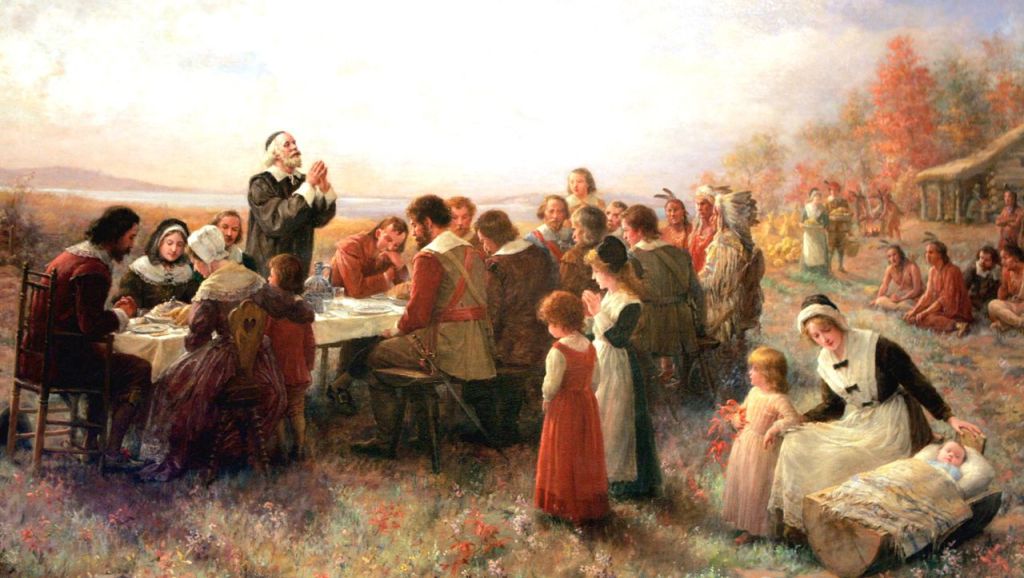
Still somewhat afar off, there’s a plain between us and Advent’s perpetual twilight eve of waiting—an oasis of sorts. It’s always been there. We just didn’t necessarily notice it until a handful of our nation’s most thoughtful carved it from the landscape, cultivated it, and made it a more prominent vista. They named this lush borderland “The National Day of Thanksgiving.”

Strangely, some of the Church Year’s travelers have been long-bothered by the demarcation of this day. Each year at this time, they share their concerns for such a day instituted by this world’s princes and celebrated by the Church. And so, passing through its parcel, they say it doesn’t belong—that the Last Sunday of the Church Year is well enough equipped for delivering us into the new Church Year, and the Day of National Thanksgiving needn’t be one of the Church’s events. I’d say these fellow travelers are right, if only by their humbug commentary they didn’t demonstrate a bizarre disposition against one more opportunity for thankfulness. Doing this, perhaps they prove, even more so, the National Day of Thanksgiving’s necessity.

I agree with them in the sense that thankfulness is already written into each and every stop along the Church Year’s way. This is true because it’s written into the souls of believing travelers by the power of the Holy Spirit through the Gospel. This means thankfulness is a fruit of faith that cannot be kept from sprouting from the soil of the Church’s collective heart, reaching up toward the sunlight of God’s grace, and rejoicing in His wonderfully sustaining love.

As this meets with the National Day of Thanksgiving, perhaps a day set aside and focused specifically on giving thanks works quite well between the Last Sunday of the Church Year and the First Sunday in Advent. The journey has ended, another is beginning, and both are born from the fact that God is always faithful all along the way. In between the two, thankfulness just seems natural. It’s what any normal traveler does when his journey has ended and he’s found himself at home’s doorstep. He does not wisp a thankless sigh, a sound made because he’s annoyed by home’s obligation. He sighs with thankful relief. He’s glad. And so, he falls to his knees—or perhaps he goes right inside to fall into his favorite chair, or into the arms of a loved one—and he gives thanks to the One who took careful notice of each of his steps along the way, being sure to guard and protect him through to the end of one journey, and into the brief respite granted before beginning another.

Saint Ambrose said so exactly: “No duty is more urgent than that of returning thanks.” In a radically individualized society filled with takers, I probably don’t need to explain Ambrose’s words to you.

With that, I say a day set aside that takes aim at thankfulness can do little, if anything, to harm our nation, let alone a Christian, no matter who established it. Besides, Christian thankfulness is already attuned within us. It’s always on the lookout for ways to show itself to a thankless culture. We need it to show itself. It certainly knows how. It knows far better than the world. Again, this is true because Christian thankfulness is powered by the right kind of joy—the kind born from the Gospel of salvation through faith in Jesus Christ. It is well-equipped for seizing every opportunity for gratitude in this life as we await the next. Christian thankfulness exists through sunshine and rain, warmth and cold, happiness and sorrow.

Just imagine how Christian thankfulness must leap for joy when it sees it has its own day on the calendar.

I suppose you don’t need to imagine it. Our Savior in Hartland is not a congregation that ignores the National Day of Thanksgiving. We’re glad for it, and we embrace it. It seems natural to do so. Perhaps even better, it seems only right. Come and see for yourself. Join the thanks-filled gathering of Christians here at Our Savior on November 25 at 10:00am. Join us as we take hold of the National Day of Thanksgiving and use it in a way that makes God smile; which, by the way, doesn’t necessarily mean we’re gathering to give anything to or do anything for Him that He needs. We gather because of what He gives and does, and we have hearts for receiving more. We desire His soul-strengthening gifts of forgiveness through Word and Sacrament ministry. We want to receive this heavenly bounty whenever we can, and after each opportunity, to be sent out by His smile, which is the gracious benediction of His face shining upon us and giving us peace.

Indeed! O, give thanks unto the Lord; for He is good, and His mercies endure forever (Psalm 136:1)!

God bless and keep you, my friends, and may you have a wonderfully happy Thanksgiving. I hope to see you in worship. And, if I do, I’ll have one more reason to give thanks to my faithful God, not only for His grace, but also for your faithfulness.

Contradiction

There are plenty of lessons to be learned with age. I know this, as I’m sure you do, too. Perhaps like me, I’m guessing that if you sat and flipped through the pages of a photo album, one containing images chronicling the expanse of your life, you’d be able to reach into each grainy portrait to retrieve a lesson, perhaps something you know and understand now that you didn’t before that particular moment. Some of the lessons were hard-learned through trial, error, or struggle. Others were simple realizations born from the natural circumstances of an ever-unfolding life.

I have a picture on my shelf that includes me, Dinesh D’Souza, and Michael Shermer. Most folks know who Dinesh D’Souza is. Michael Shermer is the founding publisher of “Skeptic” magazine. I have to say, when it comes to critical analysis, he’s no slouch. Before the debate, I read his book “Giving the Devil His Due.” I figured I’d better have some sort of grasp on the fiber of his being before attempting to engage in conversation with him. I’m glad I did. Not only did it make our time together much more gratifying—and I think, in the end, helped forge a genuine friendship—but I discovered the book wasn’t completely unenjoyable. In fact, it tested the fences of my own understanding of God—who He is and how He operates. I wouldn’t recommend giving it to an unchurched (or de-churched) high school or college student. Although, having learned rather recently that many high school students are entering universities in need of serious remedial reading assistance, unless they can dig deeper than emojis and SMS language, they might not get past the first few pages before feeling the urge to give up and watch gamer videos on YouTube. The book doesn’t spoon-feed the reader. It requires some effort.

Anyway, the picture I mentioned before was taken in my office after the debate between D’Souza and Shermer we hosted here at Our Savior in 2020. In the photo, we’re raising whisky-filled glasses in a toast. I remember the moment very well. I remember the evening’s discussion. When I look at the photo, I remember a lesson learned. Actually, I should say I learned several lessons, but the one I remember when I look at the picture is this: Humans are definitely skilled at reconciling the most glaring of contradictions. In other words, we can find ourselves trapped by inconsistencies, whether that be our behavior, words, or whatever, and yet we always seem to find a way to legitimize them, to justify them, to make them fit seamlessly together.

I won’t go into the details of the conversation that nurtured this discovery. I’ll just say it was definitely demonstrated. It was subtle, but also very apparent. Having experienced this indirect instance against the backdrop of two men of incredible intellect, I’ve learned to be much more observant, to listen more closely, and to respond more cautiously in most situations—more so than ever before. Doing so, I’m better able to see when I (or anyone I’m conversing with) have left the land of objective truth and entered into the realm of subjectivity. To flesh this out a little, I’ll give you a less cryptic example from current events.

Kyle Rittenhouse—the teen acquitted in Kenosha, Wisconsin for killing two attackers, one of whom had a handgun—had the charge leveled against him by the prosecutors (and countless onlookers) that he shouldn’t even have been in the situation to begin with, let alone armed. With that, it’s been the crux of so many that he provoked the incident. For the sake of clarity, Rittenhouse’s father lives in Kenosha, which helps make sense of his involvement; and the judge dismissed the charge that he was carrying his weapon illegally. Still, even without these things being said, a glaring contradiction emerges from the prosecutors’ charge. While they ask what reasons Rittenhouse had for being where he was—which, objectively speaking, it appears there were a several—they appear completely disinterested in the reason for the attackers being there, all three of whom had serious criminal histories. I’ve seen little discussion on this issue. Perhaps worse, it was established early on that the man who aimed the pistol at Rittenhouse was a convicted felon, namely, a pedophile. What’s a convicted felon doing with a gun—and in a city being burned to the ground, no less?

It seems the concern for one but not the other uncovers a rather glaring contradiction.

Another example I’ve been thinking about a lot lately is the visceral anger being expressed by parents in relation to local school districts around the country. I read an article in “The Federalist” last week that sorted out what’s been troubling me. Yes, parents are mad that they’re being excluded from participating in their children’s education, and now they’re fighting back. Admittedly, they should be mad. Even better, I’m glad parents are finally leaning into these radical agendizing institutions. The ideologues at their helms need to be reminded that if anyone is to be considered sovereign in the parent/school relationship, it’s the parents. But what’s bothered me for so long is that these same parents have already been more than willing to relinquish so many of their parental responsibilities to the state. Long before feeding them into all-consuming sports, so many already served their kids up to “before care” and “after care” programs that pretty much handle all of the basic food, medical, and educational needs children require from the time they wake up to when they go to bed. Parents don’t need to feed them breakfast or dinner. They don’t have to help them with homework. They don’t have to help them navigate sexual or social concerns. The schools have programs for all of it.

Parents gave their kids to the state a long time ago, and now they’re mad when the state assumes the supreme role of parent? The contradiction here is piercing.

And lest we lose a molecule of honesty we have in this regard, this stuff isn’t just happening in the world around us. We see these contradictions in the Church, too. A person gossips, and when confronted, demands the benefit of the doubt. Another person complains after a long work week about Sunday morning worship being too early, only to be found standing in line at Walmart at 4:00am on Black Friday. Another person takes offense that his church didn’t reach out often enough over the years he was absent, saying he expected more from Christians. Another claims strict faithfulness to the Bible while heralding women’s ordination, the right to abortion, or defending his or her child’s homosexual disposition.

Before I go any further, I suppose I should at least give a nod to Aristotle’s Law of Contradiction (or Non-Contradiction, as it’s sometimes called). The Law of Contradiction is a relatively simple principle, but for as simple as it is, it’s necessary to logic and foundational to basic communication between individuals. In its most elementary sense, it establishes that two antithetical premises cannot both be true. In other words, red cannot be blue—or to use the philosopher’s language, “red” cannot simultaneously be “not red.” Perhaps more interestingly, no small number of philosophers in history worried that a society found abandoning this very simple law would have poisoned itself in a way leading to certain death. I wonder what that means for America, a country where science is no longer science, where a man can menstruate and an unborn human child is not, in fact, a human life.

As you can see, glaring contradictions abound in every aspect of our lives, and the fact that human beings have the uncanny ability to reconcile them in their favor proves something innately dark to humanity. The Bible knows what it is. For starters, take a trip through texts like Ephesians 2:3, 1 Corinthians 2:14, Psalm 51:5, Genesis 8:21, Romans 5:19, Romans 8:7 and you’ll likely figure out what it is. It’s Sin. Even further, God’s Word establishes the necessary boundaries for identifying Sin, not only by revealing and then measuring the specifics of God’s holy law (the Ten Commandments) against our lives, but also by confirming the Law of Contradiction as a very real thing at work in Natural Law. The Scriptures do this when the Apostle John announces so succinctly, “No lie is of the truth” (1 John 2:21); or when Saint Paul describes God by declaring, “He cannot deny himself” (2 Timothy 2:13). Of course, there are countless others, and by all of them, the Bible is not only affirming the existence of truth, but also reminding us that when we make excuses that justify our contradictions, it’s likely we’re on a dangerous trajectory aimed away from truth.

The fact that humans are so easily inclined to do this once again proves that the Sin-nature goes much deeper than we could have ever expected. We learn that Sin has burrowed comfortably into our souls and does not want to let go.

So what do we do?

Once I finish typing this note, I’m going to finish the sermon for this morning, which in its current course, spends a lot of time in the epistle appointed for today from 1 Thessalonians 5:1-11. It’s there that Saint Paul says pretty straightforwardly, “For you yourselves are fully aware…”

Indeed, God has not left us ignorant of the predicament. His holy Word answers the question. To deliver us from the darkness, He has given His Son, Jesus Christ (John 3:16-17). Trusting in Him and the Gospel Word of His wonderful work, we are different. We are attuned. We are aware. It’s from this that Saint Paul can assume there remains very little left in this world to surprise us like a thief (v. 4). We are no longer children of the darkness, but rather “children of light, children of the day” (v. 5). We can see what’s going on and not be duped. We can watch what’s happening and not be startled. In this particular text, Paul makes the case that not even the sudden return of Christ in glory at the Last Day will catch us unaware. We cling to truth. Truth keeps us prepared.

The text ends with Paul urging the reader to “encourage one another and build one another up” (v. 11). Consider this morning’s eNews message an encouragement to you to continue holding fast to the Word of God for discerning the world around you. Let it teach the lessons you’ll learn along the timeline of your life, many of which will be camera-captured and preserved as memories to be revisited. Let it be the ultimate source of revealed truth to you. Let it bring you to the knowledge of your sinfulness—to the seriousness of your devout commitment to “self” and the sinful contradictions we so often try to justify. From there, follow its lead as it tells you of the One who took your place in Sin on the cross, giving to you a new heart and a willing spirit that has more than enough muscle for arising from contradiction’s trap and aligning with faithfulness (Psalm 51:10-12).

Doormat

Those who attended our conference back in October will know from the presentation I gave that the 1982 film “The Thing” is one of my favorites. It just so happens I’d been watching the film with my daughter, Madeline, a few days prior to the conference, and at one particular moment in the film, it suddenly occurred to me just how similar the terrifying creature was to liberal progressives and the Democrat party’s platform principles. I detailed these in my speech.

But that’s not what’s on my mind this morning.

About a year ago, I joined an online forum devoted to “The Thing.” I don’t provide much content in the group. To be honest, in all of my time in the forum, I’ve only made a handful of comments. I’m more of a lurker. Although, I did take a chance at starting a couple of discussions within the last few weeks that, in some ways, resulted in reaffirming a few premises of my presentation at the conference—which, again, if you haven’t seen it, can be viewed by visiting here: https://youtu.be/Y_97Ty6s7XA.

The first post I made was simply to share a couple of pictures of me on stage at the conference beside a projector screen beaming images of the original movie poster and a few of the movie’s characters. I shared these pictures because, firstly, it’s not out of step for the group’s members to work the well-beloved film into life’s everyday moments and then share it; and secondly, I’d just accomplished this in a public speech beside some folks of relative prominence. I didn’t tell them what my speech was about, but for context, I did include a picture of the panel discussion with Candace, Abby, Charlie, and me.

The first four or five comments were good, mostly high-five in nature, expressing how cool it was that I’d figured out how to bring the film in for a landing among such folks. But it certainly wasn’t very long before the pile-on of invectives against conservatives began, and of course, I was in the crosshairs of the viciousness.

To be clear, I did get a few private messages from folks asking for a link to view the speech. I shared the link, and a few came back in follow up messages saying not only how I’d forever influenced their perception of one of their all-time favorite films, but how glad they were for my words. Unfortunately, none came to my defense publicly, and I understand why.

The last time I checked, the post had been deleted. Interestingly, I’ve seen a few posts since then that belittle conservatives. My post, which was not malicious in any way and said nothing political in nature, is gone. Their posts are still active.

Moving on…

Call me foolish, but the second post I made in the group happened last Monday. I offered it following a dinner conversation with my son, Harrison. He had suggested that the creature in “The Thing,” which assimilates and imitates every living thing it eats, probably couldn’t eat and imitate a Xenomorph, which is the creature from the movie series “Alien”—another of my favorites. The deeper Harrison and I got into the topic, the more I realized he was right. We even found ourselves discussing it the following morning over bowls of cereal, once again reaffirming our common suspicions.

Now, if you don’t know anything about these films, please bear with me for a second. I’m certain you’ll learn something other than just how much of a sci-fi horror flick nerd I am.

In the movie “The Thing,” the alien is an organic creature that operates at a cellular level. For the record, everyone in “The Thing” forum is in agreement with this. What this means is that if even one of the creature’s cells infects your body, you’re done for. It’s going to do what it does—which is to gradually eat, assimilate, and eventually become a near-perfect imitation of you. Once the characters realize the situation, in order to find out who’s human, they develop a test. The test is simple. A copper wire is superheated with the pilot light from a flamethrower and then dipped into a petri dish containing a sample of each person’s blood. If the person is human, nothing will happen. If the blood is infected, what’s in the petri dish will fight back. It’ll do this because, again, each individual cell is a sentient organism trying to survive, and early on in the film, one thing the characters learn is that the creature hates getting burned.

In the “Alien” movie series, the creature is silicone-based, which means its biology is more of a synthetic polymer. This means its flesh does not have carbon as part of its backbone structure. What’s more, it has concentrated acid for blood. Anything its blood touches is instantaneously dissolved, no matter what it is. It even melts metal. This is one reason why a Xenomorph is very hard to kill. If you try to shoot it, or perhaps hack at it with an axe, even the slightest bit of blood spatter will burn right through and likely kill you.

Anyway, being the nerd that I am, and having all of this in mind, I shared the following thought in the “The Thing” forum. I’d say my words were pretty innocuous.

“Perhaps it’s been posited here before, but I was thinking the one creature The Thing probably couldn’t assimilate would be a Xenomorph. The acid-blood would definitely be a problem.”

As with any post, conversations ensued. What bothered me, however, is that those who disagreed with my premise did so first by way of an insult. Consider the following conversation that unfolded—and for the sake of anonymity, I’ve given this particular forum member the name “Brandon,” because, well, it just feels right.

Brandon: Eh? You aren’t too bright, are you? Assimilation is AT THE GENETIC LEVEL.

Me: I thought assimilation happened at the cellular level. That’s different from genetics. If cellular, the silicone framework would prevent it. And the acid-blood would be little less than a superheated wire causing The Thing to retreat. They’d fight, but the Xenomorph would not get assimilated.

Brandon: You are kind of ignorant when it comes to cellular biology. Blood is made of cells.

Me: No need to continue insulting me. You said genetics. That’s a different discussion than cellular. I agree with the cellular premise. Nevertheless, the Xenomorph’s blood is not cellular. It’s concentrated acid. It does not contain anything relative to cells, which means it doesn’t have anything in it with cytoplasm bound externally by cell membranes. Concentrated acids react exothermically with organic material. They burn up cellular material. It seems pretty straight forward.

Brandon didn’t offer any follow up commentary.

But here’s the thing that bugs me in all of this. In both circumstances of my posts, why attack me? It sure seems to prove the liberal-progressive caricature. They get mad. They attack. They call people names. They shout. They walk out, expecting everyone else to feel as though they lost someone important to the conversation.

I suppose we could try to examine all of this, but in a practical sense, perhaps I’ll simply ask, what good does it do as a first reaction to so venomously tear into an opponent because of a differing opinion or position? It certainly doesn’t help toward winning the opponent to your way of thinking. When a person comes out swinging in this way, I can promise you I’ve got one thing on my mind relative to his or her character. I think Nicolas Boileau said it best:

“Honor is like a rugged island without a shore; once you have left it, you cannot return.”

Frankly, one’s honor is near-fatally harmed when viciousness is shown to be the go-to tool in debate. Even further, the louder such people shout at me (or the more they write in all caps), the more I trade genuine curiosity in their position with interest in what’s happening outside the nearest window.

But notice I said “near-fatally.” No matter how much I’d prefer to write someone off completely for such behavior, from the Christian perspective, a believer must be ready to offer forgiveness in these circumstances. Say, for example, Brandon reaches out asking for forgiveness. If he were to do this, it would be on me to be ready to give it. And yet, let’s again be frank with one another. That same Christian perspective reminds us just how hard it is to salvage a relationship when the offender lacks the fruits of genuine repentance. In other words, the person can rip you to shreds verbally, and he or she can then offer an apology, but the words will lose all of their gravity when the person does not at least demonstrate an active willingness to fix it.

Amending is part of the equation.

Of course, none of this infringes on the fact that when Saint Peter asked Jesus how many times we ought to forgive a neighbor who sins against us, the Lord told him hyperbolically, “Seventy-seven times” (Matthew 18:22), which is to say indefinitely. Still, understand the Lord shared this instruction right after He taught His disciples how to deal with an unrepentant person, essentially saying that the time might arrive when forgiveness must be withheld (vv.15-18).

The Christian is mandated to forgive. Well, maybe “mandated” is too strong a word. On the other hand, maybe it isn’t, especially when one realizes that by the power of the Holy Spirit through the Gospel, a Christian has everything necessary for meeting the mandate—and not as an element of salvation, rather as a fruit of faith. Another way to say it: A Christian is privileged to forgive (1 John 4:19). The same goes for the offender. The Christian offender has at his disposal the same Spirit-endowed muscle for repentance. The offender has everything necessary for not only expressing sorrow, but for proving his sorrow is genuine by changing the behavior. The offender is privileged to amend. Take a quick trip through Saint James’ epistle. You’ll see just how insistent the Apostle is that this is true. He speaks pretty straightforwardly about faith producing what faith is designed to produce. For James, just as faith and works are inseparable, so also are repentance and forgiveness.

This is the Christian’s identity, an identity that relates to the Law as we’re born from the Gospel.

I don’t know any of the people who attacked me in the first post. I don’t know Brandon, the guy who insulted me in the second. With that, I don’t expect any of them to seek my forgiveness, at least not in an age of throw-away online relationships. Of course, if I’m wrong and they do come around asking for it, I’ll give it. Beyond any of this, here in the world of my immediate surroundings, I’ll continue to amend my behavior when I wrong someone. I’ll expect others to do the same when they wrong me. If they can’t seem to get their behavior somewhat under control, then I’m more than happy to continue forgiving them each time they ask for it, but at the same time, I’ll probably keep my distance in the same way I’ve resumed my role as a lurker in the online forum. I have other things to do—things that require focus, things that are more than hindered by the fetters of contention. And besides, turning the other cheek does not mean being someone’s doormat. Just because you’re a Christian, doesn’t mean you’re required to exist in situations where the people have access to wiping their feet on you every time they disagree. You can exist in some relationships from a distance. You can even keep the mandate to serve and forgive them from a distance, too.