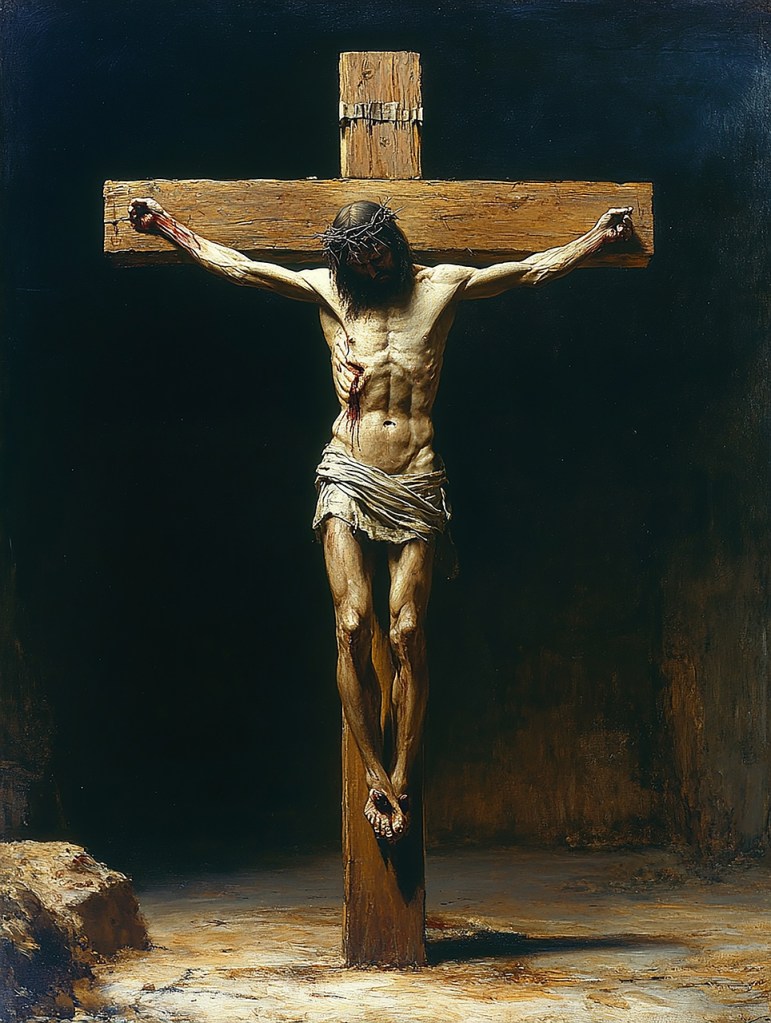
Today, the Church remembers with solemn devotion the day our Lord stormed into and invaded the enemy’s territory with great power. The invasion certainly didn’t look very commanding. In fact, it appeared dreadfully weak and pathetically insufficient. A bloodied and beaten man nailed to a cross, his head hanging low while gurgling His final words through strained breaths.
Behold, the Conqueror.
The world scoffs at such things. It looks to the cross and sees little more than a long-forgotten event that may or may not have happened. If it did happen, it certainly wasn’t anything of consequence. Consequential conquerors—genuine victors—are not captured and killed. They certainly do not submit to their captors and die willingly.
And yet, all around the world, Christians gather on Good Friday in somber reverence. They kneel in humility before their crucified King. They do so with a bizarre mixture of holy sadness and joy. The sadness comes as they acknowledge this King is innocent—that He’s paying a price He does not owe. We owe it. We’re the guilty ones. And yet, He suffers this world’s sin, bearing it fully, taking it into Himself in every way (2 Corinthians 5:21), and He does so for those who can only be counted as enemies for their crimes (Romans 5:6,10). The joy comes as they understand and embrace that He does this because He loves them. The joy emerges from a Gospel that declares He does what He’s doing without any strings attached. He does not hand the believer a bill for services and say, “Now, you owe me.” He does what He does by grace, and He bestows the merits of this world-altering effort from a heart of love.
Only the eyes of faith can see what Jesus is doing on Golgotha’s hill for what it is and receive the merits. Only the eyes of faith can behold the Lord’s divine love being poured out in a way that defeats Death at its own game. Only the eyes of faith can behold the suffering servant as the valiant destroyer of Sin and Satan—as the One turning back a world trapped in dreadfulness and ushering in the life to come. Only the eyes of faith can look upon this holiest act in all of history and desire faithfulness to the One who gave His everything for everyone.
My hope for you on this sacred day of days is that, as you have the opportunity, you’ll join your Christian family in worship. Go to the house of the Lord. Join with the multitudes of believers who know the immensity of sin’s cost and yet rejoice in the payment being made by the only One strong enough to make it—the Conqueror, Jesus Christ—the Son of God and Savior of the world.
Perhaps like me, you’re not too fond of complainers. I don’t mean people who draw attention to things that need fixing. I mean those folks who simply complain about everything, no matter what it is.
I heard it said that if humans could somehow remove their opinions from most things, we’d likely find we have little to complain about in life. I think I agree. Pitched against Lent, it makes complete sense.
For starters, Lent leads to Golgotha. No one can arrive at Golgotha’s dreadful scene and actually grasp its significance without first having a handle on why it had to happen. Jesus is doing what He’s doing because He’s the only one who can. That’s important.
Of course, this reason has other dimensions to it. Perhaps the most essential is that the Lord loves us as no one could or would, so everything Jesus does, up to and including Golgotha’s exacting, is born from this love. His passion reveals His immeasurable yearning to save us. That’s one reason the crucifixion will forever be the heart of Gospel preaching.
Closer to where I began, another dimension is sin and the fact that we’re responsible for it. We let it in, and now everything is infected. Only Jesus remains untouched; that is, until, as Saint Paul described, He became the infection in a way that will forever be mysterious to us (1 Corinthians 5:21). Simply put, He bore every ounce of sin’s dreadfulness in Himself on the cross (Isaiah 53:6, 1 Peter 2:24). Yes, He carried and endured what we could see: mocking, injustice, bludgeoning, flogging, piercing, crucifixion, and death. These things are surface products, horrible in every way. There’s still something else He carried and endured in Himself that we couldn’t see. He gives it a nod when He’s arrested in Gethsemane. He tells His betrayer, “This your hour, and the power of darkness” (Luke 22:53). He wasn’t just submitting to the physical terrors. He was submitting to something else there. And it was the awful of all awfuls. He called it a power—an all-encompassing reality. As we are so often, Judas was the power’s agent.
I know some commentators think Satan is the power Jesus is referring to. Sure, he’s a big deal. Nevertheless, Satan does what Satan does because he, too, is infected by the power. If you haven’t guessed it already, I’m saying that the power of darkness is the reigning power of sin itself. It’s the all-consuming plague that holds each of us in its sway, ultimately poisoning the whole world with eternal death and condemnation.
So, what does any of this have to do with setting aside human opinion and thereby discovering fewer reasons to complain in this life?
Well, for example, there’s plenty to complain about, especially if, in our opinion, we somehow believe we deserve better than what this sinful world so often doles out. But the thing is, Lent teaches us the power of darkness thoroughly diseases us, and we don’t deserve better (Romans 3:12). Objectively, then, the calculation becomes quite simple. We own sin’s predicament and all its potential wages, including death. If our opinions have us convinced otherwise, Lent’s destination—the crucifixion of Jesus—must be a brutal demonstration of what’s really true: Behold, there on the cross! See what the sin nature warrants! See what you deserve for your crimes!
I guess what I’m saying is simply this: What is there to bemoan when the mineral element of everything wrong with this world is technically our fault? To complain about anything troubling is to complain about ourselves.
I think this is an incredibly recalibrating thought. Having recently felt the urge to say, “I don’t deserve to be treated this way,” this Lenten recalibration pulled me back from the edge of self-righteousness. It reminded me that I was experiencing exactly what sin offers to this world. And yet, having this awareness, navigating the contentious situation was a bit easier. Indeed, contentious scenarios unfold far differently when you can readily confess to being partly responsible for all contention in general.
That leads me to something else. The sinner that I am, and living in this sinful world, I’ll always find reasons to complain about the misery. By the way, and as I began, I’m not saying we should just ignore the travesties sin imposes. These things almost certainly require our attention. What I am saying, or better yet, asking is: How are things different for me now that I know the only One who could save me stepped up and did so?
The power of sin has been overthrown. I have been rescued. Jesus did it. Knowing this, the messes I find myself in are no longer occasions for complaining. Instead, they are opportunities to understand just how terrible sin is, acknowledge what my role in the terribleness might be, and observe the Lord’s crucifixion through tears of joy. Golgotha becomes less a reminder of what I deserve and more the ultimate emblem of hope in every sadness.
Even better, this hope is empowering. It moves its bearer beyond complaining. It strengthens for getting right to work making changes in a world that needs what Christians bring to the table. For every minute I spend complaining about how bad everything is, I lose a valuable minute meant for trusting Christ and, in faith, doing what I can to make things better.


 Cruciform Stuff