
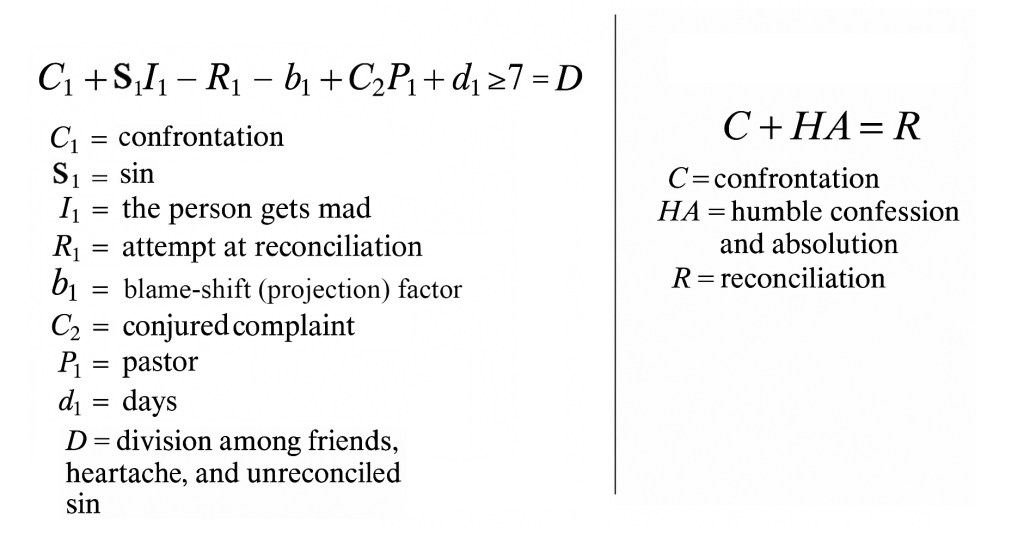
I should let you in on a little secret. It’s one that I shared with the adult Bible study group here at Our Savior last week. Essentially, it’s a formula of sorts that plays itself out in congregations fairly regularly. Here’s how it usually goes.
A troubling situation arises, and the pastor must address it—usually by speaking directly with the person at the center of the issue. He approaches the conversation with a spirit of reconciliation, aiming to restore peace. But no matter how gentle the pastor’s approach, the individual takes offense, receiving the pastor as a cruel accuser. Days pass (typically about a week, because anything sooner would be suspicious), and the pastor gets a message. This time, the grievance is reversed: the person has discovered an unrelated reason to be angry at the pastor for something he said or did. The pastor must shift his posture, now seeking to reconcile a situation in which he has somehow become the offender. But this is merely a bait and switch. The new complaint isn’t the real issue; it’s a convenient excuse. In truth, the individual needs a reason to avoid the original circumstance and leave the fellowship. What better than that the pastor did something terrible to offend him? Certainly, he can no longer stay.
That’s really all there is to the formula. It does sometimes have slight variations. But in the end, it’s typically cut and dry. The pastor confronts. The person gets mad. The person conjures a reason to be offended by the pastor, thereby having a justifiable reason to leave. Nothing more, nothing less.
Again, I shared the formula with the Bible study attendees. I don’t remember what prompted it. Whatever it was, it stirred the urge to instill awareness. Awareness is a crucial step toward navigating trouble. In this context, J.R.R. Tolkien once said, “No one likes to be told they are wrong, especially when they are.” The hidden calculus that’s often at work after the “telling” is good to know. It certainly explains some genuinely baffling behaviors.
I also shared with the group that when the formula is being employed, the pastor usually knows it. He may not let on that he does, but trust me, he does. Any pastor worth his weight has experience with projectionism. In other words, he knows when someone is attempting to transfer guilt. It’s an old trick, really—one that began all the way back at the beginning. The first examples that come to mind are Adam and Eve. Rather than confessing honestly, Adam blamed Eve. In fact, he actually blamed God. “The woman YOU put here…” (Genesis 3:12). I wonder if Eve saw the look on God’s divine face after Adam spoke, and chose instead to blame only the serpent. Either way, neither wanted to stand in the spotlight of what they’d done. Now look where we are.
Another example might be King Saul and his relationship with David. After David defeated Goliath and started growing in popularity, Saul got pretty jealous. David hadn’t done anything wrong. In fact, he did almost everything right. He was loyal, obedient, and respectful. Still, Saul grew increasingly hostile, attempting to kill David several times. But why the attitude? It was due to Saul’s own guilt stemming from his disobedience to God (1 Samuel 15). It began to fester. But instead of repenting—instead of facing his own failings—Saul found reasons to be mad at David. He projected. David became the threat, the enemy, the one worthy of his anger.
It’s the same today. When someone has caused offense, and then the one called in the stead and by the command of Christ to sort it out steps in to restore peace, an all-too-common reflex is to find a way to displace the guilt rather than be absolved of it. The formula is designed to affix the guilt to the one who had the audacity to bring the sin to light in the first place. In the Church, that’s usually the pastor.
But in reality, the goal of the confrontation wasn’t cruelty or punishment. It was reconciliation. It was peace. That gets lost when the simpler equation changes from honest reflection that knows God’s mercy to a protectionist formula that cannot fathom oneself as a genuine offender. Still, that’s often what happens. The pastor’s effort to steer the offender toward something better becomes a weapon to justify division. In truth, it really just becomes a way to simmer in unreconciled sin, eventually seeing its effects spread. In other words, it becomes a seemingly valid reason to church-shop, and while doing so, to spread the venom to anyone back home asking where you’ve been. It’s also a reason to inform each of the new church’s pastors (likely asking where you’re from and why you’re visiting) just how uncaring the pastor is at your former church.
Just be careful with this. Or perhaps better, keep the following four things in mind.
First, experienced pastors know there are two sides to every story. Second, experienced pastors likely know the formula because they’ve been in your former pastor’s shoes more times than they can count. Third, an experienced pastor will hear you bemoan your former pastor’s faults and know well enough to watch his back around you. Fourth, back home, the truth remains. And no matter where the disgruntled church member goes, the behavior and wounds remain. The former congregation may not know why the person left. They may only hear that the pastor hurt someone’s feelings or said something offensive. But the pastor knows. He remembers the original offense, the confrontation, the moment the formula began to unfold. And while he may never speak of it publicly, it becomes another scar on his heart—one more story in the quiet suffering of a shepherd who tried to do what was right.
As my incredibly wise wife, Jennifer, so famously said, having suffered helplessly through these situations on more than one occasion just because she’s married to me, “Friends are friends until they aren’t.” It’s a simple truth that carries incredible weight. It knows of friendships so easily thrown away for ridiculously trivial reasons. It knows the tragedy of those who tried to help and yet were left behind.
I realize this is some heavy stuff. Still, it’s essential to know. And besides, no one ever accused me of avoiding the harder things. I do what I can to express what some won’t. That said, there’s more to know beyond the dreadful formula’s variables. And so, allow me to blast you with a super-dose of hopefulness lifted from God’s Word.
What I’ve described happens beyond the Church’s immediate walls. It’s likely something familiar to you. I’m definitely seeing it happen more and more among families. With that, remember even in this—especially in this—the Lord does not abandon His faithful people (Deuteronomy 31:6; Hebrews 13:5). He knows their hearts (1 Samuel 16:7; Jeremiah 17:10). He sees what is hidden (Hebrews 4:13; Psalm 139:1-4). He attends to their wounds with gentleness, binding them with His own mercy (Psalm 147:3; Isaiah 42:3; Lamentations 3:22-23). He reminds the weary Christian that faithfulness is never fruitless, even when it feels unseen or dismissed (1 Corinthians 15:58; Galatians 6:9; Matthew 6:4). He brings peace in turbulence (John 14:27; Isaiah 26:3), clarity during confusion (1 Corinthians 14:33; James 1:5), and strength when the burden presses hardest (Isaiah 40:29–31; 2 Corinthians 12:9–10).
Most importantly, for pastors and parishioners alike, God reminds us that the Church is not ours to orchestrate (Matthew 16:18; Acts 20:28). It belongs to Him, and not even the most cunning formulas can undo the work He is doing through those He has called (Romans 8:28–30; Philippians 1:6; Matthew 16:18). “My grace is sufficient for you,” He says, “for My power is made perfect in weakness” (2 Corinthians 12:9). And so, the faithful press on—scarred, yes, but never without hope (Romans 5:3–5; Lamentations 3:21–24), never without the peace which surpasses all understanding (Philippians 4:7).
 Cruciform Stuff