

Shunning

I want to begin this first Sunday in the new year by telling you a story that, on its surface, might seem somewhat trivial. It’s the tale of an awkward social exchange. I only share it because, first, it’s a new year, and second, after spending a month or so simmering with it, I realize that what happened reveals something far more serious about the spirit of our age than I first imagined—and the realization is ripe for New Year’s resolutions.

About a month and a half ago, Jennifer and I attended a small local event together. As we walked into the room, I noticed two former members of Our Savior already seated a few rows from where we’d entered. For clarity, they’re not “former” because of a personal conflict with another member in the church, or because I offended them by skipping over them at the communion rail by mistake. They left because they were offended by the kind of message you’re reading right now—the same kind I’ve been writing and sharing every Sunday since 2014. Within each, my cultural and theological conservatism, along with the moral convictions it produces, is laid bare without apology. Some people appreciate the messages. Some don’t.

As I said already, it was a small event. Therefore, the space was relatively empty, leaving no ambiguity about what followed. We saw one another clearly. I waved, smiled, and said hello. They turned away. Attempting ordinary human decency, I called out a brief question, nothing cumbersome, just the sort of small talk people use to acknowledge one another’s presence. One did respond with a relatively disinterested gesture, but he did so without looking at me. That was all. No eye contact. No further acknowledgment of my presence as a fellow human being.

The very next week, the same scenario repeated itself, almost theatrically so. This time, I was alone. I entered the room through the same door. The same couple came in immediately behind me. I greeted them again. This time, there wasn’t even an awkward acknowledgment. They simply ignored me. Moments later, as a handful of couples filed in and found seats beside them, I watched and listened as they warmly greeted others—smiling and calling out hellos to people by name—leaving me to feel the sting of their dismissal and the sense that, for them, I did not even exist.

Now, before we rush to psychologize motives or nurse grievances, let me at least explain that what follows is not about wounded pride. I already know I’m despised by plenty. It goes with the pastoral territory. And unfortunately, I’m used to it. That means I can do what I do without coming undone when someone fails to be polite. Funny thing—Jennifer and I just went out to lunch together last week and we talked a little about the flak I catch for things I write and share publicly. She is perpetually amazed that I continue to subject myself to the inevitable scorn. From my perspective, as a Christian, I am called to endure far worse than social coldness. I mean, what I experience is nothing like what’s happening to Christians in Nigeria on a daily basis. Countless are being killed for their confession of Christ. And so, it’s easy enough for me to write and share a personal observation or cultural critique—and maybe why they matter, especially among Christians.

This morning, I’m examining something I’m pretty sure most folks have experienced. Essentially, it was the cold and corrosive behavior of shunning.

I suppose, in a clinical sense, shunning means treating someone as if they are unworthy of basic acknowledgment, not necessarily because they have done harm, but because they believe differently from you. It’s a way of saying, “You’re beyond the borders of my tribe, and therefore, are not owed my kindness.”

I dare say that, in our current cultural moment, shunning has become a favored tool for pretty much everyone. I catch myself doing it on occasion, too. For the most part, I think many do it to avoid confrontation. I get why that might happen. And maybe that was true in this case. Although my kindly greetings on both occasions should have implied friendliness rather than contention, which suggests another way people wield it. They shun, not to avoid confrontation, not to correct wrongdoing or pursue truth, but to punish dissent and signal some sort of superiority in the relationship. And, of course, it conveniently shields them from the burden of actual engagement, which could lead to reconciliation and peace. If you have no interest in these, then shunning is essential.

Knowing these things, here’s where genuine Christian analysis should probably step in.

I’d say the first step in the analysis is to deal with our excuses. In other words, I know there will be some who immediately jump to texts like Ephesians 5:11-14. Saint Paul tells the Church not to “participate in the unfruitful works of darkness,” but instead to “expose them” (Ephesians 5:11-14). Perhaps assuming the reader already knows that Jesus called His people “light” in this dark world (Matthew 5:14), Paul goes on to say that darkness is exposed by light (v. 13). With this in our theological pockets, Paul’s point is not complicated. He doesn’t want God’s people associating (συγκοινωνεῖτε—binding to something) with sin in ways that condone or accommodate it. In other words, a Christian would not want to attend a gay relative’s wedding lest they be considered supportive of such things.

Now, for those who remain desperate to write off someone with whom they disagree, try to notice what Paul did not say. He did not say to act as though anyone with whom a Christian disagrees does not exist. He did not say to write that relative out of your life completely. Instead, he told the Christians to do what light does. It shines in the darkness. Darkness cannot be overcome by a light that withdraws to another room. If light is going to disperse darkness, it must be present to do what light does.

And so, I suppose the second step in the analysis is to admit the extremes of this truth, which is that God’s Word is unambiguous about how we are to treat those who despise or oppose us. Jesus commands us to love our enemies, bless those who curse us, and pray for those who persecute us (Matthew 5:44). Saint Paul exhorts believers to live peaceably with all, so far as it depends on you (Romans 12:18). Even when church discipline is required—which is a rare and serious matter—it’s never enacted through petty contempt or silent scorn. It’s done openly, soberly, and with the goal of reconciliation and restoration (Matthew 18:15-17, Galatians 6:1, and 2 Thessalonians 3:14-15).

What I encountered was none of that. What I encountered was a posture that says, “Your very presence is a problem for me, and as such, your worth is negotiable.” That posture does not come from Christ. It stirs in sin’s darkness. Tragically, many Christians absorb this posture without realizing how thoroughly it contradicts the faith they profess.

I guess what I’m saying is that the Church and her Christians should know better. The Christian faith does not permit us to reduce people in this way. Certainly, at a minimum, it absolutely does not excuse discourtesy, let alone allow it to be demonstrated publicly so that it teaches the watching world something about Christianity. And what’s being taught exactly? That Christians believe some people are not worth basic human kindness.

But Christians do not believe that. The ones who do should check themselves carefully.

As usual, I’ve made New Year’s resolutions. I know some folks dog the idea. Well, whatever. I prefer to be more contemplative and deliberate with my life. Having just passed through 2026’s front door a few days ago, I find myself returning to moments like these, not with bitterness, but with resolve. Observing these things through the lens of the Gospel, as I prefer to do, they nudge me toward a more focused faithfulness. If the culture is growing colder, then I want to grow warmer. If silence is being used to wound, then I want my words and gestures to heal. Again, darkness is scattered by light, and Christians are children of that light (1 Thessalonians 5:5 and Ephesians 5:8).

Relative to the moments I shared with you, what does all of this mean specifically? Well, it means I am resolved to offer a friendly wave toward someone who’d much rather back over me with his or her car. I will continue to smile. I will continue to say hello. Not because it is easy. Not even because the kindness will be returned. But because Christians are not called to mirror the culture’s contempt. We are called to resist it. And sometimes, that resistance looks as small as refusing to pretend another human being doesn’t exist.

Now, for those who may be looking at me right now in their rearview mirror while revving their engines, know that even as my enemy, you mean something to me. And if there’s a chance we could be friends, I’m game to make it possible. Again, that’s one of my resolutions for the new year. I promise I’m going to be more deliberate in the effort.
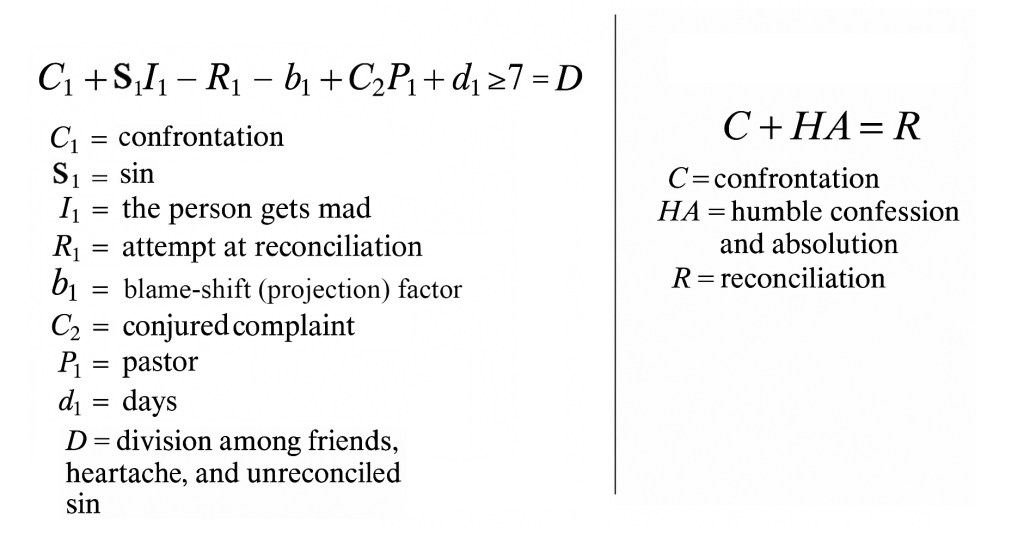

The Formula

I should let you in on a little secret. It’s one that I shared with the adult Bible study group here at Our Savior last week. Essentially, it’s a formula of sorts that plays itself out in congregations fairly regularly. Here’s how it usually goes.

A troubling situation arises, and the pastor must address it—usually by speaking directly with the person at the center of the issue. He approaches the conversation with a spirit of reconciliation, aiming to restore peace. But no matter how gentle the pastor’s approach, the individual takes offense, receiving the pastor as a cruel accuser. Days pass (typically about a week, because anything sooner would be suspicious), and the pastor gets a message. This time, the grievance is reversed: the person has discovered an unrelated reason to be angry at the pastor for something he said or did. The pastor must shift his posture, now seeking to reconcile a situation in which he has somehow become the offender. But this is merely a bait and switch. The new complaint isn’t the real issue; it’s a convenient excuse. In truth, the individual needs a reason to avoid the original circumstance and leave the fellowship. What better than that the pastor did something terrible to offend him? Certainly, he can no longer stay.

That’s really all there is to the formula. It does sometimes have slight variations. But in the end, it’s typically cut and dry. The pastor confronts. The person gets mad. The person conjures a reason to be offended by the pastor, thereby having a justifiable reason to leave. Nothing more, nothing less.

Again, I shared the formula with the Bible study attendees. I don’t remember what prompted it. Whatever it was, it stirred the urge to instill awareness. Awareness is a crucial step toward navigating trouble. In this context, J.R.R. Tolkien once said, “No one likes to be told they are wrong, especially when they are.” The hidden calculus that’s often at work after the “telling” is good to know. It certainly explains some genuinely baffling behaviors.

I also shared with the group that when the formula is being employed, the pastor usually knows it. He may not let on that he does, but trust me, he does. Any pastor worth his weight has experience with projectionism. In other words, he knows when someone is attempting to transfer guilt. It’s an old trick, really—one that began all the way back at the beginning. The first examples that come to mind are Adam and Eve. Rather than confessing honestly, Adam blamed Eve. In fact, he actually blamed God. “The woman YOU put here…” (Genesis 3:12). I wonder if Eve saw the look on God’s divine face after Adam spoke, and chose instead to blame only the serpent. Either way, neither wanted to stand in the spotlight of what they’d done. Now look where we are.

Another example might be King Saul and his relationship with David. After David defeated Goliath and started growing in popularity, Saul got pretty jealous. David hadn’t done anything wrong. In fact, he did almost everything right. He was loyal, obedient, and respectful. Still, Saul grew increasingly hostile, attempting to kill David several times. But why the attitude? It was due to Saul’s own guilt stemming from his disobedience to God (1 Samuel 15). It began to fester. But instead of repenting—instead of facing his own failings—Saul found reasons to be mad at David. He projected. David became the threat, the enemy, the one worthy of his anger.

It’s the same today. When someone has caused offense, and then the one called in the stead and by the command of Christ to sort it out steps in to restore peace, an all-too-common reflex is to find a way to displace the guilt rather than be absolved of it. The formula is designed to affix the guilt to the one who had the audacity to bring the sin to light in the first place. In the Church, that’s usually the pastor.

But in reality, the goal of the confrontation wasn’t cruelty or punishment. It was reconciliation. It was peace. That gets lost when the simpler equation changes from honest reflection that knows God’s mercy to a protectionist formula that cannot fathom oneself as a genuine offender. Still, that’s often what happens. The pastor’s effort to steer the offender toward something better becomes a weapon to justify division. In truth, it really just becomes a way to simmer in unreconciled sin, eventually seeing its effects spread. In other words, it becomes a seemingly valid reason to church-shop, and while doing so, to spread the venom to anyone back home asking where you’ve been. It’s also a reason to inform each of the new church’s pastors (likely asking where you’re from and why you’re visiting) just how uncaring the pastor is at your former church.

Just be careful with this. Or perhaps better, keep the following four things in mind.

First, experienced pastors know there are two sides to every story. Second, experienced pastors likely know the formula because they’ve been in your former pastor’s shoes more times than they can count. Third, an experienced pastor will hear you bemoan your former pastor’s faults and know well enough to watch his back around you. Fourth, back home, the truth remains. And no matter where the disgruntled church member goes, the behavior and wounds remain. The former congregation may not know why the person left. They may only hear that the pastor hurt someone’s feelings or said something offensive. But the pastor knows. He remembers the original offense, the confrontation, the moment the formula began to unfold. And while he may never speak of it publicly, it becomes another scar on his heart—one more story in the quiet suffering of a shepherd who tried to do what was right.

As my incredibly wise wife, Jennifer, so famously said, having suffered helplessly through these situations on more than one occasion just because she’s married to me, “Friends are friends until they aren’t.” It’s a simple truth that carries incredible weight. It knows of friendships so easily thrown away for ridiculously trivial reasons. It knows the tragedy of those who tried to help and yet were left behind.

I realize this is some heavy stuff. Still, it’s essential to know. And besides, no one ever accused me of avoiding the harder things. I do what I can to express what some won’t. That said, there’s more to know beyond the dreadful formula’s variables. And so, allow me to blast you with a super-dose of hopefulness lifted from God’s Word.

What I’ve described happens beyond the Church’s immediate walls. It’s likely something familiar to you. I’m definitely seeing it happen more and more among families. With that, remember even in this—especially in this—the Lord does not abandon His faithful people (Deuteronomy 31:6; Hebrews 13:5). He knows their hearts (1 Samuel 16:7; Jeremiah 17:10). He sees what is hidden (Hebrews 4:13; Psalm 139:1-4). He attends to their wounds with gentleness, binding them with His own mercy (Psalm 147:3; Isaiah 42:3; Lamentations 3:22-23). He reminds the weary Christian that faithfulness is never fruitless, even when it feels unseen or dismissed (1 Corinthians 15:58; Galatians 6:9; Matthew 6:4). He brings peace in turbulence (John 14:27; Isaiah 26:3), clarity during confusion (1 Corinthians 14:33; James 1:5), and strength when the burden presses hardest (Isaiah 40:29–31; 2 Corinthians 12:9–10).

Most importantly, for pastors and parishioners alike, God reminds us that the Church is not ours to orchestrate (Matthew 16:18; Acts 20:28). It belongs to Him, and not even the most cunning formulas can undo the work He is doing through those He has called (Romans 8:28–30; Philippians 1:6; Matthew 16:18). “My grace is sufficient for you,” He says, “for My power is made perfect in weakness” (2 Corinthians 12:9). And so, the faithful press on—scarred, yes, but never without hope (Romans 5:3–5; Lamentations 3:21–24), never without the peace which surpasses all understanding (Philippians 4:7).

He Knows and Remembers My Name

Make no mistake. I’m a man of many flaws and inabilities. I know this. Truly, there are things I do regularly that I wish I didn’t, and there are things I wish I could do more or better. This is one reason why I appreciate New Year’s resolutions. Every year, I want to do better.

Looking back to the season before Easter for a quick second, Lent’s tendency toward self-examination provided an annual platform for measuring this reality, too, but for far better reasons than a transitioning calendar might stoke. For starters, Lent feeds into us the substance of Ash Wednesday’s appointed Epistle Reading. It’s been a few weeks since we heard it. Still, with apostolic eloquence, Saint Peter encourages his readers to “make every effort to supplement your faith with virtue, and virtue with knowledge, and knowledge with self-control, and self-control with steadfastness, and steadfastness with godliness….” (2 Peter 1:5-6). In other words, actively pursue becoming a good tree that produces good fruit (Matthew 12:33). Peter goes on to suggest that if these qualities increase, an awareness occurs that can see Christ and the surrounding world in the proper perspective (vv. 8-10).

Saint Paul is no slouch here, either. He gives abundant encouragement to fight the flesh for the sake of faithfulness. In Galatians 5:16-17, he describes the ongoing battle between the flesh and the Spirit in the believer’s life. In Romans 8:13, he urges believers to resist their sinful nature through the power of the Holy Spirit. In 1 Corinthians 9:27 and Colossians 3:5, he comes right out in full force, highlighting self-discipline and mandating that Christians actively “put to death” sinful tendencies.

I’m guessing that any sincere Christian wants the perspective Peter described. I sure do. Also, like Paul, I want to put my sinful tendencies in a grave. To do this, an honest examination is required. When one does so, it’s pretty incredible what can turn up. Captured by Lent’s annual gaze, I always find something to fix. For example, here’s something I learned. It’s maybe not that big of a deal. Still, it has the potential to negatively impact my personal relationships.

To be candid, I struggle to remember names. I always have. I can recall conversations almost word-for-word. I can recite entire speeches. I can quote from various poets. I can remember historical events and their significant contextual details that led to other events. I can remember dates and statistics. I can tell you what I learned from a book, documentary, or presentation. In other words, for the most part, I can retain content. Conversely, however, it might take me a minute or two to remember the author of a quotation. Sometimes, I can’t recall a movie character’s name, even after watching the film multiple times. This has long been a frustration of mine. Honestly, it really had me on edge before my doctoral defense last year. To defend a thesis, you not only need to know the content, but you need to have a ready grasp of your field’s primary authors and researchers. I was more than ready with this information during my defense. Still, I promised myself I’d look into it and try to fix this personal deficiency. It certainly can be an exasperating kink in my life.

Lent provided a focused time for this type of relational betterment.

It turns out there is a cognitive phenomenon for this very frustration known as “anomic aphasia” (or “nominal aphasia”). While it typically refers to difficulty recalling specific words in general, for some people, it’s more acutely relative to names. When this is true, it’s sometimes called “proper name anomia” or “nominal dysphasia.” Essentially, it is as I described. A person can remember events, conversations, and details about a situation, but struggles to recall the names of the people involved. Physiologically, this is because names are stored and retrieved differently in the brain than contextual details. Strangely, the brain files and processes proper names more arbitrarily, making them harder to recall. On the other hand, because the various stories and content of life come together to form our existence’s fuller narrative, the content is more closely associated with meaning and is, therefore, filed in a way that’s more readily available.

Perhaps a simplified example would be if a person asks a friend for directions, that friend is going to tell the person which roads to take. He isn’t going to tell him the name of the person who built the road. It’s likely the name of the person isn’t essential for getting from point A to point B.

I don’t want to bore you with this stuff. Instead, I want to return to something I wrote before: “Any sincere Christian wants the perspective Peter described.” This means observing frailty through the Gospel lens. From there, I’m not only trying to push back against and correct my shortcomings, but I want to see Jesus throughout the process.

In this instance, there’s already a glorious contrast becoming visible.

In a broad sense, while I’m plagued by frailties, God has none. In a narrow sense, I can rest assured that God never forgets my name. He never struggles to recall who I am. And by no means is the narrative of my life—the crumbling roads I constructed from my deeds—of most importance to Him. The Gospel is the narrative that matters to God. That’s the story of most importance. Through faith in Christ, the Lord’s narrative becomes my life’s narrative.

Interestingly, Isaiah 43:1 reads, “Fear not, for I have redeemed you; I have called you by name, you are mine.” A little further along, Isaiah 49:16 tells us, “Behold, I have engraved you on the palms of my hands.” One of the ways I can start overcoming my forgetfulness with names is to start writing them down soon after learning them. God claims us by name. To remember us, He engraves us in His hand. Engraving is a far different form of recollection than simple writing. It cuts into the material. Engraving a hand would be painfully unforgettable. And yet, for anyone with Peter’s perspective—a view attuned to Christ—a verse like Isaiah 49:16 is awfully reminiscent of the Lord’s crucifixion. He knew our names, even as He was carved up and pierced on the cross.

One more thought comes to mind.

Just as remarkable as what God remembers relative to my name is what He forgets. Hebrews 8:12 assures me, “For I will be merciful toward their iniquities, and I will remember their sins no more.” God, who is omniscient, forgets His believers’ dreadfulness. He does not recall what can potentially condemn us; instead, His perfect perspective is that of the Gospel. He sees us through the righteousness of His Son, and the result is that our sins are accounted as far as the East is from the West (Psalm 103:12). This is the stunning reality of God’s grace. When we are forgiven, our sins are not filed away in some dark corner of God’s mind, waiting to be dredged up again. They are gone. Forgotten. Forever erased.

I suppose, in the end, human memory may be frail and selective. I may forget names. I may struggle to recall details I wish I could summon instantly. But the God of all creation does not forget His own, and in His mercy, He refuses to remember the sins that once defined us. In that, I find both comfort and the courage to keep striving toward the perspective Peter described—to see Christ and the world rightly, trusting in the One who calls me by name and clothes me in His righteousness.

A Little Bit About Grace

Grace is an amazing thing, especially when you are fully aware you need it and yet, in every way, are undeserving of it. If you don’t know what I mean, then the only thing I can think to say is that you’re a textbook narcissist who’ll never know grace’s fuller impact because you sense no need for it. That’s unfortunate. Most normal people know the downcast feeling of causing harm. Most folks likely even sense the need to admit it. When they’re all alone with their thoughts, they experience the familiar urge to ask themselves, “Why did I do that? What on earth was I thinking?”

It’s also likely that most normal people know the overwhelming exhilaration that comes from expecting retribution but receiving grace instead. I’ve certainly had my share of moments when, whether in a flurry of imposed frustration or I was just being me, I acted in ways I later regretted. I said something I wish I hadn’t. I did something I wish I hadn’t. I remember once saying something to one of my children that I felt so bad about later that I nearly couldn’t sleep for a week. I felt so terrible afterward. Still, on the very same day of my crime, there was no lack of love bestowed upon me by the one I hurt. I was treated graciously, even hugged, long before a lowly father’s sad heart materialized with a verbal apology.

Yes, grace—undeserved kindness—is an amazing thing. When you experience it, you’re different afterward.

I read somewhere that grace is proof that a person means more to you than what he or she did to you. I suppose that’s another way of saying you love them no matter what. Mark Twain wrote something somewhere about how forgiveness is the fragrance a flower leaves on the boot that crushed it. If I had the power to recraft Twain’s words, I’d swap “forgiveness” with “grace.” Grace and forgiveness are two very different things. Grace—undeserved kindness—can be extended to both the penitent and the impenitent. Forgiveness is the actual removal of sin from the sinner (Psalm 103:12). God won the whole world’s forgiveness through the person and work of Jesus. It’s there and available. Penitent faith receives it. A person who is not penitent sees no need for forgiveness. In that sense, it remains apart from him. In the meantime, grace more than sets and maintains the stage for it. When we show grace, we’re showing patient love. We’re making it so that when penitence emerges, we’re ready to bestow the kind of forgiveness that knows the full removal of guilt and the beginning of a brand new day.

Lots of folks disagree with me on this point. They point to texts like Matthew 6:15, Ephesians 4:32, and so many others. I would argue they’re missing the penitent undertow of the texts. In other words, these texts understand we ought never to withhold forgiveness from anyone desiring it. If they request forgiveness, we give it, no matter if we think the penitence is real or fake.

There’s an element of this in Jesus’ answer to Peter’s question about how many times he was required to forgive a penitent brother. “Lord,” he asked, “how often will my brother sin against me, and I forgive him? As many as seven times?” Jesus essentially responds by saying people who ask for it get from us as much as they want. “I do not say to you seven times, but seventy-seven times” (Matthew 18:21-22). That’s hyperbole. It means we never stop doling it out.

In Luke’s version of the same narrative, Jesus turns the challenge back upon the forgiver. He says, “Pay attention to yourselves! If your brother sins, rebuke him, and if he repents, forgive him, and if he sins against you seven times in the day, and turns to you seven times, saying, ‘I repent,’ you must forgive him” (Luke 17:3-4). The point here is that we should determine our own motives in the exchange. We’re not in the business of reading a person’s heart. We’re not the ones to determine if the person genuinely desires reconciliation. We’re also not in the business of making it hard for someone to be forgiven. No matter how mad at them we may be, or how much we want to get them back for their crimes, or what we think their motives might be, we get out of forgiveness’ way. We stand infinitely ready to forgive, no matter how many times they reach out to us for it.

That said, can forgiveness be given to someone who sees no need for it or, worse, rejects it outright? Knowing that human-to-human forgiveness is to be an imitation of God’s forgiveness, is that how it works between us and God (Colossians 3:13, Matthew 6:14-15)? The text from Luke 17:3-4 assumes no. John 20:23 assumes no, too, saying, “If you forgive the sins of any, they are forgiven them; if you withhold forgiveness from any, it is withheld.” The doctrine of excommunication taught in Matthew 18:15-18 and Titus 3:10-11 assumes the same. So does 1 John 1:8-9.

“But what about the Lord’s words from the cross?”

Even the Lord’s words to His Father from the cross to “forgive them for they know not what they do” (Luke 23:34) is not an insistent decree that those who were murdering Him in absolute unbelief should somehow be granted the privilege of skirting unbelief’s result. For starters, the word here for forgive is ἄφες, and it’s equally translatable in this context as “dismiss” or “disregard.” In fact, a language scholar and commentator I trust, R.C.H. Lenski, wrote concerning this verse:

 “‘Forgive’ is not expressive enough: ‘remit,’ ‘dismiss,’ ‘send away’ render the true sense. The object is not stated but is plain from the added clause: dismiss ‘what they are doing.’”

Essentially, Christ is asking His Father to be what He already knows He is: gracious. He is asking Him to put aside His wrath at this moment, knowing full well that if there was ever a time for wrath, it was now. Still, the Lord tearfully pleads for the Father to look away, to dismiss what they’re doing, to let this one go by unpunished.

By the way, grammatically, the pronoun “them” refers to the Roman soldiers performing the crucifixion. They’re its antecedent, not the Pharisees and crowd demanding the Lord’s torture and death. That’s no small detail.

In the end, this is not complicated. Christ did not upend what we know of forgiveness. He simply continued doing what He always did during His earthly ministry. He was gracious, continuously showing concern for others before the self. On the cross, He unwaveringly emitted this others-focused grace perfectly, wanting the Father to look away, perhaps even giving His fiercest enemies time to come to their senses. Again, why? Because the Lord knows better than all of us the truest nature of Sin. He knows that humanity is influenced and held captive by something we cannot fully grasp. Indeed, far too often, we do not know what we do.

I think some of my theological critics—the ones who will say I’m mistaken in this regard—believe as they do more so because pop psychology’s understanding of forgiveness has been so ingrained in our post-modern psyche. For many therapists, forgiveness is more about personal healing and the ability to move on with a normal life. For example, forgiveness has come to mean that to get beyond a traumatic marriage, a woman must learn to forgive her abusive husband. I read a story last spring about a mother who confronted her son’s smirking murderer in court, saying, “I forgive you for what you’ve done.” The killer was by no means sorry. In fact, he was glad he did it. Can he lay claim to the forgiveness she offered? No.

But her grace can be imposed on him, whether he wants it or not.

The mother can pray for her son’s killer, asking the Heavenly Father to grant him what’s necessary to come to his senses and repent. She can write Gospel-rich letters to him in prison, knowing that the Gospel is “the power of God unto salvation” (Romans 1:16). She can visit him in prison, too, and share that Gospel face-to-face. She can show him that, as a human being, he means more to her than what he did to her son. That’s grace, and it smears a perpetrator’s filthy bootheel with the kind of scent that can lead a person to the One who, ultimately, bestows the only kind of compassion capable of instilling repentance and faith (Matthew 5:13-16, 43-45; John 13:35).

I’m sure you have situations in your life to which this little rambling might be applied. We all do. The Lord knows we’re neck-deep in a political season that’s going to require a lot of grace between so many. Of course, to those who wrong you, don’t be a pushover. Make sure they know what they’ve done. Beyond that, be gracious, and then step back and see what happens. You may be surprised. There may come a time when you hear them say with sincerity, “I’m sorry.” And because you were still immersed in grace’s patience, what a joy it will be to say, “I forgive you.”

Truth Does Not Fear Scrutiny

The piece I wrote a few weeks ago about the Olympic boxers, unlike most others I’ve written, had me feeling less like I’d shared my thoughts concerning a troubling situation and more like I’d turned over the detritus of our culture’s forest floor. You know what happens when you kick over a rotten log, right? The creatures living in its decay suddenly scatter. Some scurry to find other dank places to dwell, aware that they’ve been discovered. However, the more territorial residents attack their rot’s disturber. That also happened in this instance.

The initial disturbance brought a steady stream of hate-filled termites with caps-locked keyboards and the foulest vernacular. I spent a good part of the week that followed blocking content and profiles from hundreds of “tolerant” intolerants. So much for my typical “post and ghost” policy. Although, I suppose it’s good that I hadn’t yet turned off notifications for the post. I was able to run a measure of defense.

For the most part, they swarmed me through private messaging. They chirped and trilled and clicked their usual angry sounds, calling me ignorant, bigoted, and so many other names adorned with vile adjectives. Thankfully, their stingers were words and nothing more.

I experienced only one venomous spray that seemed to invite conversation, even as I knew how that conversation might go if I engaged. So, I didn’t. All the others were colorfully uninviting. Few were spelled correctly. Seriously, if you’re going to speak viciously, the least you can do is run your savagery through Grammarly. It would appear far too many believe the word “bigot” has more than one “g.”

The grammatical ignorance was enough for me to turn off overall messaging access. After deleting a number of equally vicious remarks, I also changed the comment access for the post.

There was one private message that interested me, but only because it seemed to capture the hive logic used by so many of the others. Concerned by a relatively inconsequential detail the person thought was inaccurate, the message read something like, “If you can’t even get this one thing right, then you don’t deserve to call yourself a reverend.”

Two things about this.

First, imagine if one mistake—real or supposed—was enough to strip any of us of our livelihoods or identity completely. Of course, some mistakes, even simple ones, can have life-altering consequences. Something as simple as forgetting to use your turn signal can result in someone’s death. But the reality is that most often, our typical mistakes don’t produce those results. They’re merely incidentals along life’s imperfect way, all serving as reminders of a deeper need, a deeper incapacity in Sin. That said, there’s a reason that forgetting to put the milk carton back into the refrigerator isn’t a punishable crime. In the scheme of things, it’s not important.

But imagine if it was a punishable offense. Imagine if such a simple slip was enough to condemn you. I had a professor in my doctoral program who accidentally parsed a Greek verb incorrectly in the comments on one of my papers. Being attuned to language, especially in what has become an overly-emojied society, I remember such errors, and so I remember the mistake vividly. However, did the error prove his credentials empty? By it, did he forfeit all rights to the title “professor”? The cancel-culture insects perpetuating society’s rot would say yes.

Second, they’d say yes because forgiveness is not a part of their world. Whatever falls to the dark forest floor is eaten. But forgiveness drops light into the darkness. Indeed, its light offends the dark spaces ruled by death and decay. Still, forgiveness—the Gospel’s divine lifeblood—is meant for and goes into these spaces. It goes there understanding everyone’s dreadful imperfections while announcing promises that draw all toward the sunshine of God’s grace—a grace that gives mistake-makers what they do not deserve. Mercilessness and condemnation comprise the Gospel’s anti-nature. It is the sum and substance, the body and soul, of cancel culture. One mistake, one misstep apart from rot’s narrative, brings irrevocable imprisonment.

If this describes you, then I dare to offer two more diagnoses.

First, likely, you are so ideologically captured that you’ve become incapable of receiving information and navigating disagreements in ways beneficial to societal stability. I’m convinced one of the inevitable demonstrations of ideological imprisonment is when one is entirely oblivious to self-contradiction. An ideologically captured person willfully embraces two incompatible or inconsistent premises simultaneously and yet cannot see their incompatibility. What does that look like in real time? Well, one example might be the group “Queers for Palestine.” Homosexuality is illegal in Palestine, and I’m guessing these folks missed the news story about the 25-year-old gay Palestinian man whose decapitated torso was found in the West Bank city of Hebron. Another example might be the folks praising Kamala Harris for potentially being the first female president while also pummeling anyone who dares define what a woman is. They inevitably target with vitriol someone like me who boils the definition down to its mineral elements—the science of XY and XX chromosomes. These same people do this while demanding that folks “trust the science.” How can this be? Because when someone is ideologically captured, the only consistency that matters is one’s subscription to the narrative. Everything else, even facts, becomes pliable, and if not pliable, then irrelevant or labeled as misinformation.

Second, cancel-culture tactics prohibit the exchange of ideas, resulting in societal rot. Cancel-culture’s goal is to ostracize, boycott, and crush others into silence because of their opposing viewpoints. By default, this hinders open discussion and the free exchange of ideas. Why? Because humans are survivalists. When onlookers see a person viciously canceled for expressing his or her views, no matter how controversial or disagreeable they may be, others become fearful of speaking freely. Such an environment produces rot, which is the gradual decline or decay of essential values and mechanisms that bind a thriving society together. In a cancel culture, society suffers and inevitably comes undone because it loses the ability to challenge ideas or events that require refining or preservation.

If you are inclined to cancel others, then I encourage you to reconsider your heading. For as virtuous as you might believe yourself to be, to work this way is to be a part of the problem, not the solution. Are your ideas better? Put them into the arena for testing. We’ll see. However, if there’s one thing I know, it’s that natural law—God’s beautifully designed framework for life in this world—will always be the final determiner, even if society makes an epic mistake. Natural law will forever trounce a man who jumps from a three-story building because he’s ideologically convinced he’s a bird. Natural law promises him a painful landing. Natural law will forever complicate the biology of a person undergoing hormone therapy because he believes he was born in the wrong body. No matter how many surgeries he might have, his chromosomes and everything they’re in place to determine will never be or do anything other than what their design requires. Natural law will do what it’s constructed to do, and we’ll always be kept within its boundaries, even when we believe otherwise.

To conclude, I’ll simply say this—and maybe consider it a basic rule of thumb. If you find yourself resorting to insults, threats, or unhinged attempts to go after and silence others entirely, you might pause to consider whether your position is as strong as you think it is. Another thing to keep in mind: Truth doesn’t fear scrutiny; it thrives on it. And in the end, it will win. In one sense, that’s why Christians will always have the upper hand in life. We already know we’re mistake-makers, and yet, we’re attached to the One who is the way, the truth, and the life. The entirety of this spectacular trifecta comes together in the Gospel. Christians live in the sphere of forgiveness. Jesus lives there, too. He is the “way” of forgiveness. He is forgiveness’s epicentral “truth.” He is forgiveness’s best result—eternal “life”!

By faith, we know these things, and we’re more than familiar with the wonderful byproducts of this grace. The blessings of humble repentance stirred by an overabundance of forgiveness given by God are not lost on us. We’re glad for the newfound ability to amend our lives and share that same forgiveness with others. Ultimately, these are spirit-freeing mechanisms for courage and confidence. They lift believers above rot’s capture to the grace-drenched treetops, where we can see the world as it truly is and be quite comfortable describing what we see.

The Symphony of Family

Every family is a symphony. Every member is a skilled musician with a unique instrument in hand. Every moment is a song, and every word is a note carrying its melody. Early last week, the Thoma family’s ensemble just grew by one performer. Preston Michael took his seat among us, and as you might imagine, for this grandpa, his promise is most rapturous.

I got to meet him the day after he was born. His dad—my son, Joshua—introduced us. I didn’t get to greet Preston properly, though. He’s currently in the NICU, and he’ll likely be there for a few more days. Nevertheless, at the time, his wriggling fingers, crinkly nose, and peeking glances were silent greetings that sang straight into my heart—a kind of resonance that only children and the angels who guard them can produce (Matthew 18:10). I finally got to hold him yesterday, and what a joy it was.

I can promise you that I intend to be the kind of grampa whose hug is felt long after I’ve let go.

With Preston’s birth came an in-rushing of familiar sensations. The day after he was born, Joshua and I talked about it while Jennifer and Lexi went down the hall for a turn with him. We spoke as only fathers can. I wondered aloud something like, “When you were born, I remember experiencing a particular sensation. It was a sudden awareness—almost a presence—something I felt like I could reach out and touch if I wanted to.” I told Joshua that when I first saw him, I knew everything in my life would be different, that nothing would ever be the same again, and that whatever happened from here on out, I was all in for him. I loved him. He was family.

Joshua confirmed the sensation. I’m not surprised. I imagine that, for most parents, the moment their child arrives—finally intersecting with the world in a touchable way—it is an event like none other. In a sense, even though the Earth still revolves around the sun, there’s a shift in gravity’s center. The child becomes the middle, a luminescent joy around which all other planets must spin. Indeed, as it was when I first became a father, it was the same for Joshua. Everything was different now, and no matter what the future held, trusting Christ, Josh knew it was going to be incredible.

We both admitted it wouldn’t be easy. In that moment, roles reverted. I was the dad again, and he was the son, with both of us recalling the challenges as we knew them. We acknowledged times when Josh made life more complicated and times when I wasn’t the best parent I could’ve been. Still, we returned to where we started.  There we were, acknowledging that the lack of ease doesn’t negate the joy of parenting. If anything, it serves to remind us even more of family’s wonderfulness.

I’ve always believed that while God has fashioned some indescribably splendid things, of them all, family is one of His best. He brings two very different people together, a man and a woman, and from their union, life! However, not just human life (which, of course, is the wonder above all others), but instead the actual experience of living—the lived reality of vocation and recreation and relationships and all the things that a human experiences. The thing about family, however, is that while we’re out and about in the world living, even as that same world will so often be vicious and unforgiving, there will always be a group of people—a place—where living assumes love and where the cardinal rule of governance is forgiveness. In other words, God has designed the human family to be reminiscent of Himself. When everything around you is coming undone, or when you’ve been as unlovable as you can be, there will be someone willing to take you in, forgive you, and continue to love you.

The writer George Bernard Shaw, while he was a philosophical and spiritual mess, managed to get something right when he wrote that “family is but an earlier heaven.” In a way, Christians know at least two deeper truths in this.

First, we know that marriage, the institution that establishes families, is a glorious image of the Gospel itself. Saint Paul described marriage as a mysterious representation of something much grander: the relationship between Christ and His bride, the Church (Ephesians 2:32). Go anywhere else in Paul’s writings, and you’ll see this relationship is what it is because of the forgiveness won and exacted by the Groom, Jesus.

Second, we know family can at least be an atom-sized glimpse of heaven because, as I mentioned before, love and forgiveness are a family’s glorious essentialities. This is to say, the Gospel of Christ’s life, death, and resurrection show us a family established by grace born from devoted love. Born into this by baptism into faith, heaven becomes our rightful home. As believers, we’re those whose robes have been washed and made white in the blood of the Lamb (Revelation 7:14). By this, we belong, not because of anything we’ve done, but because of what God has done for and to us.

In short, God adopted us as His children (Galatians 3:26, Romans 8:14-15). He made us family. And now, no matter where His believers are from or what scars their pasts inflicted, God always takes in His family.

I don’t know what Preston’s future holds. But I do know he’s been born into a family that loves him, one that knows its frailties, and because of those insufficiencies, things won’t always be easy. And yet, God stands at the podium. With baton in hand, He’s conducting with grace-filled movements, coaxing from His white-robed orchestra such lovely sounds. It’s a divine composition of His care, ringing out melodies that sound like “I love you,” and “I’m sorry,” and “I forgive you,” and “It’s good to see you,” and “I’m glad you’re home,” and so many more. Preston now has a seat on this stage, and like everybody else in the orchestra and audience, I can’t wait to hear him play.

The Imitation Game

I recently listened to a new album from a band I’d been introduced to a few years ago. One particular song told the tragic story of a young girl stuck in a life of prostitution and drugs, leading to her eventual death. Along the way, the singer blamed the absent father, reminding the listener that it wasn’t the girl’s fault he wasn’t around to guide her—to teach her right from wrong, protect her, and love her like the precious gift that she was. The song ended. Another of the same band’s songs started. The new song spoke of carefree sex, and it did so in an encouraging way. The singer—a man and father—referred to himself as enjoying the activity with multiple people from various walks of life and in countless places.

Do you get it? If not, how about this?

I don’t watch much TV. But I happened to plop down in my usual chair while one of my kids watched an episode of “Castle.” It’s a typical cop show with a twist. The main character, Richard Castle, is a famous author who collaborates with a hard-nosed detective, Kate Beckett, to solve murder cases. As the seasons unfold, the handsome Castle and the beautiful Beckett become an item. Eventually, she moves in with him, and of course, the two begin engaging in everything you’d expect from such a situation.

I happened to sit in my chair during an episode in which Castle’s teenage daughter, Molly, had met and started dating a young boy. Of course, the episode portrayed Castle as a bumbling father wrestling with how nosey he should be with the relationship, getting all his advice from Beckett. More than once, Castle spoke aloud about how he didn’t want Molly to do anything she shouldn’t do. In other words, he didn’t want her to have premarital sex.

Again, do you get it? Not yet? Well, how about this one?

I’d gotten home late, and as is my custom, no matter the time, I took to the treadmill. Just as I pressed the start button, my cell phone rang. I usually try to avoid taking calls at such a late hour, especially when the person isn’t a member of my congregation—which this caller wasn’t. Still, I’d failed to return the person’s call earlier in the day, so I owed the caller a moment of my time. The heart of the caller’s concern was essentially this: “How do I get my sexually confused child to understand the importance of living biblically?” My first inquiry was, “Where’s your home church, and how often do you attend?” The person couldn’t claim a home church. When pressed for history, the caller admitted to barely a handful of visits to church over the years.

Do you get it? I sure do. In fact, after experiencing the series of comparative examples I described, I understand what the American poet, Amy Lowell, meant when she wrote, “Youth condemns; maturity condones.” She indicated that we often hold different standards for our children than we do for ourselves—double standards that prove our iniquitous nature. In other words, we don’t want promiscuity for our children even as we might practice it. The point: If you don’t want your child to do something, then don’t do it yourself. When you do it, you condone it.

Don’t use swear words if you want your child to avoid and condemn swearing. If you’re going to be crass, they’ll be crass, too. If you smoke weed, it’s likely they will, too. If you act abusively toward others, they will, too. If you gossip about others, it’s expected they will, too. If going to church means very little to you, it’ll also mean very little to them.

The premise really isn’t that hard to understand. In a way, I made the point in a brief social media post I wrote years ago. In fact, I pinned it to the top of my “Rev. Christopher Thoma” Facebook page. I wrote:

Go to church. And take your children. Yes, yes, I know that, in general, children are not very good at listening or sitting still, and this can make worship very challenging. Still, I say go to church—and take your kids—because, for the record, there is something that children do magnificently. They imitate adults.

The Scriptures certainly weigh in on the discussion. Solomon’s child-rearing advice in Proverbs 22:6 lends substance to it. Hebrews 12:11 points out that while it can be challenging for parents to hold the line for godliness, in the end, doing so produces immeasurable blessings for both the parents and children. In 1 Corinthians 15:33, Saint Paul reminds his readers that bad associations (ὁμιλίαι κακαί) result in corrupt habits (φθείρουσιν ἤθη). The word he uses for “habits” is from the root word “ethos.” A person’s ethos is the storehouse of his core beliefs. It supplies his character, which is demonstrated through action. Paul’s point is that a poisoned ethos will produce poisoned behavior. That’s how it works. And lest you doubt him, Paul begins this admonition by urging, “Do not be deceived.” In other words, don’t fool yourself into thinking it could ever be otherwise.

These things said, it’s unfortunate how adults are so often the “bad associations” Paul is describing—the hypocrites we so often accuse others of being. The Scriptures are pretty clear that how a person lives in front of others influences them (Proverbs 12:26, 13:20, Matthew 5:13-16, and others). It’s no secret that parental behavior shapes children. The way a parent lives in front of little ones will impact them, eventually forming how they live in front of their children—good or bad—and so on.

Do what you can to be mindful of this. And when you fail to demonstrate godliness for your children, the best advice? Confess your failing. Do it openly. What does a child learn from a hypocritically impenitent person? They learn to reject Christ. What do they learn from a penitent one? They learn to live within the better sphere of Christ’s mercy, holding fast to His grace.

But there’s another practical benefit to this, which helps make families even stronger, especially when the parents feel like they have no authority to lead the child because they’re guilty of some of the same harmful behaviors they’re trying to prevent.

For example, parents who lived together before marriage instructing their child to avoid doing the same thing presents an apparent contradiction that naturally negates their authority to steer the child in this circumstance. But if the parents admit that what they did was counter to God’s design—that they’ve repented, been forgiven, and are glad to be living in that grace—their parental authority is restored. The child cannot say, “Well, you did it, so why can’t I?”

“Yes, we did,” will be the parents’ answer. “We’ve confessed to this. God has forgiven us fully. Having been lifted from this self-defeating behavior, it’s our job as parents to help you avoid it altogether. We do this because we love our Lord, and because we love you.”

This is the way of things in a Christian family. We labor to help keep ourselves and each other fixed firmly to Christ. Living this way, neither the family’s victories nor defeats can crush it because every situation becomes an opportunity to demonstrate the Gospel of forgiveness. And it’s this same Gospel that, by the strength of the Holy Spirit, stirs an equally powerful desire to demonstrate faithfulness.

Credibility

I coined a phrase a few years back, one I’ve never heard anyone else say. Since its realization, I share it with regularity among the students in my theology and catechetical classes, both young and old. It almost always comes up while studying the 8th Commandment and its explanation in Luther’s Small Catechism.

Before sharing it with you, I think the best way to tee up the phrase’s instantaneous formation in my mind is to compare it with the process of information transference in the film “The Matrix.” If you’ve seen the film, then you’ll know what I mean. In one scene, Neo doesn’t know Kung Fu. In the very next, he’s a Kung Fu master. Everything necessary was instantaneously downloaded to his brain.

In my case, the phrase came to me in the middle of realizing a troubling situation had grown beyond my abilities to solve it. All along the way, my intentions were good, even Godly. I had followed the Word of God the best I knew how. I’d maintained confidences. I’d spoken to the right church leaders. I’d reached to both friend and foe alike through steady communication, all along the way doing what I could to navigate toward peaceful shores. But things didn’t work out as I’d hoped. The harder I tried, the worse things seemed to get, eventually coming undone altogether. As it would go, there was one moment when I knew I’d become infected by the undoneness.

It happened in a small meeting room in our school. It involved me and three other people. In short, what started as a calm conversation became heated, and at one point in the fray, a rather nasty word was used to describe my wife, Jennifer. Almost without hesitation, I rose from my seat, put my finger in the face of the person who’d spoken the word, and with a shout, I warned that if such a word used to describe my wife ever passed through the lips of that individual again, the results would be unforgettably severe.

In all my twenty-three years in ministry, that was the first and last time I ever lost my cool and shouted at anyone.

Unfortunately, the room and its uninsulated door are along a primary thoroughfare for church and school staff traffic, and it just so happened that a longtime staff member was passing by the room. Having no idea what I said or why I said it, but only that it was me who was shouting, the word spread quickly among my detractors, serving as evidence that I was a ruthless dictator more than capable of measuring the pastoral office against others in a threatening way. Less than a day later, when I realized what that single moment had produced among the people I was attempting to bring to repentance, a thought surged into and through me as if I’d touched an electrified wire. I was alone in my office when I heard my voice say as if in conversation, “Chris, your reputation is the only thing you own that everyone else keeps for you. Guard it.”

Since that moment, I fight for my reputation and the integrity that underpins it as if they were gold. Say something nasty to me. No problem. Post derogatory comments about me across the span of social media. I’ll brush it off and continue forward. But recast my credibility in a way that undermines my ability to serve, and things are going to get rough between us. Why? Well, not only because God’s Word describes pastors as ones who must be above reproach (1 Timothy 3:2), or because one of the lessons I’ve learned in ministry is that the people willing to exert energy in this way must be dealt with firmly, but primarily because, as I already said, if my credibility becomes questionable, who am I to bring God’s authoritative Word of correction to anyone? For example, who am I to say that shouting at someone in anger is sinful if I live my life doing the same thing? With that, I’m a firm believer that one’s credibility is tied to his or her own integrity; or as I was moved to write on social media this past week in response to Will Smith smacking Chris Rock, “An act’s integrity is relative to the moral soundness of the one performing it.” I wrote this because Will Smith hit a man who insulted his wife, Jada. And yet, Will Smith lives in an open marriage, meaning he and Jada allow one another to have sex with others. Because of this, I’d say Will Smith has very little credibility when it comes to defending his wife’s honor.

This is an incredibly important thing for all of us to consider as sometimes we, too, discover ourselves required to rebuke someone else’s behavior in defense of what’s right. What’s more, it has me thinking about something else.

Do you remember that commercial from the 80s in which a mother shouts at her son after discovering drug paraphernalia in his room? Essentially, she asks him in a rage where he got the stuff, but more importantly, how he learned about any of it. Frustrated by her hypocrisy, the boy shouts back, “I learned it from you!” The camera then pans and refocuses on her bedroom, revealing a bag of marijuana beside an ashtray full of ashes. For as hokey as the acting in the commercial was, the message was stingingly true. If you’re doing it, you have no credibility for dissuading a child from doing it, too. And this matters to more than just drug use. If you are willfully living together with someone outside of marriage, don’t be surprised or angry if your child does the same one day. And if you try to dissuade them from doing it, what can you say to them when they reply, “I learned it from you”? Not much, that’s for sure. The list goes on from here. If you swear a lot, don’t be surprised or angry when your children swear a lot, too. If you speak abusively to your spouse, don’t be shocked when your daughter-in-law reveals the man she married, your son, is verbally abusive to her.

By now, I’m guessing that some, if not all of you have already whispered to yourself something that sounds a little like, “But I’ve done these sorts of things, so what credibility do I have for steering anyone else toward what’s right?”

Well, the answer to this is relatively simple. When your sinful deeds are your only history, then you have no credibility. However, when through confession and absolution your sins are snatched away from you for all time, having been instantaneously consigned to the shoulders of Christ through faith in His sacrifice on the cross, you are no longer who you were before. Things begin again. You are remade. Or better yet, re-created as one whose credibility is not his or her own history, but Christ’s. Such newness has no baggage, at least nothing God could ever conjure up to use against you. Don’t believe me? Listen to the Psalmist speak of God’s forgiveness in a remarkable way, saying, “As far as the east is from the west, so far does he remove our transgressions from us” (103:12). Just as potently wonderful, God reminds us by His Word that when He forgives us, He also forgets the sins completely (Hebrews 8:12). Do you know what that means? It means that the only way for God to recall them will be for us to remind Him. And why? Because He looks upon us through the blood of His Son. He sees us adorned in the white baptismal garment of His love fashioned from the threads of the Law-fulfilling credibility of Christ’s perfect righteousness (2 Corinthians 5:21; Galatians 3:27; Revelation 7:14).

Knowing this, no matter what you’ve done, through humble contrition met by God’s mighty redemption, you can say to an onlooker accusing you of having no credibility due to the same sins, “I was wrong. I shouldn’t have done that. It was a sin against God and the ones involved. I know this. Thanks be to God that my Lord paid the price for this and all my failures by His death and resurrection. Now, by the power of His Holy Spirit, I want to be faithful to Him. This faithfulness moves me to want to warn you from falling into the same destructive traps I fell into. I don’t want that for you in the same way Jesus doesn’t want that for you.”

Believe it or not, such a confession can be disarming.

Of course, even such sincere communication might not win the heart of someone holding tightly to his or her transgressions. Trust me, I get it. And yet, that’s where the right handling of God’s Word, the divine courage promised to believers by that same Word, and the viscera for trusting that God will bless your efforts for faithfulness all come into play.

I need to remind myself of this regularly, especially as one who works to guard his own credibility with ferocity. The fact remains that no matter how hard I try, I won’t always succeed. I’m a sinner. But through genuine confession resulting in absolution, the script gets flipped and I can keep on keeping on. As I do, I know there will always be people out there laboring to defame me, doing all they can to bring me into the same state of despair and lostness in which they dwell. In the end, I don’t have to take it sitting down. But I also know that no matter what happens, ultimately, God’s forgiveness cements my credibility to Christ. With that knowledge, my work becomes less about trusting myself, and more about being confident in Christ, the One who’s always running point. From my perspective, that’s an impenetrable place from which to launch an offensive against this world and its terrible armies.

Friends are Friends

I’m sitting here wondering… who are the people in your life you trust, and why do you trust them? I know that’s a deeper question than it sounds. Each of us has people in our lives we’ll trust for one thing but not another. Still, there are those we keep close in everything. They are second selves in a way—people we’ll lean on no matter the circumstance.

I’m guessing that for many of you, it’s your family that best fits within the boundaries of this description. Speaking for myself, I can certainly affirm that my wife, Jennifer, is the one person I trust unreservedly with everything. She’s also the person I can trust to not pester me when there are situations happening that, while I need to keep them confidential, are clearly weighing me down. She never pries, but instead, does what she can to cheer me up, all the while encouraging me to keep pressing forward, especially when she can clearly see that I don’t feel like I can. This, again, is an aspect of her trustworthiness.

I have a trustworthy Bishop, too. He’s more than an ecclesiastical supervisor. He’s a friend. Even better, he’s a pastor’s pastor to all in the district. What I mean is that for any of the church professionals out there within reach of his supervision, if they have no one else to trust aside from Christ, they can trust him. I’m glad for that.

Since I mentioned the idea of confidential things, in contrast to those you’d trust, there are those around each of us who display a tendency for handling secrets in the same way they handle cash. They circulate them, using them to buy and sell with others. By the way, those folks are often the first ones to pester for secret information, ultimately betraying their lack of intention or ability for ever keeping to themselves whatever it is you may share. There’s another term for those people: Gossipers. For the record, I keep gossipers at arm’s length. In fact, anyone who knows me will know I have a tendency to come down hard on gossipers. Gossip is poison to the Church and it should never be tolerated.

Of course, keeping confidence isn’t the only thing that makes a person trustworthy. Again, speaking only for myself, the people I keep closest are the ones I know will receive my words honestly—easy or hard—and in turn, they know I’ll do the same with theirs. I hope Jennifer doesn’t mind that I’m repeatedly using her as an example, but this reminds me of something she articulated so wisely a few years ago. In fact, I mentioned it in The Angels’ Portion, Volume III. I may have shared it with you before. Either way, here’s what I wrote:

“‘Friends are friends until they’re not,’ my brilliant wife has observed. And the substance of her meaning is a direct outflow of her life as a pastor’s wife. She knows all too well that her husband is always just one decision, action, conversation, or sermon away from ticking someone off and seeing that which once was become a thing of the past. She knows all too well that if she shows up on Sunday and gets the cold shoulder from someone who only last week was as fresh and friendly as a springtime sprig, it’s because of something I did.”

Friends are friends until they’re not, which is why I’m guessing that like me, the people you trust the most are the ones who continue to prove the long-lasting nature of real friendship that can withstand being over-taxed by mistakes, careless words, or whatever else might cause division between people. Most often the first action of a trusted friend, at least the kind I’ve described so far, won’t be to attack you, but rather will be to seek peaceful ways to fortify his or her friendship with you through faithfulness to Christ.

I appreciate the phrase, “True friendship is never serene.” Marie de Sévigné said that. She was right. And her point: True friendships are not without turbulence. Still, I’m guessing they have something that other relationships do not: Humility and forgiveness.

Humility will always be a sturdy bridge for carrying heavier issues over from one person to another. And if forgiveness is there waiting on the other side, the friendship will be proven capable of withstanding what breaks all other relationships.

Christians, in particular, know these things very well. And why wouldn’t we? We know that even as we were God’s enemies, completely dead in our trespasses and sins, Christ humbly submitted Himself to death on our behalf (Ephesians 2:1; Romans 5:6). The forgiveness He won for us by His death is the foundation of our very identity as human beings. From this, we know without question that He is the absolute epitome of “friend,” having made clear to us that there is no greater love to be found among friends than that one would be self-sacrificing, that one would lay down his life for the other (John 15:13). When Jesus speaks this way, of course He’s referring to Himself as the only One capable of being the truest friend. And yet, He certainly gives this faithful Word in order to establish the same selfless relationships between His people, knowing that by the power of the Holy Spirit, we would be found emitting to each other in much simpler ways what He first demonstrated to us in the greatest of ways.

You may have other criteria behind your determining of trusted friends. I certainly have others I’ve not shared. Nevertheless, what I can tell you with relative simplicity is that when humility and forgiveness are present in a person, the rest of what we might consider to be not-so-likeable qualities are most often barely noticeable—which makes complete sense. It’s a lot harder to see the bad stuff when Jesus is blocking your view.

I Really Forgive You

Obviously, I’m still on vacation. And it’s been restful, for sure. Apart from a few excursions, the Thoma family’s goal has been just to be together. Although, my early-morning alone time has produced (as it always does) daily posts for Angelsportion.com. It’s been good to revisit the humorist hiding in my keyboard. Of course, knowing we’d be gathering with God’s people at Zion in Winter Garden this morning, I was thinking of you and hoping all was well back home among God’s faithful people at Our Savior.

You should know that having taken a gamble and visited with my email this morning, I was nudged by a thought that may be of some value to some of you, while for others, it may only be worth putting into your pocket for later. It has to do with forgiveness.

I’ve always thought that forgiveness costs the offended so much more than the offender, and by this, it will forever be an incredibly imbalanced exchange. Indeed, the one who bears the scars of attack must also be the one to rise from the pain to give a comforting word to a penitent enemy who, at the victim’s expense, may even have made personal gains by his dark deeds. But you must know that while we are promised plenty of challenging experiences in life, the sacred exchange of forgiveness between the offended and the offender is one of the few that truly tests the courage of both involved.

One must be brave enough to admit the behavior and its shame. The other must be courageous enough to let it pass by while facing off with the innate desire for retribution, which is to wrestle with one of the darkest parts of the human condition.

These being true, I’ll go further and say I’m not one to agree with those who’d wander the perimeter of this exchange repeating what pop-psychology teaches—which is that for peace of mind, the offended must come to terms with an unrepentant enemy by forgiving them in one’s heart.

I could be wrong, but I don’t think that’s a teaching of Christianity.

Real forgiveness does not move from one sphere to the other without the avenue of repentance. Even as it meets with our Lord’s work on the cross, He paid the full price that accomplishes absolute forgiveness for all of Mankind’s past, present, and future atrocities. Forgiveness is there. It is available. And yet, no one receives even an atom-sized drop of heaven’s storehouses of forgiveness apart from faith. Faith is born of the Gospel, and as it is birthed, its bearer’s eyes are opened to the inescapable dreadfulness of his sinful condition. From there, trust in the sacrifice of Christ as the only rescuer is engaged. The ultimate One offended—God—works this humble faith in the offender, and in that moment, the floodgates of forgiveness are opened, and the sinner is drowned in the mercies of His divine love.

An unrepentant offender remains divided from forgiveness. Apart from forgiveness, the truth is that nothing is reconciled and the two live in completely different spheres leading to vastly different consequences.

I know some might contend that texts like Luke 7:47 and Matthew 6:14-15 are clear cut examples of the Lord instructing us to forgive everyone no matter the circumstances. With regard to Luke 7, I’d argue that we ought to pay closer attention to the love the Lord describes in that particular verse before leaning on such a loose interpretation. With regard to Matthew 6, I’d suggest an important text that comes before it: Matthew 5:43-48. It’s there Jesus describes with precision how we are to relate to devoted enemies and persecutors. The word for forgiveness isn’t used, but rather the Lord calls for us to show them genuine love and to pray for them. Christ is pressing His Christians to deeds of kindness that will serve as markers leading others to the one true merciful God awaiting the lost with open arms. By the way, you may recall He already began describing this at the beginning of the sermon in Matthew 5:16. In a way, He’ll describe the glory of the whole thing later on in Luke’s Gospel when He tells the story of the prodigal son (Luke 15:17-24).

And so, boiling all of this down to relationships in general…

Did your husband cheat on you? Has he recognized and admitted to his wrongdoing and returned to seek your forgiveness? No? Then I’m not so sure you can just declare him forgiven and move on. From a Christian perspective, how would that lead him to Christ? What would that teach the children?

Did someone tell a dreadful lie about you, one that has spread like wildfire and devastated your reputation among others you once considered friends? Again, has this person come clean with you, doing what she can to amend and repair the damage? No? Again, I’m not so sure you can blanketly offer her forgiveness. How would that display for her the deeper value of forgiveness to be had from God?

I know all of this may sound somewhat controversial, especially as it seems to leave one person in the relationship to suffer. But that’s not it at all. None of this is to say you must move on from such challenging circumstances completely devoid of inner peace. God has given a way for going forward. For one, He has promised to comfort and uphold you in times of trouble (Deuteronomy 31:8; Job 5:11; Psalm 27:1; Psalm 46:1; Matthew 5:4; John 16:33; 2 Corinthians 1:3). Even better, He has already drawn you to Himself by the forgiveness He has bestowed in your life, and by this, you can go from day to day with the knowledge that you are not at war with the One who matters most, but rather you exist at peace with Him (Romans 5:1-15). It’s there you can know that no matter the offending behavior of other human beings in this awful world, be it big or small, as much as it depends on you, you can speak and act in ways that have the potential for leading your persecutors toward genuine peace with God (Romans 12:18).

With that, I pray the Lord’s blessings for you this morning, namely that you’ll be richly upheld in penitent faith by His wonderfully abundant grace given through Word and Sacrament in holy worship.