
Time Travel in the Bible?

I’m so incredibly exhausted by the world’s news cycles. Each new day brings a brand new insanity. So, here’s the thing. How about we just swim around in our own weirdness as Christians for a moment? Here’s what I mean.

For starters, I’m only late to this topic for those who follow the historic lectionary, which we do here at Our Savior. For everyone else in the liturgical community, the Transfiguration of Our Lord will likely be celebrated this Sunday. The next stop—Ash Wednesday.

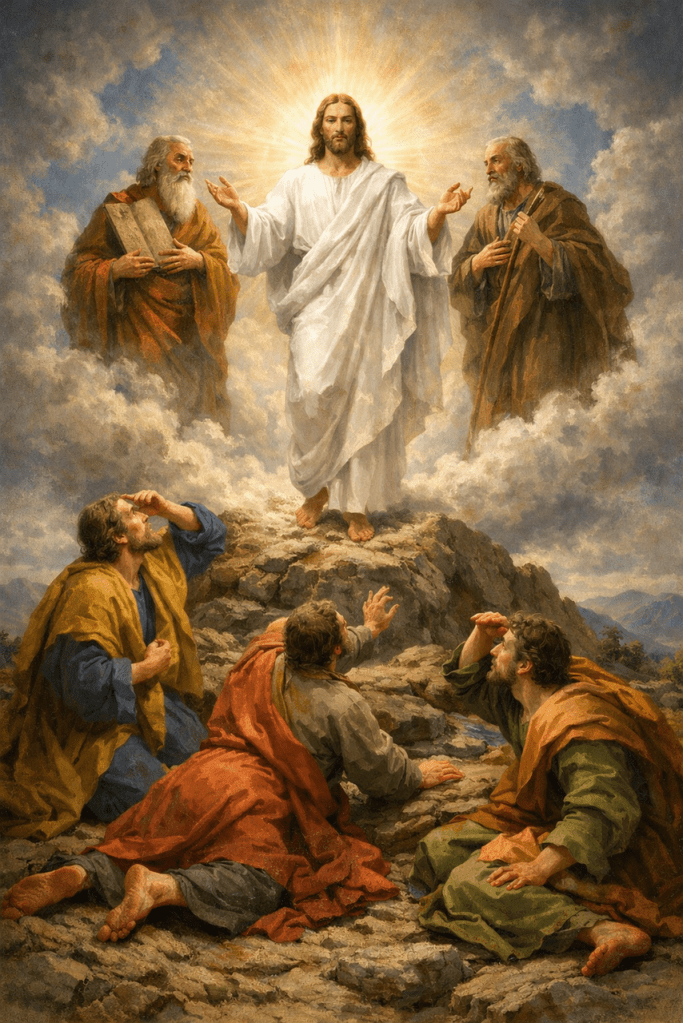
I suppose another reason I say I’m late to this discussion is that after worship here at Our Savior three weeks ago, during the Adult Bible Study hour, I shared a thought I had while preaching on the text for Transfiguration Sunday from Matthew 17:1-9. Yes, it landed on me in the middle of the sermon. It didn’t make it into the sermon. But it certainly was rattling around in my brain. Essentially, I wondered whether it might be plausible that Moses and Elijah, the two patriarchs who stood and spoke with Jesus on the mountain, were actually stepping into that moment from moments in their own time.

I shared that thought with the adults in the Bible study. However, I never finished the thought. And so, this is it.

Typically, the moment Moses and Elijah arrive is interpreted as a visit from heaven. But the whole thing seems almost too dense for that simple deduction. I mean, if this is merely a visit from heaven, even just to serve as witnesses, why does the moment feel so heavy with the entire history of divine revelation? I know it’s not a good idea to form theological positions from speculation. However, I guess what I’m wondering about is not merely what happened, but how deep the event actually runs into the fabric of the Old Testament accounts. When Moses and Elijah appear with Jesus on the mountain, is something more taking place? Is time and space converging? Is it possible that when Moses and Elijah encountered God in the Old Testament, they were, in one or more of those moments, actually meeting with Christ in the Transfiguration moment? Is this something that—not merely theologically, but actually—is a binding moment that shows the simultaneous reaching backward and forward of redemptive history? Christianity teaches that such things are true. But is it being demonstrated in the Transfiguration?

I know it might sound like a huge waste of time to some. Still, the New Testament provides the necessary theological foundation for at least asking the question. Saint John writes pretty plainly, “No one has ever seen God; the only God, who is at the Father’s side, he has made him known” (John 1:18). Christ Himself says, “Not that anyone has seen the Father except he who is from God” (John 6:46). And yet, the Old Testament repeatedly describes Moses, Elijah, and others as truly encountering God—speaking with Him, seeing His glory, standing in His presence. What’s more, the Church has historically resolved this tension by confessing that all visible manifestations of God in the Old Testament are manifestations of the pre-incarnate Son. In other words, whenever God shows Himself to anyone, Christ is the One they see. One of my favorite professors, Rev. Dr. Charles Gieschen, has written a crisp resource that leans into this kind of stuff. His book Angelomorphic Christology: Antecedents & Early Evidence, while thickly academic, is great fun.

In the meantime, these things place Moses’ experience on Sinai in an entirely new light—no pun intended. Exodus 33:11 tells us that “the Lord used to speak to Moses face to face, as a man speaks to his friend,” and yet moments later, Moses is told that no one can see God’s face and live. The paradox only resolves if the One Moses encountered was truly divine, yet not the invisible Father in His fullness.

Something similar happens with Elijah’s encounter at Horeb. The prophet stands on the mountain as the Lord moves by, accompanied by wind, earthquake, and fire, yet is finally revealed as God speaking to Him in a quiet voice (1 Kings 19). The text uses the same language of divine self-disclosure found in Moses’ encounter—“the Lord passed by”—and, like Moses, Elijah returns from the mountain back into historical time, commissioned once again for his prophetic task of preaching a faithful Word. Like the scene with Moses, though happening at different times, this one includes the mountain, the divine glory, the overshadowing presence. Once again, the Transfiguration account begs the same question—if no one has seen the Father, who was Elijah encountering?

I don’t want to force anything into this. Eisegesis is dangerous. Still, the Transfiguration itself seems almost designed to invite a deeper investigation.

Another quick thing… Saint Luke’s version of the Transfiguration account tells us that Moses and Elijah speak with Jesus about His ἔξοδον—literally, His “exodus”—which He is about to accomplish at Jerusalem (Luke 9:31). First of all, the disciples weren’t invited into this discussion. He was talking to Moses and Elijah. Second, this isn’t casual vocabulary that Luke used. Moses’ entire ministry is defined by the Exodus. And Elijah stands at the head of the prophetic tradition that would proclaim what the Exodus was all about—calling Israel back to the covenant, confronting false worship, and insisting that the God who delivered His people is the same God who remains faithful to the end. And both Moses and Elijah are, right now, on the mountain with Jesus, talking about the fulfillment of everything they were commissioned to enact or proclaim.

Well, okay, one more quick thing. Did Jesus wink toward the possibility of the kind of collapse of linear time that I’m talking about when He said to the Pharisees in John 8:56, “Abraham rejoiced that he would see my day. He saw it and was glad.” Not merely believed it, but that he saw it. I think Hebrews echoes this too when it says that the faithful of old did not receive the promise apart from us, because their perfection awaited Christ (Hebrews 11:39-40). Their story was never complete in their own time. It awaited His appearing.

In the end, is any of this provable in a strict sense? Nope. Not at all. Scripture never explicitly states that Moses was temporally present at the Transfiguration while also standing temporally on Sinai, or that Elijah consciously stepped into a future moment with Christ while at Horeb. But as I said, I thought about this right in the middle of my sermon on the Transfiguration, and this morning I decided to have a little fun with it, especially since I left it hanging during Bible study a few weeks ago.

I suppose, through all of this, regardless of the theological wandering, we did land on something the Bible establishes pretty firmly. It’s something that the dispensationalists may want to keep in mind. Essentially, all divine self-revelation is Christological, all theophany is mediated by the Son, and all redemptive moments converge in Him. Time in Scripture is not merely sequential. It’s centered—situated entirely in Jesus. You cannot be God’s people apart from Christ, who was, is, and will always be.

So, before the private messages start arriving, calling me crazy or saying I have too much time on my hands (which I absolutely don’t), I suppose the safest and most faithful way to close up shop on this is not in terms of literal time travel, but in terms of unveiled continuity. When Moses and Elijah encountered God in the Old Testament, they encountered Christ, though they did not yet know Him as Jesus of Nazareth. In other words, while Moses and Elijah were there at the Transfiguration, no matter where they came from, they weren’t visiting with someone or something new. They were visiting with the same One they’d been with during their own theophanies in their own time.

In that sense, even the Transfiguration becomes less about Moses and Elijah showing up, as if they’re appearing to the disciples alongside Jesus, and more about Jesus appearing as He is to and with Moses, Elijah, Peter, James, and John—with an element of enlisting the new guys into the same company that has always stood before Him, now finally seeing Him without the veil.

And so, however you feel about what I’ve written this morning, rest assured, it was a far better way to spend my morning than simmering in everything else going on in the world. Although the student walkouts deserve some consideration. Maybe I’ll be “unexhausted” enough to think about those things for my regular eNews message this Sunday.

Accepting My Pastoral Fate

As is always the case following our “The Body of Christ and the Public Square” conference, I took some time to read the event evaluation forms submitted by the attendees. As in previous years, most took the time to fill one out, offering uplifting commendation and valuable information upon which to reflect. From the hundreds submitted, only three or four betrayed humanity’s jagged propensity to demand something beyond normal. In other words, every crowd always has a miserabilist or two. One shrew’s comment-pocked page threatened not to return if we didn’t upgrade the chairs to ones with cushioning. Another I received by email insisted that the event would be better if we offered a menu, perhaps expanding our food options to include pasta and possibly providing a more comprehensive array of desserts. I replied, “Thanks for the suggestions.” But that was after I typed and deleted, “That’s a great idea. And since we’ve decided to upgrade all our chairs to recliners, we thought we might hire some foot masseuses to go from attendee to attendee. There’s certainly nothing better than kicking back in a La-Z-Boy at an in-person conference with tier-one speakers while getting a foot massage and eating red velvet cake.”

Seth Dillon reminded the audience that foolishness needs to be ridiculed. Regardless of what some would say, foolishness needs pushback from equally foolish humor. He reminded his listeners that we often miss opportunities to redirect people away from untruth when we meet their folly with seriousness. By treating them seriously, we imply their ideology is worthy of consideration. If a man insists he is a woman, while mindfulness is necessary lest we underestimate the societal dangers, ridiculing the ideology is also an essential part of the resistance. Thus, Seth’s company, The Babylon Bee. The Babylon Bee is devoted to making fun of ideological idiocy—or, as Seth put it, he’s a professional troll.

We talked a little about this in the Sunday morning adult Bible study following the event. The story of Elijah and the Prophets of Baal came up. Elijah ridiculed the prophets, taunting them mercilessly. When you read his words in the biblical Hebrew, you know just how crass Elijah’s words were. Saint Paul does the same in Galatians 5:12, mocking the Judaizers who demand circumcision as a requirement of faith. When you can, look at what Paul says the Judaizers should do to themselves. It isn’t polite, but it is funny.

I told the Bible study group I intend to do more trolling. I’m certainly capable.

Regardless, I had something else on my mind when I sat down to tap on the keyboard this morning, most of which began forming last night during a dinner conversation with friends. There was another thread of commentary I discovered in several of the commending evaluation forms. Essentially, folks pleaded that I do more advertising in the churches, explaining that they only heard about the event from friends or shared social media posts.

Apart from my social media efforts, I sent direct mailings to 240 churches across three states. Less than twenty were returned as undeliverable. Each mailing had a brief letter of explanation and one (sometimes more) 11” x 17” color poster advertising the event’s particulars. Of the four-hundred-plus attendees, twelve were pastors from congregations that had either received those mailings or didn’t receive one only because they knew me personally and were promoting it on their own. Admittedly, I don’t know how many attendees were there due to those men.

The first thing I should say is that I know pastors are busy. I am one. If you knew my schedule, you’d think I own a teleportation device or I’ve somehow figured out how to clone myself. Just glancing at my schedule right now, I can assure you that every day is pretty much spoken for until Christmas Day. After Christmas, I have four days free before it all starts again. Anything added to the schedule until then is little more than fanciful dance moves employed to fill in its fast-fleeting cracks.

Second, I know that when it comes to anything sent to a congregation communicating events like ours, most folks in that congregation will only learn about it if their pastor chooses to share it. He’s the gatekeeper to such information, and rightly so. He’s deciding what goes on the bulletin board and what doesn’t. He’s deciding what gets shared in the announcements or newsletter and what doesn’t. Speaking for myself, such decisions often happen when I first get the information. If it’s a letter, I open the envelope, scan it, and either keep it or toss it into the trash. Then, I move on to the next item. If it’s an email, I read it. If I intend to pursue it, I tag and save it. If not, I delete it and move on.

More to my point. It’s not that I didn’t sufficiently advertise in the churches. It’s that the pastors withheld the information. Their reasons? I don’t know. At least, I should say I don’t know for sure. I have my suspicions.

If you watch the video of the panel discussion from our recent event, you’ll observe a question directed to the group that resulted in a near-unanimous expression of optimism. I said “near-unanimous” because I chose not to answer. Essentially, each panel member agreed that the tide is turning in America. People are waking up and pushing back against radicalized school boards, LGBTQ Inc.’s jackboot agenda, and countless other issues tearing at the fabric of this great nation. As the microphone was passed from panel member to panel member, you’ll notice James Lindsay leaning toward me to speak. He asked if I wanted to respond. I said no. Keep watching. You’ll see we spent those next few moments whispering to one another. I told him I agreed that things were looking better. People are sick and tired of leftists seizing control of and destroying everything. However, that’s not what I see among pastors in the Church. From my perspective, my circle continues to shrink. As a pastor intent on leading God’s people toward faithful engagement in the public square, I’m becoming more and more of an island unto myself. I’m going to shoot straight on why I think that is.

On the one hand, it could be because my reach is increasing. With that, I’m running into what has always been a more significant percentage of pastors holding an absolute separationist view of Church and State, which ultimately betrays a thin understanding of genuine American history and a weak grip on the Two Kingdoms doctrine. More will come on this when I finish my doctoral work.

I also get the sense there may be an inhibitive spirit of competition in the Church. In other words, promoting another congregation’s event, especially a prominent one, makes the pastor feel as though he could be doing more. Depending on what that pastor does all day, I won’t say if that feeling is right or wrong. I’ll just say I think it’s there. And it’s dangerous. Faithfulness is required, not achievement. But faithfulness is by no means lazy.

I most suspect pastors withhold the information because they are simply doing what people fearful of losing their jobs do. It could be as simple as knowing that if they hang a poster promoting an educational event that any one of their parishioners misinterprets as offensive, they might make enemies.

As a pastor, I know what happens when enemies are made in a congregation. People transfer to another congregation or self-dismiss. Attendance goes down. Giving goes down. And who gets blamed? I do. Please know that I’ve long since lost concern for these dynamics. In fact, after unsuccessful attempts at reconciliation, I’ve taken the lead on showing particular folks the door. In short, I know I’ll always teeter at the edge of offending people when it comes to preaching and teaching the Word of Truth, maintaining church discipline, defending the congregation’s identity, and preserving her integrity. Of course, I’m not trying to offend anyone. I don’t associate with any pastors who are trying. But it does happen. I’ve accepted that fate, and as a result, the Lord continues to bless these efforts in ways I only wish I had time to describe.

Many pastors haven’t accepted that fate. And the fear is crippling. It keeps them holding to far easier things while preventing them from helping their people navigate the harder things—the all-consuming dreadfulnesses destroying human lives, both physically and spiritually. Doing this, those pastors become caricatures of Hosea’s divine accusation: “For with you is my contention, O priest…. My people are destroyed for lack of knowledge; because you have rejected knowledge, I reject you from being a priest to me” (4:4,6).

I told Dr. Lindsay later that night while sharing samples from my various whiskeys that I’ve long since begun weaponizing this pastoral fear. Knowing that pastors are terrified of their people, I’ve turned to reaching their people. If the pastors are afraid, I’ll use that fear, not in a sinister way, but in an encouraging one. In other words, I urge the people visiting from other congregations to encourage their pastors to get in the game and lead the way. I plead with them to do this, first doing what they can to create opportunities for their pastors to use the skills they already possess. For example, folks could call the local paper and ask about sharing a portion of their pastor’s latest sermon as an editorial. When the paper’s editor agrees, ask the pastor to send it. Put the pastor right out in front of an issue. Another example might be for church members to invite their pastor to speak at a community event, such as a Right to Life rally, School Board meeting, or an education forum. Perhaps a parishioner might arrange for his pastor to be the invocator before a congressional session in the state capitol building.

It’s not exactly the same, but this reminds me of my whisky epiphany in the early 2000s. It took a deliberate introduction to a few fine whiskies during an out-of-the-ordinary visit to London, England, to realize I had strange facilities for sensing things in drams that others could not. Like most anything else, once a pastor realizes he has additional skills he never even considered relevant to his typical duties, it’s like a light switch being flipped on. Of course, most of his efforts occur in the Kingdom of the Right—the Gospel’s kingdom. Still, when he discovers that some of those same efforts meet with the Kingdom of the Left—the civil domain—he goes about his work with a broader awareness and a more profound capability for his vocation. Together, these only add to his service, and they do so in ways that serve the Gospel rather than detract from it.

I’ll keep working in this way. It continues to result in more and more Christians stepping up to push back. Perhaps along the way, more pastors will have no choice but to join their people—and maybe even lead them. We certainly need what they’ve been put in place to bring.