What else is there to say except, “Christ is risen!” Indeed, He is no longer dead but alive, and because this is true, Death no longer holds sway for those who put their faith in Him!
But there’s more to the Lord’s resurrection than knowing Death is no longer our brutal master. Now that He has throttled and subdued it, the fear Death seeks to impose upon every man, woman, and child continually is now rendered silly. We no longer have any reason to fear Death, and so Saint Paul can say full-throated, “For me to live is Christ, and to die is gain” (Philippians 1:21). He can call out with certainty, “Death is swallowed up in victory. O death, where is your victory? O death, where is your sting? The sting of death is sin, and the power of sin is the law. But thanks be to God, who gives us the victory through our Lord Jesus Christ” (1 Corinthians 15:54-57).
Even better, the risen Lord Himself can say to Martha at Lazarus’s tomb, “I am the resurrection and the life. Whoever believes in me, though he die, yet shall he live, and everyone who lives and believes in me shall never die” (John 11:25-26).
But that’s not all Jesus said to her. Before calling her brother from his tomb, He asked Marth a final question, “Do you believe this?” (v. 26). Doing so, He looks to her while also looking up from the page at all of us, prompting a moment of contemplation. In other words, just what does it mean for you that, through faith in Jesus, Death can never claim you? The answer isn’t a lonely point on the Christological map. It is a vast frontier of wonderfulness that reaches into life in this world with an aim for the world to come.
Its topography is comprised of valleys and mountain peaks, bogs and beaches, deserts and dense forests. Steering into and through each, it understands that if Christ has conquered Death, then what else is there to fear in any circumstance? The same power that shattered the grave empowers God’s people to withstand all tyrannies and endure every terror the mortal world could ever think to conjure. Even further, a life lived in the resurrection of Christ is capably bold. It does not cower before worldly powers or bow to the culture’s demands. It does not shrink from faithfulness to the Word of God but instead stands up straight, lifts its head, and keeps an eye open for the One who is coming again in glory to judge both the living and the dead.
Indeed, the frontier of faith is lived fearlessly. Again, if Death holds no claim, then neither do its troubling underlings of persecution or suffering or loss. They may shake their fists in a rage, threatening trouble. But the threats will forever be empty. Christ is risen! Everything else is decaying transience.
Now, the Church—God’s people—marches forward toward the final and eternal day when everything else reaches its expiration. We go there, not in trembling hesitation, but with the confidence of battle-hardened soldiers who know the war has already been won, and have been, all along, awaiting the victory celebration with their King.
Christ is risen! Do you believe this? I do. Therefore, let the world (and everything in it) threaten me as it sees fit. My hope is in Jesus, the conqueror. I will not be silenced, stilled, or afraid.
It’s right around this time each year that I’m reminded that my favorite of the Lord’s Apostles is Thomas. It’s not because the name Thomas is the patronymic origin for my own last name, which can be traced as far back in Germany as the 1250s. Instead, like Thomas, from among the twelve, I want to be the one who, even if foolishly misguided, along the way, demanded the real Jesus, the once dead but now alive Savior with scars.
I want to be bold enough in every crowd I occupy to demand that Christ do what He promised He’d do.
Still, Thomas has gained the descriptive prefix “Doubting.” Doubt is a tricky thing. Some theologians say doubt was the first sin committed in Eden. Maybe doubt is the word that describes what happened. I tend to think it was more than that. I think by the Devil’s line of questioning, he went straight for the jugular of faith, ultimately stirring absolute mistrust. “You will not surely die,” the Devil replied to Eve. “For God knows that when you eat of it your eyes will be opened, and you will be like God, knowing good and evil” (Genesis 3:4-5). This was the Devil’s way of saying, “Not only did God lie to you, but He’s hiding something from you, too.” Eve unhesitatingly believed this and went straight to dining on the fruit. Adam, who was with her, did the same (v. 6).
I could be wrong, but I think mistrust and doubt are two very different things. This reminds me of a quotation I shared in my dissertation, having first shared it during a discussion with one of the pastors participating in my doctoral research. David Mills, a former editor for Touchstone magazine, once maintained:
“In the same way, ‘permissiveness’ is a very different thing from ‘licentiousness.’ The first means relaxing the rules too much, the other means actions characterized by license and lawlessness, and usually in a lewd, lustful, and dissolute way. They are not even close to the same thing…. The ideas are related but they are not the same. One cannot do the work of the other. You might as well, in a professional baseball game, send in Barry Manilow to replace Barry Bonds, because they are both rich, famous, talented men named Barry.”
In the same way, mistrust and doubt “are related but they are not the same.” Mistrust is the demonstration of a complete lack of confidence. It establishes plainly that a person is not trustworthy, and then goes no further except to act contrarily to the untrustworthy person. Doubt, while not necessarily a good thing, often makes demands before becoming mistrust. Its first vocalized insistence will likely be, “Prove it.”
That’s precisely what Thomas did. He wanted proof. Interestingly, he wanted the same proof Jesus promised He’d give. Even better, he was willing to go further. He didn’t remain apart from the other disciples but instead returned at their pleading to join with them in the upper room. That’s not mistrust. That’s a willingness to be convinced coupled with concrete expectations. He’s in a middle space between belief and unbelief, trust and mistrust.
Still, and as I hinted before, the middle space can be a dangerous place. In this circumstance, it could lead to mistrust. Jesus knew this. In fact, He acknowledged this hazardous progression when He said to Thomas, “Put your finger here, and see my hands; and put out your hand, and place it in my side. Do not disbelieve, but believe” (John 20:27). In the English, it sounds like Jesus said he was disbelieving. In the original Greek, the Lord’s words “Do not disbelieve, but believe” are more pivotal. The verb γίνου is in there. It means “to come into being, to happen, to become.” It presents the possibility of a change in location relative to one’s position. In other words, Jesus’ literal words were, “Do not become untrusting but become trusting [μὴ γίνου ἄπιστος ἀλλὰ πιστός].”
And then Thomas’ words, “My Lord and my God!” These are some of the most beautiful in all of the scriptures.
Samuel Johnson once said, “Nothing will ever be attempted if all possible objections must first be overcome.” I share these words only because they acknowledge the tension that exists between doubt and trust. That said, Jesus acknowledged the tension first and in a far better way.
The scene with Thomas ended with the Lord speaking somewhat rhetorically. His words may even have stung Thomas a little. “Have you believed because you have seen me?” the Lord asked. “Blessed are those who have not seen and yet have believed” (v. 29).
On second thought, if the Lord’s words were stinging, I’ll bet the sting didn’t last long. Jesus wasn’t wholly directing them at Thomas. According to this particular Gospel’s author, John, they were aimed at us (John 20:31). And if this is true, then they’re encouraging, not indicting. They point to the blessed nature of faith. They’re meant to remind us that even as we won’t experience the exact proofs that Thomas was given, in the end, faith doesn’t require physical proof to overcome every possible objection or tension, just as Samuel Johnson described. Faith knows without seeing. It can believe without feeling or experiencing. This is true because its assurance is from another sphere altogether. It is convinced by something far more powerful than what the human senses could ever grasp (Hebrews 11:1). That something, or better said, someone, is the Holy Spirit—God, Himself—at work in the believer. Christians are made by the power of the Holy Spirit at work through the Gospel in both its verbal and visible forms—Word and Sacrament. But Christians aren’t just made. They’re endowed with that which helps them hold on when there doesn’t seem to be anything to hold onto. In those moments, they’re equipped to say to the world’s imposing accusations, “Prove it,” all the while knowing that sufficient proof for measuring all things is always available in the most trustworthy of all locales, God’s Word (2 Peter 1:12-21), just as the Lord promised (John 5:24).
For a Christian to say, “Prove it,” and then look to the Word of God for what’s needed, in a way, is the same as Thomas expecting to meet only with the real Jesus. Indeed, Jesus is the Word made flesh.
I don’t have to tell you who the pronoun “He” is referring to in those traditional Easter acclamations. You know His name. He’s Jesus, the King of kings and the Lord of lords. He was dead and is now alive, owning the name that is above every name. Every knee in heaven and on earth and under the earth will one day bow in absolute reverence to this name, whether it’s the knee of a believer or unbeliever, friend or foe (Philippians 2:9-10).
This cosmos-encompassing event Saint Paul describes will happen in the flesh. The Lord’s resurrection has sealed its certainty (Job 19-25-27; 1 Corinthians 15:42-56). This final veneration will not be a commemorative act, one performed in memory of an exceptional individual who once was but is no more. It won’t be an act of devotion recalling a person indispensable to history but nevertheless long dead and buried. Graveyards are filled with the forgotten. Even the greatest are little more than “comets of a season,” Lord Byron would say. “The glory and then nothing of a name.”
And yet, Jesus, the One bearing the name above all names, His grave was a blink. He could not own one for long. Although I suppose if owning the grave means besting the sinister powers of sin and death that give a grave its claim, He certainly holds these powers’ enduring titles (1 Corinthians 15:55-57). He owns them as a superior champion owns a weaker opponent. They came for Him. They were strong. But they approached Him in bold assumption and were met by an ugly fact. “No one takes my life from me,” Jesus said, “but I lay it down of my own accord. I have authority to lay it down, and I have authority to take it up again” (John 10:18). “Now is the judgment of this world,” the Lord added, “now will the ruler of this world be cast out” (John 12:31). Indeed, and amen! His resurrection is the proof that His words were not empty. He’s alive, and if this is true, then even these darkly powers will be forced to their knees at this world’s final hour. They will coalesce from their formlessness in humble reverence for the One who is no longer the suffering servant but the Pantocrator—the ruler of all things created and uncreated.
Admittedly, the Lord’s work was not easy. The combat was stupendous, just as the lovely Victimae Paschali sings (LSB 460). But the good news remains as plainly splendid as it is plentiful. His foes were too weak. They lost everything, and their consequence was sealed for the great and final day.
In the meantime of eternity, to the victor goes the spoils. Among the prizes, to the Champion the most precious: us! He won us! And now, by the power of the Holy Spirit for faith, to be with Jesus is a believer’s forever. The grave is not our end. He filled in its gaping chasm. The devil cannot accuse us. He has been debarked. Death cannot consume us. It was defanged. And now, we are the Lord’s own, and we will be raised and adorned in bodies “like his glorious body, by the power that enables him even to subject all things to himself” (Philippians 3:21)!
Immersed in this joyful news, may your celebration of Easter be wonderfully full-throated as you call out to this conquered and whimpering world, “He is risen! He is risen, indeed! Alleluia!”
Holy Week begins today with Palm Sunday. Like any other week, Holy Week has seven days. And yet, it seems exceptionally longer than the others. By the time we get from Palm Sunday to Easter, a lot will have happened. For perspective, here at Our Savior, we will have packed at least ten weeks of sacred worship into these seven days. For our Kantor, musicians, and choirs, that’s an abundance of preparation and rehearsals. For the pastors, among so many other things, that’s a lot of sermon writing. I suppose that’s why you might hear me say in jest that the Lord and His pastors trade places on Easter morning. I often get very sick the week after Easter, usually from over-exertion. Although, I think it hit me early this year. I was terribly sick this past week.
Getting sick this time every year is one of many proofs that I could not do what the Lord did. He endured cosmic suffering. And yet, I count myself blessed if I can think through and preach a relatively coherent Easter sermon after Lent and Holy Week’s busyness has concluded.
I had an interesting conversation about these things last Sunday in the ER at Maclaren Hospital. A man sitting a few seats away from me in the waiting room started it. The worship pastor at his church, he endeavored to ask me how my church “does” Easter. I told him, even taking a chance at assuming between two clergy its exhausting nature. I assumed incorrectly. Along the way, he asked rather awkwardly why we continue doing it this way, especially when I almost always get sick year after year. At first, I took it as a reasonable observation and told him I had thought about cutting things back a little. But then he did something else. He took a passive-aggressive shot at what he believed was traditional worship’s tiredness. As he did, He explained worship shouldn’t be tiring, and he went out of his way to tell me that his church’s worship life could never be considered exhausting, that his church’s contemporary style was comfortable and easy—always fresh and new, always joyful, and always inspiring. He explained that worship is about praising God—about really feeling it, and blah blah blah.
Let me first say that’s not what worship is about. Praise is part of it (the lesser part, mind you) but that’s not its purpose. Worship begins with God. He serves us what we need—forgiveness. We respond with prayer, praise, and thanksgiving. Think Isaiah 55:11 and Ecclesiastes 5:1-3.
Next, I’ll ask, “Why?” What’s going on inside a person that would cause him to impose on a stranger in this way? I get that I’m easily identifiable in my clerical collar, and perhaps by it, I may represent a more traditional position. I’m no stranger to such interactions. But that alone doesn’t invite the imposition. I certainly didn’t ask for a critique of our worship style or life. As a normal human being confiding in someone I assumed might understand, I would never even think to steer into another church leader’s sphere in this way. I have no reason to criticize him. I’ve never been to his church.
Thankfully, few clergyfolk I meet are like this. Most just want to meet and visit—like normal humans. Also, thankfully, I didn’t have the time (nor the mood) to debate this particular guitar-slinger. I was seconds from being escorted to the bedside of one of my church members who’d been in a car accident. I was pondering my words to them and not to the worship pastor. Although, Blaise Pascal’s thoughts on reason would have been appropriate if the conversation had continued. Pascal once said something about how human reason’s final use is to admit there’s an infinite vastness beyond its capabilities.
What does this have to do with the interaction I just described? If I’d had the time and energy, I think it might have mattered in at least two ways.
First, Holy Week does sometimes feel unreasonably challenging. As I said, I’ve considered excluding some of the worship opportunities for this reason. And yet, as Pascal implied, even human reason admits to blessings that can only be reached by extending beyond what’s reasonable. No, the Lord doesn’t want us murdering ourselves with devotion. Still, we can (and often should) stretch ourselves past what we know is easier. This is the “no pain, no gain” principle. Still, even in an elementary sense, we also can’t remain infants, drinking only milk. We need solid food (1 Corinthians 3:1-13). The historic rites and ceremonies of the Church embody this opportunity, and if there’s ever a time to reach for solid food, it’s during this pinnacle time of the Church Year.
Some might refer to our worship style here at Our Savior as “high mass.” That description has various outside interpretations. Although, compared to other Lutheran churches, I can guess what it means. Still, I’m not interested in the other churches. I’m the pastor here. And no matter what is implied or who we’re being compared to, I’m convinced we’re enjoying solid food in this place—meat and potatoes, not frozen waffles and milk duds. It’s certainly far from being about the preacher or service meeting us right where we are, giving us what we like, and never demanding anything more. God does not call for us to remain forever where we are. We are to reach higher (Colossians 3:1-2).
By the way, a person should be able to tell when they’ve left the “where we are” of every day and entered into the new day of “higher.” Our regular worship is already wired for this. Stop by anytime. You’ll know you’ve stepped from the secular world onto holy ground. Holy Week is this on steroids, and for very good reasons.
This stirs a second thought relative to what’s reasonable. Pascal admitted to an endless array of things beyond reason’s reach. Isn’t that more or less a nod toward the nature of faith? It’s the same kind of nod Saint Paul offers in the Epistle appointed for today’s Palm Sunday celebration. In Philippians 2:6, Paul admits Christ’s incarnation was an ungraspable truth existing far beyond reason’s borders. Very little about it makes sense. However, as challenging as it is, it’s utterly accessible to faith. This is where I might have pushed back on my conversation partner even further, crossing the border into his doctrines and sharing how I think it’s strange how someone like John Calvin could ever insist, “Finitum non capax infinitum,” which is to say, finite things cannot contain infinite things. Of course, Ulrich Zwingli assumed it years before when debating Luther at the Marburg Colloquy in 1529. But either way, to say the infinite cannot be located in the finite is to be trapped behind reason’s barrier. It certainly binds God to human premises.
Since I’ve already mentioned Christ’s incarnation, if Calvin’s words are valid, then we must dismiss Saint Paul’s reason-pummeling words in Colossians 1:19-20, where he writes, “For in [Christ] all the fullness of God was pleased to dwell, and through him to reconcile to himself all things, whether on earth or in heaven, making peace by the blood of his cross” (Colossians 1:19-20). Had the conversation gotten this far, I would have encouraged my new ER friend to reconsider what the finite containing the infinite means for things like Baptism and the Lord’s Supper. I’m guessing he thinks these are just symbols. I wouldn’t attack him on this. But I would at least ask, “Is it possible they could be more?”
In the meantime, yes, the fullness of the infinite God was located in a finite human man—an object occupying a limited location. That man was Jesus. No, it doesn’t make sense. And Paul knows it. But that doesn’t stop him from upping lunacy’s ante in the Palm Sunday epistle with the reminder that the God-man Christ actually died. You think the incarnation is unreasonable; how about God dying? Paul goes further into irrationality, adding, “even death on a cross!” (Philippians 2:8).
The historic rites and ceremonies dig deeply into this, especially during Holy Week. From Palm Sunday through to Holy Wednesday and then the Triduum—the holy three days of Maundy Thursday, Good Friday, and the Great Vigil of Easter—it’s a week that carries us into these things and more. It isn’t just a day or two of our favorite and most syrupy worship songs, whatever Bible verses the preacher happens to prefer at the time, and an engaging sermon with some fetching slides. It’s several days of reaching further.
To be fair, I should come at this from another direction. As insulting as the worship pastor in the ER waiting room was with his passive aggression (most of which I didn’t share), I’ll admit some in my more traditional camp do the same things he did; not a lot, but a few. They take similar opportunities to impose their pretentiousness rather than enjoying the conversation and encouraging others toward Christian worship’s inherent beauty and benefit. For example, they can make a pastor shepherding a storefront church feel lesser for not having what they have or doing what they’re doing. Again, there aren’t a lot of them. But as the saying goes, there’s one in every bunch. Confessional Lutheranism is no exception.
In conclusion, let me just say this: For those out there who are moving in the better direction—who are reaching higher—whether or not you have the classically ornate worship space, vestments, smells, bells, or whatever, I encourage you to stay the course. You already likely know we’re in a dark time in worship history, days when almost anything goes, and as it does, the faith that worship is supposed to feed becomes shallow and weak among so many. Nevertheless, anyone who’s served as a pastor for any reasonable length of time will tell you that shepherding God’s people from point A to point B takes time. Building the muscle to reach higher takes exercise. Catechesis is key. Introduce. Teach. Stay the course. As you do, rest assured your labors are not in vain, no matter the pace or progress.
And some final advice: If a man in a waiting room scoots a few chairs closer to you to have a genuine conversation about differing worship styles, enjoy the discussion. Such conversation can be refreshing and interesting. But if a peacocking purpose becomes obvious, before the conversation goes any further, I recommend leaning toward him and asking with wide room-scanning eyes, “You can see me?” That’ll close the conversation shop’s doors. Of course, if you’re not comfortable doing that, first, compliment his retro tee, and next, tell him the hospital called you to perform an exorcism, asking if he’s the one they called about. That’ll probably work.
We’re entering the fifth week of Lent. The further we go into Lent, the more I’m sad for the churches that skip this penitential season, electing to go straight to Easter. They’ll have missed a critical view of the empty tomb.
The Gospel should always be a church’s center. That said, one of the grand benefits of observing church seasons is that they provide us with different perspectives on the Gospel. Advent considers it one way. Epiphany another. Rather than letting us coast along thinking we know everything there is to know, church seasons lift the Gospel and turn it, allowing examination on all sides. Lent is no different. If observed rightly, Lent, and then Holy Week, deliver us to the Lord’s resurrection, having first shown us the cost of Easter’s joy. Holy Week—the days between Palm Sunday and Easter—dig so incredibly deeply in this regard. It needs to. Humanly speaking, we’d much rather come to worship on Palm Sunday and then again at Easter. We’d much rather enjoy these brighter festivals, having skipped the hours of terribleness that cement the two together.
Why is this? My first guess is that the sinful nature would prefer to keep its role in the narrative a secret. It knows that if we investigate the harder scenes, there’s a chance we’ll be shocked by what we discover—perhaps even learning something about ourselves we’d prefer not to know. These reasons feed my appreciation of the masters—Caravaggio, Rembrandt, and the like. They looked into these spaces and shared the details. A more recent master, Carl Bloch, handled the details well, too. Perhaps you’ve seen his portrait of Christ being comforted by the angel in Gethsemane (Luke 22:43)? Far too many images of Christ in the garden before His betrayal are portrayed with the preferred fluffiness of gilded rays pouring from heaven, Jesus intently meditating but untouched by sadness. But that’s not what the Scriptures describe. They describe intense sadness. Bloch captures the Lord’s physical exhaustion and the angel that came to bolster Him for the forthcoming fight.
Since I already brought it up, Luther wondered aloud about the Lord’s time in Gethsemane. In a sermon in 1545, he asked his listeners why the Lord shivered and shook with such dread while praying. The gory mistreatments hadn’t even begun yet. And still, His behavior is shocking. It grips us. The Lord’s sweat became drops of blood, and Luther shared the reason: “It is for the sin of the world which God has laid upon Him.” Speaking for each of us, Luther added, “My intolerable sin brings Him to this, my sin which He has taken upon Himself and which is so hard to carry” (W.A. 52. 738). Who wants to be blamed for another person’s sadness? Not me. It stings as few other things do. When it happens, I want to look away.
Lent and Holy Week insist, “Don’t look away. Behold the bludgeoned and pathetic Christ. Indeed, it’s startling that He would suffer and die in this way. You’ve heard so often how He did it for you. Do you see what ‘for you’ means? Let your unsettled heart be a clue.”
Of course, that’s not the end of the story. Lifting the Lententide narrative and turning it for a better view, Luther continued that the Lord’s startling grief is also filling in confidence’s terrible gaps, becoming “a comfort to you, that you may be certain that Christ has taken your sin upon Himself, and paid the price for it. If, then, your sins are laid on Christ, be content. They lie in the right place, where they belong” (Ibid.).
Still, there’s the startling nature to all of this.
The topic of abortion came up during our church’s School Board meeting this past Tuesday. Relative to what we were discussing, I mentioned to the Board that I’m one who believes that the only way to end abortion once and for all would be to require our populace to see it—to experience the sights, sounds, and smells of genocide, much like the Allied troops marched Germany’s complacent citizens through the concentration camps after World War II. Changes in heart and mind occurred almost instantaneously in Germany. My theory, which I cannot necessarily prove, is that while incremental behavioral conditioning works, there’s a layer of our being that can only be pierced by jarring news. In a sense, the Bible does both. So much of the Lord’s comings and goings in the Bible are given in ways that caress us to careful attention. In a purely human sense, we’re being incrementally habituated to His identity and what He has come to do. But then there’s the actual doing—the viciousness of His suffering and death. The events themselves are anything but careful. They were a swift and consolidated shotgun blast of dreadfulness. Mark’s Gospel says the Lord was betrayed at midnight on Thursday, while Matthew, Mark, and Luke record the Lord died about the ninth hour, or 3:00 pm, on Friday. Compared to the rest of the Lord’s ministry, there’s very little time to be eased into it.
While it might not be the best analogy, this reminds me of something W.H. Auden wrote about stark incentives. I’ve been reading and writing about the psychology of attitudinal shifts for my doctoral work. Auden agreed that behavioral conditioning had a proven record. But then he joked that with a few select drugs and a simple electrical appliance, he could have almost anyone reciting the Athanasian Creed in public, and he could produce the results far more quickly than any behaviorist. Of course, he was talking about torturing someone into compliance. But beneath his dark comedy lies an elementary truth: extreme experiences have a way of cutting through our protected selves, revealing what might otherwise remain hidden to us, ultimately passing us by.
If Easter greeting cards draped in sunshine, lilies, empty crosses, and empty tombs are all one knows of the Lord’s passion, then something incredibly important has been overlooked.
I guess I’m saying this morning that Lent and Holy Week play an essential role in preventing a superficial understanding of the Lord’s labors. They were jarring, and much of these penitential seasons’ collegial goal is to remind us that redemption came at a cost, that its price tag was attached to a world-sized pile of human brokenness, and then to show us the price was paid in full. From there, the startling image becomes one of genuine comfort. A crucified Jesus is a testament to the unfathomable depths of God’s mercy. His resurrection becomes an indescribable celebration worthy of a joyful ruckus. Skipping over the precision of Lent and Holy Week risks missing this.
Don’t miss out. Start making plans now, especially for Holy Week. Here at Our Savior, we’ll have services every day, sometimes twice daily. If you do not have a church home, or perhaps your church offers little opportunity to observe the harder things, feel free to join us. You are more than welcome. Listen to God’s Word and its preaching. By these things, look into the challenging moments. Measure sin’s cost. Be equipped for another startling of sorts.
In other words, no one goes to someone’s tomb who has been viciously mauled expecting to find that person restored and alive. And yet, we do. We behold and hear Easter’s cosmic announcement that the One who suffered and died so gruesomely is now alive, never to die again, His resurrection victory being ours by faith. Talk about shocking! Indeed, it’s the overwhelming sense of joy that the Easter celebration means to bring.
I felt the urge to reach out this morning. Lent arrives this Wednesday. If there was a season to contemplate mankind’s dreadful predicament, it’s Lent.
I suppose, in a broad sense, death’s predicament is not lost on humans. We’re all facing it. Still, believers have the best handle on it. We have the Gospel—the proclamation of death’s cost and the Savior who accomplished its payment by His own death.
During staff devotions this morning, I shared a portion from Luther. He spoke of the cross and the Christian’s desire to be worthy of it. He wrote, “Is it not a wonder to be possessed of a ready will toward death, while everyone dreads it? Thus is the cross sanctified.”
I’m concerned that far too many mainstream churches seem to have lost their formal grip on this. They demonstrate as much by their crucifix-less worship spaces. One pastor (if you can call him that) in a church not far from my own won’t allow crosses to be displayed in his facility. He openly admits that crucifixes—and even bare crosses, for that matter—are offensive to visitors. And yet, Saint Paul preached so fervently, “We preach Christ crucified” (1 Corinthians 1:23), knowing that such a message would be received as offensive and foolish by an onlooking world.
It’s heartbreaking when a church views the cross through the world’s lenses.
You should know what I’ve described is rarely lost on liturgical churches. A liturgical church will likely have crucifixes displayed throughout its expanse—and not just one or two, but many. Interestingly, Paulo Freire, the father of Critical Pedagogy (which is foundational to Critical Theory), insisted that for his Marxist theories to prevail, traditional liturgical churches needed to be deconstructed and their symbols dispensed and forgotten. Freire wasn’t concerned with contemporary churches. Why? Because traditional liturgical churches are by nature impenetrably linked to faith and its symbols, and in Freire’s research, far more dangerous. They don’t roll over when persecuted. They produce a far sturdier commitment than churches devoted to cultural appeasement. Hitler agreed, calling the more contemporary churches in Germany “mushy.” He was more so bothered by historically creedal churches and their believers. The historic Creeds define, teach, and defend truth. A church’s historic liturgies carry it. The church’s calendar—the liturgical seasons—imposes it in long-lasting and unforgettable ways. And by long-lasting and unforgettable, I mean it stays with a congregation generation after generation, binding it to those who came before and those who will come after.
A persecutor laboring to destroy such a church won’t have an easy time. Its identity is built from ranks the persecutor can’t even see.
Here’s some free advice: When any organization (whether it’s the Boy Scouts, your favorite car company, football team, or whatever) begins obscuring its symbols, jettisoning its creeds, or altering its traditions, beware. These are essential to the organization’s identity. When they change, so does their identity. They’re inextricably linked.
I suppose I’ve wandered too far already. So, here’s what I really came here to tell you.
A critical Church season begins this week. It starts with a crucial moment epitomizing the Church’s identity. It deliberately resists desires to loosen our grip on who we are and what we are to believe, teach, and confess.
Epiphany and the Gesima Sundays become Lent. As these season’s crowds approach, Lent’s somber doorman, Ash Wednesday, will clatter through its ancient keyring with cinder-stained fingers to open Lent’s door. Year after year, Ash Wednesday’s digits have etched a cross upon the foreheads of countless believers passing through this entry, elbowing them toward honesty, nudging them toward a vital confession that matters when pondering Golgotha’s truest weight: “Remember you are dust, and to dust you shall return” (Genesis 3:19). And yet, Ash Wednesday’s participants do this wearing a black-powdery smudge in the shape of a cross. Yes, we are dust. We will die. And yet, in Christ, by His death on the cross, we’ve been made alive (1 Corinthians 15:22). Death in Christ is not to die but to live (Philippians 1:21).
Ash Wednesday’s liturgy amplifies what the Christian Church knows about death. It amplifies what we know about a certain Someone who met with death and outmaneuvered it. Ash Wednesday brings us in. Lent will take us the rest of the way. It will dive so much deeper into our genuine need for rescue while showing us over and over again the One who can meet the need.
Ash Wednesday, and therefore Lent, remind us that the clash between Jesus and death won’t be pretty. Death won’t just hand us over to Him. Death is the last enemy, and he’s been waiting his turn in line to consume us (1 Corinthians 15:26). Rest assured, war will ensue, and it’ll get ugly. At first, the glorious rescue will look more like defeat. Jesus will confront the challenger, submitting to its dreadfulness. He won’t lift a finger to defend Himself. He’ll endure, taking all of it in. The results will be His mutilated body nailed to a blood-soaked cross lifted high above the warfare’s haze. We’ll see Him pinned there like an animal; an outcast doled an awful demise.
And that, right there, is the message we preach! We preach Christ crucified! The Lord’s greatest work is His humble submission as the sacrifice for sin! This is His truest glory (John 12:23-33; Mark 10:32-38)! His resurrection is the proof pointing to this great deed. He owned the death we deserve, and He rose from the grave, proving He beat the specter at its own game, giving the spoils to all who believe.
This is Ash Wednesday’s message. Admittedly, it’s gritty. But it’s thoroughly consolidated and good. If you’ve never considered attending an Ash Wednesday service, I encourage you to do so. If your church doesn’t offer one, find a church that does. We’ll offer two here at Our Savior in Hartland, the first at 8:10 am and the second at 6:30 pm.
Consider these things, and in the meantime, God bless and keep you by His grace. Indeed, Lent has come. But rejoice, the fruit of the Lord’s greatest work—Easter—is coming, too.
We offer plenty of cheerful statements at various times and for multiple reasons. “Happy birthday” is one. We say that year after year as we recognize the passage of another twelve months in a person’s life. “Congratulations” is another. We’ll use that word for many reasons, never just one thing. We’ll offer it if a person lands a new job, gets engaged, wins at bingo, or any other significant or insignificant occasion.
But then there’s, “Alleluia, Christ is risen!” No other declarative assertion in history compares, and only one event can claim it.
Jesus of Nazareth, the One mocked and physically abused into gross malfiguration, and then spiked to a cross until His body could take no more, He met with the last enemy, Death (1 Corinthians 15:26). And yet, He is beautifully, brilliantly, wonderfully alive! “He has risen,” the angel told the women visiting His tomb, “he is not here. See the place where they laid him” (Mark 16:6).
It’s likely they looked. But they didn’t need to. They already knew the scene well—the terribly dreary place palled by Death’s sights, sounds, and smells. They were sitting across from the tomb’s entrance watching Nicodemus and Joseph of Arimathea take the Lord’s limp body—battered, hemorrhaging, and likely beginning to stiffen—and wrap it in a linen shroud and place it inside (Luke 23:55). The women saw the Lord’s end—His brutally gruesome end. How could anyone survive such a thing?
They don’t survive it. No one does. Even in Jesus’ case, Death came, bit down hard, and then carried Him away.
At least, Death thought it had a hold on Him.
To call out, “Alleluia, Christ is risen!” is to know that at one particular moment on the timeline, somewhere out of sight, and sometime between Good Friday and Easter Sunday, a cosmic encounter ensued. Death’s trophy opened His eyes and took back His own life (John 10:18). Having never lost His divine authority over all things but only hidden it, He enacted His ambush. He pushed apart Death’s jaws, and in between its now fully realized predicament noted by terrified whimpers, took to His feet. And in the next few moments, as His body was restored, keeping only the scars from the nails and spear (for our sake), He leaned into Death and made it His trophy.
Jesus accomplished and forever sealed the death of eternal Death.
Calling out “Alleluia, Christ is risen!” is so much more than “Happy birthday” or “Congratulations” ever will be. It’s a phrase that genuinely meets with every single moment of life—from one’s birth to one’s final breath. Easter, a singular event, celebrates the defanging and ridding of humanity’s last enemy, the one residing at the center of all human fear: Death. Death has forever lost its power. There is no longer any reason for hopeless concern in this life, no matter how challenging life may be or what the devil or the world might bring our way. Jesus defeated such concern’s master. All who believe this—those who cling by faith to Jesus and His sacrifice on the cross—receive the merits of the same conquering Christ.
And what are these merits?
The forgiveness of sins. And, of course, where there is the forgiveness of sins, there is also life—eternal life—and salvation (John 3:16-17 and 6:40, Hebrews 10:10, 1 Peter 2:24, Matthew 26:28, 1 John 1:7, and so many others).
Indeed, alleluia, Christ is risen! May God continue to bless you by the power of the Holy Spirit for faith in Jesus. May He keep you enveloped by Easter Day throughout every moment of every day.
For one, it’s proof that my congregation’s littlest children are listening—really listening—to what’s being preached and taught. This should be an assurance for anyone among us who’d question our Christian school or the rites and ceremonies of our liturgies. Our children, more than supported by faithful parents, are taking God’s Word into themselves in the richest ways—ways that equip them not only for steadfastness but for communicating the Gospel with substance. In other words, we’re raising our children to be far more than “Jesus loves you” Christians. They’re ones who can speak of God’s love and then go further into the person and work of Christ, the substance of that love.
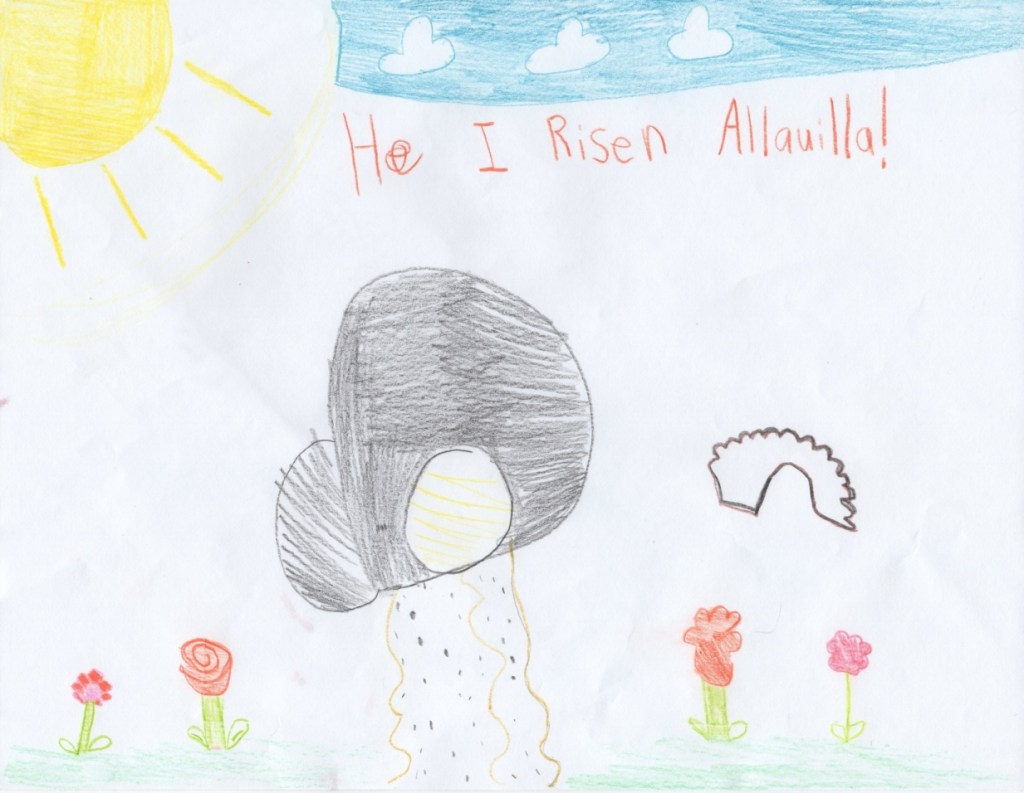
Proof of this can be seen in a series of pictures I received after worship last Sunday. The images, five in all, depict the events of Holy Week and the Triduum—from Palm Sunday to Easter. Giselle Graney made them for me. And oh, how wonderful they are!
For the record, Giselle is eight years old. But don’t let that distract you. It’s clear she knew what she was doing. By the way, I went down to the school to ask her about a few of the images’ details just to be sure. I learned she was at home feeling a little under the weather, so I called her mom, Kerry. I asked her to check with Giselle. Sure enough, Giselle was intentional, even with the seemingly inconsequential details. And by the way, what she put into the portraits proves a theological prowess that extends far beyond many adults—the kind of artistic demonstration of Christological depth that one usually only sees among the greats like Caravaggio and Rembrandt.
Give me a minute or two, and I’ll walk you through a few of Giselle’s images. I know you’ll be as blessed. But before I share, there’s one more thing to keep in mind: the rule of interpretation.
A line in The Picture of Dorian Gray comes to mind. This is likely because I recently spent some time in the book looking for another line that fit a paper I was writing. In the volume’s preface, Oscar Wilde writes, “All art is at once surface and symbol. Those who go beneath the surface do so at their peril.” In other words, when looking at art, you see the details that are actually there. That’s the surface. But there’s always more to it. There’s meaning. Art attempts to make meaning visible. That involves interpretation. That requires the viewer to dig deeper into what he sees. It also involves prerequisite knowledge. Together, there in the substratum, knowledge and meaning challenge the viewer, just as the artist would have it. Giselle has done this masterfully. What’s more, she’s been paying attention to everything she’s heard so far throughout Lent. These images prove her heart is already cemented for the events circling Golgotha’s terrifying hill. And yet, she’s making her way there (and now, she’s taking all of us along) with a firm grasp on everything Golgotha itself makes sure. Even at eight years old, Giselle is demonstrating the heart-shaping power of the Gospel.
She gave me five pictures. I’m only going to talk about four. And I’ll share each before I describe it.
The first one depicts Palm Sunday. What do I like about it? First of all, this is the only picture she drew with Jesus in it—which I’ll get to in a minute. Until then, know she gets Jesus right. It seems most Palm Sunday images are inclined to portray Jesus as jubilant and smiling. And yet, Luke’s Gospel tells us He was crying, saddened that people had no idea what was actually happening, that He was riding forth to die, and that their rejection of Him as the Savior could and would only end dreadfully (Luke 19:28-44). Giselle’s Palm Sunday roadway is festively bright with colorful cloaks and palm branches. But her Jesus is tearfully sad. (See the cropped image above.) Giselle has been paying attention to the intricate details being preached to her. She didn’t just roll along in the usual pace of a springtime smiling Jesus—which I imagine is preferable to many. She showed us the Lord’s concerned heart, even when the world around Him expected an entirely different kind of king. This matters more to the Palm Sunday story than most folks might know.
Another of her portraits that caught my eye was the one detailing Gethsemane. Strangely, as I mentioned before, Jesus is not in it. Then I realized why. Jesus has already been arrested and taken away by the guards. At the picture’s top, there’s a star-filled sky. But beneath this sky, the theme is clearly darkness, as it should be. This is the beginning of hell’s onslaught against Him. Jesus said as much when the troupe approached to take Him away. Giselle heard her Lord say this last Wednesday during midweek worship. “This is your hour,” He said, “and the power of darkness” (Luke 22:53).
Still looking for Jesus somewhere else in the Gethsemane picture, the viewer only sees where He’s been. On one side, a blood-pocked portion of grass is found beside a tree. That’s where He knelt and prayed, His sweat becoming blood (Luke 22:44). On the other side, a rooster (Matthew 26:34), a sword and a bloody ear (John 18:10), and thirty pieces of silver (Matthew 26:14-16). Beneath those images, the words: “Jesus shines butier than any star.”
Did you catch that?
Intentionally or unintentionally, Giselle did two things there. First, she combined beautiful and brighter into a single word. When writers do things like that, it’s for emphasis—to draw attention to something. Intentionally or unintentionally, Giselle highlighted a profound point: what Jesus has endured—the betrayal, the suffering, the road to a grisly death—these make for the brightest, most beautiful demonstration of God’s glory (John 12:23-29; Mark 10:35-40). Indeed, Jesus displays a glory that is butier by far than any spinning celestial in the endless sky.
Another image depicts Good Friday. Again, no Jesus. But a moment of reflection determines His location. It is finished (John 19:30). The cross at the center is empty. Jesus is in the sealed tomb to one side. The rest of the portrait reveals a blackened sky (Matthew 27:45), the Father’s hand extended as He gives Jesus over as payment for Sin (Romans 8:32), a torn temple curtain (Matthew 27:51), dice used for casting lots (Matthew 27:35), the centurion’s helmet reverently removed in the presence of God’s Son (Matthew 27:54), a wilting flower (Isaiah 40:8, Romans 8:22) beside other rich images relative to the Lord’s powerful sacrifice. Displayed most prominently are the words, “Father, forgive them” (Luke 23:34). These are the first of the seven last words Jesus spoke from the cross. I just preached on these particular words two weeks ago. Giselle was there. She heard the reason they’re first. Amid the gory details, the forgiveness of sins rests at the heart of the terrifying but butier event. That’s why Jesus is doing what He’s doing. He’s winning our forgiveness. It’s His goal. The “them” isn’t just the people attacking Him. It’s us, too. And He never loses sight of us throughout the ordeal. This sentence leads His final string of sentences, serving as the heart for each.
Giselle gets this.
The last image I’ll talk about is incredibly rich. It’s Giselle’s portrait of Easter. Again, no Jesus. But by now, I think I get Giselle’s broader theme, intentional or unintentional. First of all, while we can’t see Him, the risen and ascended Christ has promised, “Behold, I am with you always, to the end of the age” (Matthew 28:20. But more important to the Easter narrative’s cadence, Jesus is always a step ahead of His beloved. In other words, the Lord is always out in front, accomplishing what none of us could or would if left to ourselves. We can only follow and discover His wonderful work. Here, in particular, the tomb is open. The sun is shining. The flowers are blooming beneath a beautiful blue sky. Scribed across the skyline are the words announcing what He’s already done, “He I Risen Allauilla!”
Now, before you criticize Giselle’s spelling, give the eight-year-old artist her due. She’s already proven her masterful ways. Did she really misspell some words, or did she find a way to avoid using one in particular since we’re still in Lent? As many who celebrate Lent already know, tradition sets the word aside until Easter. We don’t sing, say, or write it. (Notice, I didn’t use it in this paragraph.) Also, notice it’s not “He is risen,” but “He I risen.”
Okay. She probably misspelled both words. Nevertheless, here’s a chance to apply interpretation born from what’s already been a faithful demonstration of the Gospel. The words she gave us, even if by accident, are asking to be mined more deeply.
Start with “He I risen.” That’s easy. Jesus and Giselle. That’s John 14:19. Because He lives, she will live also. As far as the other, when I saw “Allauilla,” I saw Latin. My Latin is more than rusty, but I think a case could be made for “Alla uilla!” to be translated as “Come on, to the village!” Thinking this way, remember, everything Giselle has presented so far was born from childlike faith listening to and receiving God’s Word. Staying the course, “Come on, to the village!” seems awfully familiar to Easter. If not, then you’ve forgotten Matthew 28:5-8. It’s there we read:
The angel said to the women, “Do not be afraid, for I know that you seek Jesus who was crucified. He is not here, for he has risen, as he said. Come, see the place where he lay. Then go quickly and tell his disciples that he has risen from the dead, and behold, he is going before you to Galilee; there you will see him. See, I have told you.”
Do you know what I’d say in a moment like that? “Alla uilla! Come on! Let’s go to wherever Jesus is going and find Him!” And sure enough, Jesus is found on the way to the village of Emmaus (Luke 24:13-35) and then again later that same day in the upper room in Jerusalem (Luke 24:36-49).
Giselle has given me so much through these images. I’ll cherish them until I meet face-to-face with the One who inspired them. That being said, I hope you realize how significant the investment for faith made in this little girl has been, not only by her faithful parents but by a congregation intent on preserving the pure preaching and teaching of God’s Word and the right administration of the Sacraments. A church holding to this is invaluable. A Christian school serving as an extension of such a congregation is priceless. I’m absolutely sure that’s Our Savior Evangelical Lutheran Church in Hartland, Michigan. Behold Giselle’s demonstration and know the labor among us is not in vain.
It’s been a busy week around here. Much has happened.
Henry David Thoreau said, “Success usually comes to those who are too busy to be looking for it.” That sounds nice. And perhaps it’s true. Still, it’s a gamble. Discovering oneself overcome by busyness, both reflection and recalibration are probably needed. Socrates knew as much, which is why he mused, “Beware the barrenness of a busy life.” In other words, just because you’re busy doesn’t mean you’re doing anything genuinely worthwhile or productive.
My wife, Jennifer, has been treating Madeline and Evelyn to episodes of “I Love Lucy.” I’ve missed out. Why? Because I’ve been too busy. It’s likely Lucille Ball would understand my reason. She allegedly said, “If you want something done, ask a busy person to do it. The more things you do, the more you can do.” She was describing momentum. Right now, my studies require incredible momentum, the kind that must be established and maintained. I’m capable of multitasking, and yet, I’ve noticed that if I slow down, get distracted, or become busy with something other than the reading and writing at hand, I get frustrated and produce less in almost every task across the board. For the record, I wrote a little more than seventy single-space pages of material this past week. That number doesn’t include two sermons, an editorial, or even this eNews, for that matter.
In your way, it’s likely you know what I’m describing. When you’re on a roll, things come more easily. Yardwork, remodeling, paperwork, you name it. Pace is important. It’s getting into the rhythm that’s hardest. For example, it’s no secret I despise exercising. If slamming my head in a door and walking on a treadmill both produced the same health results, I’d choose the door-slamming. But since I’m pretty sure head trauma burns far fewer calories than walking, the treadmill it must be. Even so, making my way to the treadmill is like walking the Green Mile. And once I get to the dreadful torture device, the sixty seconds it takes to put on my walking shoes, climb aboard, and then press the start button is nothing short of an Olympic-sized chore.
But once I get going—once momentum is built and I meet a reasonable stride—an hour on the treadmill seems like nothing. In fact, I discover I’m energized enough for a quick go at pushups, sit-ups, and planks. In other words, I find the strength for other things, not to mention my body feels better, and because I didn’t choose the head-slamming method, my skull is unbruised and pain-free.
I suppose one reason I’m sharing these rambling thoughts this morning is that we’re at the edge of Lent. Being more or less literarily exhausted by this past week, I’ll keep this shorter than usual, offering two things to consider.
Firstly, thinking Christologically and devotionally, Lent is a penitential time—a time for reflection, fasting, and spiritual recalibration. Its solemn color—the deepest violet—is a clue to this. Solemnity can influence. It can steer. By Lent’s prodding, one can find a way back into a healthy regimen of corporate worship, Bible study, and devotional self-care. If you’ve fallen prey to worldly busyness that leaves little time or energy for the God who loves you, Lent can be good for you. Beginning with Ash Wednesday, the six weeks that follow will involve a spiritual “exercising” of sorts. The human heart and mind will be immersed in what Saint Paul calls “the word of the cross” (1 Corinthians 1:18) in ways relatively unmatched by the rest of the Church Year. And as the routine progresses from one week to the next, momentum builds until finally meeting its stride in Holy Week and the Triduum—the great “Three Days” of Maundy Thursday, Good Friday, and the Vigil of Easter. It’s there a Christian realizes (if he or she hasn’t already) the great goodness to be had by a seemingly dreadful regimen—the cross’s dripping mess; a bludgeoned, bloody, and weakened Savior pinned to its gibbet; a terrible black sky palling the whole scene, leaving one to wonder if anything Christ said and did produced anything of value. Indeed, Easter’s stride says, “Absolutely! Everything He said was true! His resurrection is proof. By the power of the Holy Spirit through this Gospel, I have the strength to go on—to flex the muscle of Christ’s divine love until my last breath!”
Secondly, while the word “Lent” might carry some gloomier baggage for many, it’s actually a word of hope. Its root is an Old English word meaning “springtime.” Its Dutch and German crossovers mean “longer days.” In other words, inherent to Lent’s momentum is not necessarily a spiritual drudging through misery. Instead, its heart is set on counting down to the perpetually sunlit springtime of new life. Again, Easter—the festival day that proves the promise of heaven will be the longest, most wonderful summer day for all who believe in Jesus, the One who conquered the eternal night of Death on the cross!
And so, my point is twofold. Firstly, take advantage of Lent. Use its regimented traditions of fasting to your benefit. Let them help you build momentum toward a steady stride of faithfulness for the rest of the year. And secondly, do this knowing that even as building momentum may be challenging, remember your goal and then be blessed by its stride. The longer days, blossoming trees, bright-beaming sun filling pleasant days—all these things are hints to the world to come, and Lent and Easter display the scene magnificently.
Lent is nearly upon us. The next three Sundays—Septuagesima, Sexagesima, and Quinquagesima—prepare us for its spiritual throttling.
In a way, worshipping communities that employ historic liturgies already have the upper hand on Lent’s penitential nature. They’ll easily recognize the following words’ shackling character used at the Divine Service’s beginning:
“Most merciful God, we confess that we are by nature sinful and unclean. We have sinned against You in thought, word, and deed, by what we have done and by what we have left undone. We have not loved you with our whole heart; we have not loved our neighbors as ourselves. We justly deserve Your present and eternal punishment.”
Or perhaps you know it another way:
“I, a poor, miserable sinner, confess unto you all my sins and iniquities with which I have ever offended You and justly deserved Your temporal and eternal punishment.”
Present and eternal punishment. Temporal and eternal punishment. Same thing. The spheres of this world and the next are both included.
Indeed, these words are incarcerating, leaving no room for escape.
Essentially, we first approach God’s altar admitting to something. Even as believers, the nature of faith has a sense of what that something is. Faith reminds the believer to think twice before approaching God according to our human virtues. We should never think He hasn’t the right to send us away in shame. We should never be so comfortable with ourselves that we begin to think His wrath is something we don’t merit. And so, before anything else occurs in the service, believers go to their collective knees in confession. We fold our hands. We keep our heads low. We establish a posture before the One who has every right to eradicate every swirling atom of this fallen creation. We do this agreeing to His description of humankind, not our own, a description rendered so eloquently—so searingly—in His holy Word.
I’m doing more reading these days than ever before, almost to the point of it being unenjoyable. I read somewhere along the way that Frank Lloyd Wright designed his unique structures in ways that communicated his heart’s greatest love for nature. What stirred in his heart caused him to say, “The space within becomes the reality of the building.” I get what he means. He was an architectural artist. And his words sound nice. However, I’ve seen some of Wright’s buildings. In my opinion, they’re as impractical as they are impressive. But what do I know? That being said, if you really want to see a genuine architectural rendering of a human heart, stop by any of the thirty-one prisons in Michigan. There you will see a more authentic representation of humanity’s viscera in an architectural form. You will observe an exterior adorned by multiple rows of massive fences decked in razor wire surrounding windowless cinderblock. What will you discover within? Through the facility’s massive metal doors, you’ll find wall after wall securing one human cage after the next.
A prison is the human heart’s best interpretation because, of itself, humanity is not free.
As I said, I’ve been reading quite a bit lately from lots of sources. Cyril Connolly is a writer I discovered by way of Rudyard Kipling. Connelly said something about how everyone is serving a life sentence in the dungeon of self. For as depressing as that might sound, he wasn’t that far from what Saint Paul meant by a number of phrases employed throughout his Epistle to the Romans. He writes things like “the law of sin and death,” “enslaved to sin,” and “the wages of sin is death.” Paul is trying to tell us something.
For one, he wants us to know we can’t keep God’s Law rightly. As humanity is enslaved to Sin, so is humanity dragged along by the innate desire to break God’s Law. Paul says as much, writing, “For the mind that is set on the flesh is hostile to God, for it does not submit to God’s law; indeed, it cannot. Those who are in the flesh cannot please God” (Romans 8:7-8). Naturally, when laws are broken, a judicial wage is earned: punishment. With this, we find ourselves closer to what Paul needs us to know by these phrases. Even apart from their proper context, we know something more about humanity. We not only begin to sense the handcuffs—the very real restraints that bind us to our treachery—but also the eternal punishment we’ve earned in destruction’s terrible cell.
And yet, God’s inclination has never been to punish, imprison, or destroy. He wants to show mercy (Luke 23:34, 6:36; 1 Peter 1:3; Lamentations 3:22-23). He wants to forgive. He wants to redeem—to buy back the criminals from their fate. He wants to set humanity free. Already knowing that the Gospel “is the power of God unto salvation” (Romans 1:16), the rest of the text surrounding Saint Paul’s select phrases brings this Gospel and instills the freedom God desires:
“We know that our old self was crucified with him in order that the body of sin might be brought to nothing, so that we would no longer be enslaved to sin” (Romans 6:6).
“For the wages of sin is death, but the free gift of God is eternal life in Christ Jesus our Lord” (Romans 6:23).
“For the law of the Spirit of life has set you free in Christ Jesus from the law of sin and death” (Romans 8:2).
The Good News is that Christ has won your freedom. He has paid the price. Faith in Christ binds the believer to Christ, thereby binding that same believer to the certainty that he cannot be condemned to Sin’s chains or held captive by Death’s cell.
The forthcoming Gesima Sundays are delivering us into this news in unique ways. Listen carefully. Lent will display its combat. Pay close attention. Good Friday will demonstrate the great exchange. Don’t miss it. All these things will culminate in a horrendously wonderful trial resulting in a hideously sweet verdict: Christ must take humanity’s place in judgment on the cross. The guilty ones are free to go.
And then Easter. Oh, Easter!—the joyful proof of the debt’s payment followed by the prison’s absolute demolition from the inside; a glorious work accomplished by the only Prisoner who could do it!










 Cruciform Stuff