
A Good Kind of Tired

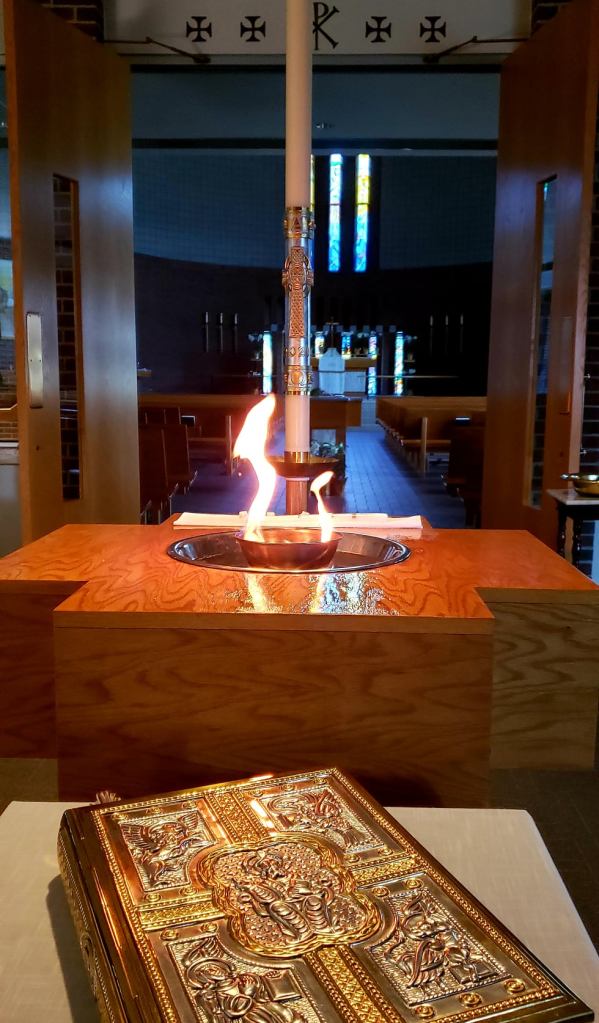
Holy Week begins today with Palm Sunday. Like any other week, Holy Week has seven days. And yet, it seems exceptionally longer than the others. By the time we get from Palm Sunday to Easter, a lot will have happened. For perspective, here at Our Savior, we will have packed at least ten weeks of sacred worship into these seven days. For our Kantor, musicians, and choirs, that’s an abundance of preparation and rehearsals. For the pastors, among so many other things, that’s a lot of sermon writing. I suppose that’s why you might hear me say in jest that the Lord and His pastors trade places on Easter morning. I often get very sick the week after Easter, usually from over-exertion. Although, I think it hit me early this year. I was terribly sick this past week.

Getting sick this time every year is one of many proofs that I could not do what the Lord did. He endured cosmic suffering. And yet, I count myself blessed if I can think through and preach a relatively coherent Easter sermon after Lent and Holy Week’s busyness has concluded.

I had an interesting conversation about these things last Sunday in the ER at Maclaren Hospital. A man sitting a few seats away from me in the waiting room started it. The worship pastor at his church, he endeavored to ask me how my church “does” Easter. I told him, even taking a chance at assuming between two clergy its exhausting nature. I assumed incorrectly. Along the way, he asked rather awkwardly why we continue doing it this way, especially when I almost always get sick year after year. At first, I took it as a reasonable observation and told him I had thought about cutting things back a little. But then he did something else. He took a passive-aggressive shot at what he believed was traditional worship’s tiredness. As he did, He explained worship shouldn’t be tiring, and he went out of his way to tell me that his church’s worship life could never be considered exhausting, that his church’s contemporary style was comfortable and easy—always fresh and new, always joyful, and always inspiring. He explained that worship is about praising God—about really feeling it, and blah blah blah.

Let me first say that’s not what worship is about. Praise is part of it (the lesser part, mind you) but that’s not its purpose. Worship begins with God. He serves us what we need—forgiveness. We respond with prayer, praise, and thanksgiving. Think Isaiah 55:11 and Ecclesiastes 5:1-3.

Next, I’ll ask, “Why?” What’s going on inside a person that would cause him to impose on a stranger in this way? I get that I’m easily identifiable in my clerical collar, and perhaps by it, I may represent a more traditional position. I’m no stranger to such interactions. But that alone doesn’t invite the imposition. I certainly didn’t ask for a critique of our worship style or life. As a normal human being confiding in someone I assumed might understand, I would never even think to steer into another church leader’s sphere in this way. I have no reason to criticize him. I’ve never been to his church.

Thankfully, few clergyfolk I meet are like this. Most just want to meet and visit—like normal humans. Also, thankfully, I didn’t have the time (nor the mood) to debate this particular guitar-slinger. I was seconds from being escorted to the bedside of one of my church members who’d been in a car accident. I was pondering my words to them and not to the worship pastor. Although, Blaise Pascal’s thoughts on reason would have been appropriate if the conversation had continued. Pascal once said something about how human reason’s final use is to admit there’s an infinite vastness beyond its capabilities.

What does this have to do with the interaction I just described? If I’d had the time and energy, I think it might have mattered in at least two ways.

First, Holy Week does sometimes feel unreasonably challenging. As I said, I’ve considered excluding some of the worship opportunities for this reason. And yet, as Pascal implied, even human reason admits to blessings that can only be reached by extending beyond what’s reasonable. No, the Lord doesn’t want us murdering ourselves with devotion. Still, we can (and often should) stretch ourselves past what we know is easier. This is the “no pain, no gain” principle. Still, even in an elementary sense, we also can’t remain infants, drinking only milk. We need solid food (1 Corinthians 3:1-13). The historic rites and ceremonies of the Church embody this opportunity, and if there’s ever a time to reach for solid food, it’s during this pinnacle time of the Church Year.

Some might refer to our worship style here at Our Savior as “high mass.” That description has various outside interpretations. Although, compared to other Lutheran churches, I can guess what it means. Still, I’m not interested in the other churches. I’m the pastor here. And no matter what is implied or who we’re being compared to, I’m convinced we’re enjoying solid food in this place—meat and potatoes, not frozen waffles and milk duds. It’s certainly far from being about the preacher or service meeting us right where we are, giving us what we like, and never demanding anything more. God does not call for us to remain forever where we are. We are to reach higher (Colossians 3:1-2).

By the way, a person should be able to tell when they’ve left the “where we are” of every day and entered into the new day of “higher.” Our regular worship is already wired for this. Stop by anytime. You’ll know you’ve stepped from the secular world onto holy ground. Holy Week is this on steroids, and for very good reasons.

This stirs a second thought relative to what’s reasonable. Pascal admitted to an endless array of things beyond reason’s reach. Isn’t that more or less a nod toward the nature of faith? It’s the same kind of nod Saint Paul offers in the Epistle appointed for today’s Palm Sunday celebration. In Philippians 2:6, Paul admits Christ’s incarnation was an ungraspable truth existing far beyond reason’s borders. Very little about it makes sense. However, as challenging as it is, it’s utterly accessible to faith. This is where I might have pushed back on my conversation partner even further, crossing the border into his doctrines and sharing how I think it’s strange how someone like John Calvin could ever insist, “Finitum non capax infinitum,” which is to say, finite things cannot contain infinite things. Of course, Ulrich Zwingli assumed it years before when debating Luther at the Marburg Colloquy in 1529. But either way, to say the infinite cannot be located in the finite is to be trapped behind reason’s barrier. It certainly binds God to human premises.

Since I’ve already mentioned Christ’s incarnation, if Calvin’s words are valid, then we must dismiss Saint Paul’s reason-pummeling words in Colossians 1:19-20, where he writes, “For in [Christ] all the fullness of God was pleased to dwell, and through him to reconcile to himself all things, whether on earth or in heaven, making peace by the blood of his cross” (Colossians 1:19-20). Had the conversation gotten this far, I would have encouraged my new ER friend to reconsider what the finite containing the infinite means for things like Baptism and the Lord’s Supper. I’m guessing he thinks these are just symbols. I wouldn’t attack him on this. But I would at least ask, “Is it possible they could be more?”

In the meantime, yes, the fullness of the infinite God was located in a finite human man—an object occupying a limited location. That man was Jesus. No, it doesn’t make sense. And Paul knows it. But that doesn’t stop him from upping lunacy’s ante in the Palm Sunday epistle with the reminder that the God-man Christ actually died. You think the incarnation is unreasonable; how about God dying? Paul goes further into irrationality, adding, “even death on a cross!” (Philippians 2:8).

The historic rites and ceremonies dig deeply into this, especially during Holy Week. From Palm Sunday through to Holy Wednesday and then the Triduum—the holy three days of Maundy Thursday, Good Friday, and the Great Vigil of Easter—it’s a week that carries us into these things and more. It isn’t just a day or two of our favorite and most syrupy worship songs, whatever Bible verses the preacher happens to prefer at the time, and an engaging sermon with some fetching slides. It’s several days of reaching further.

To be fair, I should come at this from another direction. As insulting as the worship pastor in the ER waiting room was with his passive aggression (most of which I didn’t share), I’ll admit some in my more traditional camp do the same things he did; not a lot, but a few. They take similar opportunities to impose their pretentiousness rather than enjoying the conversation and encouraging others toward Christian worship’s inherent beauty and benefit. For example, they can make a pastor shepherding a storefront church feel lesser for not having what they have or doing what they’re doing. Again, there aren’t a lot of them. But as the saying goes, there’s one in every bunch. Confessional Lutheranism is no exception.

In conclusion, let me just say this: For those out there who are moving in the better direction—who are reaching higher—whether or not you have the classically ornate worship space, vestments, smells, bells, or whatever, I encourage you to stay the course. You already likely know we’re in a dark time in worship history, days when almost anything goes, and as it does, the faith that worship is supposed to feed becomes shallow and weak among so many. Nevertheless, anyone who’s served as a pastor for any reasonable length of time will tell you that shepherding God’s people from point A to point B takes time. Building the muscle to reach higher takes exercise. Catechesis is key. Introduce. Teach. Stay the course. As you do, rest assured your labors are not in vain, no matter the pace or progress.

And some final advice: If a man in a waiting room scoots a few chairs closer to you to have a genuine conversation about differing worship styles, enjoy the discussion. Such conversation can be refreshing and interesting. But if a peacocking purpose becomes obvious, before the conversation goes any further, I recommend leaning toward him and asking with wide room-scanning eyes, “You can see me?” That’ll close the conversation shop’s doors. Of course, if you’re not comfortable doing that, first, compliment his retro tee, and next, tell him the hospital called you to perform an exorcism, asking if he’s the one they called about. That’ll probably work.

Humanity Is Not Free. Christians Are.

Lent is nearly upon us. The next three Sundays—Septuagesima, Sexagesima, and Quinquagesima—prepare us for its spiritual throttling.

In a way, worshipping communities that employ historic liturgies already have the upper hand on Lent’s penitential nature. They’ll easily recognize the following words’ shackling character used at the Divine Service’s beginning:

“Most merciful God, we confess that we are by nature sinful and unclean. We have sinned against You in thought, word, and deed, by what we have done and by what we have left undone. We have not loved you with our whole heart; we have not loved our neighbors as ourselves. We justly deserve Your present and eternal punishment.”

Or perhaps you know it another way:

“I, a poor, miserable sinner, confess unto you all my sins and iniquities with which I have ever offended You and justly deserved Your temporal and eternal punishment.”

Present and eternal punishment. Temporal and eternal punishment. Same thing. The spheres of this world and the next are both included.

Indeed, these words are incarcerating, leaving no room for escape.

Essentially, we first approach God’s altar admitting to something. Even as believers, the nature of faith has a sense of what that something is. Faith reminds the believer to think twice before approaching God according to our human virtues. We should never think He hasn’t the right to send us away in shame. We should never be so comfortable with ourselves that we begin to think His wrath is something we don’t merit. And so, before anything else occurs in the service, believers go to their collective knees in confession. We fold our hands. We keep our heads low. We establish a posture before the One who has every right to eradicate every swirling atom of this fallen creation. We do this agreeing to His description of humankind, not our own, a description rendered so eloquently—so searingly—in His holy Word.

I’m doing more reading these days than ever before, almost to the point of it being unenjoyable. I read somewhere along the way that Frank Lloyd Wright designed his unique structures in ways that communicated his heart’s greatest love for nature. What stirred in his heart caused him to say, “The space within becomes the reality of the building.” I get what he means. He was an architectural artist. And his words sound nice. However, I’ve seen some of Wright’s buildings. In my opinion, they’re as impractical as they are impressive. But what do I know? That being said, if you really want to see a genuine architectural rendering of a human heart, stop by any of the thirty-one prisons in Michigan. There you will see a more authentic representation of humanity’s viscera in an architectural form. You will observe an exterior adorned by multiple rows of massive fences decked in razor wire surrounding windowless cinderblock. What will you discover within? Through the facility’s massive metal doors, you’ll find wall after wall securing one human cage after the next.

A prison is the human heart’s best interpretation because, of itself, humanity is not free.

As I said, I’ve been reading quite a bit lately from lots of sources. Cyril Connolly is a writer I discovered by way of Rudyard Kipling. Connelly said something about how everyone is serving a life sentence in the dungeon of self. For as depressing as that might sound, he wasn’t that far from what Saint Paul meant by a number of phrases employed throughout his Epistle to the Romans. He writes things like “the law of sin and death,” “enslaved to sin,” and “the wages of sin is death.” Paul is trying to tell us something.

For one, he wants us to know we can’t keep God’s Law rightly. As humanity is enslaved to Sin, so is humanity dragged along by the innate desire to break God’s Law. Paul says as much, writing, “For the mind that is set on the flesh is hostile to God, for it does not submit to God’s law; indeed, it cannot. Those who are in the flesh cannot please God” (Romans 8:7-8). Naturally, when laws are broken, a judicial wage is earned: punishment. With this, we find ourselves closer to what Paul needs us to know by these phrases. Even apart from their proper context, we know something more about humanity. We not only begin to sense the handcuffs—the very real restraints that bind us to our treachery—but also the eternal punishment we’ve earned in destruction’s terrible cell.

And yet, God’s inclination has never been to punish, imprison, or destroy. He wants to show mercy (Luke 23:34, 6:36; 1 Peter 1:3; Lamentations 3:22-23). He wants to forgive. He wants to redeem—to buy back the criminals from their fate. He wants to set humanity free. Already knowing that the Gospel “is the power of God unto salvation” (Romans 1:16), the rest of the text surrounding Saint Paul’s select phrases brings this Gospel and instills the freedom God desires:

“We know that our old self was crucified with him in order that the body of sin might be brought to nothing, so that we would no longer be enslaved to sin” (Romans 6:6).

“For the wages of sin is death, but the free gift of God is eternal life in Christ Jesus our Lord” (Romans 6:23).

“For the law of the Spirit of life has set you free in Christ Jesus from the law of sin and death” (Romans 8:2).

The Good News is that Christ has won your freedom. He has paid the price. Faith in Christ binds the believer to Christ, thereby binding that same believer to the certainty that he cannot be condemned to Sin’s chains or held captive by Death’s cell.

The forthcoming Gesima Sundays are delivering us into this news in unique ways. Listen carefully. Lent will display its combat. Pay close attention. Good Friday will demonstrate the great exchange. Don’t miss it. All these things will culminate in a horrendously wonderful trial resulting in a hideously sweet verdict: Christ must take humanity’s place in judgment on the cross. The guilty ones are free to go.

And then Easter. Oh, Easter!—the joyful proof of the debt’s payment followed by the prison’s absolute demolition from the inside; a glorious work accomplished by the only Prisoner who could do it!

The Routine of Rest

I suppose that with the beginning of summer comes changes to routine. In this particular instance, I fully embrace the change. With anything else, however, I struggle with disruptions to routine. I’m a perpetual preschooler in the sense that I prefer to know what’s next. If you don’t know what I mean by that statement, ask a preschool teacher to explain it. Better yet, ask a substitute preschool teacher. Such a person will likely have experienced what happens after accidentally introducing an unexpected change to a classroom regimen. My guess is you’ll hear the nightmarish tale of having been tied to the craft table and circled by a mutinous band of rage-filled three-year-olds chanting, “It’s music time at nine o’clock, and then we have our morning snack. You skipped music time! You skipped music time! You skipped music time!”

Since I appreciate routine, you probably guessed I’m not a big fan of surprises, either. One example worth sharing as it meets with my job as a pastor: I don’t like cryptic requests for future discussions. In other words, I get a little worked up when people approach me saying they have something very important they need to discuss but they can’t tell me what it’s about. That usually leaves me in a psychological dead space that can (and likely will) be filled with just about anything.

“Maybe she’s angry with me about something,” I begin thinking. “I wonder what I did.”

“Perhaps he’s going to corner me with a big investment opportunity,” I ponder uneasily. “Doesn’t he know I’m pretty much broke?”

“I’ll bet they’re aliens,” I guardedly wonder, “and they’re planning to get me alone in a room so they can eat, digest, and then mimic me.”

Who knows?

Now before I free-think myself too far away from any of this being even a little bit worth your while, when it comes to surprises imposing upon routines, ironically, I was actually pleasantly surprised to identify a particular routine occurring in my life that I didn’t know about. I recognized it when Jennifer observed, “You can’t just sit still and relax, can you? You always need to be doing something.”

A minute or two after her remark, I realized she was right. (Of course, I didn’t tell her she was right. Every husband knows to limit how many times a day he admits such things.)  I was surprised by the realization that much of the gratification I get in life is found in the process of doing rather than actually reaching the destination of completion.

Don’t get me wrong. The joy that comes with a completed project is nice. But as a person whose primary task is to minister to people, the hard truth is that I rarely enjoy a series of completed projects. Almost everything I do is an on-going process, which is why I rarely complain about tasks like mowing my lawn or repairing things around the house; or why I’ve even been known on occasion to mop the floor of the church or scrub a carpet stain in the narthex. Seeing something actually begin and end provides occasional fulfillment. But strangely, just as Jennifer inadvertently suggested, the fulfillment achieved by completed tasks is often short-lived for me, which is why when a project is done, I’m almost always on to something else. I can’t sit still and relax. I must get about the process of doing.

The point I think I’m making is that I realized one of my fundamental routines is to exist in a perpetual state of pursuit. The more I think about this, the more I realize the good and bad aspects of it.

A good side to this is that I’m never bored enough to ask, “What’s the use in living?” I’m too busy mining life for its gems to be worried about asking what life has in store. Look around. There’s plenty to keep any and all of us busy.

Another positive aspect to such a routine is the strengthening of determination and the gladness that eventually ensues. The more I experience obstacles to my aspirations, the more I feel the need to find ways to break through, occasioning an even greater measure of gladness when I finally arrive at the prize. Success is certainly sweetest when all along it seemed impossibly out of reach.

But there are negative aspects to this routine, too. It can slowly boil you into false narratives.

To dwell in single-minded pursuit of anything has the potential for seeing a person distracted from far greater blessings happening on the periphery. This can be detrimental to family, friendships, and so much more. The typical example of this can be found in the parent who’s always working and never has time for the children. Such a person misses out on a lot, much to the injury of those they love. Another real-world example that comes to mind involves my wife’s grandfather who spent most of his days building a seawall at his home in Florida. While Jennifer’s grandmother (wheelchair-bound) passed the time doing various things indoors, my thought was that he was missing valuable time with her as he worked on the wall day after day, adding layer after layer of concrete. I’m guessing he died preparing to mix another bag of cement, convinced that just one more day of laboring on his seawall would result in its perfection.

Stepping from this particular image, I suppose another dangerous aspect to a routine of always doing and never resting is the prospect of human effort becoming the sole determiner for success not only in this life, but also for the life to come.

When it comes to eternal life, we would never want to be deceived into thinking God is recording a tally sheet of our good deeds. And lest you think that’s the point of Jesus words in Matthew 25:34-40, take another quick look:

“Then the King will say to those on his right, ‘Come, you who are blessed by my Father, inherit the kingdom prepared for you from the foundation of the world. For I was hungry and you gave me food, I was thirsty and you gave me drink, I was a stranger and you welcomed me, I was naked and you clothed me, I was sick and you visited me, I was in prison and you came to me.’ Then the righteous will answer him, saying, ‘Lord, when did we see you hungry and feed you, or thirsty and give you drink? And when did we see you a stranger and welcome you, or naked and clothe you? And when did we see you sick or in prison and visit you?’ And the King will answer them, ‘Truly, I say to you, as you did it to one of the least of these my brothers, you did it to me.’”

Consider the word “inherit” which occurs right at the beginning of the King’s proclamation. An inheritance isn’t something you earn. It’s something you receive because of who you are in relation to the giver. A son does not inherit from his father because he worked hard, but rather because he was his son. By faith, we are sons and daughters of the king (Galatians 3:26), and as such, we are inheritors of the kingdom.

So, why then does the King recall the things the inheritors have done?

Because these are the naturally-occurring proofs of family membership. These are the customs—the traditions and culture—of the citizens of the kingdom. Notice that the inheritors don’t really even remember what the Lord is describing. And why? Because they weren’t performing the deeds in a calculated way, one intent on seeing them worked into some sort of divine ledger used to tally their credits toward the forthcoming reward. Instead, they simply did them because of who they were by nature of faith.

This is not a text teaching works righteousness, but rather an accounting of the eternal reward given to those who trust in Christ for salvation.

Martin Luther weighed in on this, saying things like, “If the saints did their good works in order to win the kingdom of heaven, they would never win it. Rather, they would be counted among the wicked, for they would be considering with evil eyes their own good…” (On The Enslaved Will, 163 f.).

In particular, and because we’re heading into the new routines of summer, this takes aim at one very important theme behind God’s mandate regarding Sabbath rest. Being the gifted Old Testament exegete that he was, Luther explains the mandate very simply in his Small Catechism:

“Remember the Sabbath Day by keeping it holy. What does this mean? We should fear and love God so that we do not despise preaching and His Word, but hold it sacred and gladly hear and learn it.”

In other words, an important thrust of the Third Commandment is to keep us connected to the source of God’s perfect labors on our behalf. We can work all we want at so many other things in life, and we’ll likely experience a multitude of successes as we do. But when it comes to considering human effort as an all-encompassing factor in the narrative of Man, we should stop and take a contemplative breather. We should understand that we do not deserve nor can we even begin to earn our place in God’s presence. It’s by God’s grace—by His work—that we take our place before Him, whether here on earth or in heaven. Here in this sphere, He reaches to us by His Word both in worship and study. That’s Sabbath rest—a time set aside for God to engage us in some extraordinary ways. This is one reason why Lutherans (at least LCMS Lutherans) refer to holy worship as the “Divine Service.” The tendency is to think that Christians gather for worship simply to praise God, but it’s really the other way around. God is gathering us in order that He might serve us—that He might care for us. We rest in the arms of God’s wonderful love in worship as He serves us with His abundant mercy and wonderfully rich grace through Word and Sacrament ministry. He speaks and works, and by the nature of faith, we listen and reply with thanksgiving and praise. Keep these things in mind as the new summer routines take hold. Spend the extra time in the summer sun doing and then doing some more. But then be sure to stop doing and relax. Go to church. Rest in the arms of your Savior in worship, recognizing there’s nothing you can do for Him that He needs, but instead, you need everything He has promised to do for you.