
I would usually sleep on the cot in my office at the church on a snow-laden day like today. But not this time. I slept in my own bed at home last night.
For one, I prefer to make sure everything remains in good working order throughout the night, namely, that the heat and power continue uninterrupted. I also prefer not to be the only one out on the unplowed roads at 4:00 in the morning. And that’s precisely what they were on the way in. As the years go by, it seems less thought is given to the churches—to the fact that God’s people are still gathering, still trying to make their way to worship. I get the sense that Sunday morning simply isn’t factored into anyone’s plans anymore, certainly not the folks deciding what gets plowed first.
Still, in all of Our Savior Evangelical Lutheran Church in Hartland, Michigan’s 70 years, we’ve never canceled a service. Not once. And it certainly isn’t going to happen on my watch. So, rest assured, the lights are bright. The heat is on. The Lord’s gifts of Word and Sacrament will be given, no matter how many gather to receive them.
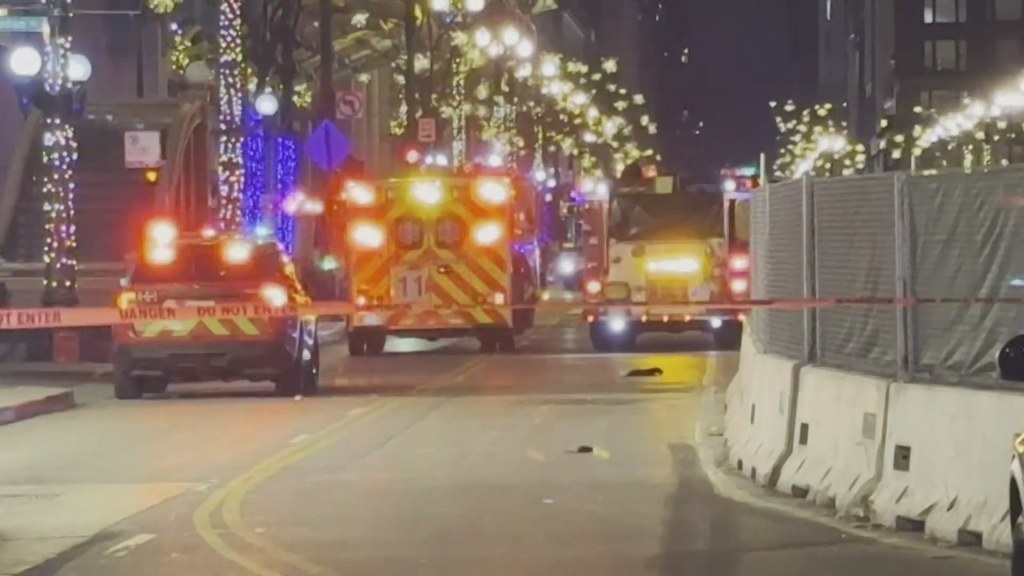
The holy season of Advent begins today. That means Christmas is coming. And yet, last weekend at an event anticipating Christmas—a Christmas tree-lighting ceremony in downtown Chicago—shots rang out, resulting in one dead and eight seriously wounded. That same night, in Concord, North Carolina, another tree-lighting ended in gunfire. Four were shot. Three of the victims are still in critical condition.
Violence in Chicago is a pretty standard thing. It’s one of the most dangerous cities in America. Concord, North Carolina, not so much. In fact, it ranks among the safest cities in America. Safe or not-so-safe, what makes all of this stand out is the setting. Although Christmas trees no longer mean to most what they’re supposed to mean. The whole point of a Christmas tree is Jesus—or at least it used to be, way back when Christian communities looked to the evergreen as a reminder of life in Christ during winter’s deathly season. But now, it’s little more than a seasonal prop stripped entirely of its sacred center. Still, public tree-lighting ceremonies continue to be celebratory opportunities, and if anything, a warm assumption of community. That’s nice. But it obviously isn’t enough. Not when dreadfulness suddenly intrudes. And in the end, that may be the most sobering point of all. Whether you live in a city known for violence or one praised for its safety, dreadfulness always finds a way in. And then what? I only ask this question having read some of the words from victims’ families, which I’ll get to in a moment.
In the meantime, I’ll simply say that sin can and will fracture anything devoid of Christ. When Christ is removed, wherever He once was is instantly hollow. An empty object is a fragile object. It certainly has no power to restrain real darkness. But that’s because Christ is missing, and He’s the only One who can carry us through times of need. In this sense, last weekend’s violence during the Christmas tree-lighting ceremonies served as a kind of grotesque sermon, reminding all of us how Christological substance is desperately needed in our lives, and how humanity just cannot manufacture it, not even through seasonal civic ceremonies that look and feel nice but in truth are entirely devoid of real meaning. This brings me back to Advent.
For the churches that observe Advent—and I mean, actually observe it—we know the centuries-old pre-Christmas season is by no means hollow. We know its language and sense. It’s a penitential time, one that acknowledges sin’s dreadful grip. And yet, Advent stakes a firm claim in hope as it simultaneously looks backward to the Rescuer who came at Christmas, and also forward to that same Rescuer’s promised return at the end of days. As we Confessional Lutherans tend to say, it’s the kind of hope that knows the fullness of God’s promises in the “right now” but also the “not yet,” all at the same time.
This weird tension is essential to Advent. It names sin honestly. It knows the situation is dire and, therefore, refuses to minimize the brokenness responsible for the violence we saw last weekend. But it does this while anchored in what Christ has done, is doing now, and will continue to do. That’s Christian hope. Christian hope is not some hollow form of vague optimism. That’s what happens at civic tree-lighting ceremonies. Advent’s longing is a deliberate, time-spanning trust that the same Savior who entered history will keep His promises, one of which is to return to set everything right. That makes Advent far more than a season that’s waiting for Christmas, but one filled with holy confidence rooted in history, promise, and unquestionable fulfillment.
That’s a place where only Christians can live.
By the way, this is not a claim of moral superiority. It’s one of theological location. To live in the “right now but not yet” requires faith. Only those who have heard God’s promise in Christ and, by the power of the Holy Spirit, believe, can stand in the middle of that tension without being crushed by it. It is a narrow place. But in its narrowness, there’s a freedom the world cannot replicate. It tries. But it just can’t do it.
Remember, Christians started all this decorating stuff. We decorated evergreens, lit candles, and hung lights. We sang ancient hymns that communicated the Gospel’s backward and forward perspective. We still do it. The world has similar traditions this time of year. It decorates evergreens, puts up light displays, and sings its holiday songs. But between the two spheres is a strict separation. Buffeted only by the world’s empty décor, culture’s residents experience what happened in Chicago and North Carolina, and suddenly, their holiday is tainted with despair. I read an interview with one of the Chicago victim’s family members. The woman being interviewed said she may never celebrate Christmas again. Essentially, the memory is too terrible, and now the holiday is, too.
I get how that could be true, especially when your only framework is a sentimental, once-a-year version of joy tied to things that can be ripped away at any moment. When that’s the case, then any tragedy is enough to make every twinkling light or holiday tune feel forever poisoned.
But from the Christian perspective, with Advent’s Gospel in mind and heart, we light candles and hang lights, not to deny the darkness, and not even because the darkness might be scary. We know it is. But we also have no intention of granting the darkness final authority. We keep singing our joy-filled hymns, not necessarily to cope, as though we’re in some starry-eyed form of denial, but as an act of genuine defiance against sin, death, and the devil. We sing because the Gospel has the upper hand, not the darkness, and we know it. And so, we are perpetually hopeful.
I guess one thing I’m saying is that Christian rituals like these, no matter how the world might twist or imitate them, will forever be Christian property. We own them. And because we know better, they’ll always be acts of resistance rather than seasonal sentiment. The evergreen—a plant that keeps its green even when all life around it has come to a frozen halt—for Christians, it’s a visible confession that death does not have the final word. A candle is not mere ambiance for us. It’s a proclamation that Light has entered the world and cannot be overcome. The hymns are not background music, but instead longstanding confessions of the one true faith that has survived the worst this world could throw at it. In fact, the chief hymn appointed for the First Sunday in Advent is proof alone. “Savior of the Nations, Come” was written by Ambrose of Milan. He lived from 340 to 397. And still, here we are, age after age of dreadful violence and persecution, and we’re still singing this great hymn of incredible hope, one that tells the entire Gospel story in eight beautiful stanzas.
This is proof that we own Advent and Christmas.
And so, while the world scrambles to make sense of yet another demonstration of human awfulness, the Church stands where it has always stood at this time—right in the middle of human ruin, all the while holding tightly to God’s promises. We stand there unshaken, proclaiming that this world’s terrors cannot overcome us. The Light of the World has come and is coming again. We know that everything around us is temporary, yet the forthcoming King and His kingdom are eternal. That divine knowledge shapes the entirety of our reality. And that’s that.
Indeed, the world is experiencing a sentimental countdown to a holiday. But that’s not us. Christians continue taking to a sacred battlefield, knowing the ultimate victory has already been accomplished and that the final victory is at hand. And the churches that observe Advent—and I mean, actually observe it—their senses are being honed to this truth.

 Cruciform Stuff