
Self-Deceit

Lying to others is wrong. Lying to oneself is deadly. These were just a few of several recurring thoughts I experienced while watching the film Gender Transformation: The Untold Story, which the Life Team here at Our Savior in Hartland, Michigan, presented during a public forum this past Friday. Our world is right now living the dreadful compounding of lie upon lie to others and to self concerning God’s magnificent design of male and female.

But here’s the thing. While perhaps not as conspicuously awful or with such unalterably horrible results as the deceit presented in the film, we all lie to others and ourselves. If we believe we don’t, then we’ve already proven we’re self-deceived.

I think one reason we end up self-deceived is because of the way we so often prefer to process reality. We have interpretive filters. We experience something, and as we do, rather than its meaning simply being its meaning, we wittingly or unwittingly recraft it to fit us more comfortably.

For example, have you ever said something you intuitively knew was hurtful, and even as you meant the words to cut your opponent, when they did, to protect yourself from feeling bad, you insisted he or she misunderstood you? That was an interpretive filter you used. Specifically, it’s called gaslighting. Most folks might say gaslighting is more others-deceptive than it is self-deceptive. Perhaps. Either way, it’s a self-insulating barrier preventing what’s real from getting through as it should.

But enough psychoanalysis. The better exercise is figuring out why things are this way and what to do about it.

The “why” is easy. The Bible says it’s because of Sin (Psalm 51:5, Romans 3:23-24, Ephesians 2:3, etc.). Concerning self-deception, Saint John digs into the why’s soil and discovers the contaminant’s results, writing, “If we say we have no sin, we deceive ourselves, and the truth is not in us” (1 John 1:5). Paul digs beside John and finds more ruined soil: “For if anyone thinks he is something when he is nothing, he deceives himself” (Galatians 6:3). Shovel in hand, James hops into the hole and discovers the same, adding: “But be doers of the word, and not hearers only, deceiving yourselves” (James 1:22).

Again, the why is easy. But now, the harder part. What do we do about it?

I have two things to say in this regard. The first is Christological. We must always start with Christ and His Word.

As John, Paul, and James went deeper into the strata, other discoveries were made. Right after discovering Sin’s potential for self-deception, John also found the fertile soil of God’s gracious invitation, noting, “If we confess our sins, [God] is faithful and just to forgive us our sins and to cleanse us from all unrighteousness” (1 John 1:9). Paul found something else, too. Back in Galatians 3:11, he wrote, “Now it is evident that no one is justified before God by the law, for ‘The righteous shall live by faith.’” James made the same discovery. After nudging his readers from complacency, urging them to be more than just hearers but also doers of what the Lord desires, he dusted off a glistening stone etched with the words “the perfect law, the law of liberty” (James 1:25), which is James’ rhetorical way of pointing his readers to Jesus, the One who is the law’s perfection, the One who sets us free from the law’s burden so that we can be those who not only hear His Word but keep it (Luke 11:28).

While the three dig deeper still, the Psalmist arrives singing a faith-filled work song, one that asks God for help against deceit. The Psalmist sings, “Put false ways far from me…” (Psalm 119:29), and “Save me, O Lord, from lying lips and from deceitful tongues” (Psalm 120:2).

The second thing I want to say is as practical as it is Christological. Essentially, the Gospel nuggets are enough for faith (Romans 1:16). The faith it produces results in repentance. That’s what it does. The word “repent” (μετανοήσατε) literally means to turn around and go the other way—to change the direction of one’s mind or purpose. From a human angle, repentance is incredibly self-analytical. It wants to rid itself of faulty filters. It wants to remove anything that might deceive the self. It wants to boil things down to their mineral elements, see what’s actually there, and fix what’s broken.

For example, consider the following scenario.

Let’s say one of my daughters was troubled about something and asked for a moment of my time, but I reasonably replied, “I’m sorry, honey, but maybe later. I just don’t have time right now.” I had a sermon to write. I had a phone call to make. I had a meeting to attend. Repentance removes the filters and sees the situation for what it is. Relative to this situation, among the long and varied list of things a person should do, repentance understands the role of priority. And so, it hears what was said as, “I’m sorry, honey, but you’re just not a priority to me right now.”

Saying it that way doesn’t feel so good. That’s true, in part because of repentance’s natural direction. Remember, repentance is a reversal. The process of going one way becomes one of moving in the opposite direction. As a preacher, I think there’s more than one way to experience this reversal’s impact. Similar to exchanging the phrase “I don’t have time” for “you’re not a priority,” the same astonishing swap is possible when we invert our language, saying out loud the opposite of what’s actually true. Here’s another example.

I mentioned to Jennifer last week that one day, I’m going to preach a sermon in which everything I say is the exact opposite of what the listeners would expect me to say. The reason? It’s one thing for the average pew-sitter to make excuses for sinful behavior. But what if those same excuses were being commended from the pastor’s mouth? I can only imagine the congregation’s response to me preaching that presence in worship isn’t all that important. How startling would it be to hear me say from the pulpit that fidelity to Christ is just as important as fidelity to all the other things taking up space on our calendars? Would there be wide eyes as I say there’s nothing wrong with putting God’s Word in the back seat on occasion? Would there be gasps when I say God knows we sometimes need a break from Him and that He’s perfectly content playing second fiddle in our lives?

I’d go on and on, never once saying what you’d expect from a Christian pastor. I think the language reversal would be overwhelmingly eye-opening. Like telling my daughter she’s not a priority, it just wouldn’t feel right.

The people here at Our Savior will undoubtedly know if and when I attempt this. Until then, think about what you’ve read so far. Ask yourself, “Do I have interpretive filters that make lying to myself easier? Do I shield myself with excuses that do little more than keep me comfortable doing the things I know I shouldn’t?” If the answer is yes, then contemplate the dangers of insulating yourself in this way and repent. Turn around and go the other way. If the answer is no, then consider that you may already be self-deceived and don’t know yourself as well as you think you do. And then, as with the first answer, repent.
God Will Let It Slide, Right?

I’m reminded of something my daughter, Evelyn, said to me on our way to the school this past Thursday morning.

Folks in Michigan will recall that Thursday was quite the sunny day. Even at 6:45am, which is when Evelyn and I set out for the day, the sun was already well above the horizon. Turning east out of our subdivision, the sun’s beams poured through the windshield, filling the car with its glory. It felt good—the warmth on my face in crisp distinction from the chill just outside my window. Even as it was somewhat blinding, before feeling the need to adjust the sun visor, its first stirring was that of happiness.

Surprisingly, Evelyn grumbled.

“I don’t like the sun in my eyes,” she said, scooting up in her seat and reaching to adjust her visor.

“I love it,” I replied, my visor still tucked neatly above the windshield. “It feels good.”

“I don’t,” she countered. “It’s too bright.”

“Well,” I added, “we probably shouldn’t complain about it, especially since we’ve been longing for days like this all winter.”

Evelyn didn’t respond, but I could tell she was reconsidering her position.

Certainly, I understood her frustration in the moment, especially since I was piloting the vehicle. For as much as I enjoyed the sun’s resplendence, I needed to be able to see, and the sun was making that a little more difficult. Still, the last thing I ever want to do is lie to myself, expressing any dismay at all for something I’ve been waiting more than a half-year of mornings to enjoy. In my eyes, or wherever, the sunshine was a welcomed guest to a long-suffered winter.

Tapping away at the keyboard while recalling this circumstance, I suppose there are plenty of lessons within it to be learned by it. Although, I can’t think of one in particular.

Okay, how about this…

Looking back at what I just wrote, the lesson that seems most prominent is the foolishness found in lying to oneself.

One of the worst things that anyone can do is to lie to his or herself. And it’s not necessarily the lie itself that holds all the danger, but rather the potential for becoming so convinced by your own deception that you willingly exchange truth for untruth. This reminds me of a video of Joe Biden from 2015 I watched this past week. It was a quasi-interesting twenty minutes of Joe sitting before a fawning reporter and cameraman and doing what Joe does, which is to wear a triangular smile while rambling incoherently. And yet, during the purgatory-like segment of softball-question nonsense, there was something Joe spoke about with relative unequivocalness. I ended up posting something about it on Facebook. Here’s what I wrote:

“I just watched a portion of a video of Joe Biden from September of 2015 in which he attempted to describe the authenticity of his Catholic faith. Barely a few minutes into his plastic words I had a thought. To be a liar is one thing. To be a sincere liar is something altogether worse. Or as Shakespeare mused through the character of Hamlet, ‘One may smile and smile, and be a villain.’”

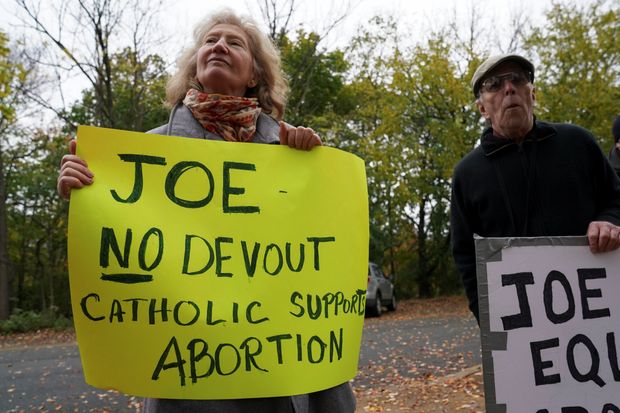
The point behind this comment relates to ongoing news of several Roman Catholic bishops around the country and overseas pushing for Joe Biden to be excommunicated. They’re doing this because Joe claims that one can be a Catholic and be pro-choice—and not just the “safe but rare” kind that the Democrats proffered back in the 80s, but rather the kind that goes right over the cliff into believing abortion (in all of its grisly forms) is a gift from God, and even worse, that full-term abortion is something upon which God dotes with an similarly triangular smile.

Do you know what full-term abortion is? If you guessed a full-term newborn child being killed immediately after delivery, then you guessed rightly. The President of the United States—your president—believes such a thing is holy.

Of course, I expect the nominal Christians to come out of the shadows to say I’m misconstruing his position, that he only supports it in this or that special circumstance. These folks will say this because, well, they voted for him, and like him, they aren’t necessarily using the lens of God’s Word for discerning these things. Well, whatever. Use whichever intellectual dance moves you prefer for avoiding the visceral fact that the President of the United States has given a thumbs-up to doctors delivering and then murdering newborn children if in such a moment a mother decides she doesn’t want her child.

But let me take a brief step backward to where this started.

As a Christian, the only way to arrive at an acceptance of the pro-choice position, no matter the justification, is to lie to yourself about a great many things. It is to lie about what life is and means. It is to lie about life’s Author. It is to lie about what that Author said with regard to human dignity and the truest definition of personhood. It is to wield the Word of God in deceptive ways, and ultimately by such handling, to summarily reject it, whether the one wielding it realizes it or not. Lastly, it is to be caught in the dilemma that to reject the Word of God, by default, is to reject the Word made flesh, Jesus Christ.

You cannot stake a claim in Christianity and reject the Savior who sits at its heart. It just doesn’t work. Thankfully, there remain plenty of Bishops in the Roman Catholic Church who are willing to enforce this basic doctrinal premise.

I wrote and posted something else this past week that comes to mind, too. It had to do with an article from The Federalist entitled “Lockdown Mongers Can Point Fingers, But The Science Is In: They’re To Blame.” By the way, one of the two senior editors at The Federalist is a biblically astute LCMS Lutheran, Mollie Hemingway, whose father is a Confessional Lutheran pastor. I should add that The Federalist has several LCMS writers on its roster of contributors, and in my opinion, that alone makes it one of the few political/cultural news sources out there to be trusted. Anyway, here’s what I wrote when I posted the article:

“The devil has plenty of instruments in his bag, but deception is the glove he wears for wielding each one.”

Again, the point here was to say that there are plenty of tools in the devil’s toolbox for drawing us into Sin, things he uses for convincing us to believe and do the wrong things. But before he goes about his darkly deeds, his grip on each instance begins with deceptively enticing half-truths.

“Sure, I know it’s against God’s Word for me and my girlfriend to live together before marriage,” the young man says, “but it makes good financial and logistical sense to do so. I figure that as long as we have the intention of getting married, God will let this one slide.”

Don’t lie to yourself. Repent.

“It makes perfect sense that the churches are closed,” the husband and wife contemplate over Sunday morning coffee. “The science says that mass gatherings for worship are sure to be super spreaders of the virus. The Church can ‘love thy neighbor’ a lot better by masking up and staying home.”

Don’t lie to yourself. Repent.

“Certainly I’m justified in speaking poorly about that person to others,” she muses. “How could I be wrong in doing so? My friend hurt me, and I need the emotional support from other friends who understand. The only way to get the support is to tell others about what happened.”

Don’t lie to yourself. Repent.

To knowingly persist in such behaviors unrepentantly, having exchanged the truth of God’s Word for lies, won’t end well. Still, the devil will work to convince you that it will. He may even do it in ways that sound pious, kind of like Adlai Stevenson’s infamous words given in jest: “A lie is an abomination to the Lord, and a very present help in trouble.”

Again, I don’t want to lie about the sunshine and say I don’t like it. I love it, even when it’s uncomfortably shining in my eyes. It’s the same here. Don’t be fooled. Stick to the truth of God’s Word, even when it’s uncomfortable to do so. No matter what happens, you’ll have the certainty of real truth. You’ll be traveling along the stepping stones of faith cut from God’s reliable quarry. Along the way, you’ll know and understand the gravity of your Sin—your very REAL Sin—and you’ll know the One who came to forgive you of that Sin, to recreate you by His wonderful love, and to send you out as someone capable of beaming the refreshing and face-warming sunlight of His love in a wintry world of Sin longing for the rescue of a divine summer.