
Ash Wednesday 2024

I felt the urge to reach out this morning. Lent arrives this Wednesday. If there was a season to contemplate mankind’s dreadful predicament, it’s Lent.

I suppose, in a broad sense, death’s predicament is not lost on humans. We’re all facing it. Still, believers have the best handle on it. We have the Gospel—the proclamation of death’s cost and the Savior who accomplished its payment by His own death.

During staff devotions this morning, I shared a portion from Luther. He spoke of the cross and the Christian’s desire to be worthy of it. He wrote, “Is it not a wonder to be possessed of a ready will toward death, while everyone dreads it? Thus is the cross sanctified.”

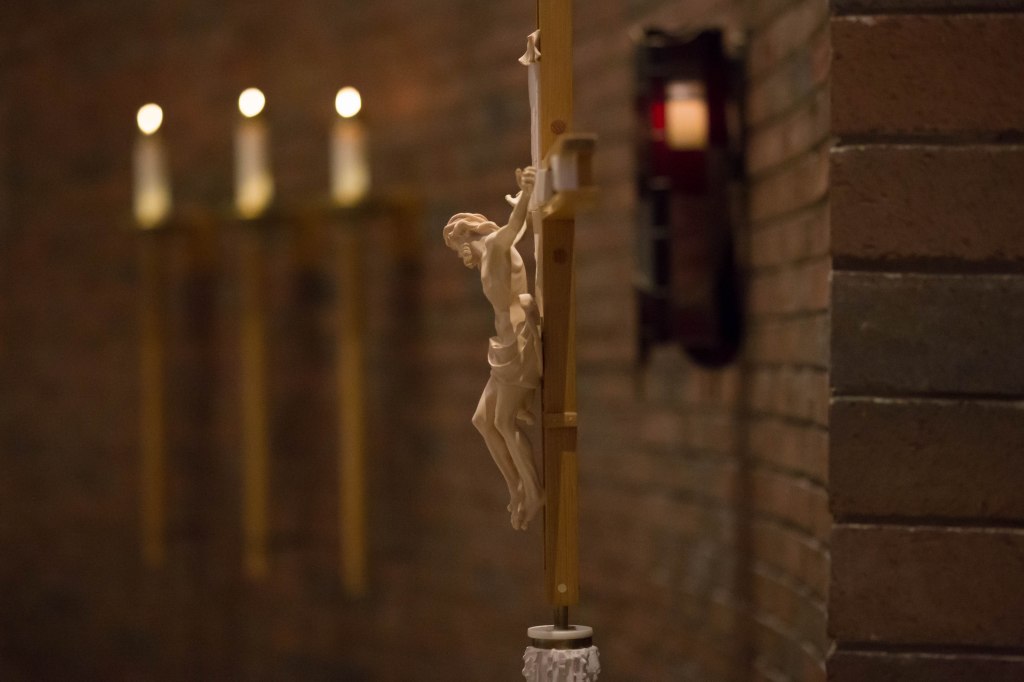
I’m concerned that far too many mainstream churches seem to have lost their formal grip on this. They demonstrate as much by their crucifix-less worship spaces. One pastor (if you can call him that) in a church not far from my own won’t allow crosses to be displayed in his facility. He openly admits that crucifixes—and even bare crosses, for that matter—are offensive to visitors. And yet, Saint Paul preached so fervently, “We preach Christ crucified” (1 Corinthians 1:23), knowing that such a message would be received as offensive and foolish by an onlooking world.

It’s heartbreaking when a church views the cross through the world’s lenses.

You should know what I’ve described is rarely lost on liturgical churches. A liturgical church will likely have crucifixes displayed throughout its expanse—and not just one or two, but many. Interestingly, Paulo Freire, the father of Critical Pedagogy (which is foundational to Critical Theory), insisted that for his Marxist theories to prevail, traditional liturgical churches needed to be deconstructed and their symbols dispensed and forgotten. Freire wasn’t concerned with contemporary churches. Why? Because traditional liturgical churches are by nature impenetrably linked to faith and its symbols, and in Freire’s research, far more dangerous. They don’t roll over when persecuted. They produce a far sturdier commitment than churches devoted to cultural appeasement. Hitler agreed, calling the more contemporary churches in Germany “mushy.” He was more so bothered by historically creedal churches and their believers. The historic Creeds define, teach, and defend truth. A church’s historic liturgies carry it. The church’s calendar—the liturgical seasons—imposes it in long-lasting and unforgettable ways. And by long-lasting and unforgettable, I mean it stays with a congregation generation after generation, binding it to those who came before and those who will come after.

A persecutor laboring to destroy such a church won’t have an easy time. Its identity is built from ranks the persecutor can’t even see.

Here’s some free advice: When any organization (whether it’s the Boy Scouts, your favorite car company, football team, or whatever) begins obscuring its symbols, jettisoning its creeds, or altering its traditions, beware. These are essential to the organization’s identity. When they change, so does their identity. They’re inextricably linked.

I suppose I’ve wandered too far already. So, here’s what I really came here to tell you.

A critical Church season begins this week. It starts with a crucial moment epitomizing the Church’s identity. It deliberately resists desires to loosen our grip on who we are and what we are to believe, teach, and confess.

Epiphany and the Gesima Sundays become Lent. As these season’s crowds approach, Lent’s somber doorman, Ash Wednesday, will clatter through its ancient keyring with cinder-stained fingers to open Lent’s door. Year after year, Ash Wednesday’s digits have etched a cross upon the foreheads of countless believers passing through this entry, elbowing them toward honesty, nudging them toward a vital confession that matters when pondering Golgotha’s truest weight: “Remember you are dust, and to dust you shall return” (Genesis 3:19). And yet, Ash Wednesday’s participants do this wearing a black-powdery smudge in the shape of a cross. Yes, we are dust. We will die. And yet, in Christ, by His death on the cross, we’ve been made alive (1 Corinthians 15:22). Death in Christ is not to die but to live (Philippians 1:21).

Ash Wednesday’s liturgy amplifies what the Christian Church knows about death. It amplifies what we know about a certain Someone who met with death and outmaneuvered it. Ash Wednesday brings us in. Lent will take us the rest of the way. It will dive so much deeper into our genuine need for rescue while showing us over and over again the One who can meet the need.

Ash Wednesday, and therefore Lent, remind us that the clash between Jesus and death won’t be pretty. Death won’t just hand us over to Him. Death is the last enemy, and he’s been waiting his turn in line to consume us (1 Corinthians 15:26). Rest assured, war will ensue, and it’ll get ugly. At first, the glorious rescue will look more like defeat. Jesus will confront the challenger, submitting to its dreadfulness. He won’t lift a finger to defend Himself. He’ll endure, taking all of it in. The results will be His mutilated body nailed to a blood-soaked cross lifted high above the warfare’s haze. We’ll see Him pinned there like an animal; an outcast doled an awful demise.

And that, right there, is the message we preach! We preach Christ crucified! The Lord’s greatest work is His humble submission as the sacrifice for sin! This is His truest glory (John 12:23-33; Mark 10:32-38)! His resurrection is the proof pointing to this great deed. He owned the death we deserve, and He rose from the grave, proving He beat the specter at its own game, giving the spoils to all who believe.

This is Ash Wednesday’s message. Admittedly, it’s gritty. But it’s thoroughly consolidated and good. If you’ve never considered attending an Ash Wednesday service, I encourage you to do so. If your church doesn’t offer one, find a church that does. We’ll offer two here at Our Savior in Hartland, the first at 8:10 am and the second at 6:30 pm.

Consider these things, and in the meantime, God bless and keep you by His grace. Indeed, Lent has come. But rejoice, the fruit of the Lord’s greatest work—Easter—is coming, too.

Light or Dark, Day or Night

Apart from our basement living space, which is a visual explosion of movie memorabilia, the rest of the Thoma home betrays our minimalist nature. We store nothing on the kitchen counters. The available shelves are not cluttered. The walls are mindfully decorated. As it is for most people, the wall adornments vary.

The stairwell is where the family photos hang. The only other place we display family pictures is in the master bedroom. There are four images of the children on its north wall. A uniquely designed horizontal frame with wedding photos is on the south wall above our bed. Excluding the furniture (which includes a fireplace mantle Jennifer and I restored and put on the longest wall), the rest of the bedroom’s walls are relatively bare.

Almost every morning, I awaken on my right side. The first thing I see is a five-foot by eight-foot sky-blue wall with nothing on it. At least it used to have nothing on it. I bought and hung a 5-inch by 10-inch crucifix last week. Relative to the space, the crucifix is somewhat small. At first glance, it may even look swallowed up by the area around it. Still, I’m keeping it where it is. It’s crisply distinct, hovering as the space’s only focal point.

Interestingly, I can see the crucifix day or night. In the daytime, it casts a notable shadow. At night, after my eyes adjust, its contours are not lost in the blackness. It’s harder to see, but it is not invisible. There’s a unique comfort to be had by this, which means the crucifix is doing its job. But before I explain what I mean, I should clarify something else.

Some people despise the usage of crucifixes, icons, and other religious items. In their ignorantly hasty opinions, they blanketly consider them idolatrous, being little more than talisman-type objects that can only nudge God from center stage. Admittedly, some people do treat religious objects this way. I knew someone who once told me he put a Bible on his bedside table, not to read but to help him sleep more soundly. He believed its presence helped ward off evil spirits. That, of course, is ridiculous. Still, my guess is that most Christians don’t keep religious items around for such reasons. Instead, they have something else in mind.

Take, for example, the crucifix on the wall beside my bed. It’s where it is for a reason. I didn’t put it there for pseudo-spiritual reasons or because the wall needed décor. I’m not afraid of the devil, and Jennifer has more than decorated our bedroom, making it a cozy place of refuge and rest. I hung it there because it’s likely the first thing I’ll see when I wake up and the last thing I’ll see when I go to bed. I’ll see it when the lights are on or off, in the sunbeams of daylight or the pitched darkness of night.

A crucifix—a cross with a body on it—is the Gospel depicted. It’s a visual proclamation of Saint Paul’s words, “We preach Christ crucified” (1 Corinthians 1:23). It is a silent sermon wholly concerned with the person and work of Jesus Christ, the world’s Savior. That’s its job—to preach. You don’t worship a crucifix just as you don’t worship a pastor. Neither replaces Christ. Both preach Christ’s visceral efforts to defeat Sin, Death, and Satan. The preacher speaks it. A crucifix shows it. The one on my wall is no different. I awaken to its quiet preaching. I also close my eyes to it, finding rest in the Gospel promise of God’s forgiveness and care for me, a sinner needing daily rescue.

Relative to optics, there’s certainly more it teaches. I mentioned I can see it in both the daytime and at night. Things are simpler with the sunlight’s ease. You know what’s going on. You can see where you’re going. Your steps are freer and more leisurely. Life’s darker moments are harder. Terrors creep there. Perceptions are skewed. It’s far more difficult to see. Nevertheless, Christ’s payment stands. In the ease of daytime or the terrors of night, Christ’s sacrifice for our eternal future remains the solitary point of reference to everything this life presents. Faith sees it. It knows it. And it is at peace.

God’s Shame

I want to start off by saying thank you to all who’ve reached out to me to show their care and concern following the surgery. Your love has been an uplifting thing, and I truly appreciate it.

This morning’s attempt at some sort of message to you is really my first time back at the keyboard since the surgery. I just haven’t had the energy for much. I still kind of don’t. I know others have far more difficult roads to travel than the one I’m currently on. Still, I won’t lie. It’s been a rough week. For one, I think I can officially say I miss sleeping far more than walking.

My plan was to forego the prescribed pain medications for as long as I could, but as it would go, I ended up taking them, anyway. Once I did, the pain lessened, but the typical difficulties I experience with the medications began. After a little more than a day of nausea, headaches, and sweating, I decidedly went cold turkey (except for Tylenol), having realized that all the discomforts brought on by the surgery were far preferable.

Of course, as some of you know, things got even more complicated this past week. Less than twenty-four hours after surgery, a terrible storm blew through and we lost power, which didn’t get repaired until Friday morning. Thankfully, we invested in a generator a few years ago. When the storm was at its worst and the lights were flickering, Madeline was over at her grandma’s house and Jennifer was running some necessary errands. Harrison and Evelyn were here with me. I probably shouldn’t have, but when the power finally did go out, I managed to hobble from my upstairs bedroom to the basement to help get the generator up and running. Harrison and Evelyn did the heavy lifting to get it outside and gassed up. Josh drove from his apartment in Argentine (through a warzone of fallen trees, as he described it) to take and fill our other gas cans. I directed traffic on breaker boxes, switches, and hookups. Once everything was in place, Evelyn covered my leg with a towel while I crutched outside in the rain to pull the startup. Not long after that, Jen made it home, and like a champ, took everything from there. I could see she’d already switched into “prepper” mode as she went right into doing things like putting flashlights in each of the bedrooms, giving directions on what things could or could not be operated while the generator was engaged, and making a point to go outside every twelve hours or so to shut the generator down to let it cool before refilling it with gas. Of course, while doing all of this, she was also making sure I had everything I needed.

I am, indeed, a blessed man with a wonderful family. And so, here we are together a few days beyond all the excitement and well on our way to greeting whatever new and exciting things may be coming over the horizon.

I won’t keep you long this morning. Again, I don’t have much energy for sharing at the moment. I guess I’ll say that for me personally, the last few days have been nothing short of constant conversation with God. Prayer, that is. I’ve been sending along a steady stream of anything and everything to His listening ears. I’m praying while eating. I’m praying in the shower. I’m praying at two o’clock in the morning. Sometimes it’s little more than unintelligible mutterings as my calf muscle cramps and pulls on the newly sewn tendon. In those moments I’m just begging for relief because the Tylenol does very little to help. In between, I’m telling Him random things that come to mind; things that pertain to my family, things that meet with many of you as individuals, things relative to the entire church family at Our Savior and beyond. Other times, my words to Him are self-analyzing. They’re honest communications telling Him what I really think about things; about myself, about what’s happening right now, about what’s going on in our world, about the things I do or don’t do that I want to change for the better.

Thankfully, God is so graciously willing to hear all these things, especially when it comes to the darker moments of genuine contrition or concern. I assure you that devout prayer does turn in such directions sometimes, so be ready.

Of course, and technically, God knows every little detail behind every possible thing we could share before we utter the first word. And yet, how incredibly comforting it is to know that He still craves for His children to spill it all, that He wants to hear our voices in His divine ears, that He wants us to know that He is listening and won’t turn us away. He loves us.

You should know that this love is what fuels His very core, and its most vivid display can be seen in the crucifixion of His Son, Jesus Christ. (Romans 5:8; John 3:16-17).

We’d expect the world to disparage the crucifixion of Jesus, and so it does. It’s strange, then, that here at 3:50 AM I’d stumble across a few Christian friends on social media expressing in passing their general discomfort with crosses and crucifixes. While I don’t know the math behind Facebook’s algorithms, I’m guessing there’s a chance these friends might read this. Still, I’m pretty sleep-deprived and in pain, so, whatever.

Firstly, and for the record, I prefer crucifixes over crosses. The corpus—the body of the Lord on the cross—matters to me. Secondly, what are you, vampires?! Why would a Christian be offended by the symbol of the Lord’s work to save us? How is it at all possible to be offended by the depiction—the visible communication, the visual transmission, the observable delivery—of the very act that rescued the world from Sin, Death, and the power of the devil?

No wonder Christianity is slipping away in America.

Although, what should I expect? So many of our mainstream churches are believing and teaching some ridiculous things these days. It should be no surprise to me, then, that there’s a pretty popular megachurch in Brighton, Michigan teaching that both crosses and crucifixes are offensive to visitors, and as a result, they refuse to display them anywhere in their facility. Think about that for a second.

Saint Paul dealt with this kind of idiocy in various places in his ministry, one of which he addresses in the very first chapter of 1 Corinthians (vv. 18-31). By the way, this was a letter written to a church filled with Christians who thought they knew better than the rest of Christendom. In many circumstances, they thought they knew better than Saint Paul, himself! So, from there, I think I’ll just say that any Christian or church offended by a crucifix needs to rethink things—a lot. I honestly don’t know how anyone can look at a crucifix and, in any way, disregard the all-important Gospel message it is silently proclaiming—which is that God was indeed ready and willing to meet us in our filth, that He wanted to be the absolute miracle of relief we needed in our most dreadful of hours. And how did He bring forth and accomplish this aid? By His Son’s death on the cross.

As this meets with prayer—since that’s what I was originally talking about—I don’t know how anyone can look at a crucifix and say honestly that God does not care enough to hear our cries no matter the hour or the need.

To close, there’s something else to consider when approaching prayer from this gritty perspective. I’d urge you to keep in mind the nature of the things you’re sharing with God and then ask yourself, “Would I be willing to publish on social media what I’m sharing with God right now?” If the answer is a red-faced “no,” then you’ve taken one step closer to the deeper teaching value of a crucifix: to the visceral nature behind something unseen becoming seen. I suppose in one sense you can know that seen or unseen, you have a “seen-it-all” God who loves and receives you as others couldn’t and wouldn’t. But then in tandem, you can be mindful that your God didn’t rescue you from your darkest, most secretive, sins by some private act. His death was a humiliating public spectacle—a sanctioned execution. He was tortured and propped up for all. His death for all sins for all time was meant to be seen. And I dare say, once you see it, you can’t unsee it. I’m guessing that while God is okay with your shame remaining hidden from the masses, He thinks it’s better for His to be out there in the open.

I’ll just leave you with that.