Love Does Not Make a Family

I suppose I have to write what you’re about to read, if only because I went on Bob Dutko’s radio show on Tuesday and mentioned I was thinking about it. Essentially, he asked me a question about American Christendom and culture, and I answered by mentioning the billboard that’s on southbound US-23 just before the exit for M-59. Jennifer managed to get a picture of it for me yesterday as we were driving to the church to drop something off. It’s sponsored by the Dave Thomas Foundation for Adoption. Dave Thomas, himself an adoptee, founded the fast-food chain Wendy’s. In short, the billboard displays two gay men with three foster children they adopted standing between them. The sign’s tagline reads “Love makes a family.”

Driving past this sign day after day, I’ve had plenty of time to think about it. Its message is crafted to appeal to compassion—and maybe even the normal human being’s seemingly instinctive desire to see children loved and cared for within the confines of a stable household. On the surface, who could possibly object to those things, right? And for the Christian passersby, isn’t that what we want? I mean, since Christians are principally pro-life, don’t we love children and champion adoption?

Yes. Yes. And yes.

However, as with most messages the culture tends to employ, the sign’s meaning often lies beneath the emotional sentiment. Unfortunately, because American Christendom has become more emotionally driven and less anchored to what God actually says in His Word, far too many Christians often absorb these syrupy messages without much discernment. Perhaps some get that it’s wrong, but they don’t know why. That’s because a generation of attractant model churches has trained entire Christian populations to evaluate truth by how something feels rather than by what God actually says about it. The result is that warm slogans like “Love makes a family” sound close enough to Christianity that they pass through a Christian’s defenses unquestioned.

I know it bothers some, but I’m one who believes too many churches today speak of faith almost exclusively in therapeutic terms, rather than the stricter terms given in the Bible. I mentioned that to Bob during the interview. I told him it sure seems like so much of modern American Christianity has quietly traded biblical categories for pop-psychological ones. Instead of talking about sin, we talk about “brokenness.” Instead of repentance, we emphasize “personal growth.” Instead of faithfulness, we encourage people to “live authentically.” I told him that far too many sermons are less about preaching the Law and Gospel inherent to God’s Word and more reframed as a therapeutic journey toward emotional wholeness.

Am I being too toxically masculine when I say that stuff makes me want to puke? Maybe.

Either way, it’s hard to argue that the vernacular shift hasn’t resulted in the authority of Scripture getting replaced by the authority of feelings. The buildings demonstrate it. The worship demonstrates it. The music demonstrates it. The question is no longer “What has God said?” but “How does this make me feel?” And once that becomes the measure of truth, a warm, winsome slogan like ‘Love makes a family’ doesn’t just sound harmless—it sounds biblical. It seems compassionate, affirming, and aligned with the therapeutic version of Christianity that many have absorbed without even realizing it. As a result, the leap from point A to point B isn’t that hard. It becomes easy for our all-affirming feelings to baptize whatever arrangement adults choose to bless.

Unfortunately, my answer to Bob is that we are where we are because this is precisely how many believers have been trained to think. American Christendom’s foolish chickens are coming home to roost.

I wrote some time ago about how, unless more people start stepping up to invalidate lies, this kind of thinking will never fade. Concerning the Church, as well as the billboard, what you’re reading is not only an attempt to analyze the situation, but also an attempt to set the record straight.

Thinking about the billboard, Christians affirm wholeheartedly that love is at the heart of family. For example, Saint Paul urges husbands and wives to love one another (Ephesians 5:25) and for parents to love their children (Titus 2:4). But one thing the Bible doesn’t do is to define familial love as some sort of free-floating feeling that justifies any arrangement we place under its banner. In the Bible, love is ordered, not autonomous. It flows from God into the structures God Himself designed. It is entirely shaped by His will, not by our preferences—and certainly not by the spirit of the age (2 Corinthians 4:4; Ephesians 2:2).

The billboard insists that love—defined sentimentally and subjectively—can validate any configuration of adults and children. But do the marketers who thought the sign was a good idea understand just how dangerous that message is? Christian or not, everything requires boundaries. Once boundaries are dismissed, then confusion reigns. In this instance, when God’s created order is dismissed, society has no consistent way to say “no” to anything that comes dressed in the language of love. Even now, sickos from every fringe subculture are demanding legitimacy. They’re all trying to rebrand themselves under the banner of love, arguing that their desires should be considered just another form of love’s genuine expression. Pedophiles, furries, you name it. And their arguments all begin and end with the premise that so long as something feels authentic or loving, it must be accepted without question.

From the beginning, God’s Word roots the concept of family not in emotional attachment, but in the created order. “Male and female He created them. … Therefore a man shall leave his father and mother and hold fast to his wife, and they shall become one flesh” (Genesis 1:27; 2:24). Indeed, marriage is the union of one man and one woman—a complementary, covenantal bond meant to be lifelong. From within that union, children are conceived and raised. Children aren’t always a possibility. Nevertheless, that was the plan. This structure is not arbitrary. It is God’s good design for human flourishing.

Of course, I get called a bigot all the time for speaking this way. And yet, even as the slurs are hurled, I know my Christian conviction is not born from prejudice. I’m bound to God. My conscience stands in fidelity to the Creator. I know, just as God knows, that a same-sex pairing, no matter how sincere the affection, falls outside that design. And when children are placed within such an arrangement, the structure of parenthood that God ordained is altered in a fundamental way.

As I noted rhetorically before, Christians support adoption. In fact, we are its greatest champions. That’s because we understand it better than anyone else. God’s Word uses the metaphor of adoption to describe our salvation. We are adopted as sons and daughters of God through Christ (Romans 8:15). How could we not want the same for parentless children in a purely human sense? But again, adoption, rightly understood, does not redefine the nature of family. Instead, it returns for many what sin snatched away. Adoption restores the family structure of father, mother, and children.

The billboard implies that children simply need “love,” no matter the adult configuration providing it. But this just isn’t true. Year after year, and study after study, research continues to affirm God’s design. No, mothers and fathers are not interchangeable. Children consistently do far better in virtually every measurable category—academic success, emotional stability, and behavior. You name the category. When children are raised by their married biological mother and father, they’re more likely to succeed in almost every facet of human life. But when a father or mother is absent, children often lose the distinct strengths that a missing parent normally provides. Fatherless homes, for example, are consistently associated with higher rates of behavioral problems, weakened impulse control, and greater struggles with confidence and identity. That’s because fathers typically play an important stabilizing role in these areas of development.

In the same way, children raised without a mother struggle with emotional regulation and speech development. Make whatever jokes you want about talkative wives. The fact remains that communication is a well-documented maternal strength. Children learn the skill best from their mom.

The reality in all of this is that two men cannot replace the unique contributions of a mother, and two women cannot replace the unique contributions of a father. No amount of affection can fully substitute for the God-designed complementarity that children naturally receive when both a mother and a father are present in the home.

I know plenty of discerning Christians will see the billboard and feel pulled in two different directions. They’ll sense compassion for vulnerable children, while at the same time experiencing concern for the redefinition of family. And that’s precisely what this billboard intends to do. Its purpose is to manipulate. It’s merely a softened version of the manipulative (and quite terrifying) question Chloe Cole told me doctors asked her parents during her transition, which was, “Would you rather have a living son or a dead daughter?” Culture insists that affirming the insanity is the only compassionate stance.

But God’s Word tells a different story. Real love points to harmful structures. Real love doesn’t nudge toward sentiment and away from truth, but instead builds on that truth, both in the immediate moments and for the long-term ones. Real love can affirm the dignity of every person, without accepting structures that fall beyond the borders of God’s perfect design.

Yes, taken at face value, the billboard urges people to support adoption. That’s a worthy goal. But the deeper message is unmistakable—that the traditional understanding of family is outdated, that father/mother-parenting is unnecessary, that family is simply any configuration that feels love, and that disagreeing with this redefinition is equivalent to a lack of compassion, maybe even bigotry.

Well, whatever. The culture does not have the authority to redefine what God created. Slogans, no matter how warm, cannot reshape biblical truth. However, in a societal sense, unless people push back and invalidate the lie, the billboard’s agenda will continue to make headway toward becoming the standard. It won’t actually be the standard. It’ll be a counterfeit. And yet, it will be accepted as the real thing.

I say, speak up. Write or call the Dave Thomas Foundation. Let them know your concern. Even better, let’s get someone with some cash to help us replace the billboard with a better message—something like “Love doesn’t make a family—God does.” Imagine the impact of a statement like that standing in the very place where confusion previously claimed authority.

Ambiguity

I suppose I should begin by closing the lid on last week’s events. Amen, and hooray, I successfully defended my doctoral thesis. To those who prayed for my success, I thank you. Indeed, it was robustly challenging, but knowing the material well, it ended up being quite exhilarating, enough so that I told Jennifer and the kids… well… I won’t simply tell you what I told them. I’ll describe it.

For those who appreciate the exhilarating terror of high-speed roller coasters, think of the first time you rode one. When you first stepped down from the loading platform into your seat, as the protective bar lowered and the coaster jerked forward, a strange concoction of excitement and apprehension began forming. Those beside you experienced it, too. It got thicker and more palpable as the coaster clacked its way to the top of the first hill. And then suddenly, you were dropped over its edge, only to be thrashed this way and that way and upside down and around until finally arriving at its end. You lived. The bar lifted, and as you climbed from the machine’s steely embrace, you said something to those beside you that would have astounded your pre-coaster self.

“Let’s do that again.”

That was, more or less, what I told Jennifer and the kids. Of course, it was necessary to tell Jennifer plainly that I had no intention of doing it again. Had I not, my words would’ve left her in fretful ambiguity.

There’s a book on my shelf I’ve owned for a long time. I hadn’t yet begun to read it until nearer to the roller coaster’s end. It was a gift to me from someone who knows my appreciation for poetry. The book is Seven Types of Ambiguity by William Empson. The book is not to be mistaken for the later novel or TV series of the same name. It came to mind several weeks ago during the ladies’ “Wine and the Word” bible study we host in our home.

Empson’s book was first published in the 1930s as a critical examination of poetry. It’s a busy volume holding multiple threads of thought. One way to consolidate them is to say Empson observes and then analyzes what he believes are common tendencies toward ambiguous words and phrases in poetry that affect meaning. Another way to think of it is that when poets are writing, they’re most often intentional in giving airy glimpses of something rather than explicitly defining it. In most circumstances, people don’t prefer being fed ambiguous information. However, in this case, ambiguity actually makes the poet’s work more accessible to others, ultimately leaving the final interpretation to the reader. To experience this firsthand, a person needs only to sit through a professor’s lesson on Shakespeare before moving down the hallway to another professor’s class on the same subject. Students will walk away from both having learned different interpretations of the same material.

Truthfully, I struggled with Empson’s book. In general, I get what he means. Still, he admits on occasion that ambiguity’s inherent fruit in communication is chaos. What’s more, at other moments in the book, he leaves the impression that chaos is beautiful.

Chaos is not beautiful. It’s ugly and destructive. But first, understand what I mean by chaos.

We’re less than a month away from the Fourth of July. People will celebrate with fireworks. Of itself, a firework’s detonation is a chaotic explosion of sound and color. Its sudden and uncontrolled expansion is stunning. Add rocket after rocket to the display, and the sky suddenly becomes a breathtaking exhibition of chaotic loveliness. But the beauty of a fireworks display is only possible by design. People created the fireworks. They tamed the chaos and then aimed it. They did this by employing chemical equations combined with specific safety measures. The chaotic nature of the object was harnessed and directed, and thereby, it was used to create something spectacular.

Take away even one of the chaos-harnessing boundaries and a fireworks display becomes deadly. Perhaps you’ve seen those videos of someone accidentally launching a Roman candle into a box of unlit rockets only to become a chaotic scene resulting in devastating injuries and destruction. Chaos—genuine disorder and confusion—is not beautiful. It leads to suffering. It leads to misery. In the Bible, chaos is not an uncommon product of sin. When God’s revealed Word is ignored or His natural law is disregarded, chaos often ensues, whether as a natural byproduct or as a direct punishment for willful disobedience.

How could it not be this way, especially since “God is not a God of confusion” (1 Cor. 14:33)? The word Saint Paul uses for confusion is ἀκαταστασίας. It’s a genitive noun meaning unstableness, violent disorder, or chaos. A genitive noun usually modifies another noun. In this case, God is the modified noun. We learn what He isn’t, namely, He does not want chaos. He wants order. And He wants it for a good reason. While instructing Timothy to pray and intercede, Paul betrays God’s reasoning, which is that “we may lead a peaceful and quiet life, godly and dignified in every way. This is good, and it is pleasing in the sight of God our Savior, who desires all people to be saved and to come to the knowledge of the truth” (1 Timothy 2:3-5).

I probably don’t need to remind most Christians just how affronting the month of June has become relative to God’s established order. Successfully hijacked by LGBTQ, Inc., June has become this world’s official month for the prideful celebration of chaotic human sexuality. It’s disheartening, especially when you know why God desires order in the first place.

Speaking of June’s established sexual licensing, have you heard of Monkeypox? The first I’d ever heard of Monkeypox (which is a sexually transmitted disease limited almost entirely to the homosexual and bisexual men’s community) was from an article in the UK at the end of last summer. It seems in 2023, there was an alarming spike in the ghastly disease’s transmission since the previous June. I read an article this morning from CNN reporting that the US Department of Health and Human Services was gearing up for another spike in the same community in June of 2024. To combat this, DHS plans to set up information stations at pride parades across the country. If that weren’t already enough, Fox News just reported a new disease—a rare, sexually transmitted ringworm fungus—affecting the same sexual demographic and requiring similar information campaigns.

Ninety-plus percent of these particular diseases are occurring and spreading in the pride-filled camps of sexual backwardness. That said, there are plenty of other diseases making the rounds among heterosexuals with countless partners. The news won’t report it, but it certainly appears that God’s plan for good order—a man and woman joined together by the bond of holy marriage—provides a relatively sturdy measure of security from a number of sin’s physical aberrations. Again, God desires order. He desires that we live peaceful and quietly lived lives. The delight a man and woman find in one another in marriage is a part of this.

Perhaps the most crucial reason behind this divine desire is discovered in the final verse of the text from Saint Paul I shared: “This is good, and it is pleasing in the sight of God our Savior, who desires all people to be saved and to come to the knowledge of the truth” (v. 5). God wants good order because it maintains the setting for preaching and teaching the Gospel. In other words, when chaos is quelled, the truth that saves remains accessible to all.

When a person understands the Gospel’s perpetuation as God’s paramount intention, it shouldn’t surprise any of us that the world gleefully embraces LGBTQ, Inc.’s hijacking of June, ultimately retitling it “Pride Month.” It shouldn’t surprise us that many in these camps consider Biblical teaching as hate speech. The Bible doesn’t just speak of the world as a planet we’re walking on. It often refers to it as a power in opposition to God and set upon our destruction (John 15:18-19, John 17:16, Ephesians 2:2, 1 John 2:15-17). The Bible mentions a particular being who partners with the world, someone whose pride led to his destruction, ultimately making him sin’s infectious conduit into the world. That same individual delights in confusion’s celebration and disorder’s gradual spread. I’m guessing June has become one of his favorite months.

Enough of that discussion. I feel like I need a shower now.

Looking back at Empson’s work from another direction, I wonder if some folks reading this have felt the urge to reply, “But Empson’s point concerning ambiguity seems to apply to Jesus. The Lord told parables. They were poetically creative and also quite ambiguous.” If a person believes Jesus’ parables were ambiguous, ultimately leaving their interpretation up to the reader, then that person has never read the parables very closely. When the Lord spoke a parable, it had an intended meaning. Even the Pharisees knew this, which is why I’ll say on occasion that the Lord’s parables played a massive part in getting Him killed. Sometimes, the Lord used a parable to demonstrate the Pharisees’ wretchedness, which only fed their devilish desire to destroy Him. What’s more, after using challenging imagery or telling a strangely worded account, the Lord would sometimes end by saying, “He who has ears to hear, let him hear” (Mark 4:9). This is to say, “What I just said has a precise meaning. There’s nothing ambiguous about it. Those who are listening with the ears of faith will not be left uncertain or confused by it but will receive and understand it to their benefit.”

By the time I finished Empson’s book, while it was insightful, I was not convinced that poetry’s beauty is necessarily related to its ambiguity. Instead, I maintain the belief that poetry’s beauty is situated in its broader creativity with language. It uses unusual words and forms for communicating precise ideas, just in a different way than we might read in a novel, news story, or eNews message like this. That said, when it comes to word choice in general, I agree with the poet Samuel Taylor Coleridge, who said, “I wish our clever young poets would remember my homely definitions of prose and poetry; that is, prose,—words in their best order; poetry,—the best words in their best order.” When it comes to creative language’s goal of unambiguous communication, I agree with Mark Twain, who wrote, “The difference between the almost right word and the right word is really a large matter—’tis the difference between the lightning bug and the lightning.” As it pertains to creative language’s purpose, I’m with T.S. Eliot, who noted, “Teach us to care and not to care. Teach us to sit still.” In other words, get our attention, and when you have it, teach us the difference between good and evil, love and hate, justice and injustice, order and chaos.

Well into June, teach us not to celebrate as the world celebrates but to rejoice in godliness.

Imperishable, Undefiled, and Unfading

One would think I should’ve been a weatherman because I’m so obsessed with the seasons. Although, it isn’t an obsession. It’s frustration. I live here, but I’m not meant for this climate, especially not the back-and-forth Michigan is currently enduring.

I dare say even the ones who adore autumn in this state will know what I’m talking about. The days are becoming wildly different.

I suppose one way to describe this is to say that, indeed, summer is over, and as a faithful doorman, autumn is watching for winter, preparing to hold open the gates when it arrives. Until then, autumn fidgets. It keeps opening and closing the door, stepping out to scan the horizon for winter’s caravan, and then stepping back inside again to watch and wait. By this, autumn stirs wildly different weather, sometimes all in one day.

Again, Michiganders will know what I mean. One moment, the sky is clear, and the sun is shining, warming all within reach of its bright array. It’s as if August locked the door, barring September and its followers from entering. But with little more than a glance to the horizon, thick clouds are invited over and into view. The door is thrown open. The sun is nudged away, its beaming warmth exchanged with chilly darkness and drizzling rain. In other words, to endure Michigan’s autumn means to be in August one minute and then October the next. One moment, the sky’s sapphire happiness is vast and cheerful. The next, you’re in deep space, a hundred million miles from our solar system’s star.

But then winter finally arrives, and that’s that—no more confusion.

I began by saying I’m not meant for this climate. I mean that in more ways than one. Interestingly, one of those ways, in part, explains why I’d never willingly leave Michigan. In truth, physically, I’m suited for Florida. My body feels better when I’m there. My back feels better. I have fewer migraines. However, God put me in Michigan. This is where my vocation’s muscle is flexed. I’ve come to realize my vocation—my combined roles as a husband, father, pastor, and the like—are less about location and more about devotion. I really can live just about anywhere when I’m confident that God has me right where He wants me. Where He puts me is a part of what He wants for me. What He wants leads to eternal life (John 6:40), which is eternity’s joyful location—an inheritance far beyond this life’s comforts.

When a Christian trades interest in this life’s comforts for the joy of the life to come, it’s incredible what can be endured. This world, steeped in its undoneness, is seen for what it is. Still, even as we endure, it’s amazing how the sun perpetually shines when, by faith, you know you’re not an inheritor of this world but of an altogether different sphere.

Saint Peter referred to this inheritance as “imperishable, undefiled, and unfading, kept in heaven for you” (1 Peter 1:4). He went on to say that this remains true, even as we are “grieved by various trials, so that the tested genuineness of your faith—more precious than gold that perishes though it is tested by fire—may be found to result in praise and glory and honor at the revelation of Jesus Christ” (vv. 6-7). Luther explained:

“This means that our hope is not set on possessions or an inheritance present here on earth, but we live in the hope of an inheritance which is at hand and which is incorruptible, and which is undefiled, and that does not fade away. We possess this good eternally, only we cannot see it yet. … All things that are on earth, even though they may be as hard as iron and stone, are perishable and cannot last. Man, as he grows old, grows ugly; but the eternal good does not change, but remains fresh and green forever. On earth, there is no pleasure so great that it does not pall in time. We see that men grow tired of everything, but this good is of a different nature.” (Luther’s Works, Weimar Edition, 12:269.)

“…there is no pleasure so great that it does not pall in time.”

In this life, the seasons change. The cold moves in. The clouds pall the landscape. The light dims. And yet, eternal life’s season—our inheritance—remains unphased. It’s ready and waiting (John 14:2-6). It stands sturdy and cheerful and sure, beaming brightly beyond this world’s veil of tears (James 1:17). What’s more, as Luther remarked, not only do we know this, but we own its resplendence right now. “We possess this good eternally,” he wrote, “only we cannot see it yet.” It’s true. Our mortal eyes cannot see heaven’s glory. But faith sees it. And it’s aware that the light feeding heaven’s extraordinary brilliance—Jesus Christ—is alive with us right now, and He’s radiating luminously through us to a darkened world in dreadful need of rescue (John 8:12; Matthew 5:14-16).

For Christians, when life in this world becomes attuned to this hope-filled future, there’s little that the temporal darkness can disrupt. Knowing I’m not an inheritor of this world—that my time here is quite temporary—I see everything this life throws at me differently. More importantly, courage for faithfulness to Christ, my Savior, is within reach every moment of every day (Ephesians 6:10).

Having said all this, I need to be clear. I still intend to live in Florida one day. If God intends it, it’ll happen. Until then, I’m where I need to be.

Context and Meaning

I spent some time last night walking on the treadmill and reading. Some of what I read was from a theologian named Stephen Paulson. You may know his name. He’s an ELCA pastor and Senior Fellow at 1517. I woke up this morning still troubled by what I’d read. But it also made me concerned for you. Here’s what I mean.

There’s a book I keep within reach of my office chair. I visit it on occasion if only to refresh my memory.

The book is Literary Theory: A Brief Insight by Jonathan Culler. The book’s ultimate goal is to ask and answer questions about writing’s purpose. I appreciate the book because it deals with the dangers of writing for public consumption. It also examines a writer’s duty to prospective readers. Believe it or not, a writer cannot just scribble whatever he or she wants without at least considering some of the ways it could be reasonably received. Culler shows similar concern for the reader, insisting that the reader must know something of the writer to connect more intimately with his or her meaning. Along the way, Culler points to context as the principal conduit. He suggests that the most precise meaning for anything written arises from context, insisting that “context includes rules of language, the situation of the author and the reader, and anything else that might conceivably be relevant” (p. 91). He goes on to say that when the writer or reader enlarges context, genuine meaning comes more into focus.

Culler’s words are insightful. Indeed, context is significant. I’ve occasionally written pieces that discourage people from swimming in the ocean. I’ve shared logical reasons. But a reader will only fully realize why I do it after learning a particularly sharky story from my youth. In other words, I have a very good reason for staying on shore. The more context I provide, the more readers can align with my intended meaning. It doesn’t mean they’ll agree. But they will, at least, grasp my objective rather than impose theirs.

As a writer, the Apostle Paul is the perfect candidate for this exercise. In certain ways, Saint Paul’s context is more significant than many realize. For one, Paul went into his role equipped with human qualities few of the other apostles had. His Roman citizenship was a crucial factor. Paul testifies to his citizenship fervently (Acts 9:11, 21:39, and 22:3), recalling his birth and upbringing in the metropolitan city of Tarsus, a prominent municipality—one that Paul himself would describe in Acts 21:39 as “no obscure city.” A relatively sizeable trade location on the Mediterranean coast, Tarsus was steeped in philosophical schools, classical literature, public orations, and other such things. Life in Tarsus offered pursuits unavailable to most others in the known world. Interestingly, a stadium was built in the city’s northern part to host Olympic-style games. It’s likely that Paul, like the rest of the city’s residents, attended the stadium’s events.

Based on these contextual details, it should be no surprise that Paul often illustrates his points the way he does. He quotes poetry. He quotes philosophers. Remarkably, while Saint James speaks of the Christian life in the traditional Judaic sense—that is, as testing (δόκιμος) leading to divine approval—Saint Paul often describes it as a race, or translated literally, stadium-running (σταδίῳ τρέχοντες). The context of his upbringing sheds light on why he wrote as he did. A grasp of the context gives us readier access to his letters—his narrative style, logic, humor, quotations, apologetics, and so much more.

And since Paul is a divinely inspired writer, I can better understand what God means to say through Paul when I know the broader array of details communicating his meaning.

Relative to meaning, however, the tables are drastically turning, especially in the 21st century, where there seems to be a limitless trajectory to what words actually mean to their recipients. The devil is behind this. He lives to twist language. Language is the chosen means for communicating God’s Word. If he can make the transmission between giver and receiver unreliable, he can ultimately confuse salvation itself.

It’s no coincidence that the word gender no longer means biological sex but instead means a subjective interpretation of personal identity. Indeed, in this peculiar sense, context is boundless, as Culler mentioned. And so, writers must be careful because there’s no telling the strange filter someone will use to interpret what’s been written. Knowing this, writing becomes a more complicated task—a minefield of sorts. Doing it for public consumption requires micro-managerial care.

I don’t necessarily know if I have that skill. I certainly do try.

This brings me closer to where I began with Paulson. I mentioned a writer’s duty to readers. I would argue that duty and responsibility are nearly the same thing. Von Goethe asked, “What, then, is your duty?” He answered himself, replying, “What the day demands!” I would say that each day’s duty requires that I be responsible with the talents and treasure God has given me—that I would care for my family, work diligently in my vocation, seek faithfulness to my Lord, and the like. Because I’m a writer at heart, one who writes hundreds if not thousands of pages of content each year, I also have a duty to readers to handle language responsibly. As this meets with the remaining 99% of our world who would never consider themselves writers, this means managing information intake honestly. It means doing everything you can to understand a speaker’s or writer’s intentions relative to his words and the context birthing them. One writer many should be examining very closely these days is Stephen Paulson.

Again, Paulson is becoming popular among Lutherans in particular. He uses words that often sound sanctified. But dig deeper into the broader contexts of his words. Suddenly, they no longer mean what we assumed they meant. For example, the Bible speaks of the atonement as Christ’s substitutionary sacrifice for humanity’s sin. He had to die. It was necessary for our salvation. From there, the Bible communicates faith as the avenue for receiving the merits of this great exchange. For Paulson, he sure does go out of his way to communicate the atonement as more of a display than a necessity. It’s less about Christ fulfilling the Law’s demands or assuaging the divine wrath aimed directly at sinners and more concerned with God’s ability to show His love and say to all who believe, “You are forgiven.” With this as the baseline for the atonement, who really needs the crucifixion? Apparently, not anyone. Jesus didn’t need to die. He merely did it to show us how much he loved us.

Does the Lord’s gruesome death show us just how much He loves us? Yes. I say that in sermons all the time. But is it the atonement’s deepest purpose? No. Confusing this, Paulson can ultimately claim that God completely “disregards the Law when He forgives sins.”

But He doesn’t do that. God’s Law is never irrelevant. It cannot just be disregarded as though, by His divine omnipotence, He’s somehow capable of turning a blind eye to what is innate to His nature. God is good. His Law is good. It is fixed. And it must be kept. Either we do it, or Jesus does it and applies the benefits to us. The thing is, we’re imperfect. We can’t do it. Jesus can. And He did. He lived perfectly in our place. Even though innocent, He suffered the consequences we deserved and died beneath their incredible weight. Faith believes and receives this. By the power of the Holy Spirit at work through this Gospel, we are recreated to love His Law—to want to keep it. That’s typically referred to as the Third Use of the Law. Believe it or not, the Third Use is not apart from genuine atonement theology.

When Paulson speaks of Jesus’s atoning work, his context is different. He’s using the same word, but has an entirely different meaning. He does not mean what the Bible means. As a result, we should expect other theologies he espouses to be just as confused. How could they not? To confuse the atonement even in the slightest is to confuse the entire Gospel, making phrases like “outlaw God” and “radical grace” suspect. In fact, in his latest article, Paulson claims Moses made up the doctrine of sanctification because he couldn’t understand how God could simply declare him righteous apart from the Law. That’s a stretch and then some. However, it makes sense when I know that God’s Law is more or less irrelevant to Paulson.

I suppose I’m trying to say that a reader can thwart this confusion and avoid this nonsense when better acquainted with the writer’s contextual meanings. Of course, discerning these things takes work. But preserving truth is a laborious trade. Writer or reader, Christians are called to deal in language’s stock exchanges. When we see misdealing (the deliberate or accidental redefining of words), we call it out, enlightening others of the potentially bankrupting information swap. When we see prized opportunities communicating beautiful truths, we herald them, encouraging others to reap the same lovely benefits we did.

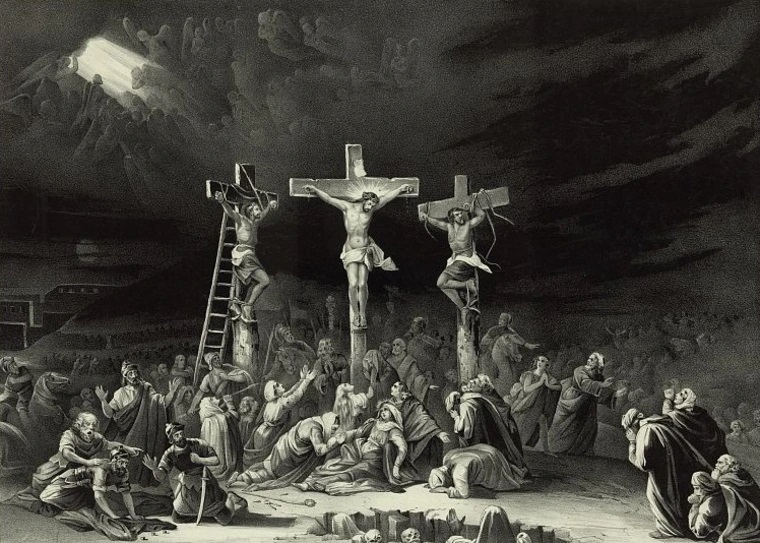
Crucification?

I mentioned a few weeks back that I’ve been watching old episodes of “Knight Rider.” I must say again that it’s great fun, not only for the horrible special effects and equally terrible dialogue but also for the 80s reminiscence it stirs. I say this mindful of a recent episode in which KITT, the show’s futuristic talking car, insisted on Christ as the only sensible reason for celebrating Christmas. Even better, a little further into the episode, Michael Knight, the main character, casually assumed out loud to another character that anyone unfamiliar with the contents of the Bible must be part of a very strange minority.

I found those perspectives refreshing. Although, when I returned to real life, I suddenly found them disheartening, having realized we’ve drifted far from such comfortable vantages. Today’s ethos makes 80s TV show language feel more like the vernacular of an alien planet than an echo of earthly history. If you think I’m exaggerating, then consider the Gallup poll from the 1980s that determined a little less than 75% of Americans were biblically literate. In 2021, the number came in at around 11%. That’s not an annoying but nevertheless inconsequential sign that we’ve lost our national footing in this regard. It’s an indication we’ve gone over the cliff and are in free-fall.

A passing conversation I had about two weeks ago with our Kantor, Keith Vieregge, comes to mind. We were talking about how so many words in the English language are mauled with regularity. When someone says “supposebly” in our presence, there’s a good chance we’re cringing internally. But it gets worse. Keith mentioned how words are being completely reconfigured, having recently heard the word “conversate” used in place of “converse”—as in, “The teacher needed to conversate with the parents regarding their child’s behavior.” I agreed and then volleyed with the made-up word “crucification,” which I’d recently seen used in place of “crucifixion” in an online forum.

So, where am I going with this? Well, I suppose one point of intersection is that not only are we thoroughly lacking in biblical literacy, but with our current culture’s reworking of words, we may discover breakdowns in the fundamental transmission of the Bible’s contents. Anyone who cares about language will tell you that when words become confused, the only way forward is chaos. I mean, consider the current confusion regarding gender. The terms “man” and “woman” mean different things to different people. In relation, the word “sex” no longer refers solely to biological gender and reproduction processes. It has become ideological, and as a result, no longer holds a firm footing for easy communication. I proposed not all that long ago that the practice of confusing terms spilled over from academia’s already-poisoned river into the streams and creeks of America when Bill Clinton, in response to a question in front of a grand jury while under investigation for perjury, said rather ridiculously, “It depends on what the meaning of the word ‘is’ is.” Clinton went on to mumble almost unintelligibly, “If the—if he—if ‘is’ means is and never has been, that is not—that is one thing. If it means there is none, that was a completely true statement. Now, if someone had asked me on that day, are you having any kind of sexual relations with Ms. Lewinsky, that is, asked me a question in the present tense, I would have said no. And it would have been completely true.”

What a rambling word-salad of ridiculousness. If we don’t know how to properly handle the two-letter verb “is,” we’re in big trouble.

This reminds me of something else.

There is a memorable line in act 2, scene 3 of Macbeth that reads, “Confusion now hath made his masterpiece.” If you know the story, then you’ll remember these words being spoken after Macbeth murders Duncan, the King of Scotland. The point is to communicate the impending chaos on the horizon for a rulerless kingdom. When no one is in charge—when there’s no certainty for direction—things come undone very quickly. Maybe this line applies to 21st-century communication, too. When the crispness of language is murdered, regardless of the unkillable nature of objective truth, the ability to actually transmit objectively true things becomes untenable, burdened by the absence of universally accepted fundamentals.

Take for example the important topic of marriage. Marriage, and the families it produces, are the fundamental building blocks of every society throughout history. In a simple way, without the hardened commitment established by marriage, societies would dissolve into little more than chaotically self-indulgent gatherings overflowing with orphans. But how can you talk about marriage in any meaningful way if the variables of its equation are undefinable?

“Marriage is to be between a man and a woman,” someone might say.

“I agree with you,” is the possible reply of a transgender woman married to a man.

But they don’t agree on marriage. A transgender woman is a man married to another man, and by such a combination, cannot begin to meet the basic parameters of natural law God has cemented into marriage, one of which is the procreation of children. The frustrating breakdown here leads to giant tech companies, with all seriousness, creating emojis of pregnant men. It leads to schools teaching children gender dysphoria is something to celebrate along with phrases like “birthing person.”

In short, words matter. What’s more, holding the line on their structures and meanings matters, too.

Truth be told, I’m only sharing with you what came to mind after reading Proverbs 21:23 during my devotion this morning. The text reads, “Whoever keeps his mouth and his tongue keeps himself out of trouble.” I suppose the text is somewhat relative to the direction of my thoughts. The word used in the text for “keep” (שֹׁמֵ֣ר) means more than just to control something. It means to guard it for the sake of preserving it. A commentary I visited with this morning compared the guarding to someone who cares about the language they use, inferring someone who says “no more than is right and fitting.” This is both contextual and residual. In other words, aware of the precise meanings of words, a righteous person also knows the long-term damage that comes when those words are misused. Misuse leads to confusion. Confusion can result in a tangling that brings incredible harm.

Come to think of it, Jesus spoke to these things in a way when He said in Matthew 5:37 to let one’s yes be yes and one’s no be no. In context, the Lord is referring to taking oaths. But His broader teaching is not only to understand what is meant by the terms but to be so certain about them that you can speak with simplicity in a way that has binding strength. You can say “yes” and be fully invested in your answer, or you can say “no” and never feel the tug to question your resoluteness.

I don’t know about you, but on my part, I’m not only doing everything I can to be careful with language but to protect the terms that make communication through language of any value, especially as it meets with God’s Word. I don’t want confusion anywhere near the Gospel. Confusion, as John Milton chimed so poetically, brings nothing less than “ruin upon ruin, rout upon rout.”