
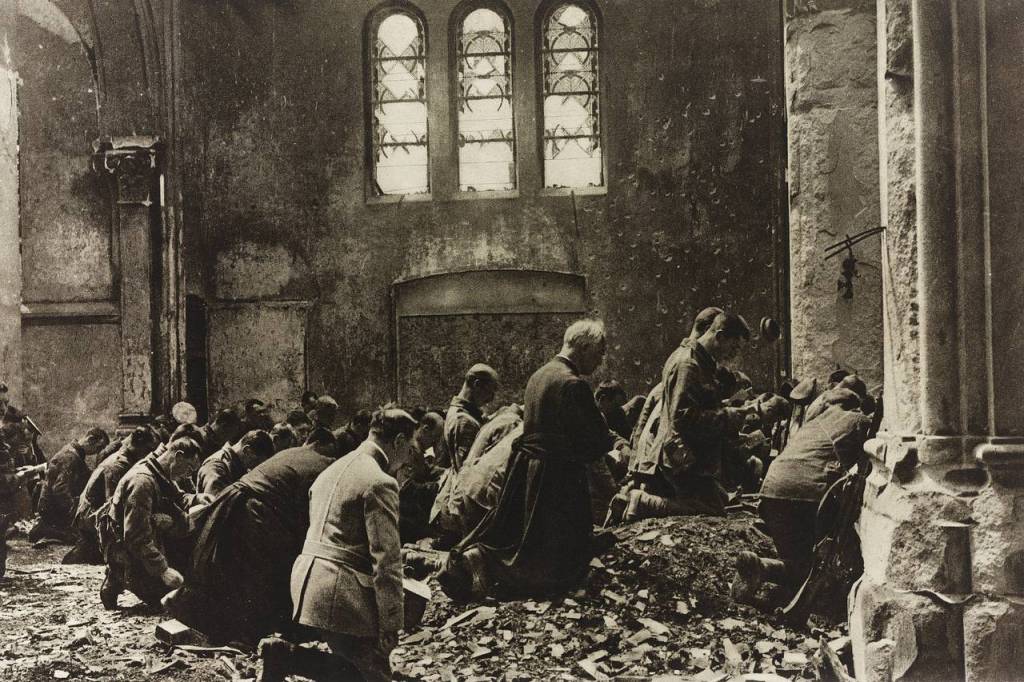
Will the Modern American Church Survive?

It’s becoming harder to pretend that things out there aren’t coming apart at the seams. I mean, people are no longer joking about civil war. Some commentators and podcasters have already jumped ahead to predicting how such a war would end. Of course, the media continues doing its part to up the ante.

CNN admitted last week that it adjusted Alex Pretti’s image to make him look more attractive in order to stir sympathy for his death. CNN also had to backtrack after leaving out that Pretti had initiated a violent interaction with ICE a week earlier, resulting in broken ribs. In other words, federal agents already knew Pretti. They knew he was dangerous. And so, when he leaned into the officers that day, when he pushed into them, when he spit on them as they tried to get away from him and into their vehicles (as the videos show), and when he ultimately died in the scuffle, which was unfortunate—but it was no surprise to the agents that he was carrying a loaded weapon with two additional magazines. But the thing is, CNN knew all this stuff, too. And yet, they reported everything but these details. And CNN’s original narrative is still out there, gaining traction. All wars have their martyrs.

Other media outlets carried the “ICE is detaining children” headline as far as they could before eventually retracting it. And yet, it turns out the child in the widely circulated image had been abandoned by his illegal father, and his mother refused to claim him. Rather than simply sending the child back into the world alone—a world in which kids like him are almost always trafficked—he was kept in federal custody. He wasn’t locked in a cage. He was being protected, which is most certainly the government’s job when it comes to little ones left to a world of wolves. But again, the thing is, the news outlets knew this, and yet they elected to foster a completely different narrative, stoking embers and adding kindling to an already blue-hot climate. Add to this the irony of a progressive left that would butcher children in the womb while weeping over a child rescued from the wolves, but only because the rescuer wore an ICE uniform rather than an abortionist’s surgical gown.

And so, again, “civil war” is a term showing up in my feed more than I’d prefer. But what should any of us expect? So many are actively laboring to make the climate perfect for one.

Having said all this, civil war is not necessarily my chief concern. Yes, what’s happening culturally and politically is troubling. Still, I’m thinking ecclesially. I’m wondering if American Christianity would even survive such a thing, especially a conflict in which Christianity is a primary target for the opposition. The progressive left is already doing everything it can to snuff the faith (John 15:18-19). What would happen if that side were to win an armed conflict? I guess I’m just wondering out loud if anything in the modern faith is still fixed enough to be confessed in a way that would survive through such an event.

For the record, this weekly message goes out in various forms to about 7,000 folks worldwide. I don’t pretend to have a comprehensive map of global Christianity, and so, I don’t necessarily know the liturgical practices of most of the churches and people who may be reading this. But I do know my own church. And I know what kind of Christianity formed it.

Our Savior Evangelical Lutheran Church in Hartland, Michigan, and the Lutheran Church-Missouri Synod with which we maintain fellowship, is creedal in nature. Creedal Christianity did not emerge from comfort. It was forged under pressure. It survived being surrounded by hostile empires, wars, internal heresies, and, most importantly, competing visions of who Jesus was allowed to be. Creedal Christianity is a faith maintained by precise statements—what we believe and what we don’t, why we do what we do, why we’re distinctly different from the world around us. Regardless of what the more fashionable Christian influencers may have told you, these things are not relics of an overly philosophical age. They are the Church’s collective memory, crystallized at the very points in history where the fires were hottest, where the culture was hell-bent on consuming and assimilating us, and where losing our identity would have meant losing Christ altogether.

While studying the Church’s creeds with the kids in confirmation over the years, I’ve often told them that confessional statements like the ecumenical creeds (the Apostles’, Nicene, and Athanasian Creeds) are very important guardrails that protect our inheritance. What I mean is that by these confessional statements, the Church was essentially saying to the world, “We heard what you’ve said about Jesus, and we’re banning that interpretation from our midst forever.” They didn’t do that because the Church is allergic to questions, but because some interpretations—some answers to very important questions about God—can kill the faith (Galatians 1:6-9). The creeds exist precisely because the Church learned, often through blood, that not every version of Jesus is compatible with the Gospel.

For example, Arius, a bishop in Alexandria, came along offering a Jesus who was inspirational but not eternal. He insisted that Jesus was not God from eternity, but rather the first and greatest of God’s created beings. To be exalted, yes. But by no means divine in the sense that He is of the same substance as the Father. In reply, the Council of Nicaea (A.D. 325) gave birth to the Nicene Creed, which said, essentially, “Um, no. He is the only-begotten Son of God, begotten of His Father before all worlds, God of God, Light of Light, very God of very God, begotten, not made, being of one substance with the Father, by whom all things were made….”

This response was not a modern branding exercise. It certainly didn’t come from thin air. It came from God’s Word (John 1:1-3, Colossians 2:9, and countless others). It was an important clarification made to preserve the one true faith that saves. I mean, what’s the point of confessing faith in Jesus—even being willing to die for Him—if the Jesus you confess is false? Creeds are in place precisely for this reason—to preserve a right confession of faith (1 John 2:22-23).

Even better, creedal Christianity never just remained on paper. Creedal Christianity was always ritualized Christianity. What the Church confessed with her mouth, she inevitably enacted with her body. I should pause here for a moment and admit that resistance to rites and ceremonies has always struck me as weird. Enacting what we believe is natural. We already do this instinctively in ordinary life. When people love one another, they don’t merely say it. They demonstrate it. They show up, they make vows, they give gifts, they mark anniversaries. When a nation believes in its sovereignty, it doesn’t just write a constitution, and then that’s it. It raises flags, sings anthems, swears oaths, and builds monuments that enshrine it. Belief naturally seeks embodiment. It inevitably embraces postures and practices that make the invisible visible. In the same way, the rites and ceremonies that emerged were the Church’s way of training the faithful to live inside the truth they confessed, week after week, year after year. It was a very natural way for the body and mind to remain in stride with what the heart confessed to be true (James 2:17).

When this kind of synchronization happens, the Christian faith becomes incredibly resistant to drift. Without them, almost anything can influence direction.

I suppose the thrust of my concern is that this is precisely what much of contemporary church culture has abandoned. Mainstream American Christendom seems to thrive on elasticity—on keeping Jesus just vague enough not to offend anyone and flexible enough to serve every demographic.

The irony in this is that it’s meant to promote growth. And yet, the American Church has been in free fall for decades. This free-floating, syrupy, confessionless, “deeds not creeds” landscape has not resulted in growth. It has resulted in massive erosion. But that’s what happens when your Jesus is more life coach than the eternal Son of God who comes again in glory to judge both the living and the dead (Acts 17:31).

Interestingly, even as creedal Christianity isn’t so much about growth as it is continuity, the early Church did grow—and quite rapidly. Why? Could it be because it refused what American Christianity is all too eager to embrace? The early Church did not survive persecution by becoming more appealing to Roman tastes. It survived by becoming more precise—more dogmatic, more confessional, and in my humble opinion, more liturgical. By its faith, life, and practices, it told the surrounding empires in no uncertain terms, in effect, “We will not adjust Christ to fit your world. You will have to adjust your world to Christ.”

Creedal Christianity can speak this way because it’s anchored in otherworldly things. It is, therefore, by design, capable of surviving this world’s storms. It doesn’t roll over when the challenges come. It can and does remain fixed in place even as everything else tries to pull it apart.

I know I’ve already gone on long enough. I’m guessing the skimmers left five minutes ago. For those who stayed to the end, I suppose I’ll circle back to where I started.

I’ll just say, again, that civil war is not my chief concern. Empires rise and fall. Cultures always burn themselves out eventually. Still, the real danger is not whether America fractures entirely. I’m just wondering if the American Church still possesses a faith sturdy enough to remain standing through it.

I don’t have this concern for creedal Christianity. It’ll survive. History has already more than proven that when and where the pressure mounted, a Church built on crisp confession remained immovable. Our Savior in Hartland is an heir to this hope-filled reality, and so, we enjoy that future. This is true because Christ did not promise His Church an easy path, but He did promise that the gates of hell would not prevail against the fixed Gospel confession that Jesus is the Christ, the Son of the living God (Matthew 16:16-18). That’s a creedal statement, and where such confessions remain, so does the Church and the Lord who preserves her.

The Imitation Game

I recently listened to a new album from a band I’d been introduced to a few years ago. One particular song told the tragic story of a young girl stuck in a life of prostitution and drugs, leading to her eventual death. Along the way, the singer blamed the absent father, reminding the listener that it wasn’t the girl’s fault he wasn’t around to guide her—to teach her right from wrong, protect her, and love her like the precious gift that she was. The song ended. Another of the same band’s songs started. The new song spoke of carefree sex, and it did so in an encouraging way. The singer—a man and father—referred to himself as enjoying the activity with multiple people from various walks of life and in countless places.

Do you get it? If not, how about this?

I don’t watch much TV. But I happened to plop down in my usual chair while one of my kids watched an episode of “Castle.” It’s a typical cop show with a twist. The main character, Richard Castle, is a famous author who collaborates with a hard-nosed detective, Kate Beckett, to solve murder cases. As the seasons unfold, the handsome Castle and the beautiful Beckett become an item. Eventually, she moves in with him, and of course, the two begin engaging in everything you’d expect from such a situation.

I happened to sit in my chair during an episode in which Castle’s teenage daughter, Molly, had met and started dating a young boy. Of course, the episode portrayed Castle as a bumbling father wrestling with how nosey he should be with the relationship, getting all his advice from Beckett. More than once, Castle spoke aloud about how he didn’t want Molly to do anything she shouldn’t do. In other words, he didn’t want her to have premarital sex.

Again, do you get it? Not yet? Well, how about this one?

I’d gotten home late, and as is my custom, no matter the time, I took to the treadmill. Just as I pressed the start button, my cell phone rang. I usually try to avoid taking calls at such a late hour, especially when the person isn’t a member of my congregation—which this caller wasn’t. Still, I’d failed to return the person’s call earlier in the day, so I owed the caller a moment of my time. The heart of the caller’s concern was essentially this: “How do I get my sexually confused child to understand the importance of living biblically?” My first inquiry was, “Where’s your home church, and how often do you attend?” The person couldn’t claim a home church. When pressed for history, the caller admitted to barely a handful of visits to church over the years.

Do you get it? I sure do. In fact, after experiencing the series of comparative examples I described, I understand what the American poet, Amy Lowell, meant when she wrote, “Youth condemns; maturity condones.” She indicated that we often hold different standards for our children than we do for ourselves—double standards that prove our iniquitous nature. In other words, we don’t want promiscuity for our children even as we might practice it. The point: If you don’t want your child to do something, then don’t do it yourself. When you do it, you condone it.

Don’t use swear words if you want your child to avoid and condemn swearing. If you’re going to be crass, they’ll be crass, too. If you smoke weed, it’s likely they will, too. If you act abusively toward others, they will, too. If you gossip about others, it’s expected they will, too. If going to church means very little to you, it’ll also mean very little to them.

The premise really isn’t that hard to understand. In a way, I made the point in a brief social media post I wrote years ago. In fact, I pinned it to the top of my “Rev. Christopher Thoma” Facebook page. I wrote:

Go to church. And take your children. Yes, yes, I know that, in general, children are not very good at listening or sitting still, and this can make worship very challenging. Still, I say go to church—and take your kids—because, for the record, there is something that children do magnificently. They imitate adults.

The Scriptures certainly weigh in on the discussion. Solomon’s child-rearing advice in Proverbs 22:6 lends substance to it. Hebrews 12:11 points out that while it can be challenging for parents to hold the line for godliness, in the end, doing so produces immeasurable blessings for both the parents and children. In 1 Corinthians 15:33, Saint Paul reminds his readers that bad associations (ὁμιλίαι κακαί) result in corrupt habits (φθείρουσιν ἤθη). The word he uses for “habits” is from the root word “ethos.” A person’s ethos is the storehouse of his core beliefs. It supplies his character, which is demonstrated through action. Paul’s point is that a poisoned ethos will produce poisoned behavior. That’s how it works. And lest you doubt him, Paul begins this admonition by urging, “Do not be deceived.” In other words, don’t fool yourself into thinking it could ever be otherwise.

These things said, it’s unfortunate how adults are so often the “bad associations” Paul is describing—the hypocrites we so often accuse others of being. The Scriptures are pretty clear that how a person lives in front of others influences them (Proverbs 12:26, 13:20, Matthew 5:13-16, and others). It’s no secret that parental behavior shapes children. The way a parent lives in front of little ones will impact them, eventually forming how they live in front of their children—good or bad—and so on.

Do what you can to be mindful of this. And when you fail to demonstrate godliness for your children, the best advice? Confess your failing. Do it openly. What does a child learn from a hypocritically impenitent person? They learn to reject Christ. What do they learn from a penitent one? They learn to live within the better sphere of Christ’s mercy, holding fast to His grace.

But there’s another practical benefit to this, which helps make families even stronger, especially when the parents feel like they have no authority to lead the child because they’re guilty of some of the same harmful behaviors they’re trying to prevent.

For example, parents who lived together before marriage instructing their child to avoid doing the same thing presents an apparent contradiction that naturally negates their authority to steer the child in this circumstance. But if the parents admit that what they did was counter to God’s design—that they’ve repented, been forgiven, and are glad to be living in that grace—their parental authority is restored. The child cannot say, “Well, you did it, so why can’t I?”

“Yes, we did,” will be the parents’ answer. “We’ve confessed to this. God has forgiven us fully. Having been lifted from this self-defeating behavior, it’s our job as parents to help you avoid it altogether. We do this because we love our Lord, and because we love you.”

This is the way of things in a Christian family. We labor to help keep ourselves and each other fixed firmly to Christ. Living this way, neither the family’s victories nor defeats can crush it because every situation becomes an opportunity to demonstrate the Gospel of forgiveness. And it’s this same Gospel that, by the strength of the Holy Spirit, stirs an equally powerful desire to demonstrate faithfulness.

Humanity Is Not Free. Christians Are.

Lent is nearly upon us. The next three Sundays—Septuagesima, Sexagesima, and Quinquagesima—prepare us for its spiritual throttling.

In a way, worshipping communities that employ historic liturgies already have the upper hand on Lent’s penitential nature. They’ll easily recognize the following words’ shackling character used at the Divine Service’s beginning:

“Most merciful God, we confess that we are by nature sinful and unclean. We have sinned against You in thought, word, and deed, by what we have done and by what we have left undone. We have not loved you with our whole heart; we have not loved our neighbors as ourselves. We justly deserve Your present and eternal punishment.”

Or perhaps you know it another way:

“I, a poor, miserable sinner, confess unto you all my sins and iniquities with which I have ever offended You and justly deserved Your temporal and eternal punishment.”

Present and eternal punishment. Temporal and eternal punishment. Same thing. The spheres of this world and the next are both included.

Indeed, these words are incarcerating, leaving no room for escape.

Essentially, we first approach God’s altar admitting to something. Even as believers, the nature of faith has a sense of what that something is. Faith reminds the believer to think twice before approaching God according to our human virtues. We should never think He hasn’t the right to send us away in shame. We should never be so comfortable with ourselves that we begin to think His wrath is something we don’t merit. And so, before anything else occurs in the service, believers go to their collective knees in confession. We fold our hands. We keep our heads low. We establish a posture before the One who has every right to eradicate every swirling atom of this fallen creation. We do this agreeing to His description of humankind, not our own, a description rendered so eloquently—so searingly—in His holy Word.

I’m doing more reading these days than ever before, almost to the point of it being unenjoyable. I read somewhere along the way that Frank Lloyd Wright designed his unique structures in ways that communicated his heart’s greatest love for nature. What stirred in his heart caused him to say, “The space within becomes the reality of the building.” I get what he means. He was an architectural artist. And his words sound nice. However, I’ve seen some of Wright’s buildings. In my opinion, they’re as impractical as they are impressive. But what do I know? That being said, if you really want to see a genuine architectural rendering of a human heart, stop by any of the thirty-one prisons in Michigan. There you will see a more authentic representation of humanity’s viscera in an architectural form. You will observe an exterior adorned by multiple rows of massive fences decked in razor wire surrounding windowless cinderblock. What will you discover within? Through the facility’s massive metal doors, you’ll find wall after wall securing one human cage after the next.

A prison is the human heart’s best interpretation because, of itself, humanity is not free.

As I said, I’ve been reading quite a bit lately from lots of sources. Cyril Connolly is a writer I discovered by way of Rudyard Kipling. Connelly said something about how everyone is serving a life sentence in the dungeon of self. For as depressing as that might sound, he wasn’t that far from what Saint Paul meant by a number of phrases employed throughout his Epistle to the Romans. He writes things like “the law of sin and death,” “enslaved to sin,” and “the wages of sin is death.” Paul is trying to tell us something.

For one, he wants us to know we can’t keep God’s Law rightly. As humanity is enslaved to Sin, so is humanity dragged along by the innate desire to break God’s Law. Paul says as much, writing, “For the mind that is set on the flesh is hostile to God, for it does not submit to God’s law; indeed, it cannot. Those who are in the flesh cannot please God” (Romans 8:7-8). Naturally, when laws are broken, a judicial wage is earned: punishment. With this, we find ourselves closer to what Paul needs us to know by these phrases. Even apart from their proper context, we know something more about humanity. We not only begin to sense the handcuffs—the very real restraints that bind us to our treachery—but also the eternal punishment we’ve earned in destruction’s terrible cell.

And yet, God’s inclination has never been to punish, imprison, or destroy. He wants to show mercy (Luke 23:34, 6:36; 1 Peter 1:3; Lamentations 3:22-23). He wants to forgive. He wants to redeem—to buy back the criminals from their fate. He wants to set humanity free. Already knowing that the Gospel “is the power of God unto salvation” (Romans 1:16), the rest of the text surrounding Saint Paul’s select phrases brings this Gospel and instills the freedom God desires:

“We know that our old self was crucified with him in order that the body of sin might be brought to nothing, so that we would no longer be enslaved to sin” (Romans 6:6).

“For the wages of sin is death, but the free gift of God is eternal life in Christ Jesus our Lord” (Romans 6:23).

“For the law of the Spirit of life has set you free in Christ Jesus from the law of sin and death” (Romans 8:2).

The Good News is that Christ has won your freedom. He has paid the price. Faith in Christ binds the believer to Christ, thereby binding that same believer to the certainty that he cannot be condemned to Sin’s chains or held captive by Death’s cell.

The forthcoming Gesima Sundays are delivering us into this news in unique ways. Listen carefully. Lent will display its combat. Pay close attention. Good Friday will demonstrate the great exchange. Don’t miss it. All these things will culminate in a horrendously wonderful trial resulting in a hideously sweet verdict: Christ must take humanity’s place in judgment on the cross. The guilty ones are free to go.

And then Easter. Oh, Easter!—the joyful proof of the debt’s payment followed by the prison’s absolute demolition from the inside; a glorious work accomplished by the only Prisoner who could do it!

Darkness’ Tongue

Do you want to know something I learned this week? Well, maybe I’ve always known it and it’s that I’ve discovered a new way of understanding and then communicating it. I learned that both genuine Christian honesty and sinful dishonesty function in similar ways. I know that sounds strange, but what I mean is that they both engage in the search for mistakes made because neither can bear the burden of wrongness.

As this meets with dishonesty, a person committed to falsehood will actively seek out his or her shortcomings, but usually for the sake of defending them. The reason? Well, as I already said, they cannot bear the burden of being seen as wrong, and so they do all they can to recraft their wrongness to appear justified, or even worse, righteous. Christian honesty seeks out its mistakes, too, but it does so with a completely different goal in mind.

Christian honesty (which I’d say includes the barometric of integrity) is a direct descendent of truth, and as such, it digs deeply in search of its mistakes. When it discovers one, like a stone in the farmer’s field, it labors to dig it up and remove it. Why? Because like dishonesty, it cannot tolerate being wrong. However, instead of turning toward excuse-making, honesty longs for wrongness’ death. It wants to be uninfected by anything contrary to truth.

Oscar Wilde was a strange bird, and yet, he wrote something interesting about excuse-making. He wrote about how experience is often the name people attach to their mistakes. He scribbled those words mindful of the human capacity for dismissing bad behavior. In other words, we do what we do, good or bad. When things go well, we pat ourselves on the back. When things go awry, we chalk it up to the importance of experience—not necessarily saying it was wrong, but rather, it was a valuable lesson. Sure, there is some truth to that statement. “We’re only human,” we say, disaffectedly; or “Well, we learn from our mistakes, right?” And yet, where does this begin and end when we know full well what we’re doing is wrong? Is sleeping around until getting a venereal disease a valuable lesson learned by experience? Is your moment before the judge for embezzling hundreds of thousands of dollars the best moment for admitting theft is wrong. Will saying to the judge, “Well, your honor, I sure learned my lesson” really be worth anything at all?

In disgust for wrongness, genuine honesty is aggravated by excuse-making. As a result, it is completely unwilling to lend even its weakest finger toward dismissing one iota of its crimes, no matter their severity. Even further, its threshold for continuing in sinful behavior is proven minimal. Once wrongness is discovered, it wants to be rid of it—like, yesterday. And why? Because by the power of the Holy Spirit at work in the Christ, fidelity to Christ far outweighs fidelity to self, and so, as soon as the Christian realizes he has wandered into shark-infested waters, he begins swimming like crazy to get to safety.

Christians know well what I mean by all this. This is true because they know the sin-nature in relation to contrite faith. They know Saint John’s words from the first chapter of his first epistle aren’t all that complicated:

“This is the message we have heard from him and proclaim to you, that God is light, and in him is no darkness at all. If we say we have fellowship with him while we walk in darkness, we lie and do not practice the truth. But if we walk in the light, as he is in the light, we have fellowship with one another, and the blood of Jesus his Son cleanses us from all sin. If we say we have no sin, we deceive ourselves, and the truth is not in us. If we confess our sins, he is faithful and just to forgive us our sins and to cleanse us from all unrighteousness. If we say we have not sinned, we make him a liar, and his word is not in us (1 John 1:5-10).”

If we say we have fellowship with him while we walk in darkness, we lie.

Saint John’s description of dishonesty’s will is emphatic. The word he uses here for walking—περιπατῶμεν (peripatōmen)—is an active subjunctive verb. It by no means allows for accidental or uninformed behavior, but rather communicates what the subject knows and wants to have happen. In other words, the willful desire to conduct one’s life according to darkness stands in contradiction to the God who is light. And so, to claim fellowship with God while willfully—intentionally, deliberately, consciously—pursuing what one knows without question to be Sin, and then even worse, to vigorously resist correction through excuse-making, is to stand before God as the worst kind of liar. I say the worst kind because as Saint John notes in verse 10, what we’re really doing by our efforts is staking God as the deceptive one—accusing Him of being the One who doesn’t understand the differences, of mistakenly mixing up good and bad.

“Sure, the Ten Commandments are helpful,” we say, “but what God doesn’t realize is that they’re often not very practical.” Continuing, we explain using darkness’ tongue, “I mean, sometimes abortion is the better solution, especially when chances are greater the child will be born into an unloving family.” Or perhaps we suggest with shadowy sincerity, “We all know it’s best to test-drive a car before buying it. It’s the same with a potential spouse. We need to test-drive him or her in every way possible before marriage. Shouldn’t we want to steer clear of making a mistake? Shouldn’t we want to learn by experience if he or she is truly the right person for us?”

And the list goes on and on.

Foolishness. Plain foolishness.

How about this instead: “Trust in the Lord with all your heart, and do not lean on your own understanding” (Proverbs 3:5).

Simple. Better.

Why is this better? Because even as you may not understand the finer, and sometimes more difficult, details of God’s gracious leading by His holy Law, He certainly has already proven His pathways worthy of trust. Knowing we could not save ourselves from Sin, He didn’t have to reach into this world to save it. But He did. His first inclination toward us was love. From this love, He sent His Son to win us back from darkness (1 John 4:19). By the power of the Holy Spirit for faith in this sacrifice, we love Him in return, and we are convinced that His will for our lives—no matter how any particular aspect of it might seem out of step with the world around us—it will always be best. Planting our flag in this promise, more often than not, we’ll find ourselves at the top of Mount Honesty. From its peak, we can search for and discover our mistakes, not for the sake of running down the mountain to hide or defend them, but to target and uproot them—to actively flex the muscle of the saintly nature against the sinful nature, doing so with the knowledge that “he who began a good work in you will bring it to completion at the day of Jesus Christ” (Philippians 1:6).

So, consider my words. Where you are apart from God’s holy Law, repent. Turn to the One who loves you for eternal relief. He’s no liar. He’s truth in the flesh—the kind of truth that will set you free (John 8:32; 14:6).