 It’s very early, 5:30am to be precise. I’m writing this note from Cantrall, Illinois. Again, to be precise, I’m at Camp CILCA, which is just outside of Springfield.
A summer camp I attended in my youth, I know this place well. Even better, I eventually became CILCA’s head counselor in the early nineties, having held the position for four consecutive summers. I should add that during those same years I was also the head lifeguard, music leader, sports director, and weekend maintenance assistant to a wonderful man I’ll forever consider a friend, Derald Sasse, may his soul rest in peace.
I stayed here at CILCA this weekend, having spoken last night at the camp’s annual banquet at Our Savior Lutheran Church in Springfield. I received a kindly invitation last fall from the current Camp Director, Reverend Joshua Theilen, to be the banquet keynote speaker. I was certainly glad to accept. And of course, the topic being something along the lines of Christian engagement in the public square, I was certainly ready to drive down and prattle on about such things. I pray my words last night were of benefit to the people in attendance.
Interestingly, I’m staying in the Christian Growth Center here at the camp, which back in my day, was the only building on the camp property with air conditioning. The funny thing is, in all my years here at CILCA, I never once spent a night in this building. I maintained it. I helped clean the rooms for various groups that came through. I fixed broken windows and repaired faulty electrical outlets, but I never actually enjoyed the fruits of my labor. And yet, here I am twenty-five years later. Life is weird that way, I guess.
As soon as I finish typing this note, I’ll be hopping into the Jeep and heading back to Michigan. To get here to Illinois, I took the backroads. I’ll probably do the same thing going home. I like driving the backroads. While they’re pleasantly uneventful, there’s plenty to see. Driving along through the sleepy farmlands provides more than enough opportunities for thoughtful observation. Thinking back to these travels a few days ago, I can think of at least two things I remember pondering.
The first thing I spent some travel time thinking about was the Old Testament reading from Genesis 22 appointed for the Fifth Sunday in Lent, which tells the story of God commanding Abraham to take his son, Isaac, to a yet undisclosed place and sacrifice him. I’d call this event dreadful if I didn’t already know its substance and ultimate conclusion. As a father, could I follow through as Abraham did? And yet, if the listener is paying attention as Abraham speaks, the comfort of trust in the promises of God is woven into the narrative. Once Abraham and Isaac arrived at the place God commanded, Abraham told the servants who journeyed with them that he and his son were going to go and worship God and then return to them.
That moment is a clue as to what Abraham knew would happen. He would unreservedly follow God’s commands already knowing something of God.
God promised Abraham that Isaac would be the one through whom the Messiah would come. God assured Abraham of this. Abraham knew that God doesn’t break His promises, and so no matter what approached from the horizon, Isaac would be fine. Abraham trusted this. If you doubt this analysis, then take a look at Hebrews 11:17-19. The writer to the Hebrews acknowledges this as he digs a little deeper into Abraham’s faith, describing him as knowing full well that if he was indeed forced to follow through with the frightful deed, God would give Isaac back to him alive. He’d have to. God would reverse Death, and preserve Isaac’s life.
This is a very rich moment, both emotionally and theologically, especially as we prepare to wrap up Lent and rejoice in the Easter celebration of Christ’s resurrection. I suppose that thinking about these things probably influenced the second thing I remember pondering along the way.
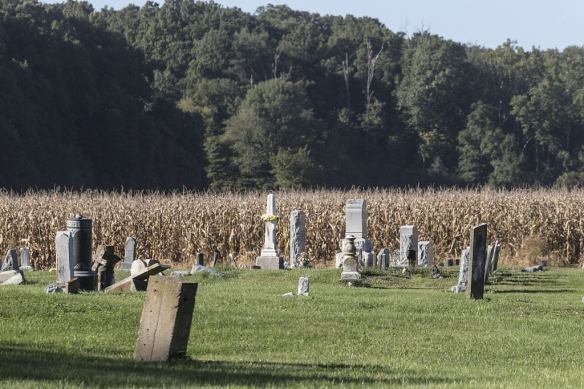
While tooling along through the farmlands of Indiana and Illinois, I noticed something familiar to each of the little towns along the way. They all have conspicuous cemeteries.
Now, you might be thinking that just about every city or town in America has a cemetery. Believe it or not, they don’t. But these backroad towns do, and each is noticeably prominent, often pitched on a hill at the edge of the city, perhaps adorned with an elderly oak tree or two. And if the cemetery isn’t standing guard at the edge of town, it’s situated somewhere along the town’s main street, making it impossible for anyone to miss while passing through. In either, the collection of headstones is a community of both old and new, and from a reasonable distance, against a setting sun, their mutual silhouette looks almost city-like.
I remember when I was a kid in the seventies and eighties, my friends and I would hold our breaths when passing a cemetery. The lore was that by breathing, there was a chance we might make a wandering spirit jealous. Another version of the myth claimed that you might accidentally inhale a spirit and become possessed. Silly, I know. Good thing I know better, because now that I’m far from those youthful fooleries, I passed a particularly lengthy cemetery on Saturday evening near Lincoln, Illinois as I was making my way to Cantrall from Morton, Illinois, where my parents and sister live. Had I held my breath as I passed, I might have ended up unconscious and in a ditch. Or worse, in a cemetery.
And yet, having said this, the fact that every town has its cemetery is a reminder that at some point, my body will end up in one. There’s no avoiding it. Read the poets. Christian or not, they get the inevitability of Death. Percy Shelley called Death the veil that is finally lifted during the deepest sleep. John Donne described Death as mighty and dreadful, and yet without pride, portraying it as simply doing what it does almost boringly even as it is unstoppable. Robert Browning describes the knowledge of unavoidable Death as motivation for living life fully. Emily Dickinson, of course, is famous for portraying Death as unstoppable, being the carriage that will one day arrive for all. And when it knocks at your door, you will be unable to keep from opening it.
Since I’ve suddenly shifted to considering the poets this morning, I’ll admit to appreciating Lord Tennyson’s description of Death:
Sunset and evening star,
And one clear call for me!
And may there be no moaning of the bar,
When I put out to sea.
Tennyson doesn’t describe Death fearfully. Instead, he sets it before his reader as something of a story’s ending. It’s the sunset to an eventful day. It is an open sky with a view to the evening star. It is a clear call of his name, and a drawing to a vessel setting sail into the open sea, a place that he loved.
I don’t know what influenced Tennyson’s perspectives on things, but I’ll say his consideration of Death is comforting. It evokes the Lord’s even more so reassuring words throughout the Gospels.
Now, don’t misunderstand the Lord’s position on Death. Jesus knows full well it’s a big deal. He knows it isn’t pretty. He knows Death is an ugly ordeal, that it’s a terrorizing power. Following His lead, Saint Paul describes it as the worst of all enemies of Man. But pretty much all of the biblical writers go out of their way to make sure we know that through faith in Christ, we don’t need to be afraid of Death. We don’t need to be fearful because Christ has defeated it. Like Abraham, we can face off with its dreadfulness with the promises of God well in hand. And so the Lord can say to Lazarus’ sisters that whoever lives and believes in Him, will live even though he dies. Saint Paul can mock Death, courageously poking at it with the Word of God’s promises, asking, “Where is your sting?” Job can speak so joyfully that even in the midst of Death, at the last, he will stand and behold God with his own eyes of flesh.
I like Tennyson’s description because he has this similar verve. It’s almost as if he’s equipped with the knowledge of faith, which we as Christians know by the power of the Holy Spirit through the Gospel enables us to see Death for what it has now become for the believer: a turning from one page to the next.
And the next page holds an unending chapter that is far better than any that came before it.
I like that. And again, the season of Lent is certainly teaching this very point, making sure we’re ready to fully embrace the significance of the Lord’s resurrection—His conquering of Death—all for us!
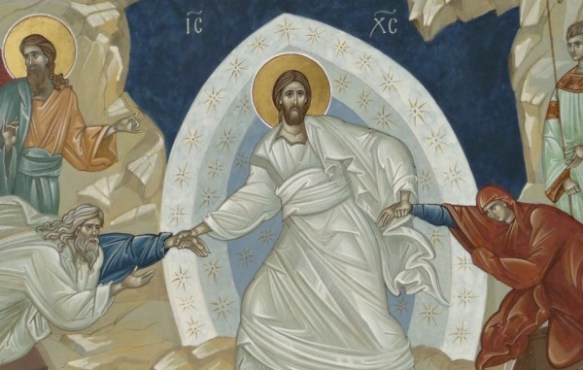
To use Tennyson’s imagery, Easter is the clear call. Easter doesn’t allow for moaning of the bar. Easter sets sail for the unending horizons of eternal life through faith in the One who was crushed and killed for our iniquities, and yet was found alive on the third day, having wrestled Death and won.
Here in a few moments I’ll be packing up my car and making my way back to Michigan. I’ll be passing many of those same cemeteries I encountered on the way here. I won’t be holding my breath when I pass, just as I won’t be looking on them as fearful markers signifying hopelessness. I’ll observe them as Abraham looked upon Isaac. God is faithful to His promises. He is our hope in the midst of Death. Through that lens—the lens of faith—each of the tombstones whizzing past me will herald particular truths. The first is that unless the Lord returns first, I will die someday. There’s no way of getting around that fact. The second is that even as Death would come calling, it is not my master. Christ has won my eternal life. I am not consigned to the grave forever, but rather with my last breath, I will set sail into the joys of eternal life with my Lord at the helm.

 Holy Week is upon us. God’s plan has been exacted.
 Just yesterday (Saturday, February 20), the Life Team of Our Savior blessed our church and community by offering an “End of Life” seminar. It was well attended. I was glad for that.
