Christmas Eve 2024

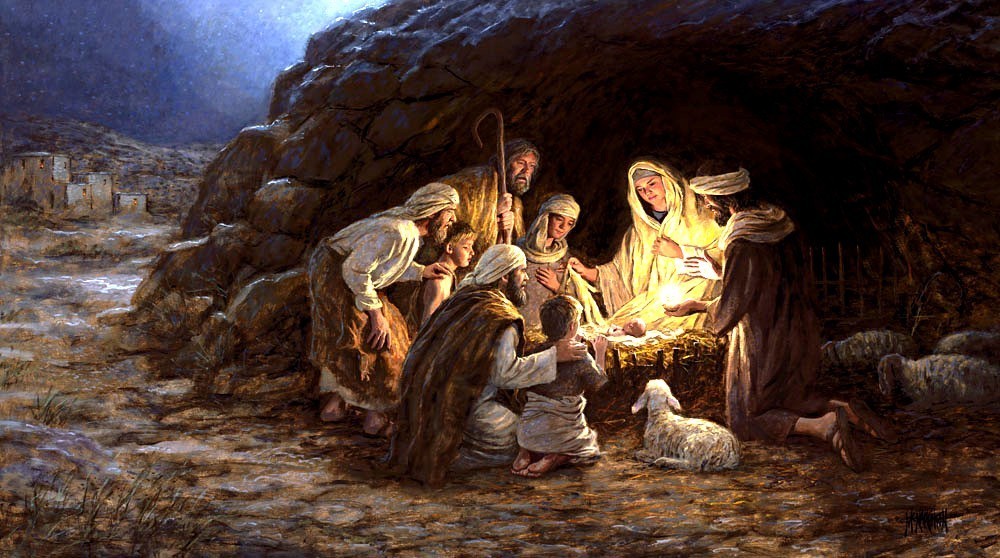
The story of our redemption begins in quiet simplicity tonight. While the world expects fanfare before a king’s arrival, the Son of God—the King of kings and the Lord of lords—enters our world wrapped in humility. He takes a feeding trough as His throne. His attendants are a young virgin and an adoptive father. His courtiers are whatever creatures that live in the stalls. His reverent nobles are backwater shepherds.  

Saint John, the inspired author of the Christmas Day Gospel, writes of the Child, “The true light, which gives light to everyone, was coming into the world. He was in the world, and the world was made through him, yet the world did not know him. He came to his own, and his own people did not receive him” (John 1:9-11).

Tonight, another inspired author, Saint Luke, tells us that, regardless of His humble beginning, the residents of heaven know who He is. The newborn is their Lord. Like Saint John, they know “all things were made through him, and without him was not anything made that was made” (John 1:2). And they say as much that first Christmas evening, piercing its pitch-black sky with celestial luminescence and an otherworldly song heralding God’s magnificent inbreaking (Luke 2:8-14). I suppose, in one sense, their knowledge and song are essential. If heaven did not claim Him, ultimately announcing His identity as the perfect Son of God, then He’d be just another human being who was equally incapable of saving us.

But He isn’t just another human being. He’s God in the flesh. And it’s here, in this tender scene, that heaven’s greatest gift is revealed—Immanuel, God with us—which is to say, the manger serves a profound role. God rests in it. It doesn’t seem possible. And yet, there He is. He is not distant. He is near, very near, right there in the manger. He has stepped into our brokenness, our struggles, and our longing. He is not above us. He is us.

Still, the manger hints further to His trajectory. Who among us was born and then placed where animals feed? See, He’s willing to go even lower. He does not shy away from the mess of life but enters into it fully, becoming all that we are and worse in the most incomprehensible way. Indeed, Saint Paul writes, “For our sake [God] made him to be sin who knew no sin, so that in him we might become the righteousness of God” (2 Corinthians 5:21).

What the Christian Church across the world celebrates tonight is by no means a mere Hallmark holiday or theological abstraction prompting tinseled gift-giving and goodwill for a few days of the year. It celebrates something extraordinary—a person—the divine Person, Jesus, a gift of the Heavenly Father, who left the realms of His eternal glory to exact what the angels declared: peace between God and mankind. That’s no ordinary act of goodwill they’re proclaiming. That’s no ordinary gift-giving. Jesus is the end of all that divides mankind from God. The angels direct the shepherds to find His beginning wrapped in swaddling cloths and lying in a manger. As we follow, the Lord’s humble lowliness resonates. We know what the hymn writer means when he scribbles, “Sacred Infant, all divine, what a tender love was Thine, thus to come from highest bliss, down to such a world as this” (LSB 373, “See Amid the Winter’s Snow,” stanza 3).

Behold, the passion of Good Friday and the weight of the cross are not far off.

Until then, tonight, we glorify Christ, knowing that His birth, even as it lacks all fanfare, is the greatest the world will ever know. This is true because, by the incarnation, the world received the only One who could save it.

With that, and by all means, I hope the genuine wonder of this night and everything it gives is revitalizing. I pray you’ll contemplate God’s Word proclaimed and the Gospel preached so that by the Nativity’s powerful message, the flames of an already pyre-like faith are fueled to burn even brighter for all in this desperate world to see.

God bless and keep you by His grace. And Merry Christmas!

Christmas Eve, 2023

Merry Christmas to you!

A favorite moment in the Church Year for many, Christmas Eve, is upon us. It’s beloved for plenty of reasons. For many, Christmas is little more than a break from work or school or, perhaps, an obligatory time for family gatherings and feasting. For faithful Christians, it’s so much more. It’s a day among days bearing a unique sense of awareness. It enjoys the best dimension of family togetherness and the greatest feast. It’s Christmas—or, more precisely, the Christ-mass! Believers gather to celebrate the beginning of God’s inbreaking through the person and work of Christ (Greek Χριστός). Christians have known for centuries that the best way to do this is by assembling at the divine table of the Lord’s Supper (Latin Missa), doing so fully aware that the same gracious Lord who gives Himself there was once an infant in a manger destined to redeem the world by submitting His very body and blood into Death for our forgiveness.

Christians know the Christmas event deserves reverent contemplation. One of the best ways to reflect is through Christian hymnody. Christmas is most certainly a time for singing some of the best-loved in Christian tradition. “Silent Night, Holy Night.” “From Heaven Above to Earth I Come.” “Angels We Have Heard on High.” “O Come, All Ye Faithful.” “Hark! The Herald Angels Sing.” Time has tested these musical portraits, and they’ve never been found wanting.

Those who know me best will know I have favorite hymns. During Lent, “Stricken, Smitten, and Afflicted” gets me in the gut. I cannot navigate past its third stanza without shuddering. It’s there the hymnographer, Thomas Kelly, puts on paper what my Christian soul knows, but my fleshly self so easily forgets. He rhymes that Sin and Death are powerful specters haunting my every moment, and in the bloody dreadfulness of the cross, I can rightly reckon their fullest cost, ultimately paid by Christ. See for yourself. Those who know the ghostly tune will be hard-pressed not to hum as they read.

Ye who think of sin but lightly
Nor suppose the evil great
Here may view its nature rightly,
Here its guilt may estimate.
Mark the sacrifice appointed,
See who bears the awful load;
’Tis the Word, the Lord’s anointed,
Son of Man and Son of God.

During Holy Week, namely Good Friday, “Sing My Tongue the Glorious Battle” is a must. With our pipe organ thundering through the stratosphere, we steer straight into the fracas of Sin’s stronghold. We don’t go meekly. Jesus is the meek One here. He is this way for us. We follow in confidence, finding ourselves on Golgotha’s bloody soil, our innards becoming a strange mixture of sadness and joyful assurance as we look upon the One who is Himself the victor and the emblem of triumph:

Sing my tongue, the glorious battle;
Sing the ending of the fray.
Now above the cross, the trophy,
Sound the loud triumphant lay;
Tell how Christ, the world’s redeemer,
As a victim won the day.

I have favorite hymns for every season of the Church Year. Interestingly, when I set them side by side, I notice something familiar to all of them: they’re in acute alignment with Saint Paul, who insisted, “We preach Christ crucified” (1 Corinthians 1:23). As each hymn carries along, eventually, there’s a moment when the hymn writer lays bare for his audience the brutal reality of Christ’s death for our redemption. In other words, no matter what appears central to a particular Church season’s thrust, the crucifixion of Jesus Christ for mankind’s rescue will always be the seed from which it sprouts. Typically, you’ll find what I’m describing right in the hymn’s middle. Not always. But usually. A favorite hymn we’ll sing tonight, the lullabying “What Child is This,” is no different.

Only three stanzas long, its middle stanza leaves the quiet splendor of Bethlehem, reaching instead for Golgotha’s brutal moments. It interprets the Lord’s strange arrival in lowliness through the bloodstained lens of what He came to endure. What’s more, He didn’t do it for Himself. He did it for us. He, the silent Word, is even now pleading for us. Again, see for yourself:

Why lies He in such mean estate
Where ox and ass are feeding?
Good Christian, fear, for sinners here
The silent Word is pleading.
Nails, spear shall pierce Him through,
The cross be borne for me, for you.
Hail, hail the Word made flesh,
The babe, the son of Mary!

Tonight at Our Savior Evangelical Lutheran Church in Hartland, Michigan, stanza two of “What Child is This?” will be handled far differently musically from stanzas one and three. The second stanza’s words require tones that rearrange a pew sitter’s insides and very nearly rattle the roof. Why? Not only because Christmas itself deserves it but because the message—the Gospel—deserves it. And these words will get what they require. Why wouldn’t they? The historical moments they describe converged into a final moment that shook our planet on its axis, causing the rocks to split (Matthew 27:50-51).

I hope that you’ll experience this thundering message for yourself. Go to church. Join your Christian family in celebration of the Christ-child’s birth. Know He came to save you. Rejoice alongside the angels at His arrival. Heaven has pierced Earth’s veil. God has come. He didn’t send a representative. He became human flesh and dwelt among us (John 1:14). He came Himself. Believe this. On the tiptoes of childlike faith, look into the manger and see this great work’s beginning. By that same faith, see in His tiny eyes a distant cross. He’s already looking there. He has you in mind. Indeed, you mean that much to Him.

Merry Christmas!

Christmas Eve, 2022

The night of all nights is upon us. Christmas Eve has come.

Like other nights in December, its chill is biting and unfriendly, and its darkness is strict and deep. From your home to your evening destinations (one of which, God willing, will be worship) and then back again, the time spent between each will provide plentiful reminders of Sin’s perpetual cruelty.

The barren trees will cast Death’s shadow. The frosted windowpanes will dully reflect humanity’s spiritual blindness. The shelterless, snow-swept fields will howl our most profound loneliness and echo our utter impotence.

Another creature—humanity’s need for rescue—will wander between December 24th’s wintry shades, just as it does on all other nights.

Still, no matter how indistinguishable its climes may be compared to all other evenings in midwinter, Christmas Eve stands apart for the believer. Tonight remembers that God reached into this world. Tonight acknowledges Death’s curse but introduces the One who has come to face off with and destroy it. Tonight concedes humanity’s lostness while gazing upon the One who arrived to seek and find it. Tonight admits to humanity’s powerlessness while singing of and to the only One with the strength to rescue all.

On Christmas Eve, immersed in the bright beaming light of its Gospel—a Good News proclaiming the birth of God’s son, Jesus Christ—no matter how lonely we are, we realize we’re never alone. No matter how far we’ve gone, we learn we’re never out of reach. No matter how uncertain about life in this world we may feel, we discover access to the sphere-breaking confidence of heaven itself (Hebrews 10:22).

How is this possible?

Remember the words of the well-beloved Christmas hymn: “Nails, spear shall pierce Him through, the cross be born for me, for you….”

Christ has come. The Word became flesh and made His dwelling among us (John 1:14). This Word went out, not returning to His throne empty-handed. Instead, He has accomplished the task for which He was sent (Isaiah 55:11). He died. It is finished (John 19:30). He rose. You are justified (Romans 4:25). All is well (Luke 17:19).

No matter your status, again, the hymn sings, “Come peasant, king, to own Him.” Put your faith in Him. Only He is worthy (Philippians 2:9-10).

This is the message of Christmas Eve. As Christians—as people born from its glistening goodness—tonight will forever be a night like no other. And so, here at Our Savior in Hartland, we’ll plunge ourselves into it, both at 4:30 pm and 10:30 pm.

Like us, God grant that you might rest easily in it, too. Indeed, it is Good News.

Colliding With Christmas

The Thoma family watched “A Charlie Brown Christmas” not long ago. Jennifer bought the DVD. Although, she had trouble finding it. Considering the religious climate in America, I’m not surprised. The Christmas Gospel from Luke 2:8-14 is the cartoon’s essential point.

Asked by Lucy to direct the school’s Christmas play, Charlie Brown goes from scene to scene, becoming increasingly frustrated with the task. Along the way, he sets out to get a Christmas tree for the set. Anyone familiar with Charlie Brown will know how that goes. He gets a rather pathetic tree, one that bends all the way to the ground when a single bulb is hooked to its branches. As the children walk off stage laughing, he snaps, calling out with a shout, “Isn’t there anyone who knows what Christmas is all about?!” Linus steps up to answer, his signature blanket in hand. “Sure, Charlie Brown,” he says, “I can tell you what Christmas is all about.”

Linus asks for the stage lights to be set and then begins, “And there were in the same country shepherds abiding in the field, keeping watch over their flock by night. And, lo, the angel of the Lord came upon them, and the glory of the Lord shone round about them: and they were sore afraid. And the angel said unto them, ‘Fear not. For, behold, I bring you good tidings of great joy, which shall be to all people. For unto you is born this day in the city of David a Savior, which is Christ the Lord. And this shall be a sign unto you; Ye shall find the babe wrapped in swaddling clothes, lying in a manger.’ And suddenly there was with the angel a multitude of the heavenly host praising God and saying, ‘Glory to God in the highest, and on earth peace, good will toward men.’”

As gently as Linus begins, he turns back to Charlie Brown. With the simplest of childlike innocence, he says so plainly, “That’s what Christmas is all about, Charlie Brown.”

Even though I’ve seen the cartoon countless times, I got a little choked up at that moment. Jen noticed it, but I explained it away. This Christmas special has been aired since 1965. It was a childhood staple for many of us. But now, while you can purchase any imaginable ungodliness, this short video is scarcely available. And why? Because of its message. Its words are, at best, considered quaintly obsolete and uninteresting and, at worst, downright hateful and offensive.

Neither is true. And yet, here we are.

Thinking about these things, the cartoon gave me something else to ponder. It was Charlie Brown’s Christmas tree that came to mind. In short, after Linus’ recitation, the rest of the children gather around Charlie Brown’s miserable tree to decorate it. When they’re done, it’s no longer pitiful but beautiful—the point: the heart of Christmas collided with the children. In turn, the children collided with their surroundings, making them beautiful.

Closer to home, as I do every year, I put up the family Christmas tree. I’ve been assembling the same six-foot tree since Jennifer and I married in 1997. The tree was a wedding gift from Jennifer’s brother. While putting up the tree, its branches looked noticeably thinner this year. With each attempt to fluff and fan them to life, I discovered more and more imitation pine needles sprinkling to the floor. I remember thinking a few years back about how the tree was becoming far too fragile with time. Still, I have not retired it. My reason is simple.

While piecing the little tree together each Christmas, I think, “This will be the last year.” But then the tree collides with the joyful reason for putting it up, and everything about it changes.

When strands of multicolored lights are woven into it, when decades of family ornaments begin filling its branches, when the familiar angel our four children take turns placing at its peak each year is found in its place, almost unexpectedly, the gravity of the tree’s nostalgia becomes cosmic. Suddenly, what was once so pathetically inferior to everything else around it has grown fifty feet tall, making all things within reach lesser by comparison.

Christmas is fantastical that way. Just ask a child. You’ll see.

When it comes to humanity’s collision with Christmas—namely, the Good News at its heart—God desires similar aftereffects (1 Timothy 2:4). He tells us through Saint Paul that the Gospel is “the power of God unto salvation” (Romans 1:16). No wonder the devil has worked feverishly to remove “A Charlie Brown Christmas” from the airwaves and internet shelves. By the incarnation and subsequent work of God’s Son, Jesus Christ, what in Sin was destined for the trash heap might bump into its pricelessness to God. There might be an accidental interlude with the Good News—the message heralding the lengths Christ was willing to go to accomplish humanity’s deliverance. The devil doesn’t want anyone to hear this message. He knows its potential. He knows that a world steeped in hopelessness remains thinly frail against his crushing accusations. But a brush with Christmas might foster a sturdy certainty for eternal life and the muscle to resist him. Satan knows that the Holy Spirit works through the Gospel. As He does, what was woefully small in shame can be raised and made gleefully grand by the all-surpassing mercy of God’s immense love for the loveless.

The devil should be concerned about these things. A collision with Christmas—the happy tidings of the Son of God’s arrival—spells his end while announcing a sinner’s fresh beginning in Jesus. Knowing this, take a chance at steering your family and friends into Christmas’ oncoming joy. Invite them to worship on Christmas Eve and Christmas Day. Bring them to where the power of God unto salvation can and will redress their weary lives with the kind of hope that only Christ can give.

The Christmas Eve services here at Our Savior in Hartland are at 4:30 pm and 10:30 pm. (There will even be a baptism in the 4:30 pm service, which I’m particularly excited about.) The Christmas Day service is at 9:30 am. Near or far, you should make the trek. Come and collide with Christmas. Of course, Satan doesn’t want you to receive such an invitation. In fact, he is likely, right now, trying to convince you to involve yourself with other, more important things. Let that be a clue to the invitation’s worth.

What Child Is This?

Once again, the night of nights is upon us. Tonight the Church of all ages and locations, of all time and space, marks and celebrates the inbreaking of the only One who could ever do what was necessary for our rescue.

Tonight we are reminded in no uncertain terms that God has acted. The fabric between heaven and earth is torn. Angels step through it. By God’s authority, they tell us He sent His Son, Jesus Christ, to bring peace between God and man. We hear these details from the Gospel writer, Luke. In his divinely-inspired way, it’s the Gospel writer John who so eloquently records that this Son of God is the very Word that “became flesh and dwelt among us, and we have seen his glory, glory as of the only Son from the Father, full of grace and truth” (John 1:14).

The angels speak of an accomplished peace. John refers to an unmistakable emittance of glory. Together, these do not mean what many might think they mean.

Perhaps like me, you have favorite hymns. One of mine is “What Child Is This.” This caressing Christmas hymn is one of the few that stirs me emotionally every time I hear it. It’s a hymn that is not only meant to be sung in solemnity and reverence, but at certain moments along its course, it invites a measure of vigor that few other hymns do. I’d say this is true because of the hymn’s innate understanding of the newborn Christ-child’s task for establishing peace through the display of His truest glory.

Right in the middle of the fantastical scene described by stanzas one and three—a scene that portrays the Virgin Mary holding the newborn Jesus close to her bosom, all the while shepherds are kneeling beneath a glistening nether sphere filled with invisible angels swirling on divine melodies—suddenly, there is the abrupt contrast brought by a more sinister sketch. Shattering the landscape’s serenity, stanza two crashes into the hymn like a meteor impacting the surface of the world. It wonders rhetorically why the divine Child has so crassly begun in the mean estate of society’s dregs. It even implies mortal embarrassment at the Son of God having little more than a manger—a feeding trough—to serve as His first cradle.

And then it hits.

“Good Christian fear, for sinners here,” stanza two continues, its momentum beginning to build, “the silent Word is pleading.”

The hymnographer refers to the Word made flesh sleeping in Mary’s arms as an imploring that’s aimed at the whole world, but even more so the Church. It calls for us to pay attention. We are urged to remember that the very presence of God in the flesh is a visible admission to what’s coming, to what absolutely must be accomplished. For as lovely as this night might seem, this Child was born to die: “Nails, spear shall pierce Him through, the cross be borne for me, for you.”

The Christmas tree sparkles. The candles flicker with gentle splendor. The tranquil setting gilded in seasonal magnificence is indeed an incredible sight. And yet, among all these things, the truest glory of Christmas, the genuine peace accomplished between God and mankind, will always be located in the death of Jesus for sinners.

If you don’t get to sing this hymn at some point during the Christmas season, then you’re missing out on something extraordinary. And if you do get to sing it, but the musician doesn’t lay into stanza two with some intensity, then you’re missing some of the hymn’s genuine import, too. “What Child Is This” answers its own question—the question of all questions—right in its middle. This Child is the One who has come to bring eternal peace. He will do this in a dreadfully gruesome, and yet, a most glorious way. His powerful death will be the piercing of heaven’s joy through and into this world’s helplessness in Sin.

I pray this joy for you this Christmas, namely, that you would cling to this glorious Savior—his person and work—and by faith in Him, you would be found confident for each of your remaining days in this life.

Merry Christmas.