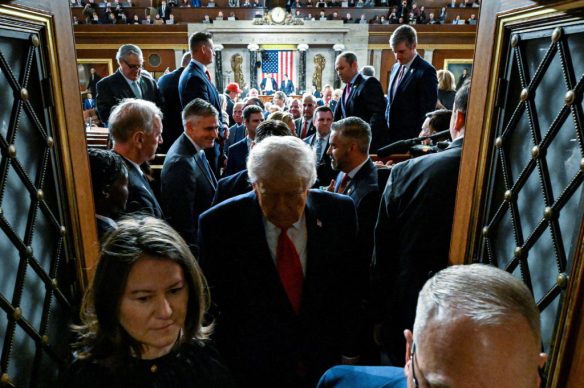
Perhaps you had a chance to watch or listen to President Trump’s State of the Union speech last Tuesday. I didn’t watch the whole thing. I’d only just gotten home before it started, and the day had already been a long and exhausting one. Still, I watched until about 10:25 PM—and that was plenty.
Political speeches, especially Trump speeches, are rarely remembered for their eloquence, even when they’re chock full of accomplishments, policy prescriptions, and legislative ambitions. That said, I can’t think of another president I’ve enjoyed listening to more than Donald J. Trump. He can be quite funny. And not to mention, he’s fearless. He steers into things that few before him have been willing to offer even the slightest glance. I should add that when my family and I met him in person, on my daughter Evelyn’s birthday, no less, he was the kindest and most genuine politician I’d ever met. He already knew it was her birthday before we walked in, and even as the Secret Service reminded us before entering that the visit would be quick—and not to touch him—he saw us enter and reached out to us, even hugging Evelyn. He took time with us, asking us questions. He shook my hand and described the pastoral office with great respect. He didn’t have to do any of those things. But he did. That’s because he’s that kind of person.
“Still, how can you admire this crass man? And you call yourself a Christian pastor!”
My first reaction to statements like that is to say I’m friends with lots of folks the perfect humans among us might be inclined to call imperfect. My second thought is to say, be careful not to fall into what has become a rather tired pitfall. I did not choose Donald Trump to be my pastor. I voted for him to be my president, and God’s Word draws a clear distinction between the roles of civil authority and spiritual shepherds. As I’ve noted on countless occasions, if I were ever on trial for murder, I’d want the best lawyer defending me, not the most pious Christian. Saint Paul teaches that governing authorities are instituted by God to “bear the sword” and to punish wrongdoing and promote civil order—a function of justice, not pastoral care (Romans 13:1-4). By contrast, 1 Peter 5:2-3 and Ephesians 4:11-12 describe pastors as shepherds who oversee souls, teach sound doctrine, and equip the saints for ministry. And of course, Jesus says, “Render to Caesar the things that are Caesar’s, and to God the things that are God’s” (Matthew 22:21). When He did this, at a minimum, He affirmed distinct spheres of responsibility. Both are established and ordained by God, and so, in that sense, they’re not absolutely divided. They’re designed to cooperate. Nevertheless, the plain structure is that civil leaders are accountable for governance and public order, while pastors are accountable for spiritual oversight. The offices are different by divine design.
But now, before I wander too far from what I intended to say, regardless of the politician giving any particular speech, most of what anyone says tends to fade almost immediately into the churn of news cycles and partisan rebuttals. What sticks are the moments—scripted or unscripted—that cut through the usual political theater, giving way to actual revelation. There was one particular moment during Tuesday’s address that stood apart for me. It proved Trump’s prowess. And for the hundreds of millions around the world watching the speech, it pared away any obscurities, leaving only the unmistakable mineral differences between two very different ideological positions.
When the president asked members of Congress to stand if they believed the primary responsibility of government is to protect American citizens before illegal aliens, the chamber responded immediately. A very simple question elicited a whole-body posture, a “yes” or “no” response that couldn’t be hidden.
Republicans rose instantly at the question, their applause swelling into a prolonged ovation that lasted several minutes. Across the aisle to their left, Democrats remained seated. Some scowled. A few shouted. Others mocked or gestured dismissively as the applause continued around them. The contrast couldn’t have been sharper. I turned to Jennifer and said, “There you have it. There’s no hiding from that. That’ll be remembered.”
Standing in support or sitting in protest during the State of the Union speech is normal. Trump used that practice, ultimately handing control of the rostrum over to the whole room, inviting everyone to state their most fundamental ideology concerning government. Who is it principally for? And the whole room answered. At that moment, the division was no longer theoretical. It wasn’t buried beneath news reporters asking the same question, only to receive rambling responses designed to avoid it entirely, lest the one being questioned offend the extremists in their party. Stand if you think the American government is in place to serve Americans before illegal aliens. Sit if you don’t.
The Republicans stood. The Democrats remained seated.
In the end, that was an important moment, if only because, as I said, almost any disagreement, whether it’s political, theological, financial, or whatever, is quite often softened by language designed to obscure fundamental differences. Competing parties frequently claim identical ends while disputing only means. Relative to what’s happening in our country right now, the rule of law, compassion, justice, and fairness are words claimed by pretty much everyone. But the varying sides understand those words differently. That all disappeared when Trump put the stand-or-sit challenge before the chamber. He cut straight through to the heart of the definitions in a way that the disagreement could no longer be about strategy or implementation. It was about first principles—who the American government is actually established to serve.
This exposed the deeper moral framework. For one side, prioritizing citizens represents the foundational duty of national sovereignty, which is one of the most basic justifications for the existence of the state itself. The other side openly refused to endorse this premise. And now, the differing postures formed an image that’s not going to fade from America’s memory anytime soon. Americans witnessed the divide. This time it had handles. It was no longer hidden behind nuance. It no longer rested comfortably behind mere policy preferences, as if both Republicans and Democrats want the same things, they’re just using different pathways to get there. Nope. The divide stems from fundamentally different understandings of the government’s moral priorities.
The whole country saw this ideological landscape mapped in real time.
In the end, like every other speech that’s ever been given, this one will be mostly analyzed for its claims and proposals. I don’t know about you, but on my part, I usually forget what the talking heads eventually end up scrutinizing. What I don’t forget are the images—the memorable moments I can visualize. I was only sixteen years old, but I can still remember watching the exchange between Lloyd Bentsen and Dan Quayle when, after Quayle compared himself to JFK, Bentsen retorted something like, “Senator, I served with Jack Kennedy, I knew Jack Kennedy. Senator, you are no Jack Kennedy.” I can safely say I knew very little about either candidate at the time. But it was a moment, for sure. And combined with the ruckus that followed, that moment defined the entire memory. Everything else has since faded.
The same kind of moment happened on Tuesday night. Years from now, few will remember the statistics cited or the priorities outlined. But many will remember that chamber—half standing, half seated—answering a relatively simple challenge without words, and in doing so revealing something far more enduring than differing points of view. It revealed, plainly and permanently, what each side believes the United States government exists to do—and whom its elected officials are in place to serve. I sense that many saw this clearly, especially folks who tend to exist in the middle on so many important issues, and now that they have, it’ll be really hard for the usual suspects to pretend they didn’t see it.
 Cruciform Stuff