
Merry Christmas to you!
A favorite moment in the Church Year for many, Christmas Eve, is upon us. It’s beloved for plenty of reasons. For many, Christmas is little more than a break from work or school or, perhaps, an obligatory time for family gatherings and feasting. For faithful Christians, it’s so much more. It’s a day among days bearing a unique sense of awareness. It enjoys the best dimension of family togetherness and the greatest feast. It’s Christmas—or, more precisely, the Christ-mass! Believers gather to celebrate the beginning of God’s inbreaking through the person and work of Christ (Greek Χριστός). Christians have known for centuries that the best way to do this is by assembling at the divine table of the Lord’s Supper (Latin Missa), doing so fully aware that the same gracious Lord who gives Himself there was once an infant in a manger destined to redeem the world by submitting His very body and blood into Death for our forgiveness.
Christians know the Christmas event deserves reverent contemplation. One of the best ways to reflect is through Christian hymnody. Christmas is most certainly a time for singing some of the best-loved in Christian tradition. “Silent Night, Holy Night.” “From Heaven Above to Earth I Come.” “Angels We Have Heard on High.” “O Come, All Ye Faithful.” “Hark! The Herald Angels Sing.” Time has tested these musical portraits, and they’ve never been found wanting.
Those who know me best will know I have favorite hymns. During Lent, “Stricken, Smitten, and Afflicted” gets me in the gut. I cannot navigate past its third stanza without shuddering. It’s there the hymnographer, Thomas Kelly, puts on paper what my Christian soul knows, but my fleshly self so easily forgets. He rhymes that Sin and Death are powerful specters haunting my every moment, and in the bloody dreadfulness of the cross, I can rightly reckon their fullest cost, ultimately paid by Christ. See for yourself. Those who know the ghostly tune will be hard-pressed not to hum as they read.
Ye who think of sin but lightly
Nor suppose the evil great
Here may view its nature rightly,
Here its guilt may estimate.
Mark the sacrifice appointed,
See who bears the awful load;
’Tis the Word, the Lord’s anointed,
Son of Man and Son of God.
During Holy Week, namely Good Friday, “Sing My Tongue the Glorious Battle” is a must. With our pipe organ thundering through the stratosphere, we steer straight into the fracas of Sin’s stronghold. We don’t go meekly. Jesus is the meek One here. He is this way for us. We follow in confidence, finding ourselves on Golgotha’s bloody soil, our innards becoming a strange mixture of sadness and joyful assurance as we look upon the One who is Himself the victor and the emblem of triumph:
Sing my tongue, the glorious battle;
Sing the ending of the fray.
Now above the cross, the trophy,
Sound the loud triumphant lay;
Tell how Christ, the world’s redeemer,
As a victim won the day.
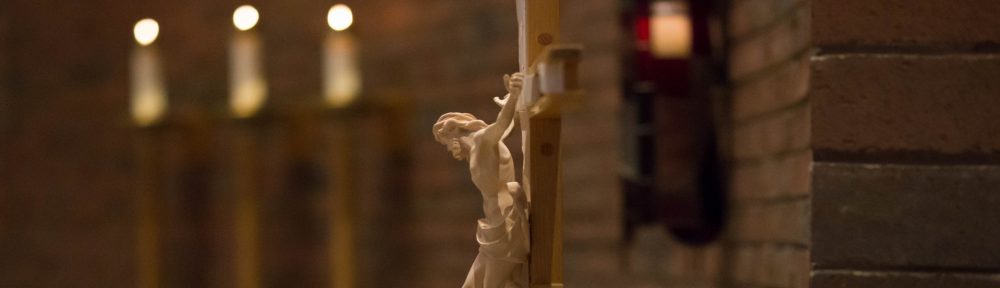
I have favorite hymns for every season of the Church Year. Interestingly, when I set them side by side, I notice something familiar to all of them: they’re in acute alignment with Saint Paul, who insisted, “We preach Christ crucified” (1 Corinthians 1:23). As each hymn carries along, eventually, there’s a moment when the hymn writer lays bare for his audience the brutal reality of Christ’s death for our redemption. In other words, no matter what appears central to a particular Church season’s thrust, the crucifixion of Jesus Christ for mankind’s rescue will always be the seed from which it sprouts. Typically, you’ll find what I’m describing right in the hymn’s middle. Not always. But usually. A favorite hymn we’ll sing tonight, the lullabying “What Child is This,” is no different.
Only three stanzas long, its middle stanza leaves the quiet splendor of Bethlehem, reaching instead for Golgotha’s brutal moments. It interprets the Lord’s strange arrival in lowliness through the bloodstained lens of what He came to endure. What’s more, He didn’t do it for Himself. He did it for us. He, the silent Word, is even now pleading for us. Again, see for yourself:
Why lies He in such mean estate
Where ox and ass are feeding?
Good Christian, fear, for sinners here
The silent Word is pleading.
Nails, spear shall pierce Him through,
The cross be borne for me, for you.
Hail, hail the Word made flesh,
The babe, the son of Mary!
Tonight at Our Savior Evangelical Lutheran Church in Hartland, Michigan, stanza two of “What Child is This?” will be handled far differently musically from stanzas one and three. The second stanza’s words require tones that rearrange a pew sitter’s insides and very nearly rattle the roof. Why? Not only because Christmas itself deserves it but because the message—the Gospel—deserves it. And these words will get what they require. Why wouldn’t they? The historical moments they describe converged into a final moment that shook our planet on its axis, causing the rocks to split (Matthew 27:50-51).
I hope that you’ll experience this thundering message for yourself. Go to church. Join your Christian family in celebration of the Christ-child’s birth. Know He came to save you. Rejoice alongside the angels at His arrival. Heaven has pierced Earth’s veil. God has come. He didn’t send a representative. He became human flesh and dwelt among us (John 1:14). He came Himself. Believe this. On the tiptoes of childlike faith, look into the manger and see this great work’s beginning. By that same faith, see in His tiny eyes a distant cross. He’s already looking there. He has you in mind. Indeed, you mean that much to Him.
Merry Christmas!
 Cruciform Stuff