Not a Compliment

I received my fair share of hate mail for what I shared last week about the church in Evanston, Illinois. Even a few business owners from the town reached out to give me a verbal slap. And yet, it is as I’ve said countless times before. Writing for public consumption is risky. And so, be ready to endure what goes with it. Of course, knowing what to expect helps. Most of the messages bore a tired spirit, the kind that only knows accusations like, “You’re a heartless human being,” or “You’re a hypocritical Christian.”

However, I found one email rather interesting. I’ve copied and pasted it here for you.

“With all due respect Mr. Thoma (I will not call you doctor or reverend because you are not) you are just one more fantic [sic] who does what you tell others not to do. You make the bible say things it does not. It does not talk about genders the way you do. It does not say anything at all about abortion. That church can make there [sic] manager [sic] scene say whatever they want. There is no rule to understand it the way you do. And didn’t Jesus say to judge not?”

There’s a lot in that message. It has a lot of the same trite prattling I’ve endured a thousand times before. That said, I’ll admit I have very little interest in responding to most of it, especially the first, third, and fourth concerns in the message. Those are easy. Yes, the Bible does speak rather precisely about gender. No, you cannot make the Gospel and its narratives into whatever you want. Lastly, you just judged me and then said Jesus insisted we not do such things.

But the second concern—that the Bible does not say anything specifically about abortion—is worthy of some attention.

This particular comment exposes a genuine hermeneutical problem—a way of interpreting God’s Word. It holds that if something is not loudly foregrounded in a familiar verse, then the Bible must intend for us to do whatever we want with it. To be fair, many within the prolife camp inadvertently reinforce this misunderstanding. This is where the prolife movement could use some help. What I’m saying is that when confronted by these same arguments, most in the prolife camp go for the low-hanging fruit. We quote Psalm 139, Jeremiah 1, Luke 1—verses about God forming life in the womb, about knowing us before birth, about children leaping for joy beneath a mother’s ribs. To be sure, these are beautiful passages. But they do not yet fully address the challenge posed in the message, which is the claim that the Bible doesn’t say anything specifically about abortion, like, at all.

And yet, the Bible does. Saint Paul himself is the crucial proof here.

A few years back, I spoke at a Right to Life banquet, and I spent most of my presentation dealing with this point. In particular, I focused on a word Saint Paul uses in 1 Corinthians 15. Before I share that word, we need to know the capabilities of the man who used it, not merely as an Apostle, but as a writer who knew the innate power of language and its ability to carry theological freight. In other words, Paul understood how one well-chosen term could do what a thousand explanations could not. And so, when he does this, we are wise to pay attention, being sure not to soften his intent, or to do what we can to explain it away.

First, Paul was fully aware he was writing Scripture (see Galatians 2:1–9). That matters. It means he knew what he wrote was not only inspired but also immutably authoritative. It wasn’t just for his time. It was aimed directly at the saints of every generation, including our own.

Second (and as a writer, I just love Paul for this), he was no dull penman. In fact, whenever I want to show the students in my religion class just how much fun the Scriptures can be, I take them into Saint Paul’s writings. The Holy Spirit’s allowance for a biblical writer’s mind, wit, personality, experiences, and education really shine through with Paul. His epistles breathe with imagery and rhetorical devices. Sometimes he thunders. Sometimes he sings. Sometimes he jokes. Sometimes he pokes with stinging sarcasm. Sometimes he rambles, as if wrestling with himself out loud. He laughs at himself on occasion. Sometimes the Holy Spirit leads him to write some really hard news, leaving him feeling slimy. When that happens, you can almost guarantee you’ll discover a strange doxological sentence afterward, as if he felt the need to take a verbal shower.

Aware of these things, Saint Paul is great fun to read.

But it also enables the reader to see those places where Saint Paul drops plainspoken word-bombs. There is one such place where the word he chooses, one that the prochoice world hopes no one will notice, is meant to rattle the teeth in a reader’s skull.

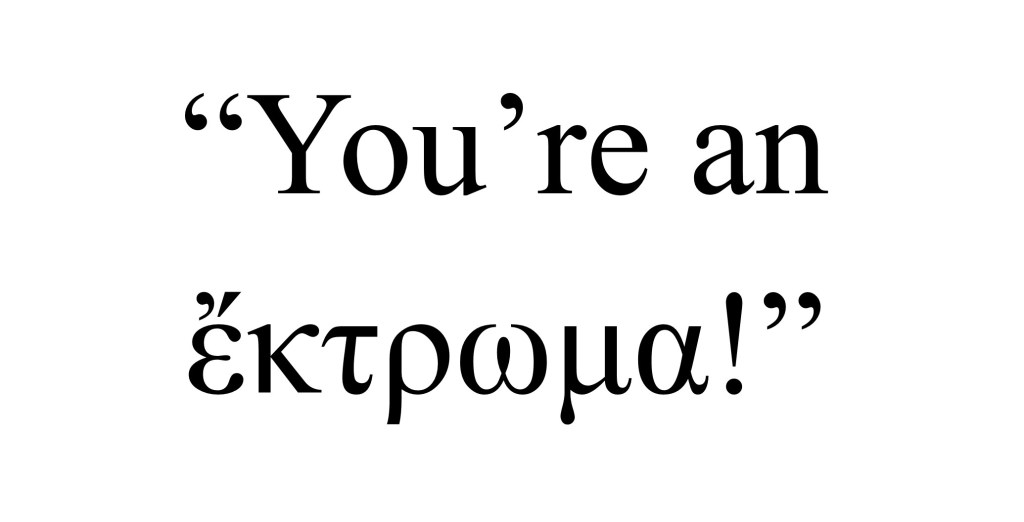
In 1 Corinthians 15:8, Paul describes himself as τῷ ἐκτρώματι. This is typically softened to “one abnormally born” or “untimely born.” Unfortunately, most assume Paul just meant he arrived late to the apostolic party, as if he were the last hired or least deserving. But that’s not at all what the word means.

Admittedly, ἔκτρωμα (ektroma) is a rare word in the New Testament. In fact, this is the only place it appears. But outside of Scripture, it is common enough in Hippocrates, Dioscorides, and other early medical writers. And there it rarely means “one abnormally born” or “untimely born.” It’s the word used for an aborted child—a baby expelled dead, and often deliberately. In other words, this is not just miscarriage or tragic happenstance language. The word includes the idea of killing a baby in the womb.

Now, let your stomach turn a little. I get the sense that’s the response Paul wanted. It’s an ugly comparison. Contextually, Paul is not mildly saying, “I was late to the apostles.” He is calling himself an abortion by comparison—a repulsive example of something terrible, the only thing he could be in his time apart from Christ, before his appointment as an apostle. Now, here’s why I think this matters to the discussion.

Years ago, I read an article in The Telegraph recounting a sermon by Rev. Katherine Ragsdale, then-Dean of the Episcopal Divinity School in Cambridge, Massachusetts. In front of an abortion clinic, Ragsdale said everything in public that the email I shared above implies. She called out from a microphone that the Bible was silent on abortion, and by its silence, a person’s freedom to have or not have one is implied. Stepping from that twisted assumption, she declared that abortion is actually a blessing given by God, and then she invited everyone in the crowd to chant, “Abortion is a blessing and our work is not done!”

Wow.

Of course, Ragsdale is not some persona plucked from modern Christendom’s fringe. Her ideas have actually taken root like invasive weeds throughout the denominational spectrum. I know this, not only because of the email that came my way, but because of the stereotypical points that “prochoice Christians” lean on to support their ungodly position. It’s a common defense to say that the Bible doesn’t even mention abortion, and since that’s true, it belongs in the category of adiaphora—something neither commanded nor forbidden by God’s Word. Furthermore, if something is neither commanded nor forbidden, we are free to do with it as we’d prefer—maybe even consider it a blessing.

Well, unfortunately for them, the Bible does mention abortion explicitly and by name—ἔκτρωμα. And by the way, I should add that it’s the theology of toddlers and thieves to shove genuine ungodliness into adiaphora’s category. I don’t care what the topic is. Besides, it is irrational to think that if any source, let alone the Bible, uses a word as an insult, the concept attached to that word could ever be considered good. Paul did not call himself a hug or a sunrise. He called himself an abortion—a grotesque image meant to reveal what sin makes of us, and what God has every right to do to us as children. In our sin, we deserve death before we even take our first breath. Grammatically, if abortion is used in this way to portray humanity’s depravity, then for Christians to call it a blessing or declare it holy is to declare altar fellowship with Molech.

The Church must know and understand this. And she must be ready to say it without stuttering. No, abortion is not a blessing. It is an abomination. It always has been, and it always will be. The Bible specifically refers to abortion as something dreadful. If your Bible translation calls it holy, go bury it somewhere. If your pastor calls it a blessing, well, don’t bury him, tempting as the thought may be. Instead, confront him and demand repentance. If he refuses, leave. Find a church that still believes the Word means what it says


It Will Never Happen

I had an interesting conversation with the 7th and 8th graders in religion class this past Monday. With Advent on the very near horizon, the season that will inevitably carry us to Christmas, we wrestled with whether or not Herod’s slaughtering of the infants in Bethlehem was a part of God’s plan. It’s a good question to ask, especially following Michigan’s recent election, one that enshrined infanticide in Michigan’s Constitution. In utter disbelief, people are asking, “Why would God do this?”

This, too, is a worthwhile question, primarily because Saint Matthew shows God’s engagement throughout the Christmas events by quoting from the Old Testament four times. Doing this, the Gospel writer stirs a sense of divine orchestration, especially as he remembers certain things revealed to God’s prophets. The slaughter of the innocents is one of them. Matthew tells of Herod’s troops storming Bethlehem, and as he does, he points to Jeremiah’s description of the scene six hundred years prior. It’s a dreadful one describing torrential tears, the piercing sounds of unrestrained wailing, and in between each gasping cry, a mother—Rachel—pushing back against any human words of consolation (Matthew 2:17-18).

In other words, Jeremiah knew a moment would come when the sound of inconsolable mothers would haunt a city and its surrounding hillsides. Matthew stakes the claim that this disturbing vision was relative to Christ’s birth and fulfilled in the slaughter at Bethlehem. But because God revealed this to Jeremiah so long ago, does that mean God planned and enacted it?

The answer is no. I’ll get to the reason in a moment.

The current effort in my religion class is the study of hermeneutics—the “how” of interpretation. As you can imagine, hermeneutics is taking us anywhere and everywhere in the Scriptures. It’s also taking us into what we read and hear in our culture. I do this with the students because language matters. Narratives matter. The intentions inherent to these things matter. They must be interpreted. When the broader horizon of genre, speaker/writer, context, history, and so on can be thoroughly examined, a person is better equipped for discernment leading to genuine wisdom. Simply applying hermeneutical principles to Proposal 3, its dreadfulness was easily detected. Teaching the students to do this is essential. The children who can do this as adults will be the ones worth trusting with critical things.

As far as the answer to the question, again, it’s no. God neither designed nor intended for all those children to die. It happened because that’s how things work in our appallingly corrupted world. Sin has a blast radius, and no one—innocent or guilty, good or bad, believer or unbeliever—is beyond its temporal effects. Therein is the interpretive key to the question’s answer, as well as the key to its relevance for us today.

Forget God’s foreknowledge for a second. While you’re at it, stop ascribing to Him authorship of everything that happens. Instead, remember what He said at the very beginning. His words to Eve and the serpent communicate His direct action. To Adam, however, His tone changes. He speaks in a resultant way, saying that because of what Adam has done, the ground is now cursed (Genesis 3:17). In other words, from now on, life will be harder, and bad things will happen. That’s the way it works in a world infected by Sin. Did God want this for His creation? No. Did He plan it? No. Matthew expresses this same theology through each clause before the four Old Testament quotations. Essentially, he uses two kinds—a purpose clause and a temporal clause. Before the reminder from Hosea 11:1 that the Messiah would come out of Egypt, Matthew uses a purpose clause (ἵνα πληρωθῇ), which comes to us as “This was to fulfill…” (Matthew 2:15). This is to say God acted in this instance. He planned it this way. Before Jeremiah’s foretelling of the Bethlehem tragedy, Matthew uses a temporal clause (τότε ἐπληρώθη), resulting in, “Then was fulfilled…” (Matthew 2:17). While the time in Egypt was divinely orchestrated, the events of Bethlehem happened because the world is now corrupt. Because of what we’ve done, this world will now produce Herod-like devils—people like Gretchen Whitmer and Dana Nessel who rejoice at the death of children, telling all to “celebrate December 23rd” because that’s the day abortion will officially be written into the Michigan Constitution. These are the kinds of celebrations Sin produces.

By the way, I find it interesting that the amendment birthed by Proposal 3 will be added to our state’s founding document the day before Christmas Eve. The devil is good at spitting in your eye right before poking it out.

Still, God knows all of this. By His omniscience, He sees these things coming. Did He ordain them? No. Again, Genesis 3:17 nudges us toward recalling that we’re responsible for letting these monsters loose in Bethlehem. The blame for Sin’s insatiable appetite for misery rests squarely with us, not God. Of course, we don’t like to hear that. And why? Because we are ones who, as Shakespeare mused, “make guilty of our own disasters the sun, the moon, and the stars.” In other words, we’re inclined to blame anything and anyone, even God, rather than accept the simple truth that tragedy’s guilt is ours alone to claim.

The only real blame we can genuinely lay at God’s feet is best placed at the foot of the cross. We can blame Him for doing what was necessary to fix the Sin problem. The death of Jesus is God’s beautiful crime—the absolute innocent One being sentenced to death for the dreadfully guilty.

So, what do we do now?

By the Holy Spirit’s power, we believe this Gospel. Recreated by this Gospel, we continue to stand against Herod while at the same time doing everything within our power to rescue the little ones from his bloodthirsty troops. I was recently asked on three separate occasions what this “standing” might look like in a future Michigan. The first thing that came to mind in each was something I’ve experienced before.

A few years ago, I happened to be visiting my friend, Pastor Stephen Long (now with the Lord), in the emergency room. A few stalls away from us was a robustly pregnant girl—a brave teenager who’d long ago chosen to keep her child. We didn’t know the details of her visit to the ER, but everything we heard through the curtains—the shuffling and crying and confusion—all of it communicated something traumatic. The sounds also reminded us just how overwhelming the terror inherent to any harrowing moment could be. It affects our emotions. It can shatter our wits. We can react in ways we might regret later. Listening in, Stephen and I prayed for the girl and her unborn child.

Now, let’s imagine that scene in today’s Michigan. Let’s say the trauma the girl experienced resulted in her healthy child being born prematurely. Let’s say it also resulted in the terrified and confused girl changing her mind. According to Michigan’s Constitution, if, in the middle of the traumatic scene, the young girl sees the child and decides she cannot be a mother—that she doesn’t have the mental or emotional fortitude required to raise the child—regardless of the stage of pregnancy, and also because the child likely needs extraordinary medical attention to survive, the newest constitutional amendment leaves room for the mother and the physician to choose to let the otherwise healthy child die. Let’s say I’m listening through the curtain to the terrible events unfolding. Let’s also say that I hear and understand what’s about to happen to the child, that she will be left for dead. Make no mistake. It would be time to take a stand. In my case, I would unhesitatingly walk into that stall, take the child into my arms, and walk out. If need be, I’d fight off security guards, nurses, or anyone intent on obeying the new amendment. I assure you I’d do this, ultimately letting the chips of my legal future fall where they may. I would not let that child die, no matter the legal boundaries of the situation.

Plenty of folks say these types of scenarios won’t occur. Well, whatever. Many people said the Supreme Court would never cement same-sex marriage. And yet, here we are, five years beyond the cement’s pouring. Here we are expecting the U.S. Congress to pass the “Respect for Marriage Act,” which will pour a permanent layer of concrete onto what “will never happen.”

Heaping condescension, ridicule, and disbelief upon those concerned for these things is almost always proven foolish.

As far as the Emergency Room scene I described, MLive published an article on November 11 entitled “The abortion rights and potential legal fights coming after Michigan’s Prop 3 won.” In it, Robert Sedler, a law professor at Wayne State and an avowed abortion advocate, mocked the pro-life movement’s concerns about such possibilities. He called them “nonsense.” And yet, the article’s equally progressive author, Ben Orner, commented that the “amendment allows lawmakers to regulate after ‘fetal viability,’ according to its text, when the attending physician believes ‘there is a significant likelihood of the fetus’s sustained survival outside the uterus without the application of extraordinary medical measures.” In other words, protection laws only apply if the doctor determines the child can survive without assistance. Orner caps this by quoting Sedler, again, writing, “The idea is that abortion is only prohibited when a doctor determines that the fetus is viable, capable of living outside of the uterus.”

Three things. Firstly, before taking action to preserve a healthy child’s life, the doctor must affirm that the child can survive outside the womb without extraordinary medical help. What does this mean? What are the boundaries? My 13-year-old daughter has Type 1 diabetes. She cannot survive without extraordinary medical care. Secondly, “when the attending physician believes” is a subjective statement. For every physician who believes one thing, five others believe something different. But objectively, even rationally, a physician’s oath is to do no harm—to provide treatment to the ailing, to preserve life rather than end it. Thirdly, I agree with Sedler, who said the amendment’s language isn’t complicated. It’s deliberately open-ended to allow for as much “reproductive freedom” as the state can provide. The law’s subjectivity is intentional. Now, will most humans in our midst choose to abandon the helpless child I described? Hopefully not. But remember, the ground is cursed. It produces Herods—monsters who write laws providing opportunities to those who’d be happy to let the child perish.

“Nonsense. It will never happen.” Those are the most notorious of all last words. It has happened. Now it will happen beneath the protective banner of the law.

I didn’t share this particular MLive article with the 7th and 8th graders during religion. But I do share articles like it. Maybe I’ll share this one. Either way, we apply hermeneutical principles to what we read. Relative to Matthew 2:13-18, these principles helped the students to dig deeply in search of objective truth. They learned where and when God acts, what He ordains, how He operates in and through His Word, the difference between His revealed and hidden wills, and so much more. In one sense, it was a refreshing discussion for me, especially as I continue to wrestle with accepting whatever God is allowing to occur in America. In another sense, and considering the answers given by the students along the way, the conversation was proof that the 7th and 8th graders at Our Savior are becoming capable of navigating America’s shaky future. Again, the recent elections in Michigan resulted in quite a few Herod-like individuals taking office and arming their troops for grim ungodliness. Was God behind this? Mindful of God’s Word, knowing what I know, you’ll never convince me that He was, not even by pointing to God’s employment of ungodly rulers in the Old Testament or by dropping Romans 13 in my lap. God did not and does not purposely establish or license authorities to exist in contradiction with His will for governance. He does not ordain for governments to murder their citizens. Human beings are the ones who scribe and sign such licenses.

The students are learning to discern these things. God willing, they’re also learning they need to step up and be what God has created them to be, if only for the sake of their children. I believe they’re on their way to being this, and in that sense, I leave class comforted, knowing God will use them—deliberately—for His good purposes.

Dying to Meet You

Do you have time for a quick story? Since you’re here, I’ll go ahead and share it.

We took a phone call here at Our Savior this past Friday. I didn’t answer it. Nikki, our Parish Administrator, did. It was someone calling to chat with me. Even though I wasn’t necessarily steeped in anything crucial, Nikki took a message for me. She does this because she knows that while technically Friday is my day off—and I probably shouldn’t tell you this—but I’m always in the office on Fridays. I have a few regularly scheduled appointments in the morning, and then after that, I use the rest of the day to catch up on things I didn’t have time for during the week. She runs block for me to let me do my thing.

Anyway, a woman called to let me know she didn’t appreciate the comparison I’d made in a recent radio bit equating Christians who justify skipping worship on a regular basis to so-called believers who justify voting for a candidate who favors abortion.

To be fair, the woman wasn’t rude with her critique—which was a welcomed difference in comparison to so many other calls or email messages I’ve received from metro-Detroit listeners. Instead, Nikki described her as someone who, with a conversational tone, was troubled “by likening someone absent from church to a Christian who’d support abortion,” and her hope was that I’d reconsider broadcasting the particular segment in its current form.

I’ll admit the association is a brutal one. And I’m more than willing to reconsider my words. The problem is, I didn’t write the script on this particular radio bit. My daughter did. Evelyn’s the one who made the observation and ultimately formed the comparative conclusion. I was so inspired by her insight, I wrote down what was spoken between us and together we recorded the 60-second radio spot right then and there. Again, I put into the microphone what I said. Evelyn put into it what she said. The brief conversation fit perfectly between the 15-second intro and the 15-second outro of my one-minute-and-thirty-seconds of airtime.

The context was simple. While waiting in my office before school, Evelyn was scanning the images from one of our previous church pictorial directories. Turning the pages, she stumbled upon the picture of someone she didn’t recognize. Second only to her dad, Evelyn practically lives here at Our Savior. She knows everyone’s name. And if she doesn’t know a member’s name, she certainly knows all the faces. Looking at a pictorial directory of people officially labeled as “members,” one holding the kindly faces of countless people she considers as members of her Christian family, it was natural for her to ask about someone she didn’t recognize. I didn’t say much at first, but I was careful not to be deceptive. Had I dodged her question, she would’ve known. Remember, like me, she’s here every Sunday. If she doesn’t recognize you, it’s probably because you don’t attend. That being the case in this particular instance, when she asked for the identity of the person, I said very nonchalantly, “She’s a member of the congregation, but she just doesn’t come to church very often.”

“Well, I’ve never seen her before in my life,” she replied, sounding somewhat concerned—just as I’d expect from this little girl with such a huge heart for her church family. “Does she work on Sundays?”

“No,” I answered, again trying not to give her any more information than she required.

“So, she could be here on Sundays?”

“I suppose.”

Evelyn thought for a moment, and then she laid the situation out unembellished. “How can she consider herself a member of a church she doesn’t even want to attend?”

My answer: “That’s a really good question, honey.”

Her next uninhibited reply, being the ardent pro-life girl that she is: “That’s kind of like people who call themselves Christian but support abortion. It just doesn’t make any sense.”

First of all, can you tell Evelyn is in tune with what’s going on around her, both in her church and her world? Second, there you have it. Even a child understands the inconsistency. How can we claim to be a devoted follower of someone we want nothing to do with? Using the same logic, how can we claim faith in Christ who is the Word made flesh (John 1:14), and yet be in opposition to the Word of God when it comes to topics like abortion?

It just doesn’t make any sense, and my little girl knew it.

Of course as adults, there will always be plenty of unknown angles to Evelyn’s observation that we’ll discover. COVID-19 has made things a little crazier these days. However, rest assured that the person in the picture was MIA long before COVID-19. That being said, be careful not to square the angles for escape from her scrutiny’s sting with whatever illegitimate excuses at whatever moment work best for you. And be sure to take even greater care not to overcomplicate or find offense in what’s been laid bare. If you do, you’re sure to miss a simple truth revealed by way of a simple faith, the same kind of child-like faith described by the Lord in Matthew 18:3 and now being demonstrated by a little girl who sees time with her Savior, concern for the members of her church family, and doing everything humanly possible to protect the lives of unborn children as essential and non-negotiable to the Christian life.

Her evaluation was simple, but it was a good one. I suppose in essence, it reminds us that even as our God cannot be in contradiction with Himself, He does not grant us space for being in contradiction with Him, either. This is built into the Lord’s announcement, “Whoever is not with me is against me, and whoever does not gather with me scatters” (Matthew 12:30).

Now, to begin wrapping all of this up, right after Nikki told me about the call on Friday, I posted on Facebook the very first thing that came to mind:

“I’m beginning to think that for some Christians, worship and Bible study are so precious they feel they need to ration them. Go to church.”

Yes, it was a sarcastic play on words.

“Well, I don’t support abortion, so don’t put my skipping church into the same category.”

But they are in the same category. Don’t have other gods. Don’t misuse God’s name. Don’t skip church. Don’t kill. Don’t lie. Don’t steal. These are all a part of the same list of things we do to thumb our noses at God, and ultimately, they’re things that keep us separated from Him. And yet, our Lord reaches to us by His Gospel. He empowers us there by His Holy Spirit for acknowledging our dreadful disobedience. Only by the power of the Gospel can we know to repent of these Sins and be changed to desire faithfulness (Romans 1:16).

I don’t necessarily know what many of the other churches around us are doing, but opportunities for holy worship are plentiful here at Our Savior. We have two Divine Services on Sunday. We enjoy the Office of Matins on Monday, another Divine Service on Wednesday, and an abbreviated Responsive Prayer (liturgics) service on Thursday.

And God is continually blessing all of our time together during these occasions for worship.

Dear Christians, there’s no need to ration your time with Christ. There’s an abundance! Indeed, the Lord is here, and His merciful gifts are overflowing all week long. Surely you can make it to one of those services to receive from the bounty that belongs to those who are His own? Wear your mask if you want to. Or don’t. No one is judging anyone in this regard. And why would we? The goal is simply to gather with the Lord and receive His care just as He desires to give it.

Quite honestly, I say all of this with a rather sizable concern in mind. For me personally, it’s one thing to be unrecognizable to Evelyn. Truthfully, if you are yet to meet her, you are missing out. But it’s a thing of far greater terror—the greatest terror there is—to be unrecognizable to Christ; to be one to hear Him say at one’s last hour, “I never knew you. Away from me…” (Matthew 7:23).

Go to church. You belong there. And even if you don’t feel like you belong just yet, go anyway. Christ is dying to meet you. Well, “died” to be more precise. And I know a church full of people who are eager to make the introduction.