
A Tiny but Divine Juggernaut

The feeling is always the same. The day after the conference here at Our Savior, there’s a lingering sense of exhilaration and anticipation. For most in attendance, I’d say the exhilaration erupts not only from the opportunity to meet people they usually only see on TV but also from a newfound passion to engage in the world for the sake of preserving our nation’s founding ideals, which is nothing less than the societal context Saint Paul insists that Christians pray for and intercede to maintain (1 Timothy 2:1-6). He said we do this so that “we may lead a peaceful and quiet life, godly and dignified in every way” (v. 2). But to what end? Again, Paul helps us, writing that such a context “is good, and it is pleasing in the sight of God our Savior” (v. 3) because He “desires all people to be saved and to come to the knowledge of the truth” (v. 4).

All of this is to say that when religious liberty is secure, the freedom to preach and teach the most important message the world has ever known is more widely available. And what is that message? Paul tells us: “For there is one God, and there is one mediator between God and men, the man Christ Jesus, who gave himself as a ransom for all, which is the testimony given at the proper time” (vv. 5-6).

There’s an excitement that comes with playing a role in this preservative action, especially when it so often seems at every turn that Christians have their backs up against the wall. Of course, we’re not inserting ourselves because we somehow think God needs our help to maintain His world. We engage because He invites us to. Interestingly, the same Gospel we’re supporting has already moved us to love Him in ways that embrace His invitations, no matter where they may lead. Luther referred to this Spirit-driven compliance as a believer’s duty. In his explanation of the First Article of the Apostles Creed in the Small Catechism, he wrote that in response to God’s “divine goodness and mercy, without any merit or worthiness in me… it is my duty to thank and praise, serve and obey Him.”

Indeed, this is most certainly true. And so, we do.

I talk with a lot of people at our conference every year, and each conversation is an enlightening one. I learn something from every person I meet. One particular takeaway from this year’s conversations happened after everything had concluded and we were cleaning up. I spoke with a woman who expressed feeling helpless to change things for the better in America. But no sooner than she said this did she thank God for what she received from our conference, describing it as superbly educational and, thereby, motivational. And then, as if wrestling with her own premise while speaking, she found herself insisting that even the slightest, most insignificant effort to engage has a way of eclipsing that helpless feeling.

I grew happier as she spoke. Why? Because without even referencing it, she essentially reiterated the conclusion to the speech I’d given only a few hours prior. She was even now digesting what was said and talking herself toward the realization that faithful engagement comes in different shapes and sizes. The size and shape are determined by God and the gifts He gives.

Stepping from this point of origin into the public square, worry’s inevitable hopelessness is overshadowed by hope’s possibilities born from God’s gracious care.

That’s what I meant at the beginning of this note when I mentioned the lingering sense of exhilaration and anticipation. Again, the exhilaration comes from getting into the game and playing hard. The anticipation is the perpetual hopefulness that, while I might not be the best player by any worldly league’s standards, God still put me on His team. His squad is not made from this world’s muscle. If you doubt this, consider Saint Paul’s perspective in 1 Corinthians 1:26-30:

“For consider your calling, brothers: not many of you were wise according to worldly standards, not many were powerful, not many were of noble birth. But God chose what is foolish in the world to shame the wise; God chose what is weak in the world to shame the strong; God chose what is low and despised in the world, even things that are not, to bring to nothing things that are, so that no human being might boast in the presence of God. And because of him, you are in Christ Jesus, who became to us wisdom from God, righteousness and sanctification and redemption, so that, as it is written, ‘Let the one who boasts, boast in the Lord.’”

Paul isn’t just implying that each and every Christian is on God’s team by faith, lest any of us think that our salvation is based on deeds. He’s also making sure we understand that to look in the mirror and determine one’s value or potential for service to His kingdom according to worldly standards is to make a grave error. God doesn’t work that way. If He did, then the innocent Son of God would not have been given over to death for the sins of the guilty. He’d have left us behind right after the events in Eden, inevitably allowing us to get what we deserve. Instead, Jesus, the epitomizing demonstration of God’s backward way—God’s Son pinned to a cross in what appears to be pathetic weakness—is the mightiest of death blows to Sin, Death, and Satan.

This Gospel is itself the muscle and skillset that outmaneuvers our wisest and strongest opponents. It strengthens its team to suffer the heaviest tackles while still getting up and getting back into formation. It is, by all means, the best play in God’s playbook—the one that, since the beginning of time, Satan and his knuckleheads just can’t seem to figure out how to stop.

We are on God’s team. We didn’t get there by trying out. He baptized us into our respective positions. He has endowed us with what’s necessary for making a difference. And so, we play as hard as we can. We use the gifts God has seen fit to grant us, putting them to work to move the ball down the field toward the goal.

The after-conference conversation I mentioned began with a sense of individual irrelevance and ended with courageous invigoration. For as challenging as it is to assemble and administer a conference like ours, I’ll be forever glad that we do it if only to be reminded that, as the saying goes, where there’s one, there are another five. In other words, my momentary conversation partner—a relatively small woman by human measurements—was by no means the only one refreshed for gameplay. And the thing is, if God continues maneuvering as He does (which I know He will), the world is never going to see this tiny but divine juggernaut coming.
State of the State

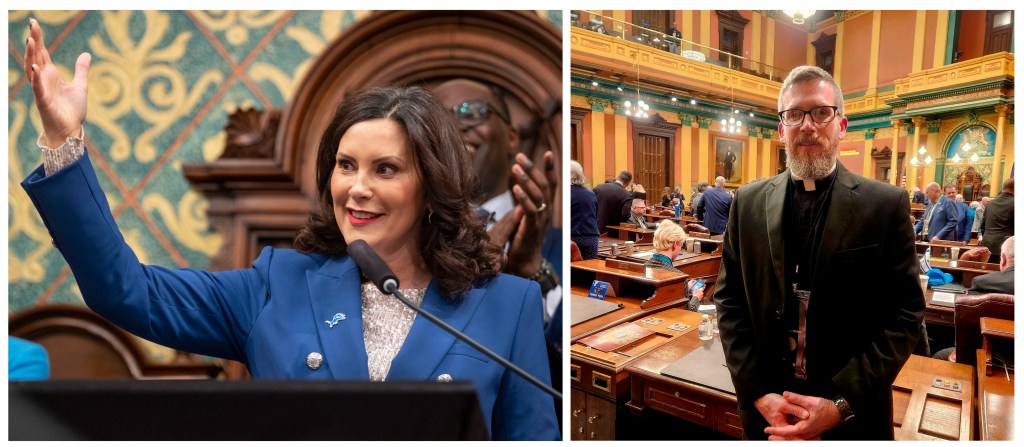
I was privileged to attend the State of the State address this past Wednesday in Lansing. Well, perhaps privileged is not the right word. Senator Jim Runestad invited me to be his guest. Therein lies the real privilege. He’s a good man and a faithful servant. It’s too bad he’s in his last term. We need more like him.

Overall, I suppose the event was worthwhile. Even though I crossed paths with people I’d just as soon avoid altogether in the future, I also met others in leadership I now consider friends. I had a chance to hide for a few minutes in Senate Minority Leader Aric Nesbitt’s office with my friend, Jeff Wiggins, and Senator Michele Hoitenga. They were great company. During the address, I sat beside Bridget Dean, the Mayor of Berkley, Michigan. I enjoyed the pre-speech conversation with her. I hope to see her again. Interestingly, my chair was on the House floor beside Representative Matthew Bierline’s desk. Matthew is one of two LCMS Lutherans in the House of Representatives. It was a pleasure visiting with him, too.

On occasion throughout the evening, some conversation partners wanted to hear firsthand why I would engage in the public square the way I do. I gave only the biblical reasons. For the ones asking from a position of genuine honesty, I get the sense their apprehensions were disarmed, even some who are likely to oppose my efforts.

We’ll see what comes of the conversations.

In the meantime, I could probably sit here tapping away at this keyboard all morning and never run out of stories to tell you. During the Pledge of Allegiance, I noticed several Democrat legislators refusing to speak. I asked Representative Bierline if that was normal. He couldn’t recall seeing that happen before.

Governor Whitmer’s speech was as I expected. She boldly opposes everything the Church holds dear. And yet, strangely, no small number of Michigan “Christians” helped choose her for Governor. The pastor she invited to give the invocation illustrated this. His prayer was not to God—not the real God, anyway. Instead, it was a prattling list of high praise for things the Bible would call sin. Worst of all, he prayed for continued blessing upon these warped endeavors. I don’t know if any roaming cameras caught it, but I’m pretty sure I was the only one in the room who turned and faced the other way during the prayer. It was clear the Invocator does not worship the same God I do. Let this be known.

The address was held in the Michigan House Chambers. As I mentioned, I had a floor seat rather than the gallery. I watched Whitmer ascend the rostrum like a determined preacher. While awkward with her colloquialisms, she exuded confidence that her administration was instrumental in recreating Michigan as a winning state.

I agree if she means Michigan is now winning the race toward dreadfulness.

She touted Michigan as a state that lets teachers “do what they do best: teach,” making it the envy of teachers in other states. And yet, U.S. News and World Report just released the state rankings in education. Michigan is number 37. Last year, we were 36. Our trajectory is by no means skyward. I wonder if this is because far too many of our school boards spend more time dividing learning communities with Diversity, Equity, and Inclusion initiatives while, at the same time, the classroom teachers are doing all they can to destroy spectral patriarchies and confuse genders rather than providing students with skills to be productive citizens in a functioning society built on objectively true things. By the way, when you add crime, fiscal stability, and other determiners to the ranking’s equation, Michigan drops to number 41. We’re nine spots short of being the worst state in the Union.

Conversely, there are categories in which we truly excel. I mean, Whitmer is quite proud that since Proposal 3 was passed in 2022, Michigan has become a top travel destination for those seeking an abortion. Proposal 3 memorialized in our state’s Constitution a woman’s right to kill her unborn child up to the very moment of birth.

If these things are what Whitmer means by winning, then she’s right. Relative to everything awful, we’re top-tier. Few can contend with us in the race to irreversibly damage our children physically, emotionally, and intellectually. Even fewer can keep with our pace to become America’s genocidal capital.

I walked away from the before- and after-speech conversations having experienced both optimism and dismay. I was optimistic about conservatism’s potential future. I met a young man with conservative aspirations. But then again, I always have such high hopes for starry-eyed conservatives, only to see those hopes dashed as they’re absorbed into what really is a power-hungry system. Not all can be Jim Runestads and maintain a steady course. Still, some good people are doing some great things. If their efforts are allowed to take root, my chief concern—religious liberty—will remain secure for at least a few days longer.

Unfortunately, the dismay I experienced was relatively familiar. Essentially, far too many of our leaders, once elected, begin demonstrating an inability to sense bare contradictory foolishness. Conservative or liberal, it doesn’t seem to matter. I’ll give you a few examples of what I mean.

Outside of the House Chambers, I happened to be standing very near to someone praising the radical gender ideologies cemented by Governor Whitmer and enforced by Attorney General Dana Nessel. I didn’t speak to her. I just listened. She emphatically announced, in short, that if a man decides he’s a woman, then he is, and for anyone to say otherwise is bigoted. In the same conversation, this person noted Michigan’s wintertime landscape as the best in the country, describing it as stunning. Thirty minutes before this, down in the Heritage Hall Stateroom, I was greeted by another gent who recognized me. I know he supported the vote last spring to redefine the word “sex” in Michigan’s Elliott-Larsen Civil Rights Act to include “gender identity” and “sexual orientation.” Attempting to schmooze, and somehow aware of my whisky endeavors, he asked me which I preferred to drink more, scotches or bourbons.

So, how do these obscure instances demonstrate contradictory foolishness?

Sight is a biological function. A person does not observe Michigan’s snow-covered landscape through one’s clavicle. The eyes are the organs for sight. Drinking is a biological function. A particular clergyman does not decide his Scotch or Bourbon preferences through his elbow. When the body is functioning as it should, the mouth receives whisky.

These two policy influencers go about their lives unquestionably submitting to biological realities while absurdly asserting that gender—the ultimate biological reality that produces humans capable of sensory perception and consumption—isn’t fixed but flexible, that it isn’t biological but rather a social construct. However, to fully realize this ideology (which they’d say can be changed at will) means extreme biological manipulation. And yet, if the mind determines gender, why is there a need for hormone therapy or surgery? Unless, of course, gender is actually rooted in biology.

I mentioned these conversations to Mayor Dean while awaiting the address. I told her the behavior reminded me of George Orwell’s “doublethink” concept, where individuals stake simultaneous claims on conflicting premises. Orwell described doublethinkers as those who will eventually be found telling a man they love him as they’re torturing him.

Governor Whitmer is a doublethinker. She stirred a standing ovation for Proposal 3’s passing. She immediately followed her words by demanding that we care for our “sweet and precious children” by guaranteeing them free school lunches. She added, “When kids are unsafe, they can’t reach their full potential.” Indeed, and amen. And yet, when does the child become precious enough for safety policies? Apparently, this is determined by location measured in centimeters.

Whitmer can tell children she loves them while making it possible to grind them to bits in the womb.

Doublethinkers are very dangerous. But in the end, the real danger is not just that they accommodate untruth. Instead, like Governor Whitmer on the rostrum, they enthusiastically preach untruth’s darkness. A lie gripped by an enthusiastic hand is the worst kind. If that hand also holds power, societies will unravel, and lives will be destroyed.

Following a few of these interactions, I couldn’t help but whisper, “God help us.” When I left the House Chamber following the speech, one person from the Democratic side of the aisle asked me what I thought of Whitmer’s words. I said I felt like I needed a shower.

Still, during the moments of deliberate conversation, I did what I could to convert and convince my discussion partners to something better.

In closing, I must confess I don’t belong in these circles. I said as much to Mayor Dean. I told her that the more I experience them, the less I want to. But I added that this is precisely why I steer into them whenever I’m invited. As a Christian who cares, I have something to offer. You do, too. Therefore, if you can chat with your local, state, or federal leaders face-to-face, do it. But again, only if you care. If you don’t care, stay home and enjoy what winning means to those who would just as soon push the Church into the shadows. If you do care, engage. Find your elected leaders. Ask them questions. Answer theirs. Praise what they’re doing well. Challenge what they’re doing wrong. Do what you can to invalidate untruths in ways that can’t be deleted from an email inbox, thrown into a trash can, or hung up on.

But there is something you should probably keep in mind. When you do this, be ready to be uncomfortable. Be prepared to experience trouble. In my experience, trouble is often the price exacted for faithfulness. And yet, as Christians, rest assured that we’re already built to endure the kind of trouble the world might inflict upon people like us. That’s because we’re not inheritors of this world. We’re inheritors of the world to come. We are set apart as Christ’s holy ones who know they have nothing to lose but Christ, making engagement with the world all the more possible and even more so necessary.