
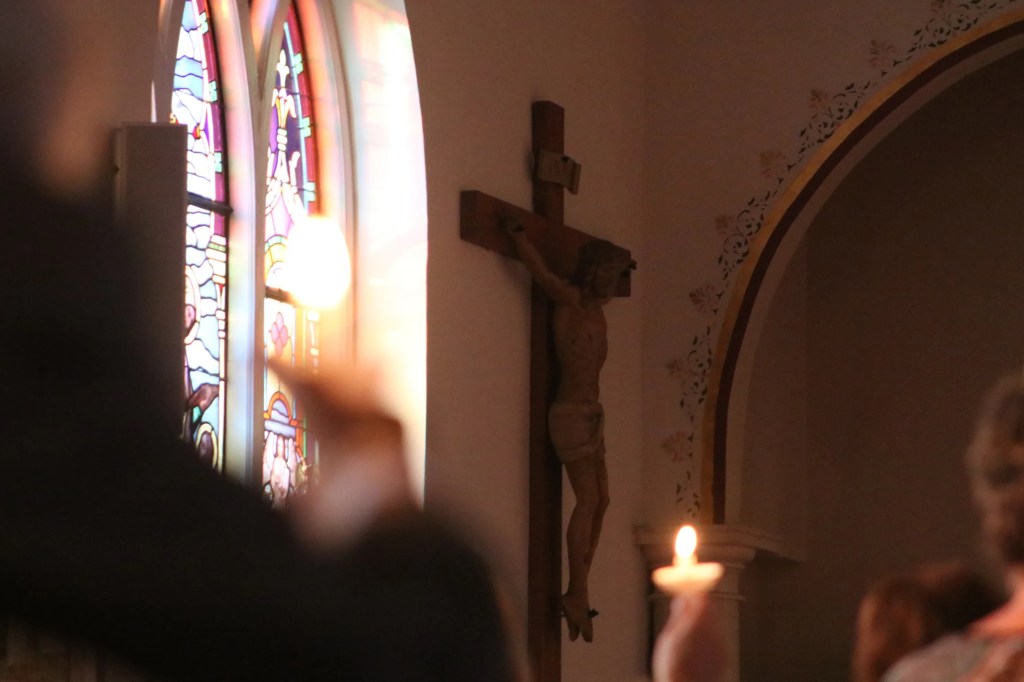
A new year is very nearly upon us. For the record, I’m with Tennyson, who said, “The year is going. Let him go.” From there, as I do every year, I ask myself, “How can I improve? What can I do differently?” The answer is always the same. “Plenty.” And so, I make New Year’s resolutions.
I know some folks think it’s a ridiculous practice. I don’t, which is why I tell you as much each year at this time. I make New Year’s resolutions not on the whim of wise words from guys like Benjamin Franklin, who encouraged his friends, “Be always at war with your vices… and let each year find you a better man.” I do it because there’s something I know about myself.
I know I’ll end this year infected with the sin-nature. I know I’ll begin the new year with the same infection. For me, this is an essential concern.
Thankfully, there’s something else I know. I am a forgiven sinner. God loves me, and I live in His grace. This Gospel of Christ’s life, death, and resurrection for my dreadful transgressions changes my trajectory entirely. By the power of the Holy Spirit through that Gospel for faith, I have a new inclination.
“You are not welcome here,” the inclination says to the sin-nature.
I suppose, reminiscent of Franklin’s words, to speak this way to the sin-nature is to coax it to war. If you’re wondering what that war might look like, take a quick moment to read Romans 7:14-25. Fully aware of sin’s dreadful grip, Saint Paul wrote in verse 23, “But I see in my members another law waging war against the law of my mind and making me captive to the law of sin that dwells in my members.”
And yet, the Apostle was prepared to face the deeply rooted inclinations of the flesh, having already written in the previous verse, “For I delight in the law of God, in my inner being…” (v. 22). Paul writes in this way only as the cross remains his strictest heading, adding rhetorically in verses 24 and 25: “Wretched man that I am! Who will deliver me from this body of death? Thanks be to God through Jesus Christ our Lord!” Paul rejoices that his wrestling with the sinful nature is entirely possible as it emerges from the Gospel deliverance won by Christ. In other words, because Christ has defeated death, sin has no rightful claim on the believer. It just doesn’t belong. And so, Christ has equipped us with a better nature, one equipped to wrestle and pin it.
From there, I think it’s interesting how Saint Paul sees God’s Law in an entirely new light. He doesn’t speak of it as burdensome, but instead, as good—as a preeminently useful weapon in the struggle against sin. From this perspective, he appears to lean in a direction that disinterests popular Christianity.
Essentially, mainstream Christianity is opposed to traditions, liturgies, rites, ceremonies, and other historical helps. But Paul appears to delight in the strictness of these things (1 Corinthians 11:1-2, 2 Thessalonians 2:15, 3:6, and others), counting it all joy to observe boundaries that keep him fixed to the Gospel.
I just watched the film Bonhoeffer. Well, I didn’t watch all of it. I only managed about forty-five minutes before I turned it off. The filmmakers framed Dietrich Bonhoeffer as someone who despised Christian tradition. They even wrote into his character syrupy, near-heretical phrases I’ve heard 21st-century mega-church pastors use concerning the faith. But Bonhoeffer didn’t write or speak this way. I studied Bonhoeffer extensively for my doctoral work and half of what so many claim to know about him and his theology is just not true. They often associate him with certain things without knowing what he actually believed. Concerning tradition, he was openly bothered by cultural influences on the Church and her historic practices, which is one reason why he was capably attuned to the Nazi dangers. Bonhoeffer didn’t see the Church’s traditions as humdrum things that needed to be jettisoned. They were protective things—Christocentric things. Their very point was to keep Christian hearts and minds fixed on Jesus. The Nazis brought their own rites and ceremonies—gestures, creeds, attire—all things that steered away from Christ to Hitler. The more they influenced the German Church’s leadership and clergy to massage these practices into the lives of the Deutsche Christen (the German Christians), the more the nation slipped into darkness.
I could go on and on about this, but I won’t. I’d rather return to Saint Paul. The Apostle to the Gentiles insisted that traditions, even though they might appear to some to have a Law sense about them, are quite useful in the spiritual battle. With this in mind, it’s interesting then how Paul insists still more in 1 Corinthians 9:24-27:
“Do you not know that in a race all the runners run, but only one receives the prize? So run that you may obtain it. Every athlete exercises self-control in all things. They do it to receive a perishable wreath, but we an imperishable. So I do not run aimlessly; I do not box as one beating the air. But I discipline my body and keep it under control, lest after preaching to others I myself should be disqualified.”
Mindful of the benefits of such discipline, first, Paul understands its nature and activities. He uses a very strange verb—ὑπωπιάζω—translated as “discipline.” It’s a visceral word that quite literally means to “strike beneath the eye,” thereby implying its visible nature. In other words, Paul doesn’t fight the flesh only in private with prayer, devotionals, quiet meditation, or whatever. His practices are activities—behaviors that others can see. He does these things to “keep [the flesh] under control,” that is, to enslave it to something better, something godly. That something is Christ.
These public behaviors are designed to keep him set on Christ.
I suppose that leads me to something else relative to New Year’s resolutions and why I think they’re good.
Essentially, Paul engages in self-discipline, viewable or unviewable, knowing it is not aimless but purposeful. That purpose matters for himself and others. If it’s visible, then Paul must know it has corporate effects. And so, he says as much in verse 27 when he writes, “I myself should be disqualified.” Disqualified from what? He already said what it was. His role as an Apostle who preaches. Paul knows that if he does not continue to practice visible or invisible discipline—keeping his body under control for the sake of godliness—his work as an Apostle could very easily become of little use not only to himself but also to the body of believers to whom God has sent him.
I practice self-discipline. One of my practices is to make New Year’s resolutions. It’s not just for me but also for you—for my family, friends, parishioners, people who know and see me. I know my sinful tendencies, and so, as a pastor, I fight them for the sake of remaining faithful to my calling.
As for you, consider your own vocation. As you do, take a chance at making your own New Year’s resolutions. Keep your eyes on the cross, and from there, try adding a routine to your life, some rites (words) and/or ceremonies (actions) that help keep your eyes fixed on Christ. For example, start off small. Maybe begin each day by making the sign of the cross and praying before you even get out of bed. If you already do this, maybe add something else. Maybe try something as simple as hugging your spouse and children daily and telling them how thankful to Christ you are for them.
You know you. You know what needs betterment. Give it a try. Be encouraged in the war against the flesh. And when you fail, don’t worry. Dust yourself off and get back in the fray. God is with you. He loves you. Steadied by His Gospel, He’s given you everything you need to maintain the course.

 Cruciform Stuff