
Ash Wednesday 2024

I felt the urge to reach out this morning. Lent arrives this Wednesday. If there was a season to contemplate mankind’s dreadful predicament, it’s Lent.

I suppose, in a broad sense, death’s predicament is not lost on humans. We’re all facing it. Still, believers have the best handle on it. We have the Gospel—the proclamation of death’s cost and the Savior who accomplished its payment by His own death.

During staff devotions this morning, I shared a portion from Luther. He spoke of the cross and the Christian’s desire to be worthy of it. He wrote, “Is it not a wonder to be possessed of a ready will toward death, while everyone dreads it? Thus is the cross sanctified.”

I’m concerned that far too many mainstream churches seem to have lost their formal grip on this. They demonstrate as much by their crucifix-less worship spaces. One pastor (if you can call him that) in a church not far from my own won’t allow crosses to be displayed in his facility. He openly admits that crucifixes—and even bare crosses, for that matter—are offensive to visitors. And yet, Saint Paul preached so fervently, “We preach Christ crucified” (1 Corinthians 1:23), knowing that such a message would be received as offensive and foolish by an onlooking world.

It’s heartbreaking when a church views the cross through the world’s lenses.

You should know what I’ve described is rarely lost on liturgical churches. A liturgical church will likely have crucifixes displayed throughout its expanse—and not just one or two, but many. Interestingly, Paulo Freire, the father of Critical Pedagogy (which is foundational to Critical Theory), insisted that for his Marxist theories to prevail, traditional liturgical churches needed to be deconstructed and their symbols dispensed and forgotten. Freire wasn’t concerned with contemporary churches. Why? Because traditional liturgical churches are by nature impenetrably linked to faith and its symbols, and in Freire’s research, far more dangerous. They don’t roll over when persecuted. They produce a far sturdier commitment than churches devoted to cultural appeasement. Hitler agreed, calling the more contemporary churches in Germany “mushy.” He was more so bothered by historically creedal churches and their believers. The historic Creeds define, teach, and defend truth. A church’s historic liturgies carry it. The church’s calendar—the liturgical seasons—imposes it in long-lasting and unforgettable ways. And by long-lasting and unforgettable, I mean it stays with a congregation generation after generation, binding it to those who came before and those who will come after.

A persecutor laboring to destroy such a church won’t have an easy time. Its identity is built from ranks the persecutor can’t even see.

Here’s some free advice: When any organization (whether it’s the Boy Scouts, your favorite car company, football team, or whatever) begins obscuring its symbols, jettisoning its creeds, or altering its traditions, beware. These are essential to the organization’s identity. When they change, so does their identity. They’re inextricably linked.

I suppose I’ve wandered too far already. So, here’s what I really came here to tell you.

A critical Church season begins this week. It starts with a crucial moment epitomizing the Church’s identity. It deliberately resists desires to loosen our grip on who we are and what we are to believe, teach, and confess.

Epiphany and the Gesima Sundays become Lent. As these season’s crowds approach, Lent’s somber doorman, Ash Wednesday, will clatter through its ancient keyring with cinder-stained fingers to open Lent’s door. Year after year, Ash Wednesday’s digits have etched a cross upon the foreheads of countless believers passing through this entry, elbowing them toward honesty, nudging them toward a vital confession that matters when pondering Golgotha’s truest weight: “Remember you are dust, and to dust you shall return” (Genesis 3:19). And yet, Ash Wednesday’s participants do this wearing a black-powdery smudge in the shape of a cross. Yes, we are dust. We will die. And yet, in Christ, by His death on the cross, we’ve been made alive (1 Corinthians 15:22). Death in Christ is not to die but to live (Philippians 1:21).

Ash Wednesday’s liturgy amplifies what the Christian Church knows about death. It amplifies what we know about a certain Someone who met with death and outmaneuvered it. Ash Wednesday brings us in. Lent will take us the rest of the way. It will dive so much deeper into our genuine need for rescue while showing us over and over again the One who can meet the need.

Ash Wednesday, and therefore Lent, remind us that the clash between Jesus and death won’t be pretty. Death won’t just hand us over to Him. Death is the last enemy, and he’s been waiting his turn in line to consume us (1 Corinthians 15:26). Rest assured, war will ensue, and it’ll get ugly. At first, the glorious rescue will look more like defeat. Jesus will confront the challenger, submitting to its dreadfulness. He won’t lift a finger to defend Himself. He’ll endure, taking all of it in. The results will be His mutilated body nailed to a blood-soaked cross lifted high above the warfare’s haze. We’ll see Him pinned there like an animal; an outcast doled an awful demise.

And that, right there, is the message we preach! We preach Christ crucified! The Lord’s greatest work is His humble submission as the sacrifice for sin! This is His truest glory (John 12:23-33; Mark 10:32-38)! His resurrection is the proof pointing to this great deed. He owned the death we deserve, and He rose from the grave, proving He beat the specter at its own game, giving the spoils to all who believe.

This is Ash Wednesday’s message. Admittedly, it’s gritty. But it’s thoroughly consolidated and good. If you’ve never considered attending an Ash Wednesday service, I encourage you to do so. If your church doesn’t offer one, find a church that does. We’ll offer two here at Our Savior in Hartland, the first at 8:10 am and the second at 6:30 pm.

Consider these things, and in the meantime, God bless and keep you by His grace. Indeed, Lent has come. But rejoice, the fruit of the Lord’s greatest work—Easter—is coming, too.

Light or Dark, Day or Night

Apart from our basement living space, which is a visual explosion of movie memorabilia, the rest of the Thoma home betrays our minimalist nature. We store nothing on the kitchen counters. The available shelves are not cluttered. The walls are mindfully decorated. As it is for most people, the wall adornments vary.

The stairwell is where the family photos hang. The only other place we display family pictures is in the master bedroom. There are four images of the children on its north wall. A uniquely designed horizontal frame with wedding photos is on the south wall above our bed. Excluding the furniture (which includes a fireplace mantle Jennifer and I restored and put on the longest wall), the rest of the bedroom’s walls are relatively bare.

Almost every morning, I awaken on my right side. The first thing I see is a five-foot by eight-foot sky-blue wall with nothing on it. At least it used to have nothing on it. I bought and hung a 5-inch by 10-inch crucifix last week. Relative to the space, the crucifix is somewhat small. At first glance, it may even look swallowed up by the area around it. Still, I’m keeping it where it is. It’s crisply distinct, hovering as the space’s only focal point.

Interestingly, I can see the crucifix day or night. In the daytime, it casts a notable shadow. At night, after my eyes adjust, its contours are not lost in the blackness. It’s harder to see, but it is not invisible. There’s a unique comfort to be had by this, which means the crucifix is doing its job. But before I explain what I mean, I should clarify something else.

Some people despise the usage of crucifixes, icons, and other religious items. In their ignorantly hasty opinions, they blanketly consider them idolatrous, being little more than talisman-type objects that can only nudge God from center stage. Admittedly, some people do treat religious objects this way. I knew someone who once told me he put a Bible on his bedside table, not to read but to help him sleep more soundly. He believed its presence helped ward off evil spirits. That, of course, is ridiculous. Still, my guess is that most Christians don’t keep religious items around for such reasons. Instead, they have something else in mind.

Take, for example, the crucifix on the wall beside my bed. It’s where it is for a reason. I didn’t put it there for pseudo-spiritual reasons or because the wall needed décor. I’m not afraid of the devil, and Jennifer has more than decorated our bedroom, making it a cozy place of refuge and rest. I hung it there because it’s likely the first thing I’ll see when I wake up and the last thing I’ll see when I go to bed. I’ll see it when the lights are on or off, in the sunbeams of daylight or the pitched darkness of night.

A crucifix—a cross with a body on it—is the Gospel depicted. It’s a visual proclamation of Saint Paul’s words, “We preach Christ crucified” (1 Corinthians 1:23). It is a silent sermon wholly concerned with the person and work of Jesus Christ, the world’s Savior. That’s its job—to preach. You don’t worship a crucifix just as you don’t worship a pastor. Neither replaces Christ. Both preach Christ’s visceral efforts to defeat Sin, Death, and Satan. The preacher speaks it. A crucifix shows it. The one on my wall is no different. I awaken to its quiet preaching. I also close my eyes to it, finding rest in the Gospel promise of God’s forgiveness and care for me, a sinner needing daily rescue.

Relative to optics, there’s certainly more it teaches. I mentioned I can see it in both the daytime and at night. Things are simpler with the sunlight’s ease. You know what’s going on. You can see where you’re going. Your steps are freer and more leisurely. Life’s darker moments are harder. Terrors creep there. Perceptions are skewed. It’s far more difficult to see. Nevertheless, Christ’s payment stands. In the ease of daytime or the terrors of night, Christ’s sacrifice for our eternal future remains the solitary point of reference to everything this life presents. Faith sees it. It knows it. And it is at peace.

Apologizing to Thomas

There is the rather elementary saying that one thing leads to another. It’s elementary because it’s true, and I have the perfect example to share.

You may or may not know this, but I’m a fan of 80s and early 90s sci-fi and horror films. I’ve seen them all, both the A and the B list—from Academy Award winners like “Silence of the Lambs” to straight-to-VHS gems like “Attack of the Killer Tomatoes.” Watching them now, I have to say that many are still very good. They’ve stood the test of time. Others were trash before they ever became a script, and they remain trash long afterward. The special effects were terrible, often intentionally. The dialogue was just as bad. It’s easy to tell that many were made just to be made. Trust me, “Friday the 13th” could have been put to rest after “Part IV, The Final Chapter.” Still, they gave us seven more and an attempted reboot. The same goes for the “A Nightmare on Elm Street” series. “Dream Warriors,” the third movie in the series, was the last of the franchise’s serious attempts. But the thing is, even the cringe-worthy sequels remained great fun. Their hokeyness only made the good films seem better.

Not long ago I was watching a documentary series called “The Movies that Made Us.” One episode focused on James Cameron’s masterpiece “Aliens.” Anyone who’s been in my basement will confirm the film as an absolute favorite of mine. I mean, it did win seven Academy Awards, one of which was for best visual effects.

Anyway, after watching the documentary, I did a little reading about James Cameron. In comparison to his accomplishments, I was fascinated with his beginnings. Interestingly, after seeing “Star Wars” on the big screen, he was inspired to leave his job as a truck driver and take aim at making movies in Hollywood. Personally, I’m glad he took the chance.

Reading about his life, I came across a TV interview he did with a California news station in what I believe was the early 2000s. During the interview, he said something along the lines of, “If your goals are set ridiculously high and then you fail, you’ll already be well past everyone else, having failed well above everyone else’s successes.”

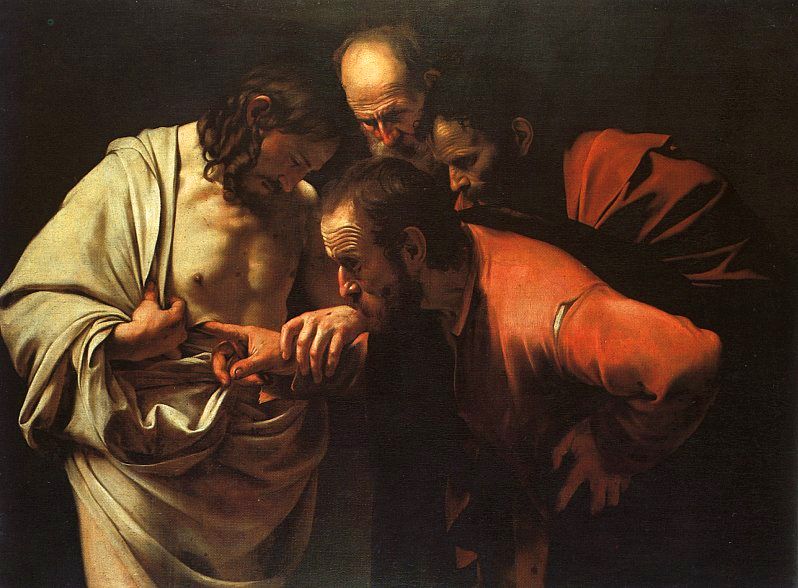
Remember how I said one thing leads to another? Well, here’s why I said it. That comment reminded me of the disciple Thomas. By the way, apart from Jesus, Thomas is the most important character in the resurrection narrative from John 20:19-31, which is also the appointed Gospel reading for the Second Sunday of Easter. Essentially, Thomas is the one who continues even now to get a bad rap for doubting the Lord’s resurrection. But the thing is, his seemingly greatest failure was far above the successes of everyone else in the bunch. Here’s what I mean.

All the disciples deserted Jesus. Peter denied the Lord. Still, it would appear that after the crucifixion and burial, all but Thomas were gathered together in the upper room. The narratives say this happened because the disciples were afraid of what the Jews would do to them, too. But where was Thomas? I’m willing to bet that the answer is assumed by the ease with which the disciples retrieved him after the Lord’s first resurrected appearance among them. They went to where they knew they’d find him—at home. Thomas went back to his life, apparently having already accepted his fate concerning a failed messiah.

But Jesus hadn’t failed. And so, the disciples went to Thomas to tell him the Lord had risen. What were Thomas’ words in reply?

“Unless I see in his hands the mark of the nails, and place my finger into the mark of the nails, and place my hand into his side, I will never believe” (John 20:25).

These words prove Thomas’ failure was well above everyone else’s successes. While everyone else was stowed away in fear and asking questions bent on self-preservation, Thomas had subscribed to his fate. But he did this bearing the embers of a faith that was asking for the only proof Jesus had ever promised to give. In other words, Thomas knew (whether consciously or subconsciously) that his faith could only be rekindled when he met a living Jesus with crucifixion wounds.

I was asked a few weeks ago who I’d like to meet first in heaven. Apart from the Lord Himself, and then my brother, I hope to meet Thomas. I intend to apologize to him on behalf of any human in history who ever used the title “Doubting Thomas” to describe him. Indeed, Thomas’ failure was well above the rest of our so-called successes. In the darkest hour of Good Friday and Holy Saturday’s deepest confusion, Thomas was asking the right questions. Everyone else was asking for personal safety. Thomas was asking to see the One who would eventually say by Revelation 1:18, “I died, and behold I am alive forevermore, and I have the keys of Death and Hades.” He believed as Saint Paul would eventually preach foundationally: faith in Christ crucified and raised (1 Corinthians 1:23, 15:1-26).

If only we could be as clear-sighted for receiving the risen Christ as Thomas, who is also the same one who gave what is perhaps one of the most moving confessions of joyful faith ever recorded in the scriptures. When Thomas took the strangest of chances at rejoining his fellow disciples in the upper room, the Lord gave Thomas what he asked for—the opportunity to touch His wounds. And again, what were Thomas’ words?

 “My Lord and my God!” (John 20:28).

I dare say that as we so often live our lives beneath a shroud of deeper doubt than even that of Thomas, not trusting that the Lord will care for us as He’s promised, there will come the day when the Lord shows us His wounds in the glories of heaven—wounds that will forever be the proof of His triumph in and over all things. I’m guessing there’s a good chance we’ll sound a lot like that one disciple with the millennia-long bad reputation.