Perhaps You Heard…

I’m going to wander a bit this morning, if you don’t mind. Perhaps you heard the news? If not, I’ll share what I posted last week in two separate social media posts.

From March 10:

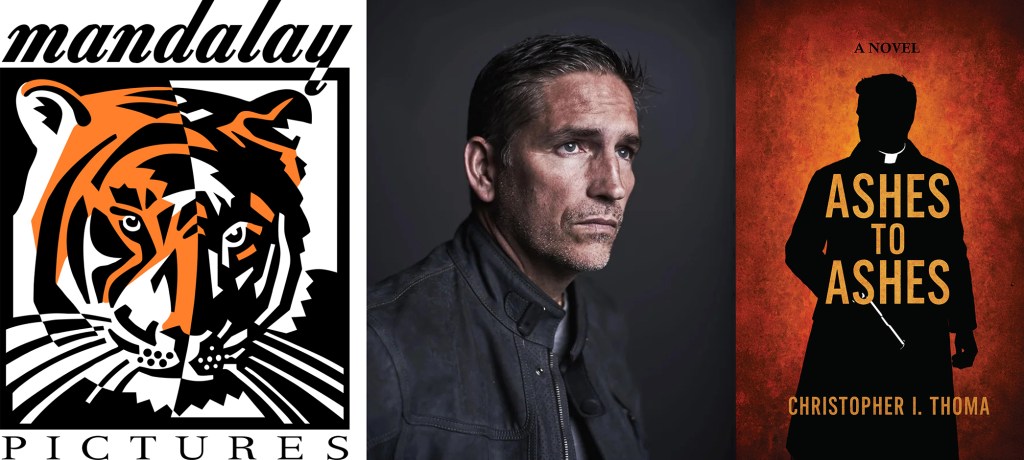
After months of discussion, it’s official. Mandalay Pictures is turning my novel ‘Ashes To Ashes’ into a movie. Jim Caviezel is on board to play Rev. Daniel Michaels. This is a humbling moment for my family and me, to be sure, even more so that a handful of some of the most influential producers in the film industry have expressed to me personally a love for the story and its themes, all with the expectation that it’s going to be a huge success, even bigger than we may yet anticipate. Either way, and again, it’s official. It is happening. And for the record, I intend to embrace the experience fully. If you have not yet read the book, you can order it here: https://www.amazon.com/Ashes-Christopher-I-Thoma/dp/1955355053/. (If you do read it, please return to Amazon and leave a review!) You may do some preemptive reading by visiting here: https://christopherthoma.com/. [I know it will be offered in love, but please do not comment here with contractual advice or concerns/interest for representation. I signed with an agent in Hollywood last December. She is exceptional. In fact, she’s essentially family to us now. God truly has us well in hand.]

From March 12:

I can’t even begin to describe how Rev. Daniel Michaels is actually coming to life. He is already a beloved character for the director, Alejandro Monteverde (who is co-writing the script with Rod Barr), and the lead actor, Jim Caviezel. Their praise is humbling. Truly. And with all at the top of Mandalay saying the same things, this is moving forward at full throttle. Even better, they’re committed to remaining true to the book. That alone settles in my deepest insides. It’ll be a long road to the finished product. Still, pray for and rejoice with me, friends. This is something very good.

Whether you read those posts when they were shared, or you’re reading them now for the first time, I hope you’ve sensed the mixture of excitement, gratitude, and careful restraint that comes with sharing news of this kind. I suppose had you been present when I announced it during Bible study last Sunday, you’d have heard a whole lot more. I took the faithful here at Our Savior—my Christian family—into the deepest recesses of my heart concerning what’s about to happen to me. That’s because when something like this moves from the realm of possibility into the realm of certainty, the instinct is to share the untold details—and the privilege of those details belongs to family.

Beyond family, wisdom suggests saying only what is necessary and letting the moment settle where it should. And so, that was the purpose of the first post. It simply established the facts. After months of discussions, Mandalay Pictures has committed to bringing Ashes to Ashes to the screen. Jim Caviezel will portray Rev. Daniel Michaels.

Admittedly, those are remarkable sentences to write. I have to imagine that any novelist blessed to scribble such things knows the gravity. What’s more, for a pastor who wrote the story while carrying the ordinary rhythms of ministry—preaching, teaching, visiting, counseling, and doing all the tasks required to shepherd a congregation—it adds an additional layer of astonishment. It represents the convergence of a great many emotions. It’s made from moments that belong, first, as I said, to those who know me best, but also the readers who took a chance with the story, discovering a love for it, and now to the filmmaking professionals who believe it can and will be adored by millions more.

The second post I shared was already stirring even as I was typing the first. A product of multiple conversations from the last two weeks, it concerned the people entrusted with interpreting the story. And so, the question: “Do they understand it?” I’m betting that question rests quietly in the heart of every author whose work enters the world of film. It’s no different when the story itself grows out of a pastor’s experience combined with a wandering imagination. Indeed, the character of Rev. Daniel Michaels was never intended to be a caricature or a symbol for anything. In so many ways, he’s real. Do they understand this? Do they know why he does this instead of that? Does it make sense that he’d say these words instead of those? How can he suddenly turn from his role of protecting a flock to one of hunting the wolves?

There’s a lot to consider with these questions. I spent most of Friday night and Saturday morning thinking through and writing a character study for the potential script writer, if only to help him better grasp the innards of these things. But no matter how you see Rev. Daniel Michaels, he demonstrates genuine humanity. There’s nothing formulaic here. In that sense, I should tell you something I said to the folks at Mandalay.

In an early conversation, I said that Rev. Daniel Michaels was written as a man, but also a true shepherd of souls. He really cares and wants nothing more than to be faithful. True shepherds do not do what they do to fill church pews. They’re called in service to Christ. As they do, they bear the very real burdens and convictions that come with that calling (Matthew 5:11-12, John 15:18, and so many others). Being a pastor is not for the faint of heart. Pastors—real ones, that is—are not the prudish or sometimes aloof pietists you so often see on screen. They’re also not necessarily the syrupy skinny-jeans-wearing hipsters you see in contemporary Christian film—even as so many try to emulate that ridiculous form. I added to this that a writer writes what he knows. This was to say, I’m a pastor, and so, Daniel Michaels is me, or an apparition of me, at least. He knows what I know. He speaks as I speak. He carries himself as I carry myself. He drives the same car. He lives in the same town. He loves the people in his care deeply enough to put his own reputation and security on the line to preserve them. Knowing that Jim will be playing the character, I wrote to him specifically, “It’s no small thing for me to say that, very soon, you could be the person who has come closest to being ‘me’ that anyone ever has.”

I repeated that for my wife, Jennifer, this past Thursday night. We were watching a movie when I started getting texts from the director, writer, and producer of the very movie we were watching. Talk about a surrealistic fever dream. She paused the film, I responded, and then turned to her to say that very soon I’d be watching a movie—a character on the screen. It won’t be me, but it’ll be me. I barely have the words to describe how I feel about that.

But then there are all the other conversations so far. It has been particularly encouraging along the way to hear the affection everyone involved in this production has for Rev. Daniel Michaels. When filmmakers praise the character rather than simply the plot, it’s usually a sign that they have a sense for the story’s center of gravity. As this particular fictional world’s creator, I’m convinced they get it. Even better, they’ve committed to staying faithful to the book’s vision.

I’m sure, like me, you’ve read a book and, after seeing the film adaptation, were dreadfully disappointed, if only because the filmmakers took far too many liberties. Adaptation always involves translation. However, in this case, those leading the effort openly acknowledge the sanctity of the original form. This is a great place to start. It suggests that no one involved is trying to reinvent anything. They want the story and the characters that I wrote. That’s good. I want them, too. Will liberties be taken? Yes. But we’re already starting in a very good place.

I’ve already gone on long enough, and I need to get ready for the day ahead. I suppose I’ll close by saying to you what’s been said to me, which is that the road from development to a finished film is long and filled with plenty of moving parts that not even I will ever know or see. Creative decisions multiply. Scripts evolve. Things happen. Still, the essential reality is that the project is underway, the right people appear to be in place, and the story that once existed only on paper has begun the slow process of becoming something more. For a pastor who never set out to write for Hollywood—even though, admittedly, I’ve always had a cinematic mind and style—that realization remains quietly astonishing.

But here’s the thing. I am and remain a pastor. I love my Lord. I love preaching and teaching His Word. I love the congregation I serve. As I said, they’re family. The faithful here at Our Savior will most certainly get first dibs on any potential benefits from this Hollywood stuff. In the meantime, as things unfold, it is more than enough to give thanks to God for His grace in all things, and to rest in the knowledge that something pretty incredible is happening.
Not Recording… But Recording

The following has been on my mind for some time. I’ve only just now felt the urge to parse my thoughts. Essentially, Jennifer and I were sitting together and watching a news report on the Nancy Guthrie case a few weeks ago when something relatively small (but actually not very small at all) slipped into the host’s conversation.

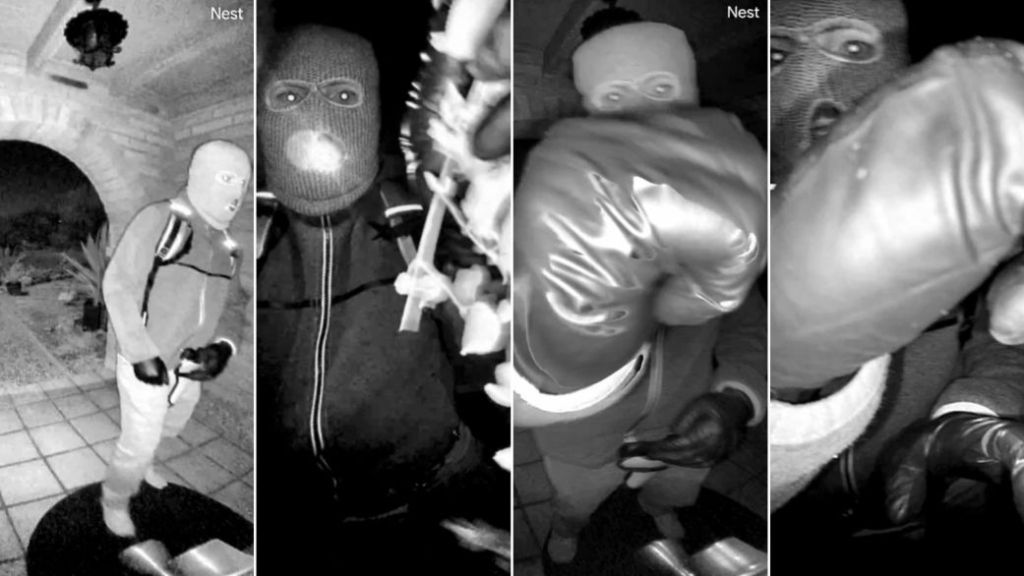
Nancy Guthrie’s Ring Doorbell footage was playing on the screen. The suspect was visible, moving about the Guthrie porch area, doing what he could to cover the camera’s lens and then break into the home. At one point, Dan Bongino joined the broadcast. Bongino is the former Deputy Director of the FBI. The host and Bongino both commented on the FBI’s impressive technological capacity, how the Bureau likely had the tools to use the video’s contents to identify and track down the suspect, even though his face was covered by a ski mask.

But then came the statement that bothered me.

The show’s host mentioned that, even though the Ring Doorbell camera was turned off and not recording, the FBI was able to obtain the footage we were watching at that very moment, which was, in fact, stored at Google. Nothing was added to the comment. There was no explanation. No clarification. The conversation simply moved on.

I immediately turned to Jennifer and said, “Did you hear that? The camera wasn’t recording, but somehow the FBI was able to acquire recorded footage from Google’s servers.”

That detail, while it seemed to matter very little to the host or Bongino, has not left me. We are told our devices are dormant until activated. We have a Google Home device that sits quietly on a cabinet near our dining area. It’s not supposed to listen unless prompted with what’s called a “wake word,” and it’s not supposed to record until that wake word is used and the command to record is given. It’s certainly not supposed to store audio without our consent. Still, notice the logic. To hear a “wake word,” it has to be listening—always.

And so, the FBI obtained uninterrupted video footage from a Google device that wasn’t awake.

How many times has the Thoma family joked about this sort of thing? More than I can count. It’s become something of a running gag in our house. For example, if the kids are horsing around, poking fun at each other, mock-threatening in that exaggerated, theatrical way siblings do, someone might laugh and say, “I’m gonna murder you.” They all laugh. And yet, almost instantly, one of them will add, “In Minecraft.”

It’s reflexive now. The joke, of course, is that our Google device is always listening. So, if an algorithm somewhere flags the word murder, we quickly clarify that no actual murder is about to take place, but rather someone is going to get revenge in the blocky video game universe of Minecraft. The kids laugh, but they also qualify. They tease, but they also amend the record. And that’s the curious part for me. Again, we’ve been assured the device isn’t listening. And yet, here we are, instinctively adding digital disclaimers at dinner, as though an invisible guest might be taking notes.

But we have good reason to believe it’s happening. Maybe you’ve had the same experiences we’ve had. There’ve been times when we were discussing something obscure during dinner or while sitting around the corner on the couch—talking about something oddly specific—and moments later, we discovered advertisements or suggested articles or videos related to that very topic appearing in our feeds. No one looked anything up on the internet during the original discussion. No one shared a video link by text. We simply spoke. Then, suddenly, strangely, there was the topic of our discussion in digital form on all our phones.

We laugh and say, “Big Brother’s listening.” Maybe he is.

This also has me wondering out loud that if a Ring camera can be “not recording” and yet still have retrievable footage stored somewhere, what exactly does “not recording” mean? Technology companies use careful language. My guess is that “recording” may not mean what ordinary people think it means. In other words, maybe it means something other than the typical layman’s understanding of “on” and “off.” Whatever the definition might be, the former Deputy Director of the FBI just told me that federal investigators can, in fact, access recordings from a device that’s not recording. And they can use it against you.

I suppose for me, the question in that moment became something more like, “What’s the price I’m willing to pay for convenience—or personal safety?” I like the fact that we have cameras around the outside of our home. Writing for public consumption has proven the cameras necessary. But I also like the convenience of seeing that a package was delivered while I’m away. I like being able to adjust the thermostat from an app. I like calling out into the thin air, “Hey, Google, what’s the weather going to be like today?” even though I live in Michigan and I can pretty much guarantee it’s going to be cold.

But for all the things I might appreciate about technology, convenience and personal safety are rarely free, especially in the modern home. The modern home hums with interactive devices. I was at Home Depot a week or so ago and passed by a refrigerator with an interactive screen bigger than my desktop computer’s two monitors combined. And so, I suppose the question changes a little. I should probably be asking whether we understand the scope of what we’ve invited into our homes.

Having said all this, I’m not sure where to go next. Although I suppose Lent is an appropriate season for asking these kinds of questions, especially that last one.

Lent is a season of examination. The examination most certainly could reach into our digital habits. But in the end, its reach isn’t technological. It’s spiritual. Lent is in place to help us slow down. We quiet the world’s noise. We take inventory. We ask what has quietly crept into the house of our hearts and what’s humming in the background of our souls.

Sure, we worry about devices that are always listening. We joke about invisible listeners, and we clarify our ribbing jokes with “in Minecraft,” just in case. But God’s Word reminds us that there is, in fact, One who truly hears every word and knows everything about us. Read Psalm 139 if you don’t believe me. The first twelve verses will tell you everything you need to know:

“O Lord, you have searched me and known me! You know when I sit down and when I rise up; you discern my thoughts from afar. You search out my path and my lying down and are acquainted with all my ways. Even before a word is on my tongue, behold, O Lord, you know it altogether. You hem me in, behind and before, and lay your hand upon me. Such knowledge is too wonderful for me; it is high; I cannot attain it. Where shall I go from your Spirit? Or where shall I flee from your presence? If I ascend to heaven, you are there! If I make my bed in Sheol, you are there! If I take the wings of the morning and dwell in the uttermost parts of the sea, even there your hand shall lead me, and your right hand shall hold me. If I say, ‘Surely the darkness shall cover me, and the light about me be night,’ even the darkness is not dark to you; the night is bright as the day, for darkness is as light with you” (vv. 1-12).

What the Psalmist declared could be either terrifying or comforting. It’s terrifying if God is merely a cosmic surveillance system waiting to use our words against us—to capture us in wrongdoing and bring swift judgment. On the other hand, the Psalmist’s words are comforting if the One who hears and sees is also the One who went to the cross for every intentional or unintentional crime of thought, word, and deed we’ve ever committed (Matthew 12:36). In other words, the difference is the cross.

And that’s where Lent is taking us—to Good Friday’s holy massacre.

This world is an uneasy one. The assumption is that we’re being watched, not only by corporations and governments, but by sin, death, and the devil, forces far more formidable than the FBI. And yet, in the midst of these things, the Holy Spirit calls us by the Gospel to remember that we are seen fully by God—and loved and cared for still. The Lord who knows what is whispered in our dining rooms is the same Lord who bore our sin in His body on the cross. He does not need devices or algorithms to track us down. He certainly didn’t look upon His world with His first inclination being that it would only end in eternal imprisonment. His first response was love. His first response was rescue. His first response was to act. And so, He reached into this world personally. Through the person and work of Jesus Christ, God came down Himself.

Perhaps that’s the best direction to go with all of this. We fear unseen listeners in plastic devices sitting on shelves in our living spaces. And yet, the One who truly sees and hears us—the One who knows the worst that we are—was already there all along. Even better, He took upon Himself human flesh and joined us at the table. He wasn’t invisible. He was seen. He showed us just how much He cares. And now, through faith in His sacrifice—inevitably demonstrated through repentance, faith, and the amending of the sinful life—the verdict is declared to those who believe: Whatever you’ve done, it isn’t enough to condemn you. You are forgiven. And this happened in reality, not in Minecraft.

An Unforgettable Moment—State of the Union 2026

Perhaps you had a chance to watch or listen to President Trump’s State of the Union speech last Tuesday. I didn’t watch the whole thing. I’d only just gotten home before it started, and the day had already been a long and exhausting one. Still, I watched until about 10:25 PM—and that was plenty.

Political speeches, especially Trump speeches, are rarely remembered for their eloquence, even when they’re chock full of accomplishments, policy prescriptions, and legislative ambitions. That said, I can’t think of another president I’ve enjoyed listening to more than Donald J. Trump. He can be quite funny. And not to mention, he’s fearless. He steers into things that few before him have been willing to offer even the slightest glance. I should add that when my family and I met him in person, on my daughter Evelyn’s birthday, no less, he was the kindest and most genuine politician I’d ever met. He already knew it was her birthday before we walked in, and even as the Secret Service reminded us before entering that the visit would be quick—and not to touch him—he saw us enter and reached out to us, even hugging Evelyn. He took time with us, asking us questions. He shook my hand and described the pastoral office with great respect. He didn’t have to do any of those things. But he did. That’s because he’s that kind of person.

“Still, how can you admire this crass man? And you call yourself a Christian pastor!”

My first reaction to statements like that is to say I’m friends with lots of folks the perfect humans among us might be inclined to call imperfect. My second thought is to say, be careful not to fall into what has become a rather tired pitfall. I did not choose Donald Trump to be my pastor. I voted for him to be my president, and God’s Word draws a clear distinction between the roles of civil authority and spiritual shepherds. As I’ve noted on countless occasions, if I were ever on trial for murder, I’d want the best lawyer defending me, not the most pious Christian. Saint Paul teaches that governing authorities are instituted by God to “bear the sword” and to punish wrongdoing and promote civil order—a function of justice, not pastoral care (Romans 13:1-4). By contrast, 1 Peter 5:2-3 and Ephesians 4:11-12 describe pastors as shepherds who oversee souls, teach sound doctrine, and equip the saints for ministry. And of course, Jesus says, “Render to Caesar the things that are Caesar’s, and to God the things that are God’s” (Matthew 22:21). When He did this, at a minimum, He affirmed distinct spheres of responsibility. Both are established and ordained by God, and so, in that sense, they’re not absolutely divided. They’re designed to cooperate. Nevertheless, the plain structure is that civil leaders are accountable for governance and public order, while pastors are accountable for spiritual oversight. The offices are different by divine design.

But now, before I wander too far from what I intended to say, regardless of the politician giving any particular speech, most of what anyone says tends to fade almost immediately into the churn of news cycles and partisan rebuttals. What sticks are the moments—scripted or unscripted—that cut through the usual political theater, giving way to actual revelation. There was one particular moment during Tuesday’s address that stood apart for me. It proved Trump’s prowess. And for the hundreds of millions around the world watching the speech, it pared away any obscurities, leaving only the unmistakable mineral differences between two very different ideological positions.

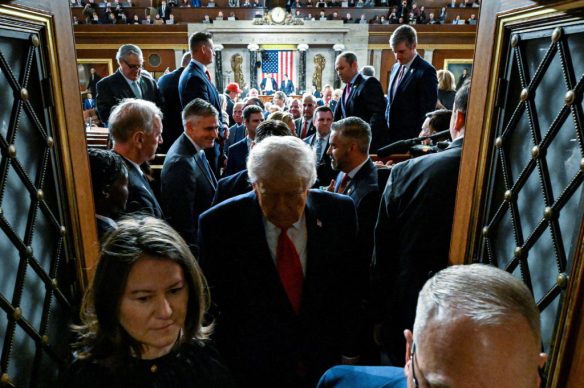
When the president asked members of Congress to stand if they believed the primary responsibility of government is to protect American citizens before illegal aliens, the chamber responded immediately. A very simple question elicited a whole-body posture, a “yes” or “no” response that couldn’t be hidden.

Republicans rose instantly at the question, their applause swelling into a prolonged ovation that lasted several minutes. Across the aisle to their left, Democrats remained seated. Some scowled. A few shouted. Others mocked or gestured dismissively as the applause continued around them. The contrast couldn’t have been sharper. I turned to Jennifer and said, “There you have it. There’s no hiding from that. That’ll be remembered.”

Standing in support or sitting in protest during the State of the Union speech is normal. Trump used that practice, ultimately handing control of the rostrum over to the whole room, inviting everyone to state their most fundamental ideology concerning government. Who is it principally for? And the whole room answered. At that moment, the division was no longer theoretical. It wasn’t buried beneath news reporters asking the same question, only to receive rambling responses designed to avoid it entirely, lest the one being questioned offend the extremists in their party. Stand if you think the American government is in place to serve Americans before illegal aliens. Sit if you don’t.

The Republicans stood. The Democrats remained seated.

In the end, that was an important moment, if only because, as I said, almost any disagreement, whether it’s political, theological, financial, or whatever, is quite often softened by language designed to obscure fundamental differences. Competing parties frequently claim identical ends while disputing only means. Relative to what’s happening in our country right now, the rule of law, compassion, justice, and fairness are words claimed by pretty much everyone. But the varying sides understand those words differently. That all disappeared when Trump put the stand-or-sit challenge before the chamber. He cut straight through to the heart of the definitions in a way that the disagreement could no longer be about strategy or implementation. It was about first principles—who the American government is actually established to serve.

This exposed the deeper moral framework. For one side, prioritizing citizens represents the foundational duty of national sovereignty, which is one of the most basic justifications for the existence of the state itself. The other side openly refused to endorse this premise. And now, the differing postures formed an image that’s not going to fade from America’s memory anytime soon. Americans witnessed the divide. This time it had handles. It was no longer hidden behind nuance. It no longer rested comfortably behind mere policy preferences, as if both Republicans and Democrats want the same things, they’re just using different pathways to get there. Nope. The divide stems from fundamentally different understandings of the government’s moral priorities.

The whole country saw this ideological landscape mapped in real time.

In the end, like every other speech that’s ever been given, this one will be mostly analyzed for its claims and proposals. I don’t know about you, but on my part, I usually forget what the talking heads eventually end up scrutinizing. What I don’t forget are the images—the memorable moments I can visualize. I was only sixteen years old, but I can still remember watching the exchange between Lloyd Bentsen and Dan Quayle when, after Quayle compared himself to JFK, Bentsen retorted something like, “Senator, I served with Jack Kennedy, I knew Jack Kennedy. Senator, you are no Jack Kennedy.” I can safely say I knew very little about either candidate at the time. But it was a moment, for sure. And combined with the ruckus that followed, that moment defined the entire memory. Everything else has since faded.

The same kind of moment happened on Tuesday night. Years from now, few will remember the statistics cited or the priorities outlined. But many will remember that chamber—half standing, half seated—answering a relatively simple challenge without words, and in doing so revealing something far more enduring than differing points of view. It revealed, plainly and permanently, what each side believes the United States government exists to do—and whom its elected officials are in place to serve. I sense that many saw this clearly, especially folks who tend to exist in the middle on so many important issues, and now that they have, it’ll be really hard for the usual suspects to pretend they didn’t see it.